
Navigating the complexities of taking time off work for significant family or personal medical needs can be a daunting prospect, especially when factoring in state-specific regulations. For residents of California, understanding how to file for leave under the Family and Medical Leave Act (FMLA), and its state-level counterpart, the California Family Rights Act (CFRA), is crucial. These laws provide vital job protection, allowing eligible employees to take unpaid, job-protected leave for specified family and medical reasons. This guide aims to demystify the process, offering insights into eligibility, application procedures, and key considerations for California employees seeking to utilize these important protections.
Understanding Eligibility and Entitlements
The Family and Medical Leave Act (FMLA) is a federal law that applies to most private-sector employers with 50 or more employees within a 75-mile radius, and to all public agencies, including state, local, and federal employers. However, California has its own state law, the California Family Rights Act (CFRA), which often provides broader coverage and additional protections. For the most part, CFRA mirrors FMLA’s provisions, but it’s essential to understand both to grasp the full scope of your rights.
Federal FMLA Eligibility
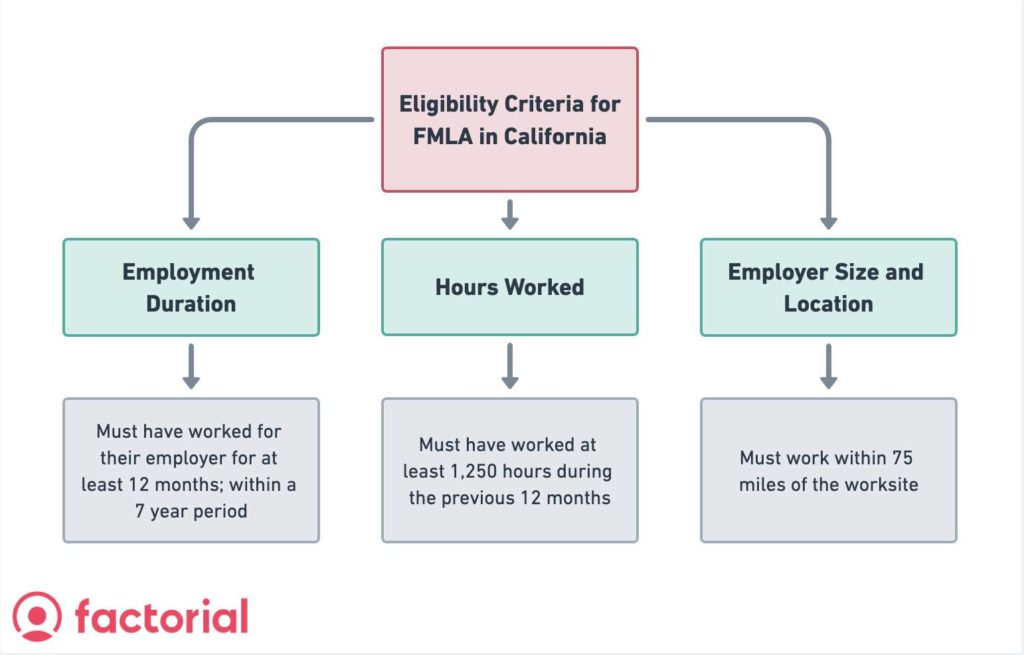
To be eligible for FMLA leave, an employee must meet three main criteria:
- Employer Coverage: Your employer must be covered by FMLA. This typically includes private employers with 50 or more employees within a 75-mile radius, public elementary or secondary schools, and public agencies.
- Employee Tenure: You must have worked for your employer for at least 12 months. These months do not need to be consecutive, but they must total at least 12 months.
- Hours of Service: You must have worked at least 1,250 hours of service during the 12 months immediately preceding the start of your FMLA leave.
California CFRA Eligibility
CFRA eligibility largely aligns with FMLA but has some key differences that can expand coverage:
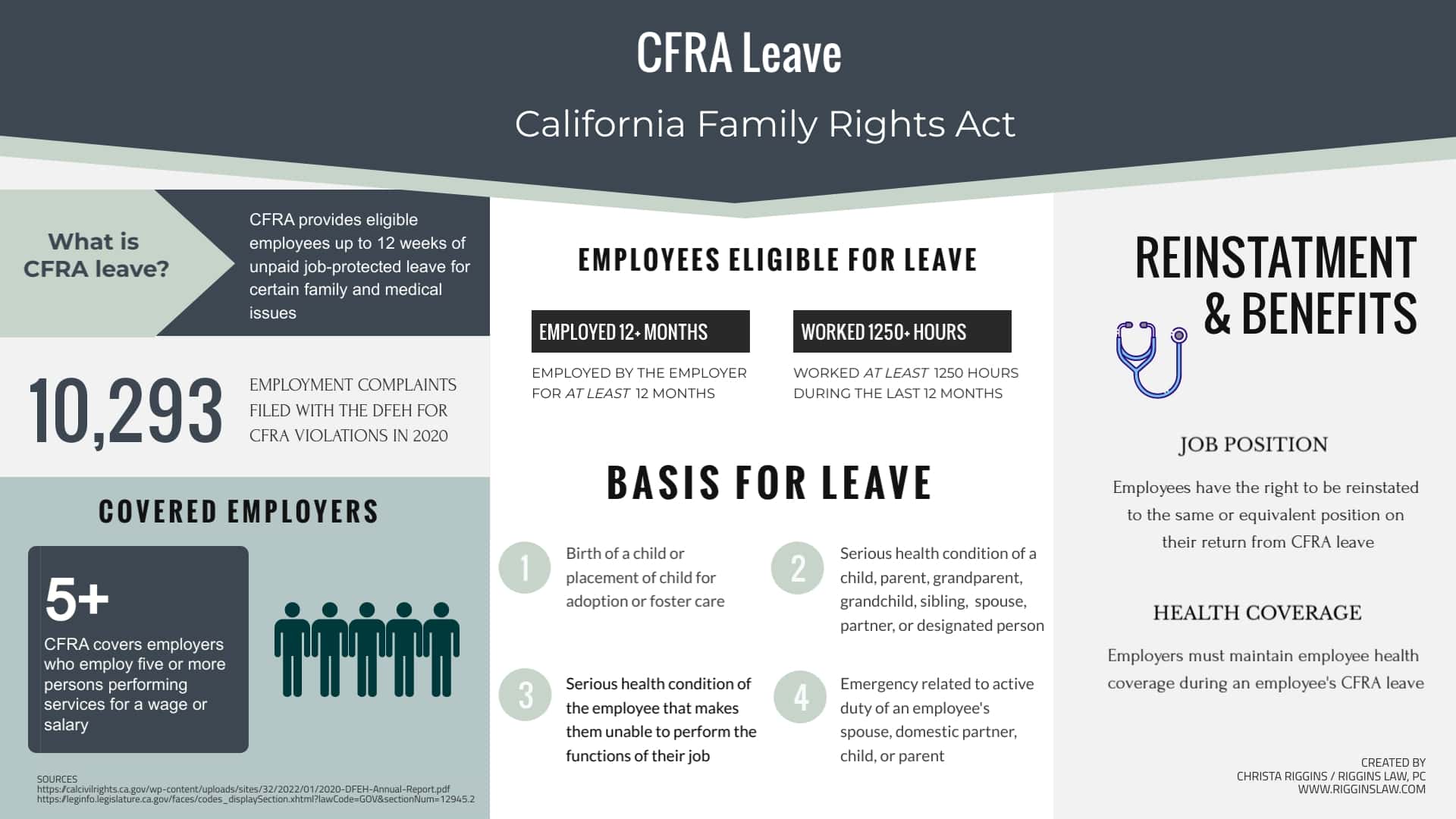
- Employer Coverage: CFRA applies to employers with five or more employees (compared to FMLA’s 50). This means more small and medium-sized businesses in California are subject to CFRA than FMLA.
- Employee Tenure: Similar to FMLA, you must have worked for your employer for at least 12 months.
- Hours of Service: CFRA requires you to have worked at least 1,250 hours of service during the 12 months immediately preceding the start of your leave.
Crucially, CFRA provides leave for a broader range of family relationships than FMLA. While FMLA covers parents, spouses, and children, CFRA includes:
- Parents (by blood, adoption, foster care, step, or legal guardianship)
- Children (biological, adopted, foster, step, or legal ward)
- Spouses
- Grandparents
- Grandchildren
- Siblings
- Domestic partners
This expansion of covered relationships is a significant advantage for California residents.
What is Covered Leave?
Both FMLA and CFRA allow eligible employees to take up to 12 workweeks of unpaid, job-protected leave in a 12-month period for one or more of the following reasons:
- Birth, adoption, or foster care placement of a child: This leave must be taken within one year of the child’s birth or placement.
- To care for an immediate family member (spouse, child, or parent) with a serious health condition: A serious health condition is generally defined as an illness, injury, impairment, or physical or mental condition that involves inpatient care or continuing treatment by a healthcare provider. Under CFRA, this includes care for broader family relationships as mentioned above.
- For a serious health condition that makes the employee unable to perform the essential functions of their job: This applies to your own health condition.
- Qualifying exigencies related to a family member’s military service: This is specific to situations involving active duty or call to active duty of a spouse, child, or parent in the regular or reserve components of the Armed Forces.
California also offers Paid Family Leave (PFL), which provides partial wage replacement for eligible workers who need to take time off to care for a seriously ill family member or bond with a new child. While PFL is a wage replacement program, FMLA and CFRA provide the job protection aspect of the leave. You can often coordinate PFL benefits with your FMLA/CFRA leave.
The Application Process: Step-by-Step
Initiating the process for taking family medical leave involves clear communication and documentation. While the specifics might vary slightly depending on your employer’s internal policies, the general steps remain consistent.
Step 1: Review Your Employer’s Policy and Understand Your Rights
Before formally requesting leave, it’s wise to familiarize yourself with your employer’s policies regarding family and medical leave. Many employers will have a dedicated HR department or a policy manual that outlines the procedures for requesting leave, required documentation, and contact persons.
Simultaneously, ensure you have a solid understanding of your rights under both FMLA and CFRA. Websites like the U.S. Department of Labor and the California Department of Fair Employment and Housing (DFEH) offer valuable resources and fact sheets.
Step 2: Notify Your Employer
The initial notification to your employer is a critical first step.
- Timing of Notification: You are generally required to provide your employer with at least 30 days’ advance notice of your need for FMLA/CFRA leave when the need for leave is foreseeable (e.g., a planned surgery, birth of a child). If the need for leave is not foreseeable, such as in a medical emergency, you should provide notice as soon as practicable.
- Content of Notification: Your initial notice doesn’t need to be a formal written request, but it should clearly state that you are requesting leave for a qualifying reason under FMLA or CFRA, and that you anticipate needing the leave for a specific duration. You do not need to disclose the specific nature of your or your family member’s illness, but you may need to provide details later for certification.

Step 3: Obtain and Complete Leave Request Forms and Certification
Your employer will typically provide you with specific forms to complete for your leave request. These usually include:
- Request for Leave Form: This form will gather basic information about your request, including the start and end dates of your anticipated leave, the reason for the leave, and your contact information.
- Medical Certification Form: This is a crucial document that must be completed by the healthcare provider treating you or your family member. It will confirm the existence of a serious health condition, the date it began, the probable duration of the condition, and the necessity of your involvement in care (if applicable).
It is vital to ensure the medical certification is complete and accurate. Delays or inaccuracies can hold up your leave approval. You are generally responsible for returning the completed certification to your employer within 15 days of the request.
Step 4: Employer Review and Approval
Once you submit the required documentation, your employer will review your request and the provided certifications. They will determine your eligibility based on the criteria discussed earlier and verify that the reason for leave is covered under FMLA/CFRA.
If approved, your employer should provide you with written notification detailing the expected duration of your leave, whether it will be paid or unpaid (and how any paid time off, like vacation or sick leave, will be applied), and your rights and responsibilities during the leave. This notification will also confirm your job protection and the terms of your return to work.
Step 5: During Your Leave
During your leave, maintain communication with your employer as appropriate and as outlined in your leave approval. If your condition or the family member’s condition changes, or if you need to extend your leave, you must notify your employer promptly. You may be required to provide updated medical certifications for extended leave.
Important Note on Coordination with Paid Family Leave (PFL): While FMLA/CFRA provides job protection, California’s Paid Family Leave (PFL) program provides partial wage replacement. You will likely need to file a separate claim with the California Employment Development Department (EDD) to receive PFL benefits. Your employer can guide you on how to apply for PFL, and it’s important to understand how these benefits will integrate with your unpaid FMLA/CFRA leave.
Considerations for a Smooth Leave Experience
Taking family medical leave is a significant undertaking. Proactive planning and a clear understanding of certain nuances can help ensure a smoother experience for both you and your employer.
The Role of Healthcare Providers
Your healthcare provider plays an indispensable role in the FMLA/CFRA process. They are responsible for providing the medical certification that validates your need for leave.
- Choose a Provider Wisely: Ensure you are receiving care from a licensed healthcare provider who is qualified to diagnose and treat your condition or your family member’s condition.
- Be Prepared for the Certification: Before your appointment, discuss with your doctor the requirements of the FMLA/CFRA medical certification form. Ensure they understand the need for detailed information regarding the serious health condition and your role in providing care.
- Ask Questions: If you are unclear about any aspect of the certification process or your medical condition’s impact on your ability to work or provide care, don’t hesitate to ask your healthcare provider for clarification.
Communication with Your Employer
Open and honest communication with your employer throughout the leave process is paramount.
- Honest Timelines: Provide your employer with the most accurate estimated return-to-work date possible, based on your healthcare provider’s assessment. If this date changes, inform your employer immediately.
- Contact During Leave: Discuss with your employer how and how often you will be contacted during your leave, if at all. This can help manage expectations and ensure your privacy.
- Return to Work: Before your return, it’s a good idea to connect with your manager or HR to discuss your reintegration into the workplace. This might involve discussing any changes that have occurred in your role or responsibilities.
Understanding Job Protection and Return Rights
A cornerstone of FMLA and CFRA is job protection. This means your employer is generally obligated to return you to the same or an equivalent position upon your return from leave.
- Same Position: An equivalent position is one that is virtually identical to your original job in terms of pay, benefits, and other employment conditions, and that involves the same or substantially similar duties, responsibilities, and working conditions.
- Exceptions: There are limited exceptions to this rule, such as if the employee would have been laid off or terminated regardless of taking leave, or if the employer has taken steps to minimize the impact of the employee’s absence.
- Benefits Continuation: During your leave, your employer must continue to provide you with the same group health benefits you had before the leave began, under the same conditions as if you had continued to work. You may be required to continue paying your portion of the premium.
Potential Challenges and Solutions
While FMLA and CFRA offer robust protections, challenges can arise:
- Disputes over Eligibility or Certification: If you believe your employer has wrongly denied your leave request or is not adhering to the law, you have recourse. You can file a complaint with the U.S. Department of Labor or the California DFEH.
- Lack of Understanding: Sometimes, challenges stem from a misunderstanding of the law or an employer’s obligations. Seeking clarification from your HR department, a union representative (if applicable), or legal counsel can be beneficial.
- Impact on Income: Remember that FMLA and CFRA provide unpaid leave. Coordinating with California’s Paid Family Leave (PFL) is essential to mitigate the financial impact. Exploring employer-offered short-term disability or using accrued paid time off can also help.
By understanding your rights, diligently following the proper procedures, and maintaining clear communication, you can navigate the process of filing for family medical leave in California with greater confidence, ensuring you receive the necessary time and support for your family and personal well-being.
LifeOutOfTheBox is a participant in the Amazon Services LLC Associates Program, an affiliate advertising program designed to provide a means for sites to earn advertising fees by advertising and linking to Amazon.com. Amazon, the Amazon logo, AmazonSupply, and the AmazonSupply logo are trademarks of Amazon.com, Inc. or its affiliates. As an Amazon Associate we earn affiliate commissions from qualifying purchases.