
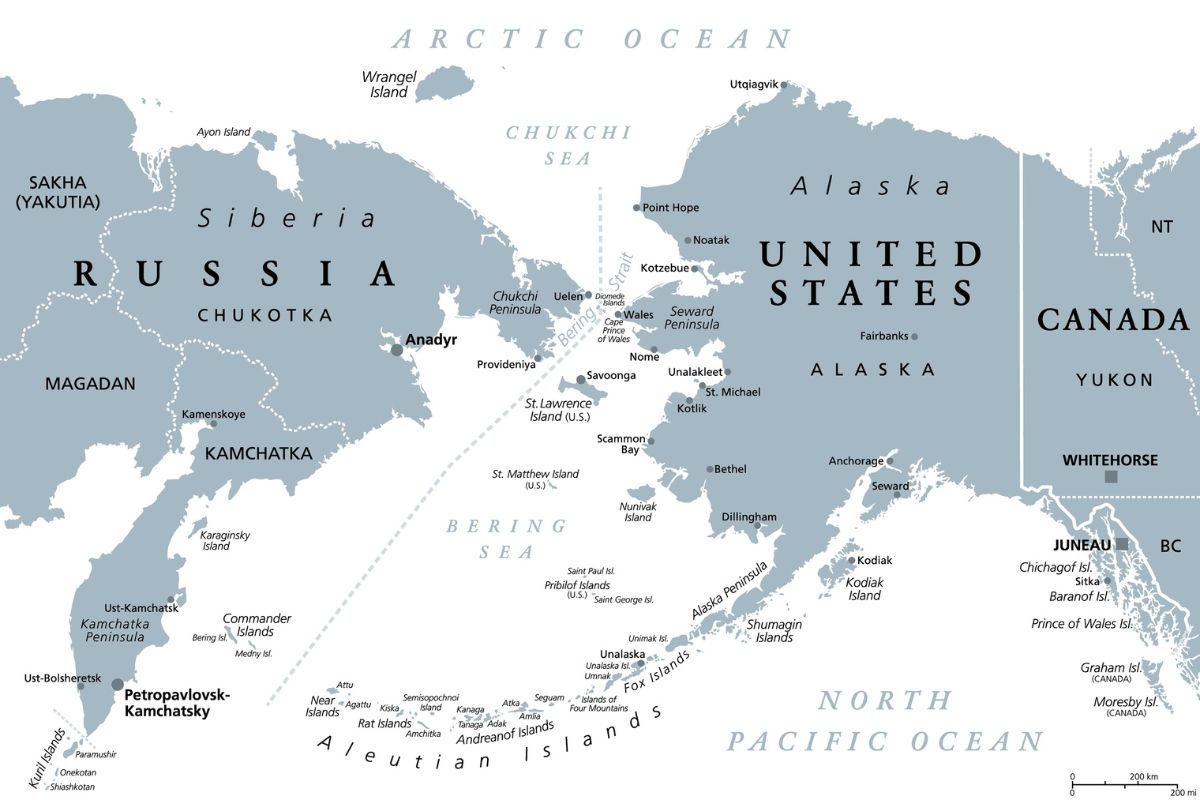
The question “How far is Alaska from Russia?” often conjures images of vast, ice-covered expanses and immense geographical separation. Yet, the reality is startlingly different: these two global giants are separated by a mere 55 miles (88 kilometers) at their closest point. This narrow stretch of water, known as the Bering Strait, is one of the most intriguing geographical boundaries on Earth, connecting the Pacific Ocean to the Arctic Ocean and dividing two continents, North America and Asia. For those with a passion for travel and a keen interest in the world’s most remote destinations, the proximity of Alaska and Russia presents a fascinating blend of history, culture, and extreme adventure.
This unique geographical relationship isn’t just a matter of miles; it’s a portal to understanding deep historical connections, indigenous cultures, and the challenging yet captivating tourism landscape of the Arctic. From planning an expedition to the Bering Sea to exploring the rich legacy of Russian America, this region offers unparalleled experiences for intrepid travelers.
The Geography of Proximity: Bridging Continents
The core of the Alaska-Russia proximity lies within the Bering Strait, a relatively shallow waterway that has played a pivotal role in human migration and global history. This natural bridge, or barrier depending on the perspective, defines the literal and metaphorical distance between these two powerful nations.
The Bering Strait and the Diomede Islands
At the heart of the Bering Strait are the Diomede Islands, two small, rocky outposts that serve as the physical manifestation of the continental divide. Little Diomede belongs to the USA, specifically Alaska, while Big Diomede is part of Russia. These islands are separated by an astonishingly short 2.4 miles (3.8 kilometers). On a clear day, inhabitants of Little Diomede can literally gaze across the water and see Russia. This close distance underscores the stark reality of how geographically intertwined these two landmasses truly are.
During winter, the Bering Strait often freezes over, forming an ice bridge that historically allowed animals and, crucially, humans to cross between continents. While today this crossing is fraught with political and logistical challenges, the geographical possibility has shaped millennia of migration and cultural exchange. The deep waters of the Chukchi Sea to the north and the Bering Sea to the south frame this critical choke point, making it a hotspot for scientific research, particularly concerning climate change and its impact on Arctic ecosystems.

Understanding the International Date Line
Adding another layer of fascination to the Diomede Islands is the passage of the International Date Line between them. This imaginary line dictates the change of calendar date, meaning that when it is Monday on Little Diomede (USA), it is already Tuesday on Big Diomede (Russia). This creates a peculiar phenomenon where one can literally look into “tomorrow” from the Alaskan side. For travel enthusiasts seeking unique geographic markers, standing on Little Diomede offers a surreal experience of time and space, a genuine landmark of both geography and chronology.
The passage of the International Date Line through the Bering Strait means that not only are two continents separated by miles, but also by a full day. This makes the region a captivating subject for those interested in cartography, time zones, and the sheer wonder of our planet’s intricate systems.
Historical and Cultural Connections Across the Bering Sea
The story of Alaska and Russia is far richer than just geographical proximity; it’s a narrative steeped in exploration, trade, conquest, and resilience. Understanding this shared past is crucial for appreciating the present-day dynamics of the region.
A Legacy of Russian Influence in Alaska
Long before Alaska became the 49th state of the USA, it was known as Russian America. Russian explorers, primarily Vitus Bering, first sighted Alaska in 1741, ushering in an era of Russian colonization driven largely by the lucrative fur trade. For over a century, Russian Orthodox missionaries, traders, and settlers established outposts, impacting the indigenous populations and leaving an indelible mark on the landscape. Many towns in Alaska still bear Russian names, and Russian Orthodox churches stand as enduring landmarks across the state, particularly in the Aleutian Islands and Southeast Alaska.
The sale of Alaska to the United States in 1867, famously known as the Alaska Purchase and orchestrated by Secretary of State William H. Seward, marked the end of the Russian colonial era. This historic transaction, initially mocked as “Seward‘s Folly,” proved to be one of the most significant land acquisitions in US history, providing access to vast natural resources and a strategic foothold in the Arctic. For history buffs and those interested in cultural tourism, visiting sites like the Russian Bishop’s House in Sitka offers a tangible connection to this rich, shared heritage.
Indigenous Cultures and Cross-Strait Migrations
The lands surrounding the Bering Strait are the ancestral home of various indigenous peoples, including the Inupiat, Yup’ik, and Siberian Yupik on the Alaskan side, and the Chukchi and Yupik on the Russian side. These communities have a shared cultural heritage spanning thousands of years, having regularly interacted, traded, and even intermarried across the strait. Their lifestyles, deeply intertwined with the marine environment and the cycles of the Arctic seasons, reflect a profound understanding of this challenging landscape.
The concept of a land bridge, known as Beringia, which connected Asia and North America during the last ice age, is central to understanding the peopling of the Americas. This ancient landmass, now submerged beneath the Bering Sea, served as a vital migration route for humans and animals. Today, the cultural similarities, languages, and traditional practices among indigenous groups on both sides of the strait stand as living testaments to this ancient connection, offering a unique perspective for those interested in authentic local culture and history. Engaging with these communities provides an unparalleled opportunity for cultural tourism and a deeper appreciation of human resilience in extreme environments.
Travel and Tourism: Exploring the Edges of the World
While the proximity of Alaska and Russia is striking, directly traversing the Bering Strait is an undertaking fraught with significant challenges due to geopolitical restrictions, extreme weather conditions, and logistical complexities. However, the region remains a compelling frontier for adventure travel and immersive experiences.
Visiting the Alaskan Side: Gateways to the Arctic
For most travelers, the most realistic way to experience the proximity to Russia is by visiting the Alaskan towns and villages along the Bering Sea coast. Towns like Nome, located on the southern coast of the Seward Peninsula, and Kotzebue further north, serve as fascinating gateways to the Arctic. These remote communities offer a glimpse into the resilient lifestyle of indigenous peoples, historic gold rush legacies, and breathtaking wilderness.
Tourism in these areas often revolves around unique activities such as dog sledding, northern lights viewing, wildlife photography (polar bears, walruses, whales), and exploring historical sites. Nome, famous as the finish line of the Iditarod Trail Sled Dog Race, offers a rugged charm and a chance to experience the frontier spirit. While direct views of Russia are rare from these mainland towns, the palpable sense of being at the edge of the world, where two continents almost touch, is an experience in itself. Getting there typically involves flying from major Alaskan cities like Anchorage or Fairbanks, making the journey part of the adventure.
The Challenges and Realities of Crossing the Bering Strait
For those dreaming of physically crossing the Bering Strait, the reality is much more complex than the short distance suggests. Independent crossings are virtually impossible due to strict border controls, lack of infrastructure, and the inherent dangers of the Arctic environment. The Russian side, particularly the Chukotka region, is a highly sensitive border zone requiring special permits that are exceedingly difficult to obtain for foreign travelers.
However, specialized expedition cruises sometimes offer routes that navigate the waters of the Bering Strait and the Bering Sea. These voyages typically depart from Alaska or other Arctic regions, offering passengers the chance to witness the Diomede Islands, observe abundant wildlife, and learn about the region’s unique ecosystem and indigenous cultures. While landing on the Russian side is often not part of the itinerary due to permit issues, these cruises provide the closest legal and safe proximity to the continental divide. Such trips fall under the category of luxury travel or specialized adventure travel, catering to those seeking unique, once-in-a-lifetime experiences in truly remote destinations.
Planning Your Arctic Adventure: Accommodation and Experiences
Embarking on a journey to this remote corner of the world requires meticulous planning. When considering accommodation on the Alaskan side, expect options to be limited and often rustic, reflecting the frontier lifestyle. In towns like Nome, you might find quaint local hotels or bed and breakfasts, offering a cozy retreat after a day of exploration. For those on expedition cruises, the ship itself serves as your floating hotel, complete with amenities, educational programs, and gourmet food designed to enhance the Arctic experience.
Budgeting is also a key consideration. Travel to remote Alaska can be costly, especially flights to distant communities. However, the unparalleled natural beauty, the rich cultural tapestry, and the sheer exhilaration of being at the crossroads of continents make it an investment in unforgettable memories. For those looking for budget travel options, exploring the Alaskan interior first and then considering a shorter, land-based trip to the edge of the Bering Sea might be more feasible. Regardless of your lifestyle preferences or budget, the Arctic offers a spectrum of experiences that transcend typical tourism.
Beyond the Horizon: Geopolitical and Environmental Significance
The narrow Bering Strait is not just a geographical curiosity or a historical bridge; it holds immense strategic importance and is increasingly a focal point for environmental concerns.
Strategic Importance and Climate Change
Historically, the Bering Strait has been a Cold War flashpoint, representing the ideological divide between the USA and the Soviet Union. Today, its strategic significance is evolving with the accelerating pace of climate change. As Arctic ice melts, new shipping lanes through the Northern Sea Route are becoming viable, drastically shortening maritime distances between Asia and Europe. This potential for increased commercial traffic raises questions about navigation rights, environmental protection, and geopolitical influence, particularly for Russia which controls a significant portion of the Arctic coastline.
The region is also a critical habitat for numerous Arctic species, making it highly vulnerable to the impacts of climate change and increased human activity. Scientists and environmentalists from both sides of the strait collaborate on research efforts to understand and mitigate these impacts, highlighting a shared responsibility for this delicate ecosystem. For eco-conscious travelers, this dimension adds a layer of depth to their journey, offering opportunities to learn about conservation efforts and the challenges faced by indigenous communities adapting to a rapidly changing environment.

Future Prospects for Cross-Bering Interactions
Despite the current political barriers, there remains a persistent interest in fostering greater cooperation and even direct connections across the Bering Strait. Ideas, some dating back over a century, include the construction of a “Bering Strait Tunnel” or a bridge, which would literally connect the continents by rail or road. While such mega-projects remain firmly in the realm of future speculation due to the immense engineering, environmental, and political challenges, they underscore the enduring human desire to bridge geographical divides.
For now, the Bering Strait stands as one of the world’s most intriguing and formidable natural borders. Its astonishingly close proximity between Alaska and Russia offers a profound lesson in geography, history, and the delicate balance between human ambition and the power of nature. For those seeking truly off-the-be-beaten-path travel experiences, a visit to the Alaskan side of the Bering Sea provides a window into a world that is both geographically close and culturally distant, making it an ultimate destination for the discerning explorer.
LifeOutOfTheBox is a participant in the Amazon Services LLC Associates Program, an affiliate advertising program designed to provide a means for sites to earn advertising fees by advertising and linking to Amazon.com. Amazon, the Amazon logo, AmazonSupply, and the AmazonSupply logo are trademarks of Amazon.com, Inc. or its affiliates. As an Amazon Associate we earn affiliate commissions from qualifying purchases.