
Understanding the Chicago Manual of Style
The Chicago Manual of Style (CMOS) is a widely adopted style guide in academic and professional writing, particularly in the humanities and social sciences. Known for its flexibility, it offers two primary systems for citation: the Notes-Bibliography system and the Author-Date system. For research papers, dissertations, and scholarly articles that delve deeply into sources, the Notes-Bibliography system, which utilizes footnotes and endnotes, is often the preferred choice. This system allows for supplementary information to be embedded within the notes themselves, enriching the reader’s understanding without disrupting the main text’s flow. The focus of this guide is to demystify the creation and formatting of footnotes according to the CMOS.

The Purpose of Footnotes in Chicago Style
Footnotes serve multiple critical functions within the Notes-Bibliography system of the Chicago Manual of Style. Primarily, they provide immediate attribution to sources, guiding readers to the origin of specific information, ideas, or direct quotations. This is fundamental for academic integrity, preventing plagiarism and acknowledging the intellectual contributions of others. Beyond simple citation, footnotes offer a space to expand on points made in the main text, offer tangential but relevant information, or provide commentary that would otherwise interrupt the narrative. This can include defining a complex term, providing historical context, or noting an alternative viewpoint without derailing the primary argument. For the discerning traveler writing about their experiences, a footnote might clarify the etymology of a local term in Rome or provide a brief historical anecdote about a particular landmark in Paris.
Key Components of a Chicago Style Footnote
A well-constructed Chicago style footnote comprises several key elements, designed to clearly and concisely identify a source. While the exact format can vary slightly depending on the type of source (book, article, website, etc.), the core components remain consistent.
- Author’s Full Name: The name of the author or authors as they appear on the source.
- Title of the Work: The full title of the book, article, chapter, or webpage, italicized for books and enclosed in quotation marks for articles or chapters.
- Publication Information: For books, this includes the city of publication, the publisher, and the year of publication. For articles, it includes the journal title (italicized), volume and issue numbers, and the date of publication. For websites, it includes the website name and the date of publication or last update.
- Page Number(s): The specific page or pages from which the information was drawn. This is crucial for allowing readers to locate the exact passage in the source.
- Access Information (for online sources): The URL and the date the source was accessed.
Distinguishing Footnotes from Endnotes
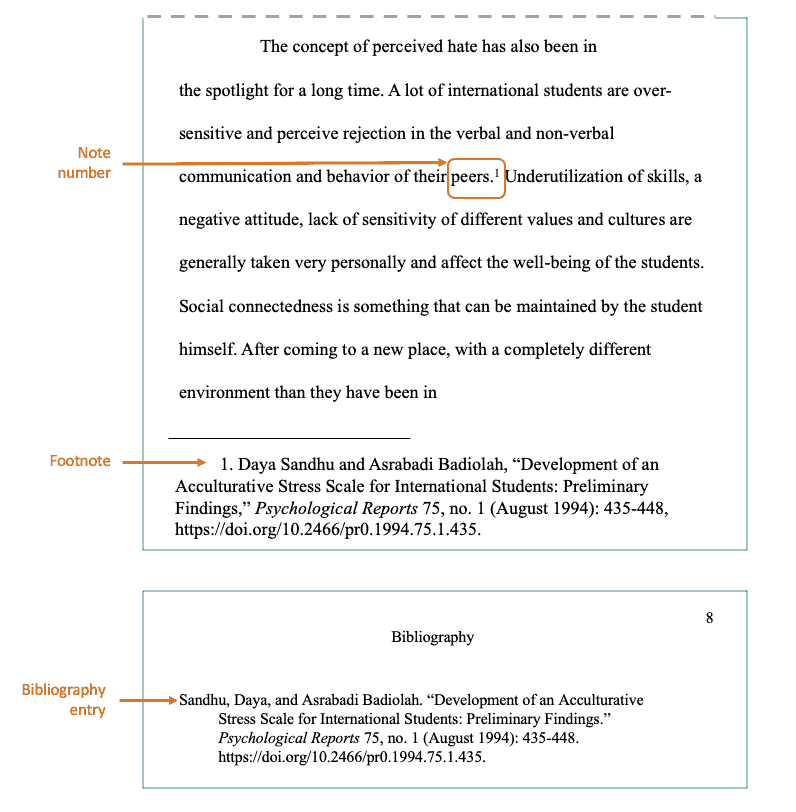
It is important to differentiate between footnotes and endnotes, as both are part of the Chicago Notes-Bibliography system. Footnotes appear at the bottom of the page on which the reference is made, indicated by a superscript number in the main text. Endnotes, on the other hand, are compiled and listed at the end of the document, chapter, or book. While the content and formatting of the notes themselves are identical whether they are footnotes or endnotes, their placement offers different reading experiences. Footnotes can be more immediately accessible, allowing readers to consult the source information without having to turn to the end of the work. This can be particularly beneficial for lengthy academic texts or for travel narratives where immediate context might enhance engagement.
Crafting Chicago Style Footnotes: A Step-by-Step Guide
Creating accurate and consistently formatted Chicago style footnotes can seem daunting at first, but by breaking down the process and understanding the nuances of different source types, it becomes manageable. The key is meticulous attention to detail and adherence to the established conventions.
Initial Setup: Superscript Numbers and Corresponding Notes
The process begins by identifying where a citation is needed within your main text. Whenever you introduce information that is not common knowledge, a direct quotation, or a paraphrased idea from another source, you must insert a citation. In Chicago style, this is done using a superscript number. This number should appear directly after the punctuation of the sentence or clause to which it refers. For instance, if you are discussing the architectural marvels of Chicago, and a specific detail about the Willis Tower comes from a particular book, the superscript number would follow the sentence describing that detail.
Once the superscript number is placed in the text, a corresponding note must be created at the bottom of the page. This note will begin with the same numeral, followed by the citation details. The first time a particular source is cited in your footnotes, it requires a full citation. Subsequent citations of the same source can use a shortened format, typically including the author’s last name, a shortened version of the title, and the page number.
Formatting Footnotes for Common Source Types
The most critical aspect of crafting Chicago style footnotes lies in correctly formatting the citation for each specific type of source. While the general principles remain the same, the specifics of publication details, titles, and page numbers necessitate different approaches.
Books
For a book, the initial footnote citation typically includes:
-
Author’s First Name Last Name, Title of Book (City of Publication: Publisher, Year), Page Number.
Example:
- Sarah Johnson, Adventures in the Mediterranean (New York: Wanderlust Press, 2022), 45.
For subsequent citations of the same book, a shortened form is used:
- Johnson, Adventures, 78.
If the author is the same for consecutive citations, “Ibid.” (Latin for “in the same place”) can be used, followed by the page number if different:
- Ibid., 112.
- Ibid. (if referencing the same page as the previous note).
Journal Articles
Citing a journal article involves details about the publication’s periodical nature:
-
Author’s First Name Last Name, “Title of Article,” Title of Journal Volume, no. Issue (Month/Season Year): Page Number(s).
Example:
- Michael Chen, “The Evolution of Culinary Tourism in Southeast Asia,” Journal of Global Travel Studies 15, no. 2 (Spring 2023): 112.
Subsequent citations would be shortened:
- Chen, “Evolution of Culinary Tourism,” 115.
Websites and Online Articles
Citing online content requires noting the website and access date:
-
Author’s First Name Last Name (if available), “Title of Webpage or Article,” Name of Website, publication date or last modified date, URL.
Example:
- “Exploring the Ancient Ruins of Machu Picchu,” Incan Discoveries, August 15, 2023, https://www.incandiscoveries.com/machu-picchu-ruins.
If no author is listed, the title of the page or article comes first. For websites without a clear publication or modification date, the access date is crucial:
-
“Top Ten Hidden Gems in Kyoto,” Travel Japan Blog, accessed October 26, 2023, https://www.traveljapanblog.com/kyoto-gems.
Subsequent citations for websites would follow the shortened format, usually including the author (if present) and a portion of the title, along with the page number if applicable.
Other Source Types
The Chicago Manual of Style provides specific guidelines for a vast array of source types, including book chapters, edited volumes, newspapers, magazines, interviews, and even unpublished manuscripts. The core principle remains consistent: provide enough information for the reader to locate the source material. When in doubt, consulting the latest edition of the Chicago Manual of Style is the definitive approach.
Best Practices for Footnote Usage
Beyond the mechanics of formatting, several best practices can enhance the effectiveness and professionalism of your Chicago style footnotes, particularly in travel writing and descriptive narratives.
Maintaining Consistency
Consistency is paramount in any citation style. Once you have chosen a format for a specific type of source, adhere to it throughout your document. This includes the capitalization of titles, the punctuation used, and the order of information. Inconsistent formatting can confuse readers and detract from the credibility of your work. Whether you are detailing your journey through the historic streets of Prague or describing the breathtaking vistas of the Canadian Rockies, consistent citation practices signal a commitment to rigor.
Balancing Citation with Narrative Flow
While footnotes are designed to keep supplementary information out of the main text, they should not overwhelm it. The goal is to provide necessary citations and context without creating an interrupted reading experience. For travel narratives, footnotes can be particularly useful for adding intriguing historical facts, cultural insights, or practical tips that don’t fit seamlessly into the prose. For example, a footnote might elaborate on the local customs observed at a bustling market in Marrakech or explain the significance of a particular architectural detail on a building in Barcelona. The key is to judge what information truly benefits from being in a note versus what can be integrated into the main text or omitted.
Utilizing Footnotes for Supplemental Information
The power of Chicago style footnotes extends beyond mere citation. They offer a valuable space for enrichment. In travel writing, this could mean providing a brief explanation of local currency conversion, the historical context of a dish served at a restaurant in Italy, or a more detailed description of a hiking trail in New Zealand. This supplemental information can deepen the reader’s appreciation and understanding of the destination, transforming a simple account into a more immersive experience. For instance, while describing the vibrant street art of Berlin, a footnote could offer a concise history of the East Side Gallery.

Revisiting and Proofreading
The final, and perhaps most crucial, step is meticulous proofreading. Errors in footnotes can range from simple typos to more significant inaccuracies in page numbers or publication details. These mistakes can undermine the author’s credibility and make it difficult for readers to verify the information. Always proofread your footnotes with the same care you give to the main body of your text. Cross-reference your superscript numbers with your actual notes to ensure they match. A final check can catch any inconsistencies and ensure that your work adheres to the high standards expected of Chicago style documentation. When documenting your explorations, whether it’s the art scene in Buenos Aires or the natural wonders of Banff National Park, precision in your footnotes speaks volumes about your attention to detail and your commitment to providing reliable information.
LifeOutOfTheBox is a participant in the Amazon Services LLC Associates Program, an affiliate advertising program designed to provide a means for sites to earn advertising fees by advertising and linking to Amazon.com. Amazon, the Amazon logo, AmazonSupply, and the AmazonSupply logo are trademarks of Amazon.com, Inc. or its affiliates. As an Amazon Associate we earn affiliate commissions from qualifying purchases.