
The intricacies of academic and professional writing often hinge on precise citation methods, ensuring proper attribution and avoiding plagiarism. For those delving into research, historical analysis, or any discipline that relies on extensive source material, understanding how to effectively employ footnotes is paramount. The Chicago Manual of Style (CMOS), a widely respected citation guide, offers a comprehensive system for incorporating footnotes, providing clarity and authority to your work. This guide will navigate the essential principles and practical applications of citing footnotes in the Chicago style, a method favored in fields such as history, art history, and literature.
Understanding the Chicago Style Footnote System
The Chicago Manual of Style provides two primary systems for citation: the Notes and Bibliography system and the Author-Date system. This article focuses exclusively on the Notes and Bibliography system, which utilizes footnotes or endnotes to cite sources. Footnotes appear at the bottom of the page where the reference occurs, while endnotes are compiled at the end of the document. For clarity and immediate reference, footnotes are generally preferred in many academic contexts.
The Purpose of Footnotes
Footnotes serve several crucial functions in scholarly writing:
- Attribution of Sources: The primary role of a footnote is to acknowledge the original source of information, whether it be a direct quote, a paraphrase, or a specific idea or fact. This respects intellectual property and allows readers to locate the original material.
- Elaboration and Supplementary Information: Footnotes are also an excellent space to provide supplementary details, explanations, or tangential information that might disrupt the flow of the main text. This could include further historical context, definitions of terms, or brief discussions of related concepts.
- Internal Cross-References: They can be used to refer readers to other parts of your own work, guiding them through your arguments and analyses.
- Discussions of Methodological or Theoretical Issues: Complex methodological considerations or nuanced theoretical discussions can be effectively managed in footnotes, keeping the main narrative focused.
Key Components of a Footnote Citation
A Chicago-style footnote typically includes the author’s name, the title of the work, publication details (place, publisher, year), and specific location information (page number). The format varies slightly depending on the source type (book, journal article, website, etc.), but the core elements remain consistent.
Citing Books in Footnotes
Books are among the most common sources encountered in academic writing, and their citation in Chicago style footnotes requires attention to detail.
First Reference to a Book
When a book is cited for the first time, the footnote should include:
- Author’s First Name and Last Name: For example, “David McCullough.”
- Title of the Book (in italics): Followed by a comma. For example, The Great Bridge.
- Publication Information: Enclosed in parentheses, this includes the place of publication, publisher, and year of publication. For example, “(New York: Simon & Schuster, 1972)”.
- Page Number(s): Preceded by “p.” for a single page or “pp.” for multiple pages. For example, “p. 45.” or “pp. 112–115.”
Example First Footnote for a Book:
- David McCullough, The Great Bridge: The Epic Story of the Building of the Brooklyn Bridge (New York: Simon & Schuster, 1972), p. 105.
Subsequent References to the Same Book
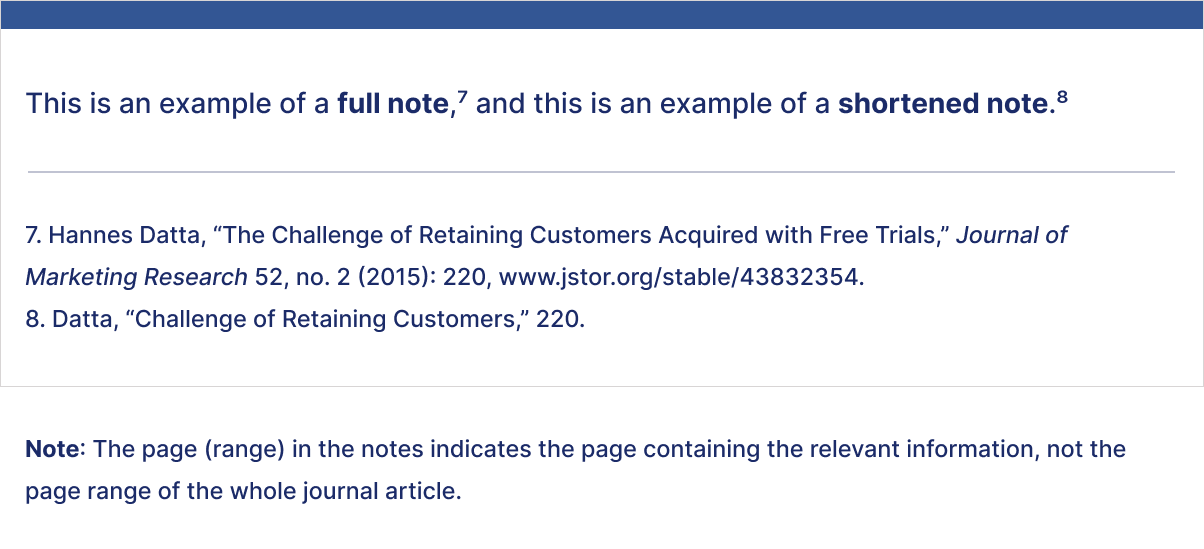
Once a book has been cited, subsequent references can be shortened for conciseness, provided there is no ambiguity.
- Shortened Note: This typically includes the author’s last name, a shortened version of the title (if the full title is lengthy and has a clear primary title), and the page number.
Example Subsequent Footnote for a Book:
- McCullough, The Great Bridge, p. 210.
- Using “Ibid.”: If the immediately preceding footnote refers to the exact same source and page number, you can use “Ibid.” (Latin for “in the same place”). If it’s the same source but a different page, you would use “Ibid.” followed by the new page number.
Example Using “Ibid.”:
- McCullough, The Great Bridge, p. 210.
- Ibid. (Refers to p. 210 of McCullough’s book)
- Ibid., p. 215. (Refers to p. 215 of McCullough’s book)
It is important to note that some scholars advocate for the use of shortened notes over “Ibid.” for greater clarity, especially in longer or more complex works. The choice often depends on individual preference and the specific guidelines of an institution or publisher.
Citing Journal Articles in Footnotes
Journal articles are another vital source for scholarly research. Their citation format differs slightly from books due to the inclusion of journal volume, issue, and date.
First Reference to a Journal Article
A first-time citation of a journal article in a footnote typically includes:
- Author’s First Name and Last Name: For example, “Jane Doe.”
- Title of the Article (in quotation marks): Followed by a comma. For example, “The Evolution of Urban Planning.”
- Title of the Journal (in italics): Followed by a comma. For example, Journal of Urban Studies.
- Volume Number: Often abbreviated as “vol.” For example, “vol. 35.”
- Issue Number: Often abbreviated as “no.” For example, “no. 2.”
- Publication Date: Usually the month and year, or just the season and year. For example, “Spring 2023.”
- Page Number(s): Preceded by “pp.” For example, “pp. 150–175.”
Example First Footnote for a Journal Article:
- Jane Doe, “The Evolution of Urban Planning,” Journal of Urban Studies 35, no. 2 (Spring 2023): pp. 150–175.
Subsequent References to the Same Journal Article
Similar to books, subsequent references to journal articles can be shortened.
- Shortened Note: Author’s last name, shortened article title (in quotation marks), and page number.
Example Subsequent Footnote for a Journal Article:
- Doe, “Evolution of Urban Planning,” p. 160.
- Using “Ibid.”: The use of “Ibid.” follows the same logic as with book citations, referring to the immediately preceding source.
Citing Online Sources and Websites in Footnotes
The digital age has made online sources increasingly prevalent. Citing them in Chicago style requires attention to accessibility and stable URLs.
General Principles for Online Sources
When citing online sources, the goal is to provide enough information for the reader to locate the source. This often includes:
- Author (if available)
- Title of the specific page or document
- Title of the overall website
- Date of publication or last update
- URL
- Date of access
Example Footnote for a Web Page
- John Smith, “A Brief History of the Great Wall of China,” History Today, last modified October 26, 2022, https://www.historytoday.com/brief-history-great-wall-of-china. Accessed March 15, 2024.
Note on URLs: It is generally recommended to use stable URLs or DOIs (Digital Object Identifiers) when available. If the URL is very long or complex, you might consider using a shortened URL service, though this is less common in formal academic contexts. The date of access is important because online content can change or disappear.
Other Common Source Types
Beyond books and journal articles, you may encounter and need to cite various other materials.
Newspaper Articles
For newspaper articles, include the author (if known), article title, newspaper title, publication date, and page number(s).
Example Footnote for a Newspaper Article:
- Emily Carter, “Local Council Approves New Park Development,” The Daily Chronicle, March 14, 2024, p. A3.
Interviews
When citing interviews, include the interviewee’s name, the interviewer’s name (if different from the author of the paper), the date of the interview, and the format (e.g., personal interview, phone interview, email interview). If the interview is recorded or transcribed, provide details of that.
Example Footnote for an Interview:
- Interview with Maria Garcia, conducted by the author, March 10, 2024, personal interview.
Conference Proceedings
Cite conference proceedings with the author of the paper, the paper title, the conference name, the location and date of the conference, and the publication details of the proceedings.
Example Footnote for Conference Proceedings:
- Robert Lee, “Advances in Renewable Energy Storage,” in Proceedings of the International Conference on Sustainable Technologies, held in San Francisco, California, October 5–7, 2023, 112–125.
Formatting and Best Practices
Adhering to consistent formatting is crucial for professional presentation.
Numbering
Footnote numbers should be sequential throughout the document, starting with 1. The superscript Arabic numeral should be placed after the punctuation of the sentence or clause it refers to.
Consistency
Maintain a high degree of consistency in your formatting. If you use a particular style for citing books, stick to it for all book citations. The same applies to journal articles, websites, and other source types.
Proofreading
Thoroughly proofread all your footnotes for accuracy in names, titles, dates, page numbers, and punctuation. Errors in citations can detract from the credibility of your work.

Consult the Official Guide
The Chicago Manual of Style is the definitive resource. For specific or unusual source types, or for detailed guidance on complex citation scenarios, always refer to the latest edition of the manual. Many universities and publishers provide online resources or style guides that summarize these rules, but the original text remains the ultimate authority.
Mastering the art of footnote citation in Chicago style is an investment in the rigor and integrity of your writing. By understanding the core principles and applying them diligently, you can enhance the clarity, authority, and scholarly value of your work. Whether you are writing a research paper, a historical monograph, or any document demanding meticulous source attribution, the Chicago footnote system provides a robust framework for scholarly engagement.
LifeOutOfTheBox is a participant in the Amazon Services LLC Associates Program, an affiliate advertising program designed to provide a means for sites to earn advertising fees by advertising and linking to Amazon.com. Amazon, the Amazon logo, AmazonSupply, and the AmazonSupply logo are trademarks of Amazon.com, Inc. or its affiliates. As an Amazon Associate we earn affiliate commissions from qualifying purchases.