
Navigating the intricacies of academic citation can often feel like deciphering an ancient code. For students and researchers alike, mastering a consistent and accurate bibliography format is paramount. Among the most widely adopted citation styles, the Chicago Manual of Style (CMS) stands out for its flexibility and comprehensive guidelines. This article will delve into the specifics of constructing a bibliography in Chicago style, equipping you with the knowledge to properly attribute your sources and enhance the credibility of your work.
Understanding the Chicago Style: Author-Date vs. Notes-Bibliography
Before diving into the mechanics of bibliography creation, it’s crucial to recognize the two primary systems within the Chicago Manual of Style: the Author-Date system and the Notes-Bibliography system. While both aim for clarity and accuracy in citation, they differ in their in-text referencing and the structure of the final bibliography.
Author-Date System
The Author-Date system, often favored in the social sciences and natural sciences, uses brief parenthetical citations within the text that include the author’s last name and the year of publication. For example, a citation might appear as (Smith 2023, 12). Consequently, the bibliography in this system is typically titled “References” and lists sources alphabetically by the author’s last name, followed by the year of publication. This system allows readers to quickly locate the full source information by cross-referencing the in-text citation with the alphabetically ordered reference list.
Notes-Bibliography System
The Notes-Bibliography system, more prevalent in the humanities, relies on numbered footnotes or endnotes to cite sources. Each note corresponds to a superscript number in the text, and the notes themselves provide the source details. The bibliography, usually titled “Bibliography,” follows the notes and lists all cited sources alphabetically by author’s last name. While the notes can provide varying levels of detail upon first mention, the bibliography entries offer a comprehensive and standardized format for each source. This system allows for more detailed explanations or tangential information to be included in the notes without disrupting the flow of the main text.
For the purpose of this guide, we will focus primarily on the structure and common elements of a bibliography as typically presented in the Notes-Bibliography system, as it is widely adopted in academic disciplines that emphasize extensive textual analysis and historical context. However, the core principles of providing complete and accurate source information remain consistent across both systems.
Essential Components of a Chicago Style Bibliography Entry
A robust bibliography entry in Chicago style aims to provide all necessary information for a reader to locate and consult the original source. The specific elements required will vary depending on the type of source (book, journal article, website, etc.), but a general understanding of the core components is vital.
Identifying Key Bibliographic Information
Regardless of the source type, you will invariably need to identify several key pieces of information:
- Author(s) or Editor(s): The name(s) of the individual(s) or organization(s) responsible for creating the work. For the bibliography, the last name is listed first, followed by the first name and any middle initials.
- Title of the Work: The full title of the book, article, website, or other source. Titles of books and standalone works (like journals or websites) are italicized. Titles of shorter works within larger publications (like journal articles or chapters in an edited book) are placed in quotation marks.
- Publication Information: This includes the city of publication, the publisher’s name, and the year of publication. For journal articles, this will include the journal title, volume number, issue number, and publication date. For websites, it will include the website name and the date of publication or last update.
- Page Numbers: For specific sections of a larger work (like articles or book chapters), the relevant page numbers are crucial.
- DOI or URL: For online sources, a Digital Object Identifier (DOI) or a stable URL is often required to ensure the reader can access the exact version of the source.
General Formatting Guidelines
While the specific order and punctuation may vary slightly by source type, some general formatting rules apply to all Chicago style bibliography entries:
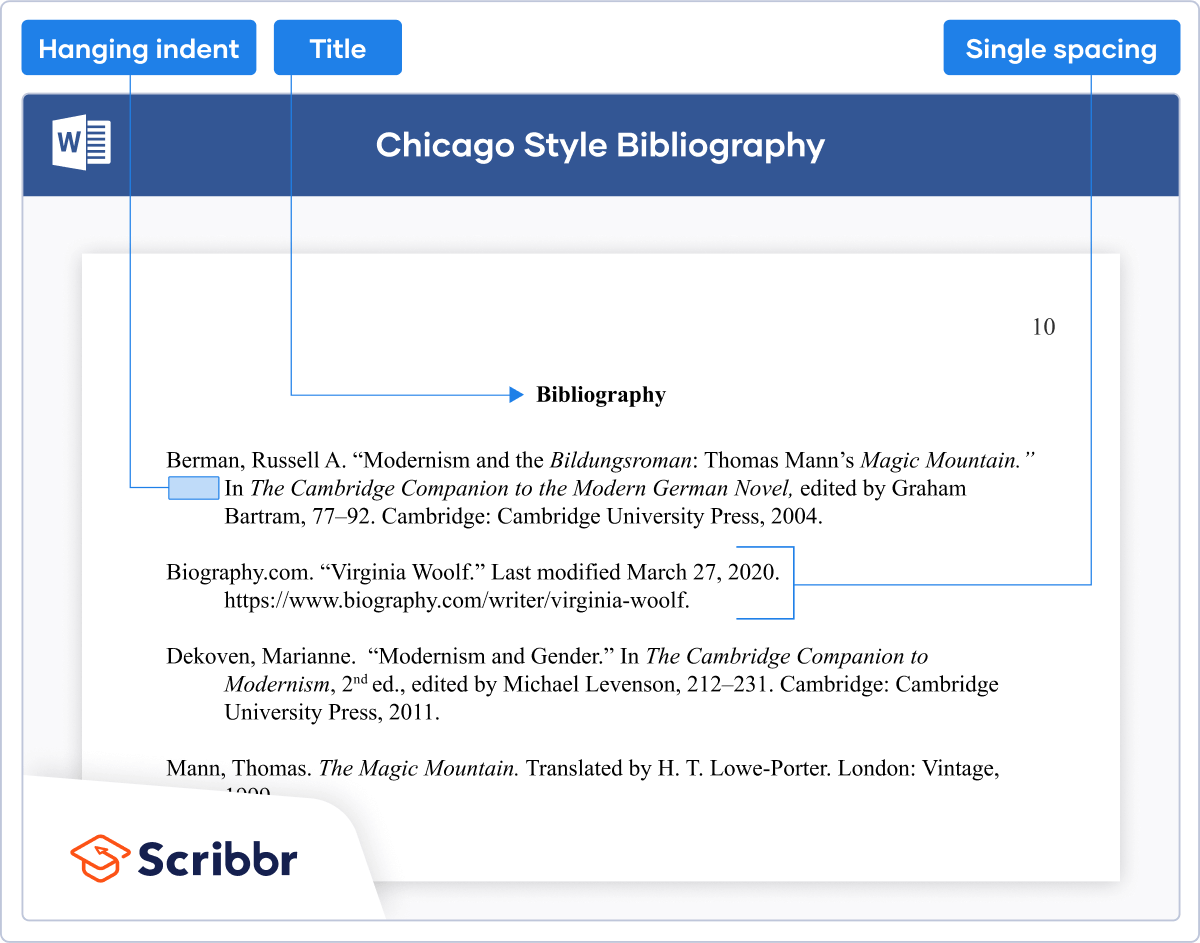
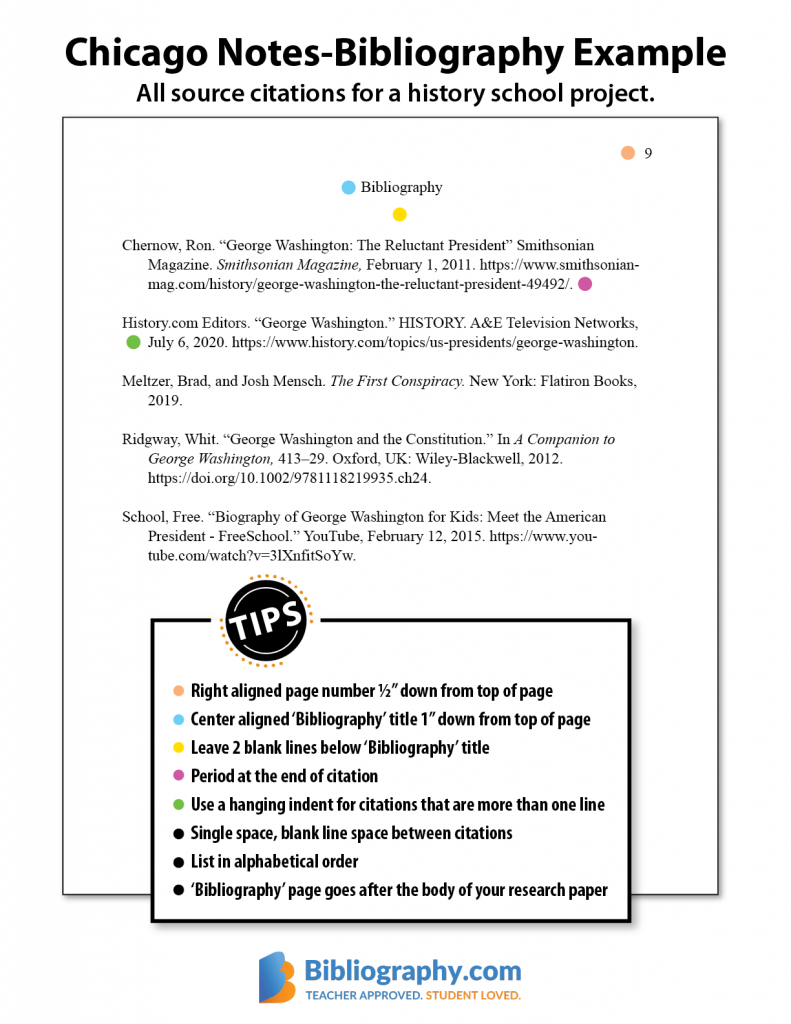
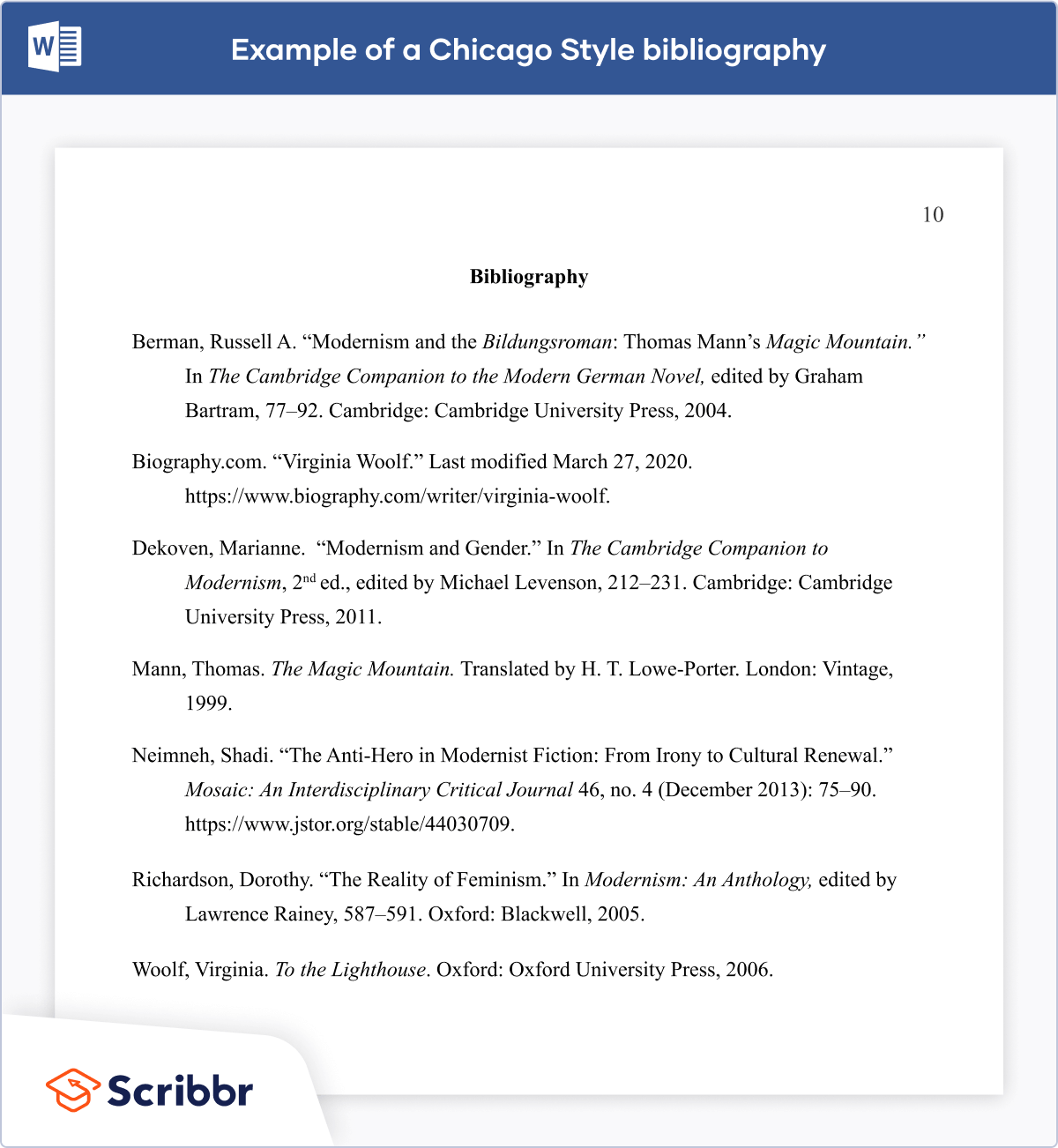
- Alphabetical Order: All entries in the bibliography must be arranged alphabetically by the author’s last name. If an author has multiple works cited, these should be listed chronologically by publication year.
- Hanging Indent: The first line of each bibliography entry is flush with the left margin. Subsequent lines for that same entry are indented (typically by 0.5 inches).
- Punctuation: Pay close attention to the punctuation, as it is specific and consistent. Commas, periods, colons, and quotation marks all play a role in clearly delineating the different parts of a citation.
- Italics and Quotation Marks: As mentioned, titles of standalone works are italicized, while titles of works within larger compilations are in quotation marks.
Crafting Bibliographic Entries for Common Source Types
The most common challenge in creating a Chicago style bibliography lies in adapting the general rules to specific types of sources. Here, we’ll outline how to cite several frequently encountered materials.
Books
Citing a book is fundamental. The basic structure for a monograph (a single-authored book) is as follows:
Structure:
Author’s Last Name, First Name. Title of Book. City of Publication: Publisher, Year of Publication.
Example:
Austen, Jane. Pride and Prejudice. London: T. Egerton, Whitehall, 1813.
Variations:
- Edited Books:
Editor’s Last Name, First Name, ed. Title of Book. City of Publication: Publisher, Year of Publication.
Example: Foucault, Michel. The Order of Things: An Archaeology of the Human Sciences, trans. Alan Sheridan. New York: Vintage Books, 1994. - Books with Multiple Authors:
First Author’s Last Name, First Name, Second Author’s First Name Last Name, and Third Author’s First Name Last Name. Title of Book. City of Publication: Publisher, Year of Publication.
Example: Smith, John, Mary Jones, and David Lee. Theories of Modern Art. New York: Art Publications, 2020. - Chapters in Edited Books:
Chapter Author’s Last Name, First Name. “Title of Chapter.” In Title of Book, edited by Editor’s First Name Last Name, Page numbers. City of Publication: Publisher, Year of Publication.
Example: Eco, Umberto. “The Structure of Bad Italian.” In On the Shoulders of Giants, edited by Stephen Hawking, 29-42. New York: Da Capo Press, 2002.
Journal Articles
Journal articles are a cornerstone of academic research, and their citation requires specific details about the publication itself.
Structure:
Author’s Last Name, First Name. “Title of Article.” Title of Journal Volume, no. Issue (Year of Publication): Page numbers. DOI or URL.
Example:
Kuhn, Thomas S. “The Structure of Scientific Revolutions.” Journal of the History of Ideas 12, no. 4 (1962): 523-64.
Important Considerations:
- Volume and Issue Numbers: Ensure these are correctly identified from the journal’s masthead.
- DOI: If available, a DOI is the preferred stable identifier for online articles.
- Page Numbers: Include the full range of pages the article occupies.
Websites and Online Resources
The dynamic nature of the internet presents unique challenges for citation. Accuracy and accessibility are paramount.
Structure:
Author’s Last Name, First Name (if available). “Title of Specific Page or Document.” Title of Website. Date of Publication or Last Update. Accessed Date. URL.
Example:
National Park Service. “History of Yellowstone.” Yellowstone National Park Official Website. Last modified October 15, 2023. Accessed November 20, 2023. https://www.nps.gov/yell/learn/historyculture/history.htm.
Key Points for Online Sources:
- “Accessed Date”: This is crucial because online content can change or disappear. It indicates when you last viewed the source.
- Author and Date: If the author or publication date is not clearly stated, indicate that. You might use “n.d.” for “no date” if no publication or update date is evident.
- URLs: Use the most direct and stable URL available.
Other Common Source Types
The Chicago Manual of Style provides guidelines for a vast array of source types, including:
- Newspaper Articles: Similar to journal articles but typically include the date of the newspaper.
- Dissertations and Theses: Include the university and year of completion.
- Government Documents: Often require specific formatting based on the issuing agency.
- Audiovisual Materials: Films, music, and interviews have their own distinct citation formats.
When encountering a source type not detailed here, always consult the latest edition of the Chicago Manual of Style or reliable academic writing resources that adhere to its guidelines.
Ensuring Accuracy and Consistency in Your Bibliography
Creating a flawless bibliography is not just about following rules; it’s about demonstrating intellectual integrity and enabling others to engage with your research.
The Importance of Proofreading
Even the most diligent researcher can make mistakes. Thoroughly proofreading your bibliography is an essential final step.
- Check Every Detail: Verify author names, titles, publication dates, page numbers, and punctuation. A misplaced comma or a misspelled name can detract from the professionalism of your work.
- Consistency: Ensure that all entries follow the same formatting conventions. If you italicize book titles, do it for every book. If you use a hanging indent, apply it uniformly.
- Alphabetical Order: Double-check that your entries are indeed in strict alphabetical order.
Utilizing Citation Management Tools
For larger projects or for those who frequently produce academic work, citation management tools can be invaluable. Software like Zotero, Mendeley, or EndNote can help you:
- Organize Sources: Store your research materials and their bibliographic information in a centralized database.
- Generate Citations: Automatically create in-text citations and bibliographies in various styles, including Chicago.
- Maintain Consistency: Reduce the risk of human error by allowing the software to handle the formatting.
While these tools can be powerful aids, it’s crucial to remember that they are not infallible. Always review the generated citations to ensure they meet the specific requirements of your assignment or publication.
Seeking Clarification
If you are unsure about a particular citation format or encounter a source type that is not covered in standard guides, do not hesitate to seek clarification. Your professor, librarian, or academic writing center can provide expert guidance. Many universities also offer workshops or online resources dedicated to citation styles.
Final Thoughts on the Bibliography
A well-crafted Chicago style bibliography is more than just a list of sources; it’s a testament to the thoroughness of your research and your respect for the work of others. By understanding the core principles, mastering the specific formats for different source types, and committing to accuracy and consistency, you can confidently present your research with the highest academic standards. The effort invested in a correct bibliography significantly enhances the authority and credibility of your academic endeavors.
LifeOutOfTheBox is a participant in the Amazon Services LLC Associates Program, an affiliate advertising program designed to provide a means for sites to earn advertising fees by advertising and linking to Amazon.com. Amazon, the Amazon logo, AmazonSupply, and the AmazonSupply logo are trademarks of Amazon.com, Inc. or its affiliates. As an Amazon Associate we earn affiliate commissions from qualifying purchases.