
A Geographical Perspective for the Discerning Traveler
When planning a grand European adventure or considering a sun-drenched escape to the American South, understanding the sheer scale of your potential destinations can profoundly shape your itinerary and expectations. For many, the allure of Italy conjures images of ancient ruins, rolling vineyards, and vibrant cities, while Florida evokes images of sprawling beaches, theme parks, and a distinct subtropical charm. But beyond these popular perceptions, how do these two geographically distinct, yet equally captivating, destinations truly stack up against each other in terms of size? This exploration delves into the physical dimensions of Italy and Florida, offering a geographical primer that can inform your next travel decision.

The Footprint of Nations and States
To accurately compare Italy and Florida, we must first establish their respective land areas. This is not merely an academic exercise; for travelers, understanding these dimensions helps in grasping the logistics of travel within each destination, the diversity of landscapes one can encounter, and the sheer amount of ground to cover to experience its full breadth.
Italy: A Boot-Shaped Peninsula of Rich History and Diverse Terrains
Italy, a country renowned for its profound historical significance, artistic masterpieces, and culinary excellence, occupies a substantial landmass in Southern Europe. Its iconic boot shape stretches out into the Mediterranean Sea, encompassing a total area of approximately 301,340 square kilometers (or about 116,350 square miles). This figure includes its mainland territory and the large islands of Sicily and Sardinia, each offering a unique travel experience.
The varied topography of Italy plays a significant role in its perceived size and the travel time required to traverse it. From the towering peaks of the Alps in the north, forming a natural border with countries like France, Switzerland, and Austria, to the central Apennine mountain range that forms the “spine” of the boot, and the sun-drenched coastal plains and volcanic landscapes in the south, Italy presents a remarkably diverse physical geography. The extensive coastline, bordering the Adriatic Sea to the east and the Tyrrhenian Sea and Liguria Sea to the west, further contributes to its vastness and the variety of its attractions.
Florida: The Sunshine State’s Expansive Reach
Florida, a state in the southeastern United States, is characterized by its subtropical climate, extensive coastline, and vibrant tourism industry. It covers a total area of approximately 170,312 square kilometers (or about 65,758 square miles). While this figure might seem smaller at first glance compared to Italy, it’s crucial to remember that Florida is a single political entity within a much larger nation, whereas Italy is a sovereign country.
The geography of Florida is predominantly flat, with its highest point, Britton Hill, only reaching about 345 feet above sea level. Its defining features are its extensive coastline, with more than 1,350 miles of shoreline, and its vast wetland regions, most notably the Everglades. The state’s peninsular nature means water is a constant presence, influencing its climate, ecosystems, and the types of activities available to visitors, from the iconic beaches of Miami and South Beach to the fishing villages of the Florida Keys.
Direct Comparison: Italy vs. Florida by the Numbers
When juxtaposing the figures, a clear disparity emerges. Italy is considerably larger than Florida. To put it in perspective:
- Italy is roughly 1.77 times the size of Florida. If Florida were overlaid onto the map of Italy, there would be significant room to spare. You could comfortably fit Florida within Italy and still have substantial territory left to explore, perhaps equivalent to the size of several Italian regions combined.
This difference in scale has practical implications for travel:
- Travel Time: Covering the length and breadth of Italy requires more time and planning than traversing Florida. A road trip from the northern regions near the Italian Lakes to the southern tip of Calabria would be a multi-day endeavor, akin to driving from the panhandle of Florida to the Keys, but with far more varied and challenging terrain.
- Diversity of Experiences: Italy’s larger size, combined with its diverse geography and rich history, translates to a greater array of distinct cultural and natural experiences. You can ski in the mountains, explore Roman ruins, wander through Renaissance cities like Florence, and relax on Mediterranean beaches, all within the same country. While Florida offers its own unique blend of attractions – from theme parks in Orlando to the vibrant Cuban culture of Tampa and the natural wonders of the Everglades – the sheer geographic and historical depth of Italy provides a broader canvas for exploration.
Navigating the Landscape: Implications for Travelers
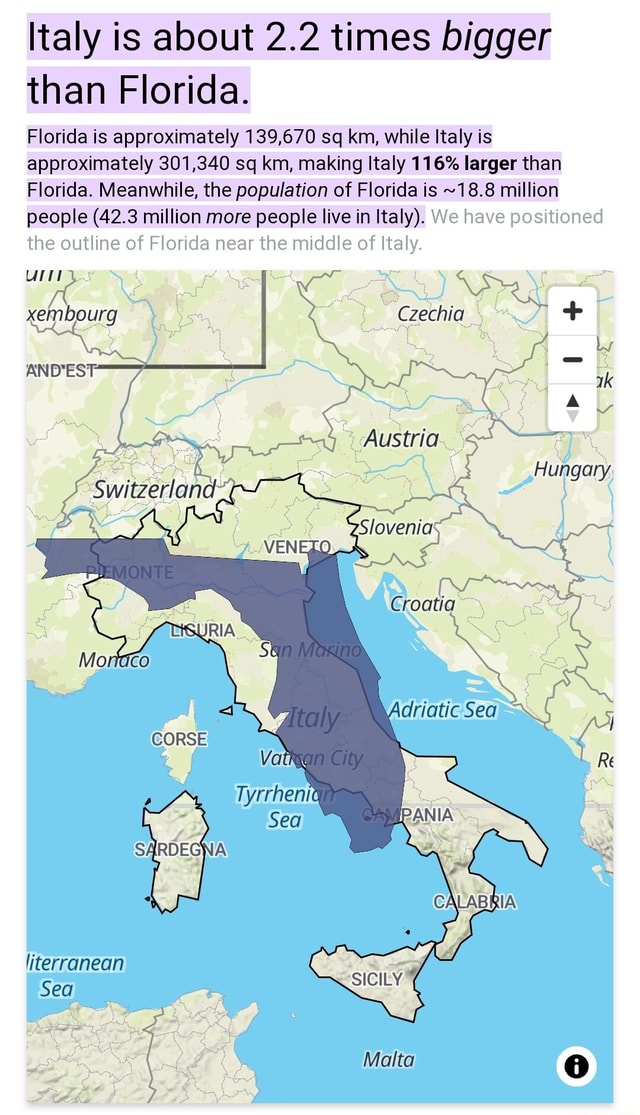
Understanding the size difference between Italy and Florida is not just about numbers; it directly impacts how one approaches planning a trip to either destination.
Planning Your Italian Itinerary: Pace and Scope
A common misconception for first-time visitors to Italy is to attempt to see “everything” in a short period. Given its size and the density of its attractions, this is an almost impossible feat. A two-week trip, for instance, might realistically allow for exploring a few key regions or cities. For example, a classic itinerary might focus on Rome, Florence, and Venice, perhaps with a day trip to the Tuscan countryside. Trying to add the Amalfi Coast, Cinque Terre, and the Italian Lakes would likely lead to a rushed and less enjoyable experience.
Regional Diversity and Travel Logistics
Italy is divided into 20 regions, each with its own distinct dialect, cuisine, traditions, and landscapes. Traveling between these regions can involve high-speed trains, scenic drives, or even short flights. For instance, a journey from Milan in the north to Palermo in Sicily is a significant undertaking, comparable to flying from New York to Miami and then driving further south.
- Northern Italy: Home to the Alps, the Italian Lakes (including Lake Como and Lake Garda), and fashion capitals like Milan.
- Central Italy: The heartland of the Renaissance, featuring Florence, the historical capital of Rome, and the rolling hills of Tuscany.
- Southern Italy: Known for its ancient Greek ruins, vibrant cities like Naples, the stunning Amalfi Coast, and the islands of Sicily and Sardinia.
To truly appreciate the nuances of Italian culture and geography, it is often recommended to focus on one or two regions per trip, allowing for deeper immersion rather than superficial sightseeing.
Exploring Florida: Sunshine and Sprawling Attractions
Florida, while smaller than Italy, still offers a substantial area to explore. Its well-developed infrastructure, particularly its highway system, makes inter-city travel relatively straightforward.
Key Regions and Their Appeal
Florida can be broadly divided into several key regions, each catering to different interests:
- North Florida: Characterized by its Southern charm, historic cities like St. Augustine, and the natural beauty of the panhandle’s beaches.
- Central Florida: The undisputed theme park capital of the world, with Orlando as its centerpiece, alongside attractions like Kennedy Space Center.
- Southwest Florida: Known for its pristine beaches, upscale resorts, and proximity to the Everglades and the Ten Thousand Islands.
- Southeast Florida: Home to vibrant metropolises like Miami, the stylish beaches of South Beach, and the upscale communities of the Palm Beaches.
- The Florida Keys: A unique archipelago extending south, offering a laid-back island vibe, world-class diving, and a distinct tropical atmosphere.
Traveling from the panhandle city of Pensacola to Key West at the southern tip of the state is a journey of over 800 miles, taking approximately 12-13 hours of driving time. This is a comparable distance to driving from the northernmost point of Italy (e.g., the Austrian border) to the southern tip of Calabria, though the terrain and road conditions in Italy can be more challenging.

Conclusion: Scale and the Art of Travel
The comparison of Italy and Florida in terms of size reveals that Italy is a significantly larger entity, offering a more expansive canvas for diverse experiences. This difference in scale is a crucial factor for travelers to consider when planning their trips.
For those drawn to the historical depth, varied landscapes, and rich cultural tapestry of Italy, it is essential to approach planning with an understanding of its vastness. Prioritizing regions, embracing slower travel, and leveraging efficient transportation networks like high-speed trains will allow for a more rewarding and immersive journey. Whether you are dreaming of the Roman Colosseum, the canals of Venice, or the vineyards of Piedmont, the size of Italy means that each visit can be a unique exploration of a distinct facet of this remarkable country.
Conversely, Florida, while smaller, still provides ample opportunities for exploration, from its world-renowned entertainment hubs and beautiful coastlines to its unique natural habitats. Its well-developed infrastructure makes it an accessible destination for those seeking sunshine, adventure, and a taste of the American South.
Ultimately, whether you choose to explore the boot of Europe or the Sunshine State, understanding their geographical footprints will empower you to create a travel plan that maximizes your enjoyment and fully captures the essence of your chosen destination. The journey of discovery is often as much about understanding the ground you cover as it is about the sights you see.
LifeOutOfTheBox is a participant in the Amazon Services LLC Associates Program, an affiliate advertising program designed to provide a means for sites to earn advertising fees by advertising and linking to Amazon.com. Amazon, the Amazon logo, AmazonSupply, and the AmazonSupply logo are trademarks of Amazon.com, Inc. or its affiliates. As an Amazon Associate we earn affiliate commissions from qualifying purchases.