
Navigating the intricacies of child support calculations in Florida is a crucial aspect of family law, aiming to ensure that both parents contribute financially to the well-being of their children. The state employs a statutory guideline system designed to be fair and equitable, taking into account various factors to determine the appropriate amount. Understanding these factors and how they are applied is essential for parents, whether they are going through a divorce, separation, or establishing paternity. This guide will delve into the core components of Florida’s child support formula, offering a clear pathway to comprehension.
Understanding Florida’s Child Support Guidelines
Florida utilizes a “percentage of income” model, where the child support obligation is primarily based on the net incomes of both parents and the number of overnights each child spends with each parent. The overarching principle is that a child should not suffer a diminished standard of living due to the dissolution of their parents’ marriage. The state’s child support guidelines are found in Section 61.30 of the Florida Statutes.
Net Income Calculation
The foundation of any child support calculation is the determination of each parent’s net monthly income. This is not simply gross salary; it involves a series of deductions.
Gross Income
Gross income includes all sources of income, such as:
- Salaries and wages
- Commissions, bonuses, and tips
- Self-employment income
- Disability benefits
- Pension and retirement benefits
- Interest and dividend income
- Alimony received
However, certain types of income are excluded, such as public assistance benefits like Temporary Assistance for Needy Families (TANF) or Supplemental Security Income.
Allowable Deductions
From gross income, specific deductions are permitted to arrive at net income. These typically include:
- Federal income tax (calculated for a single person claiming one exemption)
- State income tax (if applicable, though Florida has no state income tax)
- Social Security taxes
- Medicare taxes
- Mandatory retirement payments
- Mandatory union dues
- Health insurance premiums for the child(ren)
- Costs of dependent or child care necessary for the parent to work or attend school
For individuals who are self-employed, the calculation of net income can be more complex, often involving adjustments for legitimate business expenses. The court has discretion in determining what constitutes a legitimate business expense.
Determining the Income of a Voluntary Underemployed or Unemployed Parent
A crucial provision in Florida law addresses situations where a parent is voluntarily unemployed or underemployed. If the court finds that a parent has the ability to earn income but is intentionally not doing so, the court can impute income to that parent. This means the court will calculate child support based on the parent’s earning potential, rather than their current actual income. This is often determined by looking at the parent’s past earnings, job history, and prevailing wage rates for similar work in the community. This provision prevents parents from deliberately reducing their income to evade their child support obligations.
Calculating the Basic Child Support Obligation
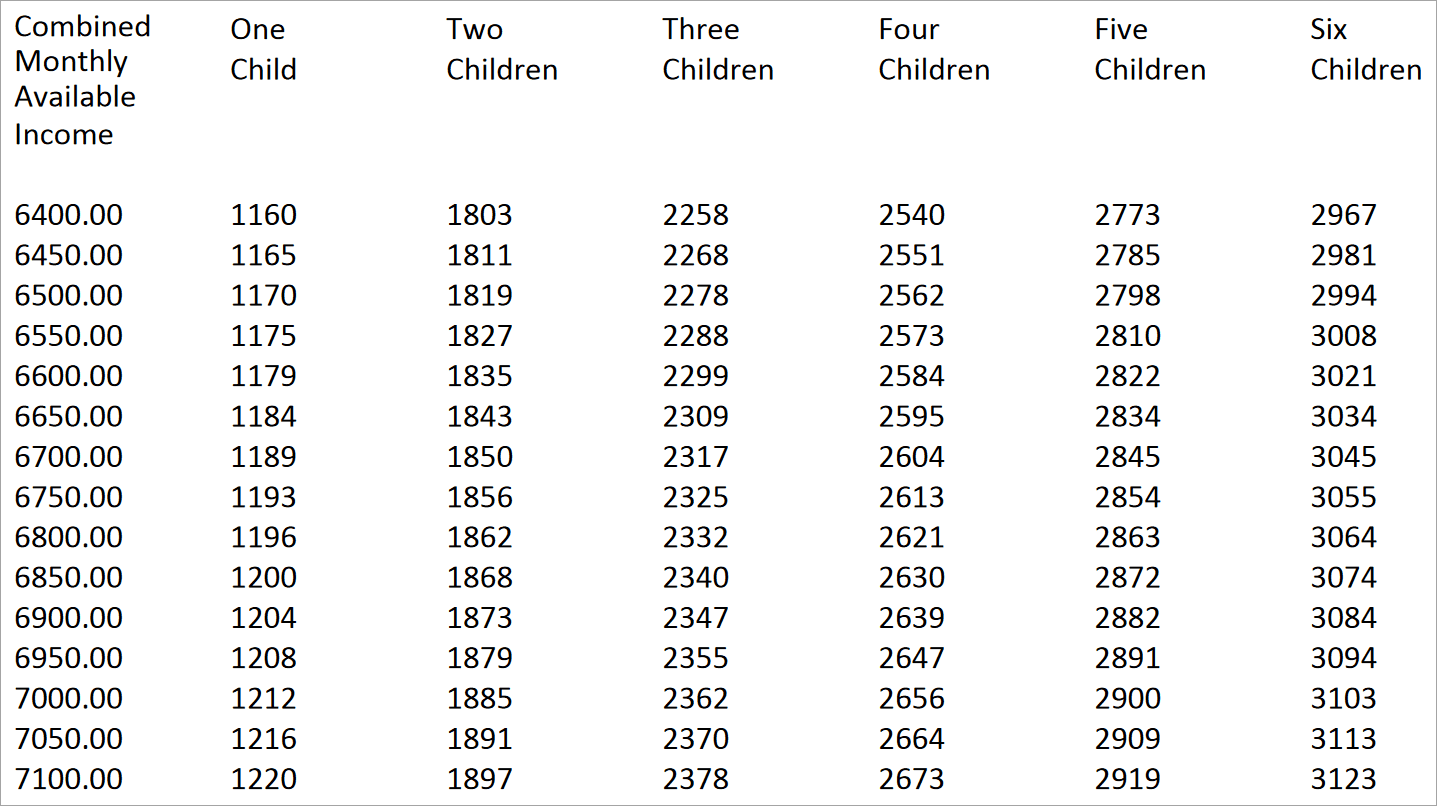
Once the net monthly income for both parents is established, the next step is to determine the “basic child support obligation.” This is the total amount of money that should be spent on the child(ren) per month, as outlined in the Florida child support guideline tables.
The Guideline Support Schedule
Florida provides a detailed schedule in Section 61.30(7) of the Florida Statutes that links a combined net monthly income figure for both parents to a corresponding monthly child support amount. This schedule is tiered, meaning the higher the combined income, the higher the basic child support obligation. The schedule accounts for the number of children being supported.
Example Scenario
Let’s assume a combined net monthly income for both parents of $6,000, with two children. According to the Florida child support guidelines, the basic monthly support for two children at this income level might be, for instance, $950. This $950 represents the total amount deemed necessary for the children’s basic needs.
Allocation of the Basic Obligation
The basic child support obligation is then allocated between the parents based on their proportion of the combined net monthly income.
Calculation Example
Continuing with our example:
- Parent A’s net monthly income: $4,000
- Parent B’s net monthly income: $2,000
- Combined net monthly income: $6,000
Parent A’s percentage of the combined income is ($4,000 / $6,000) * 100% = 66.7%.
Parent B’s percentage of the combined income is ($2,000 / $6,000) * 100% = 33.3%.
Therefore, Parent A would be responsible for 66.7% of the basic child support obligation, and Parent B would be responsible for 33.3%.

- Parent A’s share: 66.7% of $950 = $633.65
- Parent B’s share: 33.3% of $950 = $316.35
This allocation represents each parent’s presumptive share of the basic support costs.
Adjustments to the Basic Child Support Obligation
While the basic obligation is the starting point, several adjustments can be made to the child support order to reflect the specific circumstances of the family and the needs of the child(ren).
Child Care Costs
When a parent incurs work-related child care expenses because they are employed or seeking employment, these costs are added to the basic child support obligation. The total child care cost is then divided between the parents in proportion to their net incomes. For instance, if child care costs $500 per month and Parent A earns 66.7% of the combined income, Parent A would be responsible for 66.7% of the child care costs. These costs are typically paid directly to the parent who is incurring them, or sometimes directly to the childcare provider.
Health Insurance Premiums
The cost of health insurance premiums for the child(ren) is also factored into the calculation. The parent who pays for the child’s health insurance premiums receives a credit for that amount. This means that the parent’s share of the basic obligation is reduced by the amount they pay for the child’s health insurance. This credit is applied after the initial allocation of the basic obligation.
Overnight Stays and Time-Sharing Schedules
Florida child support calculations are significantly influenced by the number of overnights each child spends with each parent. The guidelines recognize that when a child spends a substantial amount of time with the non-custodial parent, the costs associated with supporting the child are also incurred by that parent.
The Overnights Adjustment
Specifically, if a child spends 20% or more of the overnights with the non-custodial parent (which equates to at least 73 overnights per year), a reduction is applied to the non-custodial parent’s support obligation. This reduction is calculated using a table found in Section 61.30(10)(b) of the Florida Statutes, which provides a percentage reduction based on the number of overnights. This adjustment aims to account for the fact that the non-custodial parent is already bearing some of the child’s living expenses during their visitation periods.
Additional Expenses
Beyond basic needs, child support orders may also address other expenses that are deemed necessary for the child’s well-being. These can include:
- Educational Expenses: Costs associated with private schooling or tutoring, if deemed necessary and in the child’s best interest.
- Medical Expenses: Uninsured medical, dental, and vision expenses. These are typically divided between the parents in proportion to their incomes.
- Special Needs Expenses: Costs related to a child with a documented special need, such as therapies or specialized equipment.
- Transportation Costs: In some cases, especially with long-distance parenting plans, transportation costs for visitation may be considered.
These additional expenses are often ordered as a separate component of the child support obligation, distinct from the basic support amount.
Deviations from the Guidelines
While the child support guidelines are presumed to be in the best interest of the child and are used in most cases, Florida law allows for deviations from the guidelines under specific circumstances. A deviation may be considered if applying the guidelines would be inequitable or unjust to the child or to either parent.
Grounds for Deviation
Possible grounds for deviation can include:
- Extreme difference in incomes between parents.
- A child with extraordinary medical, educational, or psychological needs.
- The age of the child.
- The standard of living the child enjoyed prior to the divorce or separation.
- The needs of other children the parent supports.
- The unique needs of a blended family.
To deviate from the guidelines, the court must make a specific finding that the guideline amount is unjust or inequitable and must provide written reasons for the deviation. The deviation must still be in the best interest of the child.
Modification of Child Support
Child support orders are not set in stone. They can be modified if there has been a substantial change in circumstances since the last order was entered. Common reasons for seeking a modification include:
- A significant change in either parent’s income (e.g., job loss, promotion, disability).
- A substantial change in the child’s needs (e.g., medical issues, increased educational costs).
- A change in the time-sharing schedule that results in a change of 15% or more in the overnights the child spends with each parent.
A modification can result in an increase or decrease in the child support amount, depending on the nature of the change in circumstances.

Conclusion
Calculating child support in Florida involves a structured, guideline-based approach that considers parental incomes, the number of children, and time-sharing arrangements. While the statutory formula provides a clear framework, the specifics of each case, including potential adjustments for child care, health insurance, and extraordinary expenses, can add layers of complexity. Understanding these elements is key for parents to advocate effectively for their children’s financial needs and to ensure a fair distribution of parental responsibility. Consulting with a qualified legal professional is always recommended to navigate the nuances of individual cases and to ensure compliance with Florida child support law.
LifeOutOfTheBox is a participant in the Amazon Services LLC Associates Program, an affiliate advertising program designed to provide a means for sites to earn advertising fees by advertising and linking to Amazon.com. Amazon, the Amazon logo, AmazonSupply, and the AmazonSupply logo are trademarks of Amazon.com, Inc. or its affiliates. As an Amazon Associate we earn affiliate commissions from qualifying purchases.