
Navigating the intricacies of business registration in the Sunshine State can sometimes feel like deciphering a complex map. For entrepreneurs and business owners operating within Florida, a crucial step in this process is understanding and fulfilling the Beneficial Ownership Information (BOI) reporting requirements. This mandate, part of the Corporate Transparency Act (CTA), aims to enhance transparency and combat illicit financial activities. This guide will walk you through the essential steps of filing BOI in Florida, ensuring your business remains compliant and operational.
Understanding the Beneficial Ownership Information (BOI) Requirement
The Corporate Transparency Act (CTA), enacted by the U.S. Department of the Treasury, introduced a significant new federal filing obligation for most businesses operating in the United States. The primary goal of the BOI reporting rule is to create a centralized database of the individuals who ultimately own or control reporting companies. This information is intended to be made available to law enforcement agencies for national security and law enforcement purposes, and to financial institutions to facilitate due diligence.

What is a Reporting Company?
In Florida, as elsewhere in the U.S., a “reporting company” generally includes any entity created by the filing of a document with a secretary of state or similar office. This broad definition encompasses a wide range of business structures, including:
- Corporations: Both C-corporations and S-corporations.
- Limited Liability Companies (LLCs): This is a very common business structure in Florida.
- Limited Partnerships (LPs) and Limited Liability Partnerships (LLPs).
There are 23 types of entities exempted from the definition of a reporting company, often referred to as “large operating companies” and other entities that already provide significant information to the government. It is critical to determine if your entity falls into one of these exemptions to avoid unnecessary filing.
Who is a Beneficial Owner?
A “beneficial owner” is defined as an individual who, directly or indirectly, exercises substantial control over a reporting company or owns 25% or more of the ownership interests of a reporting company.
- Substantial Control: This is a broad standard. An individual exercises substantial control if they meet any of these criteria:
- Serving as a senior officer (e.g., president, chief financial officer, general counsel).
- Having authority to appoint or remove any senior officer or a majority of the board of directors.
- Being a significant decision-maker for the company.
- Having any other form of substantial control over the reporting company.
- 25% or More Ownership: This refers to individuals who own, directly or indirectly, 25% or more of the ownership interests of the reporting company. Ownership interests can include a variety of instruments, such as equity, stock, or other similar interests.
Key Dates and Deadlines
The BOI filing requirement is not retroactive for existing companies. However, the deadlines depend on when your company was created:
- Companies created before January 1, 2024: Had until January 1, 2025, to file their initial BOI report.
- Companies created on or after January 1, 2024, and before January 1, 2025: Have 90 days from the date of creation or notice of creation to file their initial BOI report.
- Companies created on or after January 1, 2025: Will have 30 days from the date of creation or notice of creation to file their initial BOI report.
Once filed, any changes to the beneficial ownership information must be reported within 30 days of the change.
Preparing Your BOI Filing in Florida
The Financial Crimes Enforcement Network (FinCEN), a bureau within the U.S. Department of the Treasury, is the agency responsible for collecting and maintaining BOI reports. While Florida has its own business registration processes, the BOI filing is a federal requirement managed by FinCEN.
Information Required for Filing
To complete your BOI report, you will need to gather specific information for each beneficial owner and, if applicable, for each company applicant.
Information About the Reporting Company:
- Legal Name: The full legal name of the entity as registered in Florida.
- Doing Business As (DBA) Names: Any trade names or fictitious names the company uses.
- Business Address: The primary U.S. address of the reporting company. For businesses without a principal U.S. place of business, this can be the company’s main office address.
- Jurisdiction of Formation: The state or tribal jurisdiction where the reporting company was formed (e.g., Florida).
- Employer Identification Number (EIN): A unique nine-digit number assigned by the Internal Revenue Service (IRS) to business entities.
Information About Each Beneficial Owner:
- Full Legal Name: As it appears on a valid government-issued identification document.
- Date of Birth: Month, day, and year.
- Residential Address: The residential street address of the beneficial owner. For individuals who qualify as beneficial owners solely through their role as senior officers, the business address may be used if a residential address is not applicable or available.
- Unique Identifying Number: A number from one of the following documents:
- A non-expired U.S. passport.
- A non-expired driver’s license issued by a U.S. state or territory.
- A non-expired identification card issued by a U.S. state or territory, or a tribal government.
- A non-expired U.S. military identification card.
You will also need to provide a clear image of the front of the document from which the unique identifying number was obtained.
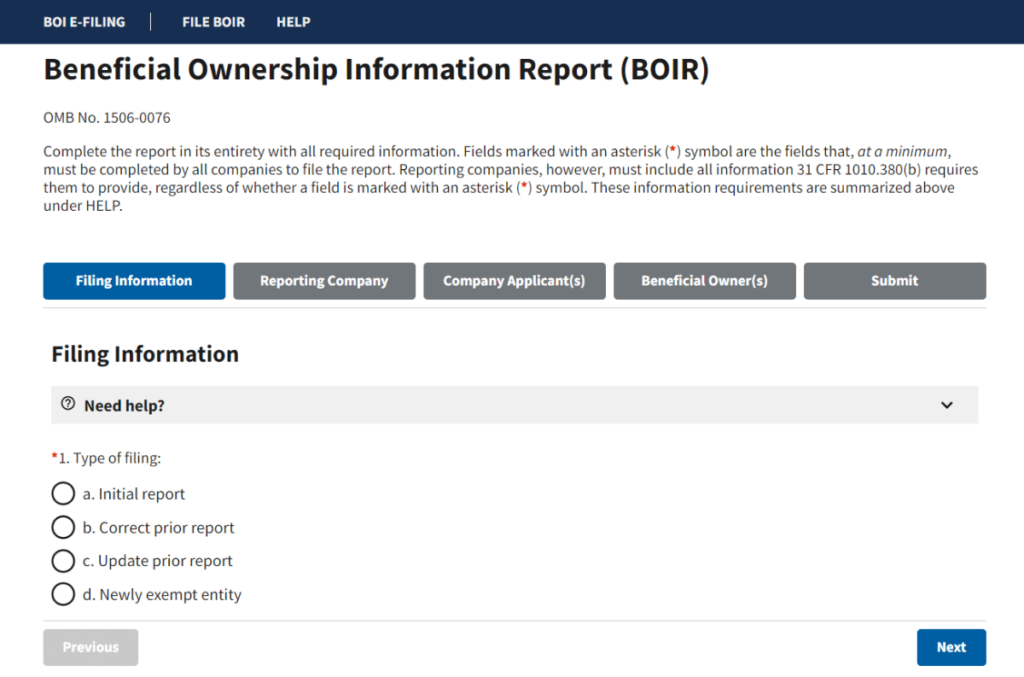
Information About Company Applicants (for companies created on or after January 1, 2024):
Company applicants are individuals who file the document that creates or registers the entity. For entities created before January 1, 2024, company applicant information is not required. For entities created on or after this date, you will need the same information as for beneficial owners for each company applicant.
Obtaining a FinCEN Identifier
A FinCEN Identifier is a unique alphanumeric number that FinCEN will issue to individuals and reporting companies after they submit certain identifying information.
- For Individuals: An individual can obtain a FinCEN Identifier by filing an initial BOI report on their own behalf. This is particularly useful if an individual is a beneficial owner for multiple reporting companies, as they can then provide their FinCEN Identifier instead of repeating all their personal information for each company.
- For Reporting Companies: A reporting company can obtain a FinCEN Identifier by filing its BOI report. This can be used by beneficial owners or company applicants who are associated with that reporting company.
Using FinCEN Identifiers can simplify future filings by reducing the amount of information that needs to be submitted.
Filing Your BOI Report with FinCEN
The FinCEN BOI E-Filing System is the official platform for submitting your beneficial ownership information. The system is accessible online and is designed to be user-friendly.
Steps to File Online:
- Access the FinCEN BOI E-Filing System: Navigate to the official FinCEN website. Look for the dedicated BOI E-Filing portal.
- Create an Account or Proceed as Guest: You may have the option to create a secure account for easier management of filings or to proceed as a guest for a single filing.
- Select Filing Type: Choose whether you are filing an initial report, an updated report, or a corrected report.
- Enter Reporting Company Information: Provide all the required details about your business as outlined in the preparation section.
- Enter Beneficial Owner Information: Systematically enter the information for each individual who meets the definition of a beneficial owner. Ensure all details are accurate and complete.
- Enter Company Applicant Information (if applicable): If your company was created on or after January 1, 2024, provide the necessary details for each company applicant.
- Review and Submit: Before submitting, carefully review all entered information for accuracy. Any errors or omissions could lead to penalties. Once satisfied, submit the report electronically.
- Confirmation: Upon successful submission, you will receive a confirmation receipt. It is crucial to save this confirmation for your records.
Alternatives to E-Filing
While e-filing is the recommended method, FinCEN may offer alternative submission methods for specific circumstances, such as mail-in options for individuals who cannot file electronically. However, the e-filing system is by far the most efficient and secure method.
Maintaining BOI Compliance in Florida
The BOI reporting requirement is not a one-time event. Ongoing compliance is essential to avoid penalties.
Reporting Changes and Updates
As mentioned, if any of the information provided in your initial BOI report changes, you must file an updated or corrected report with FinCEN within 30 days of the change. This includes:
- Changes in beneficial owners (e.g., new individuals gaining substantial control or 25% ownership).
- Changes in the personal information of beneficial owners (e.g., a change in name or residential address).
- Changes in the reporting company’s information (e.g., a change in its legal name or jurisdiction of formation).
- If a company was previously exempt but later loses its exemption, it must file an initial BOI report within 30 days of losing its exempt status.
Record Keeping
It is highly recommended that reporting companies maintain thorough records of their BOI filings and any supporting documentation. This includes copies of submitted reports, proof of identity documents for beneficial owners, and records of any changes made. These records can be invaluable in demonstrating compliance if requested by FinCEN or other authorities.
Penalties for Non-Compliance
Failure to comply with the BOI reporting requirements can result in significant penalties. Both civil and criminal penalties can be imposed:
- Civil Penalties: Up to $500 per day for each day a violation continues after the relevant deadline.
- Criminal Penalties: Willful violations can result in imprisonment for up to two years and/or fines of up to $10,000.
Seeking Professional Assistance
The nuances of the Corporate Transparency Act and BOI reporting can be complex. If you are unsure about your company’s obligations, whether it qualifies for an exemption, or how to accurately complete the filing, it is advisable to seek professional guidance. Attorneys specializing in business law, certified public accountants (CPAs), or other qualified professionals can provide expert advice and assistance to ensure your Florida business remains compliant with these federal regulations. Consulting with a professional can help prevent costly errors and ensure smooth operation of your business.
LifeOutOfTheBox is a participant in the Amazon Services LLC Associates Program, an affiliate advertising program designed to provide a means for sites to earn advertising fees by advertising and linking to Amazon.com. Amazon, the Amazon logo, AmazonSupply, and the AmazonSupply logo are trademarks of Amazon.com, Inc. or its affiliates. As an Amazon Associate we earn affiliate commissions from qualifying purchases.