
Navigating the legal complexities of divorce can be a daunting experience, but understanding the process in Florida can significantly ease the journey. This guide outlines the essential steps and considerations for dissolving a marriage in the Sunshine State, focusing on clarity and practical advice for individuals facing this life transition. While this article provides an overview, it is always recommended to consult with a qualified Florida attorney for personalized legal counsel.
Understanding Florida Divorce Laws
Florida is a no-fault divorce state, meaning that neither party needs to prove that the other is to blame for the marriage ending. This simplifies the initial filing, as you only need to assert that the marriage is irretrievably broken. However, other critical aspects of the divorce, such as equitable distribution of assets and debts, alimony, and child-related matters, require careful consideration and adherence to state statutes.

Types of Divorce in Florida
Florida offers several avenues for divorce, each with its own requirements and implications:
- Uncontested Divorce: This is the most straightforward and often the least expensive type of divorce. It occurs when both parties agree on all the terms of the divorce, including property division, alimony, and child custody. In an uncontested divorce, a Marital Settlement Agreement is drafted and signed by both parties, which is then submitted to the court for approval.
- Contested Divorce: This occurs when spouses cannot agree on one or more key issues. Contested divorces typically involve more court involvement, including hearings, mediation, and potentially a trial. The court will then make decisions on the disputed matters.
- Simplified Dissolution of Marriage: This is a streamlined process available for couples who meet specific criteria. To qualify for a simplified dissolution, both parties must agree that the marriage is irretrievably broken, they must have no minor or dependent children, they must not be seeking alimony, and they must have signed a Marital Settlement Agreement that equitably divides all assets and debts. This option can significantly reduce the time and cost associated with divorce.
- Collaborative Divorce: This is an alternative dispute resolution method where both parties and their attorneys agree to work together cooperatively to resolve the divorce outside of court. The focus is on mutual respect and finding solutions that meet the needs of both spouses and any children. If the process breaks down, the collaborative attorneys must withdraw, and the parties would then hire new legal representation for litigation.
Residency Requirements
Before filing for divorce in Florida, at least one spouse must meet the state’s residency requirements. This means that one of the parties must have resided in Florida for a minimum of six months immediately preceding the filing of the petition for dissolution of marriage. This ensures that the Florida courts have jurisdiction over the case.
The Divorce Process in Florida
The divorce process in Florida generally involves several key stages, from initial filing to final judgment. While an uncontested divorce can be relatively quick, a contested divorce can take many months or even years to resolve.
Filing the Petition
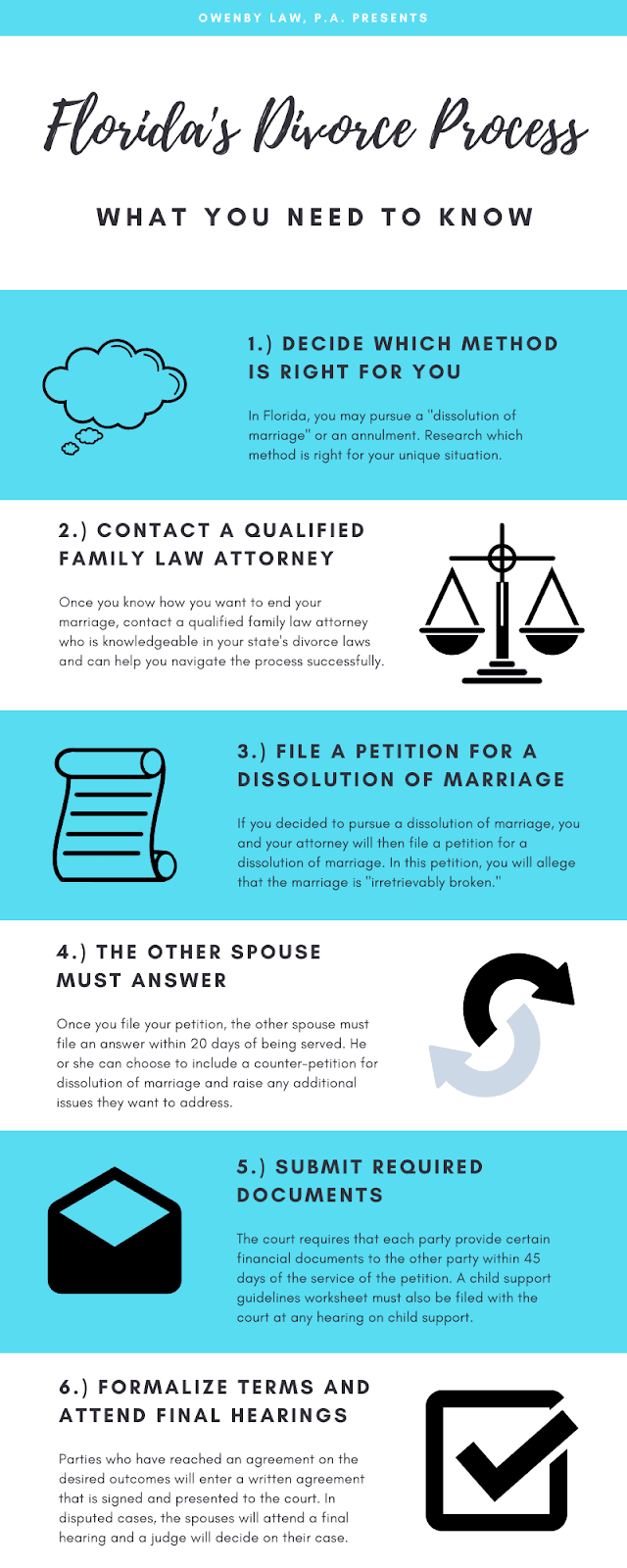
The divorce process begins when one spouse, the “petitioner,” files a Petition for Dissolution of Marriage with the appropriate Florida Circuit Court. This document formally requests the court to grant a divorce and outlines the relief sought by the petitioner, such as division of property, alimony, and child custody arrangements. The petitioner must also file a Summons, which is a legal document notifying the other spouse, the “respondent,” of the lawsuit.
Service of Process
Once the petition is filed, the respondent must be formally notified of the divorce proceedings. This is known as service of process. Typically, a sheriff’s deputy or a certified private process server will hand-deliver a copy of the petition and summons to the respondent. The respondent then has a specific period, usually 20 days, to file a response with the court.
Financial Disclosure
A crucial aspect of any divorce is the full and honest disclosure of all marital assets and debts. Both parties are required to provide detailed financial information to each other and to the court. This typically includes bank statements, investment accounts, tax returns, property deeds, and loan documents. Failure to disclose assets can have serious legal consequences.
Mediation
In many Florida counties, mediation is a mandatory step in the divorce process, especially when children are involved. Mediation is a confidential process where a neutral third-party mediator helps the spouses communicate and negotiate to reach an agreement on contested issues. If an agreement is reached, it is submitted to the court for approval.
Court Hearings and Trial
If the parties cannot reach an agreement through mediation or negotiation, the case will proceed to court. This may involve various hearings on temporary orders (e.g., temporary alimony or child support) or motions filed by either party. If the divorce remains contested and no settlement is reached, the case will ultimately go to trial, where a judge will hear evidence from both sides and make decisions on all outstanding issues.
Final Judgment
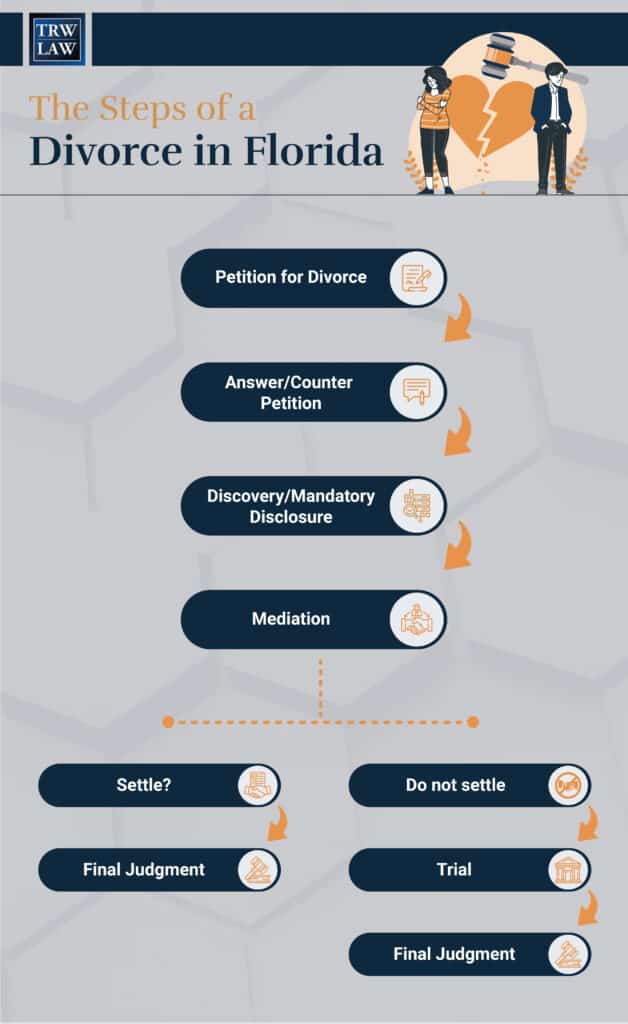
The divorce is finalized when the court issues a Final Judgment of Dissolution of Marriage. This legally terminates the marriage and outlines all the court’s orders regarding property division, alimony, child custody, and child support. It is essential for both parties to adhere to the terms of the final judgment.
Key Issues in Florida Divorce Cases
Beyond the procedural steps, several substantive issues must be addressed during a Florida divorce. These are often the most contentious aspects of the dissolution process.
Equitable Distribution of Marital Assets and Debts
Florida law mandates the equitable distribution of marital assets and debts. Equitable distribution does not necessarily mean an equal 50/50 split, but rather a fair and just division. Marital property includes assets and debts acquired by either spouse during the marriage, regardless of whose name is on the title. Separate property, such as inheritances or gifts received by one spouse during the marriage, is generally not subject to division, but it can become commingled with marital property.
Alimony (Spousal Support)
Alimony, or spousal support, is financial assistance paid by one spouse to the other after a divorce. Florida law recognizes several types of alimony, including:
- Bridge-the-Gap Alimony: Intended to help a party transition from marriage to single life.
- Rehabilitative Alimony: Designed to help a party acquire education, training, or experience to become self-supporting.
- Durational Alimony: Awarded for a set period to provide financial assistance for a defined length of time.
- Permanent Alimony: Awarded in long-term marriages where one spouse is unable to become self-supporting.
The court considers numerous factors when determining whether to award alimony and in what amount, including the length of the marriage, the financial resources of each party, the standard of living established during the marriage, and the age and health of each spouse.
Child Custody and Support
When minor children are involved, child custody (now referred to as “parental responsibility” and “time-sharing” in Florida) and child support are paramount. Florida law presumes that it is in the best interest of the child to have both parents involved in their upbringing.
- Parental Responsibility: This refers to the rights and responsibilities of each parent regarding decisions for the child, such as education, healthcare, and religious upbringing. Florida courts generally favor shared parental responsibility, where both parents have equal input.
- Time-Sharing: This outlines the schedule of when the child will be with each parent. The court will create a time-sharing schedule that is in the child’s best interests, considering factors like the child’s needs, the parents’ ability to care for the child, and the child’s wishes (if of sufficient age and maturity).
- Child Support: Child support is calculated based on statutory guidelines, primarily considering the income of both parents and the number of overnights each parent has with the child. The goal is to ensure that the child receives the same level of support from both parents as they would have if the parents were still married.
Preparing for Your Florida Divorce
A Florida divorce involves significant personal and financial adjustments. Proactive preparation can lead to a smoother and more informed process.
Seek Legal Counsel
While it is possible to represent yourself in a Florida divorce (pro se), it is highly recommended to hire an experienced family law attorney. Attorneys can explain your rights and obligations, guide you through the legal complexities, advocate for your best interests, and help you achieve a fair outcome. They can also advise on the nuances of Florida divorce law, which can be intricate and subject to change.
Organize Your Finances
Gathering all relevant financial documents is critical. This includes bank statements, credit card statements, tax returns, investment account details, retirement plan information, pay stubs, and any documents related to debts and assets. A comprehensive understanding of your financial situation will be essential for negotiations and court proceedings.
Consider Your Children’s Needs
If you have children, their well-being should be the primary focus. Discuss with your legal counsel how to minimize the impact of the divorce on them. Open and honest communication with your children, appropriate to their age, can also be beneficial. Co-parenting strategies, even after the divorce, are vital for their emotional stability.
Explore All Options
Understand the different types of divorce available in Florida and which might be the best fit for your circumstances. An uncontested or simplified dissolution can save time and money. If there are significant disagreements, explore mediation or collaborative divorce as alternatives to a traditional, potentially adversarial, court battle.
Divorce in Florida is a significant legal and personal undertaking. By understanding the laws, the process, and the key issues, individuals can approach this transition with greater confidence and work towards a resolution that allows for a positive future.
LifeOutOfTheBox is a participant in the Amazon Services LLC Associates Program, an affiliate advertising program designed to provide a means for sites to earn advertising fees by advertising and linking to Amazon.com. Amazon, the Amazon logo, AmazonSupply, and the AmazonSupply logo are trademarks of Amazon.com, Inc. or its affiliates. As an Amazon Associate we earn affiliate commissions from qualifying purchases.