
The crisp, colonial air of Boston once crackled with more than just the scent of the sea; it was thick with the tension of an impending revolution. Today, visitors flock to this historic city in Massachusetts, eager to explore its cobbled streets, delve into its rich past, and experience the vibrant culture that defines it. Among the myriad stories etched into Boston’s fabric, few are as pivotal or as poignant as that of the Boston Massacre. Often depicted as a pivotal moment on the road to American independence, this event on March 5, 1770, was not an isolated incident but the tragic culmination of years of simmering resentment, political strife, and cultural clashes between the American colonists and their British overlords.
Understanding “why” the Boston Massacre happened requires a journey back in time, stripping away the comfort of modern travel and immersing oneself in the charged atmosphere of a city on the brink. It’s a story not just about musket fire and bloodshed, but about the intricate dance of economics, politics, and human emotion that ultimately ignited a revolution. For those seeking to connect with the authentic spirit of American history, a visit to Boston offers an unparalleled opportunity to walk in the footsteps of revolutionaries, to stand on the very ground where these dramatic events unfolded, and to grasp the profound significance of this moment. From grand landmarks to immersive tourism experiences, the city provides a living testament to a past that continues to shape the present.
The Crucible of Colonial Resentment: A City Under Strain
The seeds of the Boston Massacre were sown long before that fateful March evening. For years, economic policies, political ideologies, and fundamental disagreements over governance had been eroding the relationship between Great Britain and its American colonies. Boston, a bustling port city and intellectual hub, found itself at the epicenter of this growing discontent. Its merchants, thinkers, and ordinary citizens were increasingly vocal in their opposition to perceived injustices emanating from London.
Economic Grievances and Political Unrest
Following the costly French and Indian War (also known as the Seven Years’ War), the British Parliament sought to recoup its expenses by imposing a series of taxes on the American colonies. These acts, such as the Sugar Act (1764), the Stamp Act (1765), and later the Townshend Acts (1767), were met with fierce resistance. The core grievance wasn’t necessarily the taxes themselves, but the principle behind them: “no taxation without representation.” Colonists argued that since they had no elected representatives in Parliament, Parliament had no right to tax them. This fundamental clash of constitutional understanding fueled widespread outrage and gave birth to organized resistance movements.
Groups like the Sons of Liberty, a secret society dedicated to protecting the rights of colonists, emerged from the taverns and meeting halls of Boston. They organized boycotts of British goods, intimidated tax collectors, and used public demonstrations to express their displeasure. The non-importation agreements, in particular, hit British merchants hard, putting economic pressure on Parliament to repeal the unpopular taxes. While some acts were repealed, the lingering presence of British customs officials and the continued assertion of Parliamentary supremacy kept tensions high. Every merchant, every dockworker, every housewife felt the pinch of these policies, and their frustration manifested in a growing sense of collective identity and purpose, distinct from their British brethren across the Atlantic.
Occupation and Friction: The Redcoats Arrive
The resistance in Boston became so pronounced that in 1768, Great Britain decided to send troops to the city to enforce its laws and maintain order. Thousands of British soldiers, known as “Redcoats” for their distinctive uniforms, disembarked in Boston, effectively turning the bustling port into an occupied city. This military presence was like pouring oil on an already smoldering fire.
The presence of soldiers created daily friction. Colonists resented having troops quartered in their town, especially when those soldiers competed for scarce jobs, such as stevedoring, further impacting the local economy. Taunts, insults, and minor skirmishes became commonplace. Boys would throw snowballs, rocks, and refuse at soldiers, while soldiers, often young and far from home, responded with aggression and disdain. These weren’t just abstract political disagreements; they were personal, face-to-face confrontations that eroded any remaining goodwill. The sound of fife and drum, the sight of marching formations, and the ever-present red coats were a constant reminder of British authority and colonial subjugation. The stage was set for a dramatic escalation, an event that would forever alter the course of history for the fledgling nation.
The Fateful Night of March 5, 1770
The evening of March 5, 1770, was cold and moonlit, with a thin layer of snow covering the streets of Boston. What began as a minor altercation quickly spiraled into a deadly confrontation that would become known as the Boston Massacre. It was a culmination of the deep-seated grievances, daily aggressions, and mutual mistrust that had plagued the city for years.
The Bell Tolls and the Crowd Gathers
The incident began innocently enough near the Custom House on King Street (now State Street). A lone British sentry, Private Hugh White, was standing guard. A young wigmaker’s apprentice, Edward Garrick, allegedly insulted a British officer, leading to a scuffle where White struck the boy with his musket. News of this spread rapidly through the city, drawing a crowd of angry colonists, many of whom were still in the taverns, into the street. The crowd grew larger and more boisterous, pelting White with snowballs, ice, and verbal abuse.
Fearing for his safety and the security of the Custom House, White called for reinforcements. Seven additional Redcoats, led by Captain Thomas Preston, arrived on the scene, bayonets fixed. They formed a semi-circle, attempting to protect White and push back the surging mob. The colonists, now numbering in the hundreds, grew bolder, challenging the soldiers, daring them to fire, and continuing their barrage of projectiles and insults. Church bells began to ring, a traditional signal of fire, further drawing more people out of their homes and into the escalating chaos. The air was thick with the scent of fear, anger, and the cold reality of a city teetering on the edge of violence.
Shots Fired: The Tragedy Unfolds
In the confusion and uproar, conflicting accounts emerged about what transpired next. Amidst the shouts of “Fire!” and the clanging of bells, a soldier, Private Hugh Montgomery, was reportedly struck by a club and fell. His musket discharged, whether accidentally or intentionally. This first shot ignited a chain reaction. Believing they had been given the order to fire, or perhaps acting out of panic and self-preservation, other soldiers began to shoot into the crowd.
When the smoke cleared, five colonists lay dead or dying, and several others were wounded. The first to fall was Crispus Attucks, a former slave of African and Native American descent, often regarded as the first casualty of the American Revolution. Other victims included James Caldwell, Samuel Gray, Patrick Carr, and Samuel Maverick. The scene was horrific, transforming a street skirmish into a massacre and forever altering the relationship between the colonies and Great Britain. The immediate aftermath was one of stunned silence, followed by renewed outrage and calls for justice. The streets of Boston, once a symbol of colonial prosperity, had become a site of brutal conflict, a stark reminder of the human cost of political oppression.
Aftermath and Legacy: Fueling a Revolution
The immediate shock of the Boston Massacre quickly gave way to a powerful wave of outrage and a concerted effort to shape public opinion. This tragic event did not instantly spark war, but it significantly deepened the chasm between the colonies and Great Britain, serving as a potent symbol of British tyranny and colonial resistance.
The Trials and Their Impact
In a testament to the complex legal and political landscape of the time, Captain Thomas Preston and his eight soldiers were arrested and charged with murder. What followed were two of the most significant trials in colonial history, largely due to an unexpected twist: prominent Patriot leaders, John Adams and Josiah Quincy II, agreed to defend the British soldiers. Despite their strong Whig beliefs and personal commitment to the Patriot cause, Adams famously stated, “Facts are stubborn things; and whatever may be our wishes, our inclinations, or the dictates of our passions, they cannot alter the state of facts and evidence.” He believed in the fundamental right to a fair trial, even for those universally despised.
The trials, which took place in late 1770, were meticulously conducted. Adams and Quincy argued that the soldiers were acting in self-defense against a violent mob. Their meticulous defense, coupled with the prosecution’s struggle to prove an order to fire, resulted in the acquittal of Preston and six of his men. Two soldiers, Private Hugh Montgomery and Private Matthew Kilroy, were found guilty of manslaughter, branded on their thumbs, and released. While the legal outcome demonstrated a commitment to justice, it did little to quell the public’s perception of British oppression. The trials, though fair, underscored the deep divisions and set a precedent for the importance of legal due process even in highly charged political environments, an enduring legacy for today’s legal systems.
Propaganda and Public Outcry
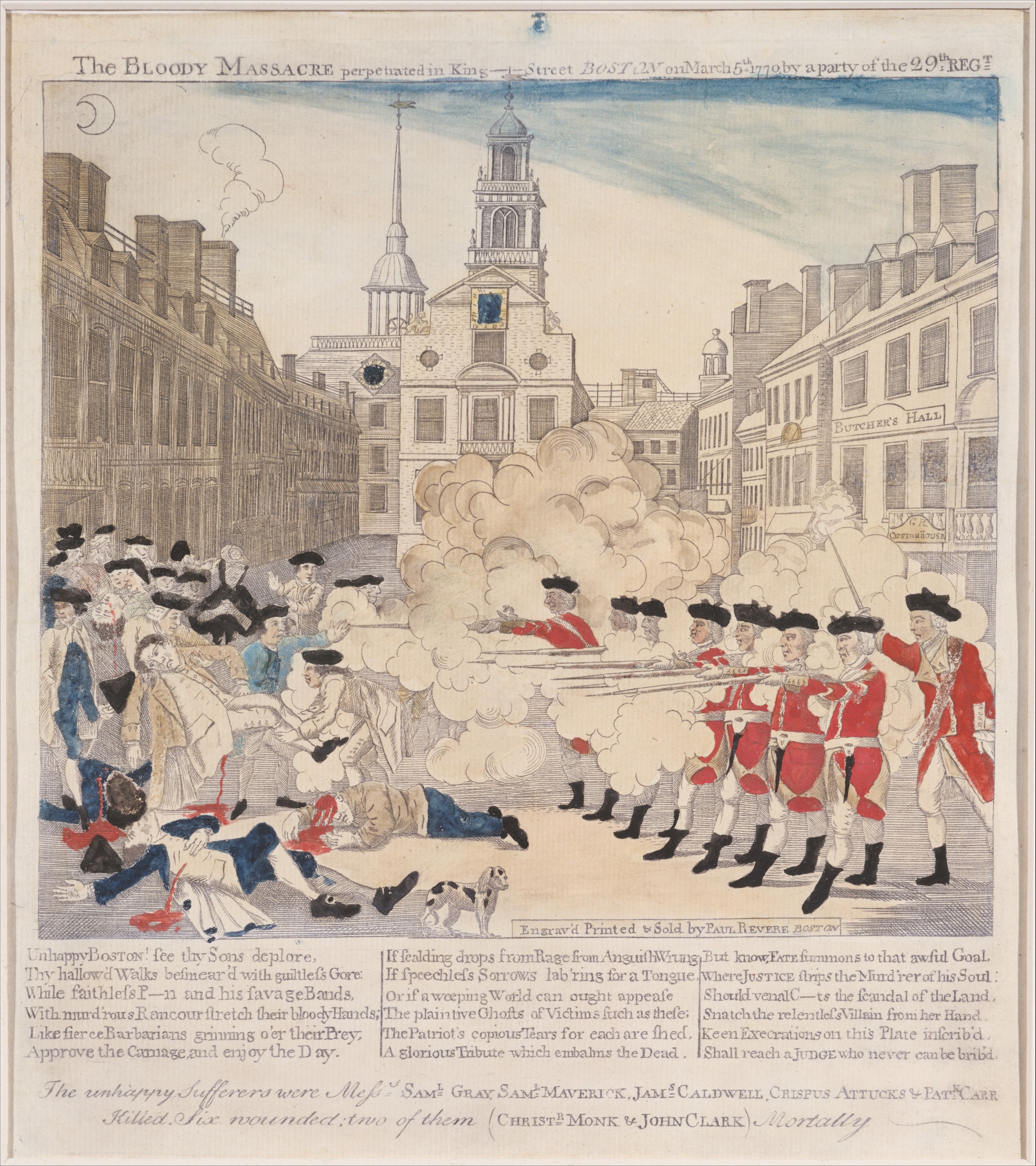
Despite the acquittals, the Boston Massacre became an immediate and powerful tool for Patriot propaganda. The most famous example is the engraving by Paul Revere, titled “The Bloody Massacre Perpetrated in King Street Boston on March 5th 1770 by a party of the 29th Regt.” This iconic image, though highly inaccurate and inflammatory, depicted a disciplined line of British soldiers firing ruthlessly into an innocent, unarmed crowd. It omitted the mob’s aggression and depicted the soldiers as bloodthirsty murderers.
Revere’s engraving was widely circulated throughout the colonies, fanning the flames of anti-British sentiment. Along with impassioned speeches and pamphlets by figures like Samuel Adams and Joseph Warren, the incident was framed as a deliberate act of tyranny by a corrupt government. This narrative solidified colonial resolve and created a shared sense of grievance, uniting disparate communities across North America. The massacre became a rallying cry, a tangible symbol of why independence was not just desirable but necessary.
Paving the Way for Independence
While the Boston Massacre didn’t immediately lead to war, it irrevocably altered the psychological landscape of the colonies. It transformed abstract political arguments into a stark, bloody reality, demonstrating the potential for violence inherent in British rule. It galvanized public opinion, convincing many undecided colonists that reconciliation with Great Britain was increasingly impossible. The event became a reference point in every subsequent debate, a constant reminder of British aggression.
The massacre contributed to a lull in overt revolutionary activity for a few years, but the underlying tensions only deepened. The seeds of revolution had been watered with blood. This period of relative calm was shattered in 1773 with the Boston Tea Party, which in turn led to the Intolerable Acts, pushing the colonies even closer to armed conflict. The Boston Massacre was a critical step in escalating the conflict from civil disobedience to open rebellion, marking a point of no return on the long and arduous path to the American Revolution.
Experiencing History Today: A Walk Through Revolutionary Boston
For the modern traveler, Boston offers an unparalleled opportunity to step back in time and witness the historical tapestry that led to the Boston Massacre and beyond. The city masterfully blends its rich historical heritage with contemporary urban life, making it an ideal destination for history buffs, culture enthusiasts, and families alike.
The Freedom Trail: A Journey Through Revolutionary Sites
The most iconic way to immerse oneself in Boston’s revolutionary past is by walking the Freedom Trail. This 2.5-mile red-lined path weaves through downtown Boston, connecting 16 historically significant sites. For those specifically interested in the Boston Massacre, the most crucial stop is the Old State House. Standing proudly at the intersection of State Street and Congress Street, this brick building with its lion and unicorn statues was the seat of colonial government. On the very spot where the Boston Massacre occurred, a cobblestone circle commemorates the five victims, offering a poignant moment of reflection amidst the bustling modern city.
Beyond the Old State House, the Freedom Trail guides visitors to other crucial sites that illuminate the context of the massacre. Faneuil Hall, known as the “Cradle of Liberty,” was where many fiery debates and public meetings took place, fueling the revolutionary spirit. The Paul Revere House, the oldest house in downtown Boston, provides insight into the life of one of the Revolution’s most famous figures, the man who immortalized the massacre through his controversial engraving. Further along, the Old North Church, famous for the “one if by land, two if by sea” signal, and the Bunker Hill Monument in Charlestown offer a broader perspective on the escalating conflict.
Beyond the Landmarks: Immersive Cultural and Travel Experiences
While the landmarks themselves are powerful, Boston also excels at providing immersive tourism experiences. Guided tours, often led by costumed interpreters, bring the stories of the past to life, offering vivid narratives of the people and events that shaped the nation. Beyond the historical narrative, Boston’s local culture thrives. Visitors can savor delicious local cuisine, from fresh seafood in the Seaport District to authentic Italian fare in the North End. Exploring the vibrant neighborhoods, each with its unique charm, offers a glimpse into the modern lifestyle of this dynamic city.
When planning a trip, finding the right accommodation is key. Boston boasts a range of options, from luxury hotels and boutique resorts in the heart of the city to cozy apartments in historical districts, many offering stunning views and easy access to attractions. Whether you prefer a sophisticated suite near Copley Square or a charming guesthouse in Beacon Hill, there’s an accommodation to suit every travel style and budget. Engaging with the city’s living history, dining at restaurants that have stood for centuries, and staying in a hotel that perhaps overlooks a square where revolutionaries once gathered truly completes the experience, making the abstract concept of history tangible and personal.
The Boston Massacre was a tragic but essential chapter in the narrative of American independence. It was not merely a random act of violence but a logical, albeit horrifying, consequence of mounting political and economic tensions. The clash between colonial aspirations for self-governance and British imperial control reached a violent crescendo on King Street, igniting a revolutionary fervor that would culminate in the birth of a new nation.

Today, Boston invites travelers to explore this profound history firsthand. By visiting the exact spots where events like the Boston Massacre occurred, by walking the Freedom Trail, and by immersing oneself in the city’s vibrant cultural landscape, one gains a deeper appreciation for the courage, sacrifice, and complex circumstances that defined this pivotal era. From luxurious hotels offering modern amenities to charming historic accommodations, Boston provides the perfect backdrop for a historical journey that is as educational as it is inspiring. It’s a destination where every cobblestone has a story, and every visit offers a renewed connection to the very foundations of American liberty.
LifeOutOfTheBox is a participant in the Amazon Services LLC Associates Program, an affiliate advertising program designed to provide a means for sites to earn advertising fees by advertising and linking to Amazon.com. Amazon, the Amazon logo, AmazonSupply, and the AmazonSupply logo are trademarks of Amazon.com, Inc. or its affiliates. As an Amazon Associate we earn affiliate commissions from qualifying purchases.