
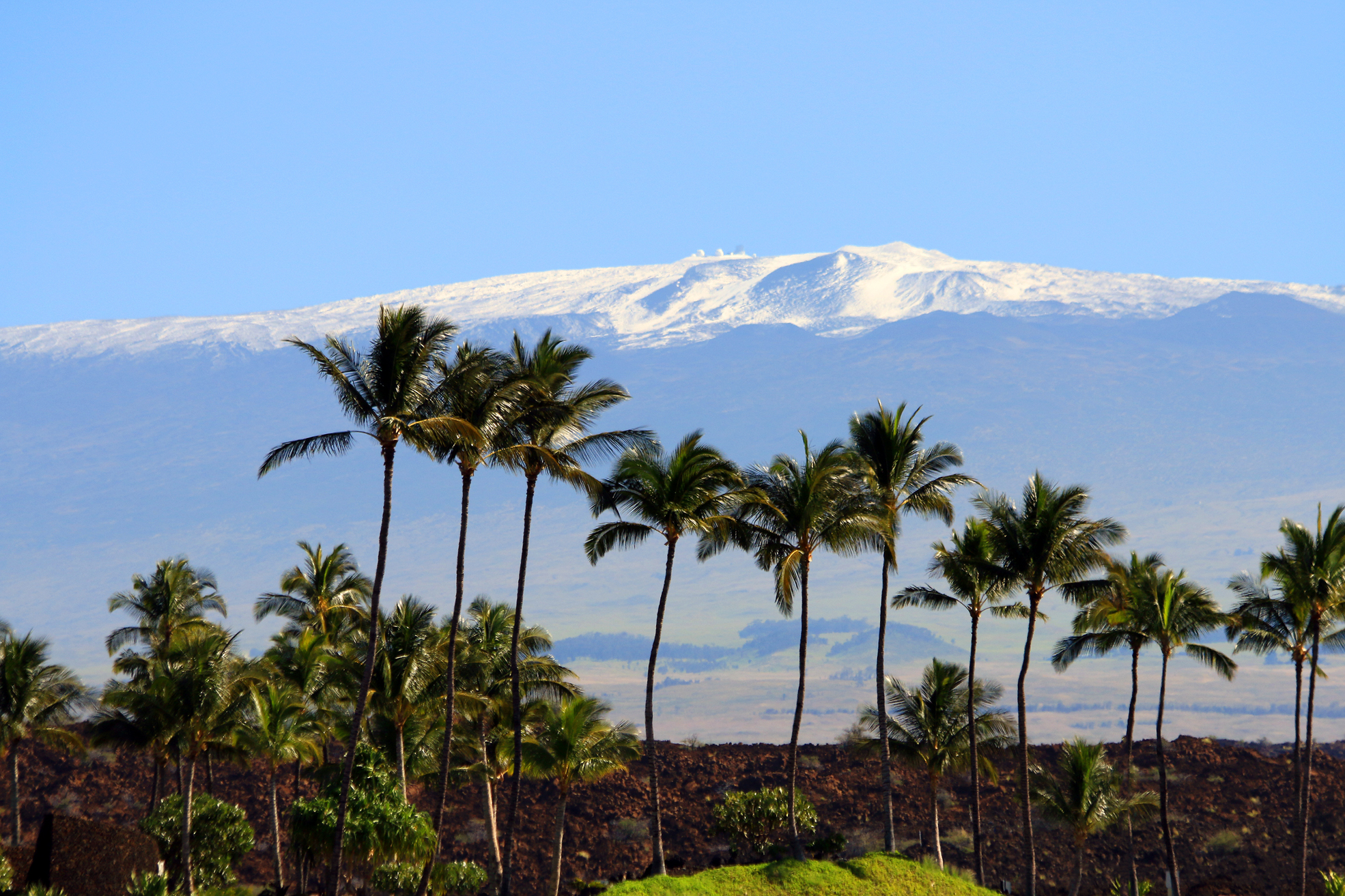
The image of Hawaii held by most of the world is one of eternal summer, where golden beaches meet turquoise waters and the scent of hibiscus hangs heavy in the air. However, those who look beyond the palm-fringed coastlines toward the towering volcanic Landmarks that dominate the interior will find a surprising meteorological reality. Yes, it does snow in the United States‘ tropical paradise, though this phenomenon is reserved for the state’s most magnificent heights.
The presence of snow in Hawaii is not a rare glitch in the climate but a seasonal occurrence on the highest summits of the Big Island and, occasionally, on Maui. These peaks rise so high into the atmosphere that they pierce the tropical inversion layer, reaching altitudes where the air is thin, cold, and capable of supporting alpine conditions. To understand how snow exists in a place synonymous with heat, one must explore the unique geology and geography of these massive volcanic structures.

The Majestic Peaks of the Big Island: Mauna Kea and Mauna Loa
The primary stages for Hawaii’s winter displays are the two giants of the Big Island: Mauna Kea and Mauna Loa. These mountains are not merely tall by island standards; they are among the most significant geographical Landmarks on Earth.
Mauna Kea: The White Mountain
In the Hawaiian Language, the name Mauna Kea translates literally to “White Mountain.” This name is a direct reference to the seasonal snowcap that often blankets its summit during the winter months, typically from December through February, though snowfall has been recorded in nearly every month of the year. Standing at 13,803 feet above sea level, Mauna Kea is the highest point in the state. If measured from its base on the ocean floor, it would be the tallest mountain in the world, surpassing even Mount Everest.
The summit of Mauna Kea is a desolate, Mars-like landscape of cinder cones and volcanic ash. When a cold front or a “Kona Storm” passes over the islands, the moisture-rich air is forced upward. As it ascends the slopes of the mountain, the temperature drops below freezing, transforming rain into snow. It is not uncommon for the summit to receive several inches, or even feet, of snow during a single storm. The contrast between the white-capped peak and the deep blue of the Pacific Ocean visible in the distance is one of the most striking sights in the North Pacific.
Mauna Loa: The Long Mountain
Neighboring Mauna Kea is its massive sibling, Mauna Loa. While slightly lower in elevation at 13,678 feet, Mauna Loa is the largest subaerial volcano on the planet by volume. Because of its immense mass and high elevation, it also experiences regular snowfall. Unlike the sharper profile of Mauna Kea, Mauna Loa is a shield volcano with a broad, gently sloping profile.
Snow on Mauna Loa can be particularly dramatic due to the mountain’s active volcanic nature. The sight of fresh snow settling on relatively recent lava flows from the Moku’aweoweo Caldera creates a juxtaposition of fire and ice that is rare anywhere else on the globe. Accessing the snow on Mauna Loa is significantly more difficult than on its neighbor, requiring strenuous high-altitude hiking, making the snow here a sight reserved for the most dedicated explorers.
Haleakala: Maui’s Volcanic Sentinel
While the Big Island sees the most consistent snow, the island of Maui is not entirely left out of the winter festivities. Haleakala, the massive shield volcano that forms more than 75% of the island, occasionally receives a dusting of snow.
The Summit of Haleakala National Park
Haleakala National Park peaks at 10,023 feet. Because it is roughly 3,000 feet lower than the summits on the Big Island, snow is a much rarer occurrence here. It typically happens only once every few years when a particularly cold and powerful storm system moves through the region. When it does snow, the event becomes a major news story across the islands.
The “House of the Sun,” as Haleakala is known in local lore, offers a unique environment for snow. The summit area is famous for its vast crater—more accurately a dormant volcanic erosional valley—which features colorful cinder cones and strange, endemic plant life. Seeing the red and orange sands of the Haleakala Crater covered in a thin veil of white is a surreal experience that highlights the incredible diversity of the Hawaii landscape.
A Brief Phenomenon
Unlike the deep snowpacks found in the Rocky Mountains or the Sierra Nevada, snow on Haleakala is fleeting. It usually melts within a few hours or days as the tropical sun regains its strength. Nonetheless, for the residents of Maui, the sight of a white-topped mountain rising above the tropical rainforests of Hana and the resorts of Wailea is a cherished rarity.
The Cultural and Ecological Significance of Hawaii’s High-Altitude Snow
In the context of History and local culture, snow in Hawaii is far more than a weather curiosity. It is woven into the spiritual and ecological fabric of the islands.
Poli’ahu: The Snow Goddess of Mauna Kea
In Hawaiian Mythology, the summits of the great volcanoes are considered sacred realms, the “wao akua” or the wilderness of the gods. Poli’ahu is the deity of the snow, said to reside on the summit of Mauna Kea. She is often depicted as a beautiful woman draped in a white kapa (cloth), representing the snow that blankets the mountain.
The stories of Poli’ahu often involve her rivalry with Pele, the goddess of fire and volcanoes who dwells on Kilauea. These myths are a poetic reflection of the geological reality of the Big Island, where the cooling influence of snow and ice has historically interacted with the heat of volcanic eruptions. To many Native Hawaiians, the snow is a physical manifestation of the divine, and the summits are treated with the utmost reverence.
Rare Ecosystems and Lake Waiau
The presence of snow and freezing temperatures has created unique ecological niches atop these volcanoes. One of the most remarkable features is Lake Waiau, located near the summit of Mauna Kea. It is one of the highest lakes in the United States and the only alpine lake in Hawaii. The lake is fed by snowmelt and sits within a cinder cone, held in place by a layer of permafrost—a stunning anomaly in the middle of the Pacific Ocean.
The alpine tundra zone of these mountains is home to species found nowhere else on Earth. The Mauna Kea Silversword, or ‘ahinahina, is a plant specifically adapted to the harsh, high-UV, and freezing conditions of the summit. Its silver-haired leaves reflect the intense sun and protect the plant from the nightly frost. Similarly, the Wekiu Bug survives on the summit of Mauna Kea by consuming frozen insects blown up from the lower elevations. The seasonal snow plays a critical role in providing the moisture necessary for these fragile ecosystems to survive.
The Science of Tropical Snow: Understanding Hawaii’s Alpine Climate
The existence of snow in Hawaii is a fascinating study in atmospheric science. Most of the state’s weather is governed by the trade winds, which bring moisture from the northeast. However, the trade wind inversion usually sits between 6,000 and 8,000 feet, trapping moisture below that level and keeping the summits dry.
The Role of Kona Storms
Significant snowfall usually requires a disruption of the normal trade wind pattern. This often comes in the form of a Kona Storm, a low-pressure system that develops to the west or north of the islands. These storms draw up moisture from the south and can lash the islands with heavy rain at sea level and heavy snow at the summits.
Because the air at 13,000 feet is significantly colder than at sea level—often by as much as 30 to 40 degrees Fahrenheit—the freezing point is frequently reached. For visitors traveling from the coastal heat of Kailua-Kona or Hilo, the rapid transition from 80-degree weather to sub-freezing temperatures is a profound reminder of the vertical diversity of Hawaii.

Astronomy and Clear Skies
The same conditions that allow for snow also make these peaks world-class Landmarks for science. The Mauna Kea Observatory houses some of the world’s most powerful telescopes. Scientists value the summit because the atmosphere is exceptionally stable, dry, and clear. While the occasional snowstorm can shut down operations and block the access roads, the cold, thin air is essential for infrared and submillimeter astronomy.
For those wishing to witness this winter wonder, the journey often begins at the Onizuka Center for International Astronomy, located at 9,200 feet on the access road to Mauna Kea. From here, travelers can see the transition from the lush tropical forests of the lower slopes to the stark, snow-dusted volcanic desert of the peaks. Whether viewed from a distance or experienced firsthand, the snow in Hawaii serves as a powerful symbol of the islands’ geological majesty and the surprising complexity of the natural world.
LifeOutOfTheBox is a participant in the Amazon Services LLC Associates Program, an affiliate advertising program designed to provide a means for sites to earn advertising fees by advertising and linking to Amazon.com. Amazon, the Amazon logo, AmazonSupply, and the AmazonSupply logo are trademarks of Amazon.com, Inc. or its affiliates. As an Amazon Associate we earn affiliate commissions from qualifying purchases.