
Navigating the legal landscape of relationships can be a complex endeavor, particularly when you are looking to solidify your commitment within a specific jurisdiction. For many couples residing in New York State, domestic partnership serves as a vital legal tool. While marriage remains the most common path for legal recognition, domestic partnership offers a distinct alternative that provides essential rights, particularly concerning health benefits, hospital visitation, and certain municipal protections. Understanding the nuances of this process—and how it impacts your lifestyle as a resident—is essential for any couple looking to formalize their life together in the Empire State.
Understanding the Legal Status of Domestic Partnership
Domestic partnership in New York is not a singular, statewide mandate that blankets every municipality with identical rules. Instead, it is a status defined largely by local ordinances. This means that your ability to register as a domestic partner often depends on where you live within the state.
The City of New York vs. The Rest of the State
The most robust domestic partnership registry is found within New York City. The city maintains a formal registry that grants significant protections to couples, including those of the same sex or opposite sex, who share a common residence and are committed to each other. Outside of the five boroughs, the rules change. Many smaller cities and towns in the Hudson Valley or Long Island may not have formal domestic partnership registries at all. It is vital to check the specific clerk’s office in your municipality before beginning your application.
Legal Protections and Benefits
For those who qualify, the benefits of registering can significantly impact one’s lifestyle. Registered domestic partners often gain:
- Hospital Visitation Rights: Ensuring you have access to your partner in medical settings where only “family” is permitted.
- Health Insurance Eligibility: Many private employers and municipal plans in Albany and other major hubs recognize domestic partnerships for dependent coverage.
- Bereavement Leave: The ability to take time off work to mourn a partner, a right often restricted to spouses in traditional employment contracts.
- City Employee Benefits: If you or your partner work for the city, registration is often a prerequisite for obtaining health insurance or bereavement leave for your partner.
Eligibility Requirements and Documentation
Before you head to the clerk’s office, you must ensure you meet the eligibility criteria. These requirements are designed to prove that your partnership is a committed, long-term arrangement rather than a temporary living situation.
Proving Shared Residency
The hallmark of a domestic partnership is the sharing of a primary residence. You will generally be required to show documentation that confirms you and your partner live at the same address. Acceptable documents often include:
- A joint lease agreement or mortgage statement.
- Utility bills featuring both names.
- Bank statements or credit card bills mailed to the same address.
- Drivers’ licenses or state-issued IDs showing the identical address.
The Declaration of Partnership
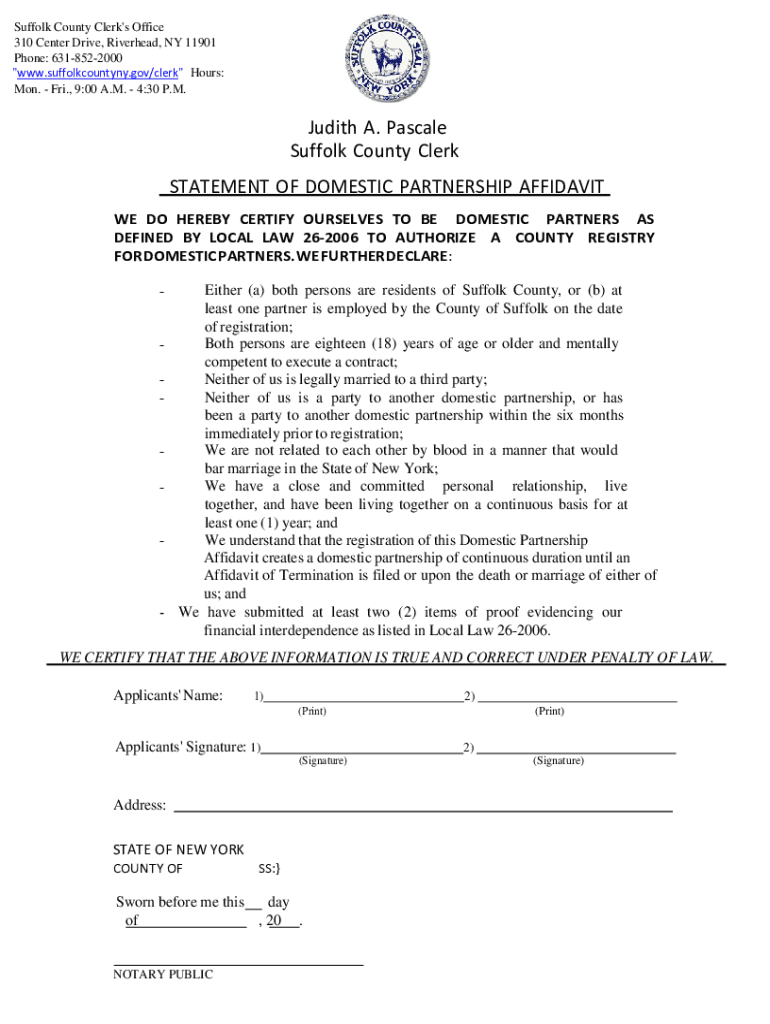
Most jurisdictions require you to sign an Affidavit of Domestic Partnership. This is a legal document, often signed under penalty of perjury, in which you and your partner declare that you are in a committed relationship, are not married to anyone else, and are each other’s sole domestic partner. This document often requires the presence of a notary public, a service usually available at the city clerk’s office or your local bank.
Age and Mental Capacity
In Buffalo, Rochester, and throughout the state, both parties must typically be at least 18 years of age and of sound mind. You must be legally competent to enter into the agreement. Furthermore, you must attest that you are not related by blood in a manner that would prohibit marriage under New York law.

The Application Process: Step-by-Step
Once you have gathered your documents, the actual filing process is straightforward but requires attention to detail. Whether you are in the heart of Manhattan or the rural expanses of the Catskills, the steps are generally uniform.
1. Locate Your Local Clerk’s Office
As mentioned, domestic partnership is largely a municipal matter. Visit the website of your city or town clerk to determine if they offer a domestic partnership registry. Do not assume that because the Empire State Building is in a state with recognition that every town in the state supports it.
2. Schedule an Appointment
Many municipal offices, especially in densely populated areas like Brooklyn or Queens, require an appointment for the filing of domestic partnership applications. Walk-ins may be discouraged or simply unavailable. Ensure you bring valid photo identification, such as a passport or a state-issued ID.
3. Submission and Fees
You will need to present your completed Affidavit of Domestic Partnership. If it has not been notarized previously, you will likely do so at the clerk’s office. There is typically a nominal fee associated with the registration—a modest investment for the peace of mind the status provides.
4. Receiving Your Certificate
After the clerk reviews your documentation and processes the payment, you will receive a Certificate of Domestic Partnership. Keep this document in a secure location. It serves as your primary evidence when dealing with human resources departments, healthcare providers, or property managers who require proof of your relationship.
Lifestyle Considerations for Modern Couples
Choosing to formalize your relationship via domestic partnership is as much a lifestyle decision as it is a legal one. In a fast-paced environment like the United States, having your affairs in order allows you to focus on the quality of your time together rather than the bureaucracy of emergency situations.
Updating Your Estate Planning
While a domestic partnership certificate is powerful, it is not a substitute for a will or a healthcare proxy. Even as registered domestic partners, the law does not automatically grant you the same inheritance rights as a legal spouse. Once you have registered, take the time to sit down with a legal professional to ensure your estate planning reflects your partnership. This might include naming each other as beneficiaries on retirement accounts or creating a living trust, especially if you reside in an area with complex real estate laws like The Hamptons.
Communication with Employers
Many people assume their employer automatically knows about their domestic partnership. In reality, you must take the initiative to notify your HR department. Present your Certificate of Domestic Partnership to add your partner to your insurance plan or to update your emergency contact list. The earlier you integrate this documentation into your professional life, the smoother your transition will be during a life event.

Long-Term Planning and Future Status
It is important to remember that laws evolve. Relationships that begin as domestic partnerships may eventually transition into marriages, or circumstances may require the dissolution of the partnership. Familiarize yourself with the process for terminating a domestic partnership, which is often just as formal as the application process. Knowing how to revoke your registration ensures you maintain control over your legal standing, no matter where life leads you—whether you choose to remain in the bustling streets of Syracuse or move to a quieter corner of the Adirondacks.
By taking the time to understand the requirements and the scope of domestic partnership in New York State, you are taking a proactive step toward protecting your lifestyle and your partner. Whether you are living in a high-rise in Jersey City—which, while outside of the state, informs the regional approach to these agreements—or a historic home in Saratoga Springs, legal recognition offers a foundation of stability for your future together.
LifeOutOfTheBox is a participant in the Amazon Services LLC Associates Program, an affiliate advertising program designed to provide a means for sites to earn advertising fees by advertising and linking to Amazon.com. Amazon, the Amazon logo, AmazonSupply, and the AmazonSupply logo are trademarks of Amazon.com, Inc. or its affiliates. As an Amazon Associate we earn affiliate commissions from qualifying purchases.