
The skyline of New York is perhaps the most recognizable architectural silhouette in the world. Defined by a relentless pursuit of verticality, the city has spent over a century pushing the boundaries of engineering and design. From the early Art Deco pinnacles of the 20th century to the ultra-slim “pencil towers” of the modern era, the tallest buildings in Manhattan represent more than just real estate; they are symbols of ambition, economic power, and structural ingenuity.
The Pinnacle of Modern Engineering: One World Trade Center
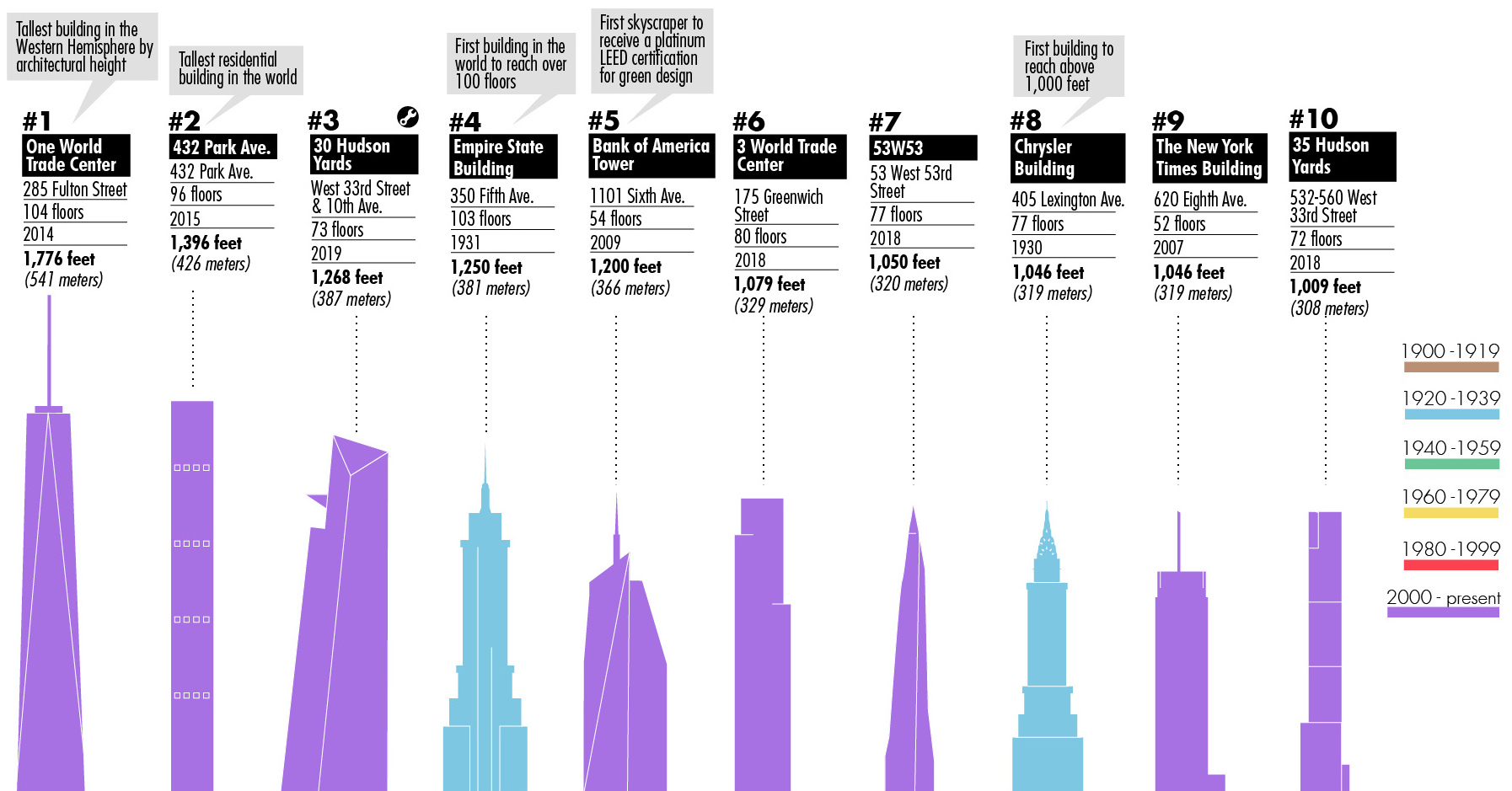
Standing as the centerpiece of the rebuilt World Trade Center complex in Lower Manhattan, One World Trade Center is the tallest building in the United States. Its symbolic height—1,776 feet—serves as a direct reference to the year of the signing of the Declaration of Independence.

Design and Symbolism
Designed by architect David Childs of Skidmore, Owings & Merrill, the tower features a complex geometric form. The base is a square, but as the building rises, its corners are chamfered back, resulting in a series of eight elongated isosceles triangles. This design creates a crystalline form that reflects the changing light and movement of the city below. The building is not merely a commercial office space; it is a masterpiece of safety and sustainability, built with high-strength concrete and reinforced steel to meet the highest security standards.
The Observation Experience
For visitors, the One World Observatory offers an unparalleled vantage point. Located on floors 100, 101, and 102, it provides 360-degree views of the New York Harbor, New Jersey, and the sprawling expanse of Brooklyn. The experience begins with a high-speed elevator ride that uses time-lapse LED technology to show the architectural evolution of the city since the 1600s.
The Era of Pencil Towers on Billionaires’ Row
In recent years, the geography of height in New York City has shifted toward 57th Street, an area now colloquially known as “Billionaires’ Row.” These structures, characterized by extreme slenderness ratios, represent a new typology of supertall architecture.
Central Park Tower
Currently holding the record as the second-tallest building in the city, Central Park Tower stands at 1,550 feet. It is the tallest residential building in the world. Located on the edge of Central Park, the building utilizes advanced engineering—such as a tuned mass damper—to mitigate the sway caused by high-altitude winds. The glass and steel curtain wall provides residents with panoramic views that span from the Atlantic Ocean to the Hudson River.

111 West 57th Street
Perhaps the most iconic example of the “pencil tower” movement is 111 West 57th Street, also known as the Steinway Tower. With a width-to-height ratio of 1:24, it is officially the skinniest skyscraper in the world. The design incorporates the historic Steinway Hall, seamlessly blending 1920s landmark preservation with 21st-century residential luxury. Its facade, featuring terracotta cladding and bronze detailing, pays homage to the golden age of New York skyscrapers while asserting a minimalist, modern aesthetic.
Architectural Legacy: The Art Deco Giants
While modern supertalls dominate the skyline, the foundation of New York’s identity remains rooted in the mid-century icons. These buildings defined the skyscraper age and remain among the most beloved landmarks in the country.
The Empire State Building
For forty years, the Empire State Building held the title of the tallest building in the world. Completed in 1931 during the Great Depression, this limestone and granite giant is the quintessential image of Midtown Manhattan. Its setbacks, required by the 1916 Zoning Resolution, give it its signature “wedding cake” silhouette, while its crown is illuminated in colors that mark holidays and special events. Visiting the 86th and 102nd-floor observation decks remains a rite of passage for every traveler.
The Chrysler Building
Often cited by architects as the most beautiful skyscraper in the city, the Chrysler Building is a masterpiece of Art Deco style. Its terraced crown, adorned with iconic steel sunbursts and eagle gargoyles, captures the spirit of the Machine Age. While it no longer ranks among the top five tallest buildings, its cultural significance is unmatched. It represents the height of 1930s optimism and remains an essential stop for those exploring the architectural history of Lexington Avenue.
Vertical Trends and Future Horizons
The competitive nature of New York’s skyline suggests that the quest for height is far from over. As technology allows for lighter building materials and more sophisticated structural dampers, architects are finding ways to build higher on smaller plots of land.
The Evolution of Zoning and Density
The future of the skyline is heavily dictated by city zoning laws. The evolution from the 1916 Zoning Resolution—which encouraged the setback style—to modern floor-area-ratio bonuses has allowed for the rise of massive, mixed-use developments. Projects like Hudson Yards on the West Side demonstrate how entire neighborhoods can be reconfigured vertically, integrating retail, office space, and luxury living into a single elevated ecosystem.
Sustainability and the Tall Building
New challenges face the architects of tomorrow: sustainability and energy efficiency. The latest generation of skyscrapers, such as those found in Lower Manhattan and Midtown, are being constructed with high-performance glass, greywater recycling systems, and smart climate controls. As buildings get taller, they must also become smarter. The goal is no longer just to be the tallest; the goal is to be the most efficient, ensuring that New York’s architectural marvels can withstand the environmental pressures of the coming century.
Whether one is standing at the base of the Empire State Building looking up or viewing the city from the Top of the Rock, the impact of these structures is undeniable. They are the artifacts of human progress, built on a dense, rocky island, reaching endlessly toward the clouds. For any visitor to New York City, these buildings offer more than just a place to work or live—they provide the essential framework through which we view and understand the city itself. They are the landmarks that guide us, the silhouettes that haunt our dreams, and the monuments to the infinite possibility of urban life.
LifeOutOfTheBox is a participant in the Amazon Services LLC Associates Program, an affiliate advertising program designed to provide a means for sites to earn advertising fees by advertising and linking to Amazon.com. Amazon, the Amazon logo, AmazonSupply, and the AmazonSupply logo are trademarks of Amazon.com, Inc. or its affiliates. As an Amazon Associate we earn affiliate commissions from qualifying purchases.