
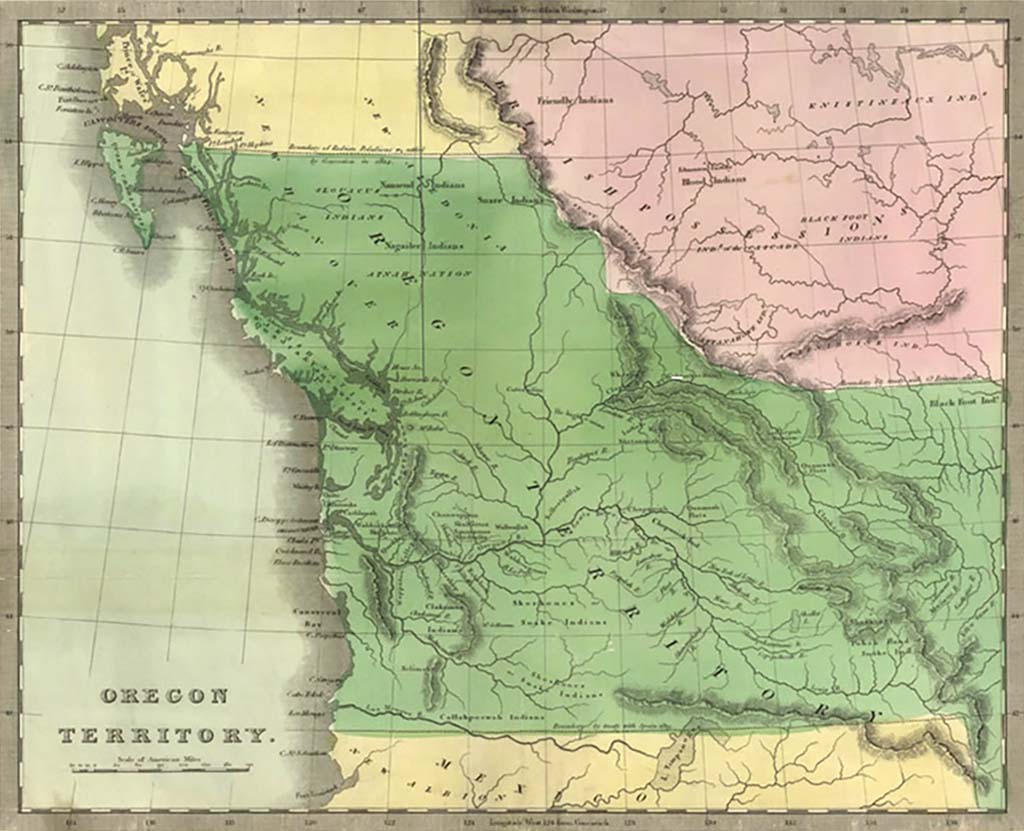
The story of how the United States acquired the Oregon Territory is a complex narrative of exploration, diplomatic maneuvering, and the inexorable push of westward expansion. This vast region, which eventually encompassed the modern-day states of Oregon, Washington, and Idaho, as well as parts of Montana and Wyoming, was once the site of a high-stakes geopolitical contest between the world’s greatest empires.
Early Exploration and Conflicting Claims
Before the territory became a focal point of American domestic policy, it was a wilderness defined by its dramatic topography—the rugged Cascade Range, the fertile Willamette Valley, and the treacherous waters of the Columbia River.

The Maritime Pioneers
The claim to Oregon was initially rooted in maritime exploration. Spanish explorers were among the first Europeans to sight the coastline, followed closely by British captains such as James Cook. However, it was the American captain Robert Gray who provided the United States with a vital anchor for its future claims when he discovered and navigated the mouth of the Columbia River in 1792.
The Lewis and Clark Expedition
The diplomatic impetus for American ownership solidified following the Louisiana Purchase in 1803. President Thomas Jefferson commissioned the Lewis and Clark Expedition, led by Meriwether Lewis and William Clark, to map the newly acquired territory and find a water route to the Pacific Ocean. Their successful journey to the coast provided the United States with a transcontinental roadmap and solidified its interest in the Pacific Northwest.
The Era of Joint Occupation and Diplomacy
By the early 19th century, the United States and Great Britain were the two primary powers vying for control over the region. Both nations asserted their rights based on discovery and occupation, leading to a period of uneasy coexistence.
The Convention of 1818
To prevent armed conflict, the two nations signed the Convention of 1818. This agreement established the 49th parallel as the border between the United States and British North America (modern-day Canada) from the Lake of the Woods to the Rocky Mountains. Regarding the Oregon Country, they agreed to a ten-year period of “joint occupation,” which allowed citizens of both nations to settle the region without prejudice.

The Hudson’s Bay Company Influence
During this time, the Hudson’s Bay Company dominated the region’s economy, establishing trading posts like Fort Vancouver. The British presence was largely mercantile, focusing on the lucrative fur trade. Meanwhile, American presence remained sporadic until the 1830s, when missionaries and pioneers began braving the Oregon Trail, a two-thousand-mile route starting in Independence, Missouri, that transformed the demographic landscape of the territory.
The Drive for “Manifest Destiny” and the Oregon Treaty
By the mid-1840s, the concept of “Manifest Destiny” had gripped the American consciousness. This ideological belief held that the United States was divinely ordained to expand across the entire North American continent, from the Atlantic Ocean to the Pacific.
Fifty-Four Forty or Fight
The presidential election of 1844 turned Oregon into a central campaign issue. James K. Polk ran on an expansionist platform that demanded the entirety of the Oregon Territory up to the parallel of 54°40′ north latitude. The rallying cry “Fifty-Four Forty or Fight!” became a symbol of American resolve to challenge British claims, which insisted on the boundary of the Columbia River.
The 1846 Compromise
Despite his aggressive campaign rhetoric, President Polk was already preparing for a potential conflict with Mexico and sought to avoid a two-front war. Recognizing that the British Empire was unlikely to surrender the territory entirely, he negotiated a diplomatic solution. The Oregon Treaty of 1846 was signed, formally setting the border between the United States and British North America at the 49th parallel, extending from the Rocky Mountains to the Strait of Georgia, and bypassing Vancouver Island, which remained with the British.
Legacy and Settlement of the Pacific Northwest
The resolution of the boundary dispute cleared the way for the United States to formalize its administration of the region. This led directly to the creation of the Oregon Territory in 1848, officially bringing the vast lands of the Pacific Northwest under federal jurisdiction.
Infrastructure and Statehood
The acquisition spurred massive migration. Settlers arrived by the thousands, drawn by the promise of free land via the Donation Land Claim Act. This influx of population led to the rapid development of infrastructure, the growth of cities like Portland, and the subsequent admission of Oregon as the 33rd state in 1859.
Historical Impact
The acquisition of Oregon was a cornerstone of American expansionism. It secured the United States a significant presence on the Pacific Coast, providing the nation with deep-water ports essential for expanding trade with Asia. More than just a diplomatic victory, it fundamentally altered the economic potential of the young republic, transforming it from a collection of states bordering the Atlantic into a true transcontinental power.
Today, the Oregon Territory serves as a testament to the turbulent era of 19th-century geopolitics. The remnants of this history are still visible throughout the landscape—from the preserved landmarks of the Oregon Trail to the historic sites located in Salem and Olympia. The diplomatic caution shown by James K. Polk in 1846, coupled with the persistent movement of pioneers, ultimately ensured that this fertile, resource-rich land became an integral part of the American landscape, shaping the cultural and physical borders of the nation as we recognize them today. The transition from a contested frontier to a cornerstone of the modern United States remains one of the most significant chapters in the history of the American West.
LifeOutOfTheBox is a participant in the Amazon Services LLC Associates Program, an affiliate advertising program designed to provide a means for sites to earn advertising fees by advertising and linking to Amazon.com. Amazon, the Amazon logo, AmazonSupply, and the AmazonSupply logo are trademarks of Amazon.com, Inc. or its affiliates. As an Amazon Associate we earn affiliate commissions from qualifying purchases.