
The story of how the United States acquired Hawaii is a complex tapestry woven with threads of exploration, economic ambition, political maneuvering, and cultural clashes. Far from a simple tale of discovery, it’s a narrative that encompasses centuries of rich Hawaiian history, the gradual encroachment of foreign powers, and ultimately, the annexation of a sovereign kingdom into an American territory. For travelers exploring the breathtaking islands today – from the vibrant shores of Waikiki Beach to the majestic slopes of Mauna Kea – understanding this intricate past enriches the experience, revealing the deep cultural roots and historical significance behind every landmark and local tradition.
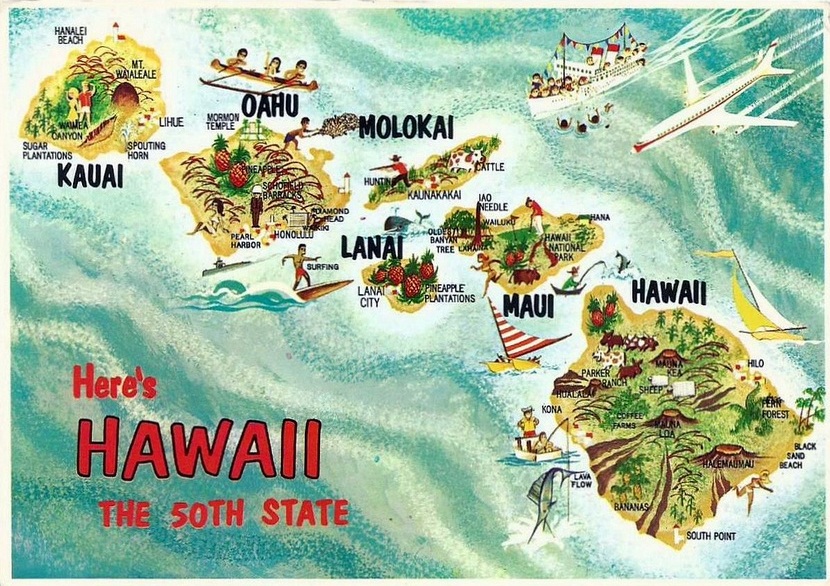
The Dawn of a Kingdom: Ancient Hawaii and Early Encounters
Before it became the 50th state of the United States, Hawaii was a vibrant, self-sufficient kingdom with a rich history spanning over a thousand years. Its journey from a collection of isolated chiefdoms to a unified nation, and later, to a coveted prize for global powers, is a testament to the resilience and strategic importance of these Pacific islands.
A Flourishing Polynesian Society
The first settlers arrived in Hawaii from other Polynesian islands, likely the Marquesas and Tahiti, sometime between 400 and 800 CE. These master navigators brought with them not only their knowledge of the seas but also their plants, animals, and intricate social structures. Over centuries, they developed a complex society governed by an elaborate kapu (taboo) system, a sophisticated land division known as the ahupua’a, and a deep spiritual connection to the ‘aina (land) and kai (sea). Each island, and often distinct regions within islands, was ruled by its own ali’i nui (high chief), frequently engaged in inter-island conflicts. This period of isolation fostered a unique Hawaiian culture, language, and religious practices that flourished untouched by Western influence.
By the late 18th century, a powerful warrior chief named Kamehameha I began a series of military campaigns to unify the islands. Utilizing both traditional Hawaiian warfare and newfound Western weaponry acquired through trade, he successfully brought all the major islands under his rule by 1810, establishing the Kingdom of Hawaii. This monumental achievement marked the birth of a unified Hawaiian nation, a sovereign entity recognized by world powers.
Western Arrival and Shifting Tides
The arrival of Captain James Cook in 1778 marked a pivotal turning point in Hawaiian history. While his initial contact was met with curiosity and reverence (he was initially mistaken for the god Lono), it also heralded the end of Hawaii’s isolation. Cook’s “discovery” opened the floodgates for Western traders, whalers, and missionaries, forever altering the social, economic, and political landscape of the islands.
The early 19th century saw a dramatic transformation. Whaling ships made Honolulu and Lahaina bustling ports, bringing with them foreign goods, diseases that decimated the native population, and new ideas. American Protestant missionaries arrived in 1820, quickly gaining influence within the royal court. They introduced Christianity, literacy (creating a written Hawaiian language), and Western legal concepts, profoundly shaping Hawaiian society. These encounters, while bringing advancements in some areas, also began to erode the traditional Hawaiian way of life and opened the door for increasing foreign control.
The Seeds of Influence: Growing American Presence
As the 19th century progressed, the United States’ interest in Hawaii intensified, driven by strategic geographic location for naval bases and lucrative economic opportunities, primarily in the burgeoning sugar industry. This growing influence gradually undermined Hawaiian sovereignty.
Missionaries, Merchants, and Economic Grip
The descendants of early American missionaries, often referred to as the “missionary boys,” played a crucial role in shaping Hawaii’s future. They established powerful businesses, particularly sugar plantations, and became influential advisors to the Hawaiian monarchs. The fertile lands and favorable climate of Hawaii were ideal for growing sugarcane, which became the islands’ primary export. This industry required vast tracts of land, leading to significant changes in land ownership.
A pivotal moment was the Great Mahele of 1848, a land redistribution act that, despite its intentions, fundamentally altered the traditional Hawaiian land system and allowed foreign ownership. Many native Hawaiians lost their traditional land rights, making way for large-scale sugar plantations predominantly owned by American businessmen. These powerful landholders formed a tight-knit oligarchy that increasingly wielded political power, often at odds with the desires of the Hawaiian monarchy and its people.
The economic ties deepened with the Reciprocity Treaty of 1875 between the Kingdom of Hawaii and the United States. This treaty allowed Hawaiian sugar to enter the U.S. duty-free, boosting the sugar industry significantly. In return, Hawaii agreed not to lease any Hawaiian port or territory to any other foreign power, effectively giving the United States a strategic advantage and paving the way for the eventual leasing of Pearl Harbor as a naval base. This treaty cemented Hawaii’s economic dependence on the United States.
The Bayonet Constitution and Loss of Sovereignty
By the 1880s, the foreign business elite, largely American in origin, grew increasingly frustrated with the Hawaiian monarchs’ attempts to assert more independence and protect native Hawaiian rights. This frustration culminated in the infamous Bayonet Constitution of 1887.
Under threat of violence from a militia controlled by the Hawaiian League (a secret society of American and European businessmen and citizens), King Kalakaua was forced to sign a new constitution. This document drastically reduced the power of the monarch, transforming the Kingdom of Hawaii into a constitutional monarchy where the king was little more than a figurehead. More critically, it disenfranchised many native Hawaiians and Asian immigrants by imposing property and income qualifications for voting, while granting voting rights to non-Hawaiian foreign residents, primarily the American and European planter class. The constitution earned its name because it was imposed under duress, literally at bayonet-point. This event marked a significant turning point, essentially transferring political power from the Hawaiian monarchy to the foreign business elite.
The Overthrow and the Republic: End of a Monarchy
The stage was set for the final act in the drama of Hawaiian sovereignty. The Bayonet Constitution had ignited deep resentment among the native Hawaiian population and fueled a desire for restoration of their monarch’s power and their own political rights.
The Final Reign of Queen Liliuokalani
Upon the death of her brother King Kalakaua in 1891, Queen Liliuokalani ascended to the throne. A fiercely intelligent and patriotic leader, she understood the precarious position of her nation and was determined to restore power to the monarchy and the Hawaiian people. Her primary goal was to promulgate a new constitution that would revoke the provisions of the Bayonet Constitution, re-enfranchise native Hawaiians, and restore the monarch’s authority.
Her efforts, however, were met with staunch opposition from the powerful, largely American planter and business class. They viewed her proposed constitution as a direct threat to their economic and political dominance and feared it would disrupt their plans for annexation to the United States. The stage was set for a confrontation that would decide the fate of Hawaii.
The Coup and the Provisional Government
On January 17, 1893, a group of American and European businessmen and residents, organized as the Committee of Safety and led by Sanford B. Dole, staged a coup d’état. They declared the overthrow of the Hawaiian monarchy and the establishment of a Provisional Government. Crucially, the coup was supported by John L. Stevens, the U.S. Minister to Hawaii, who ordered U.S. Marines from the USS Boston to land in Honolulu and take up positions near government buildings. While the marines did not directly participate in the overthrow, their presence intimidated the Queen’s forces and prevented any effective resistance.
Facing superior force and seeking to avoid bloodshed, Queen Liliuokalani surrendered, issuing a statement that she yielded to the superior force of the United States government, “to avoid any collision of armed forces, and perhaps the loss of life.” She appealed to the United States for justice, believing that the U.S. government would investigate and restore her rightful position.
Indeed, President Grover Cleveland, upon reviewing the situation, condemned the overthrow as an “act of war” against a friendly nation and called for the restoration of the monarchy. However, the Provisional Government, now firmly in control under Sanford B. Dole, refused to relinquish power. Instead, they declared the establishment of the Republic of Hawaii in 1894, with Dole as its first and only president. The stage was now set for a direct path to annexation, a goal the conspirators had sought from the beginning.
Annexation and Statehood: Becoming a Part of the United States
Despite President Cleveland’s objections, the Republic of Hawaii remained an independent, albeit internationally controversial, entity. Its leaders, primarily American expatriates, relentlessly pursued annexation by the United States.
The Path to American Territory
The push for annexation faced strong opposition within the United States Congress, primarily from anti-imperialists who questioned the morality of acquiring territory against the wishes of its native population. However, geopolitical events soon swung the tide in favor of annexation. The outbreak of the Spanish-American War in 1898 highlighted Hawaii’s strategic value as a coaling station and naval base in the Pacific, particularly for supplying U.S. forces en route to the Philippines.
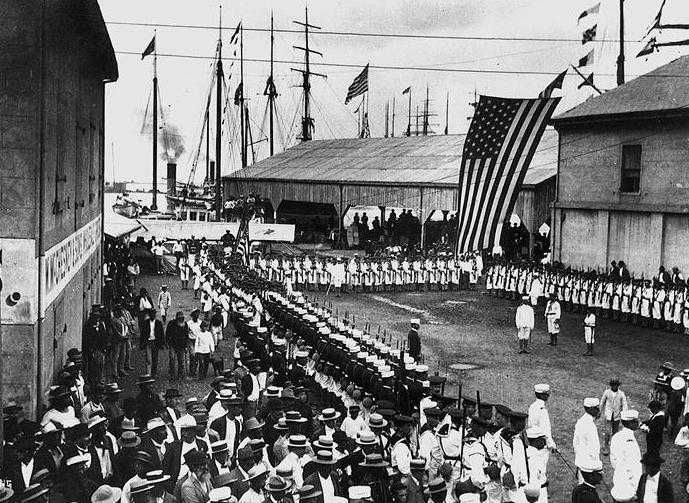
With the rise of expansionist sentiment and a new administration under President William McKinley, the path to annexation became clear. Rather than pursuing a treaty, which would require a two-thirds majority in the Senate (and was likely to fail), annexationists opted for a joint resolution of Congress. The Newlands Resolution was passed by both the House and Senate and signed into law by President McKinley on July 7, 1898. This act formally annexed the Republic of Hawaii to the United States. On August 12, 1898, a formal ceremony was held at ʻIolani Palace, where the Hawaiian flag was lowered and the American flag was raised, officially marking the end of Hawaiian independence.
In 1900, the Organic Act established the Territory of Hawaii, granting its residents U.S. citizenship but without the full rights of statehood. The sugar and pineapple industries flourished under American control, while Pearl Harbor grew into a critical naval base, cementing Hawaii’s military importance in the Pacific.
From Territory to the 50th State
For over half a century, Hawaii remained a territory. The islands’ strategic importance was tragically highlighted on December 7, 1941, when the Japanese attack on Pearl Harbor plunged the United States into World War II. Following the war, the movement for statehood gained significant momentum. Hawaiian residents had proven their loyalty and contribution to the United States, and the argument against “taxation without representation” resonated deeply.
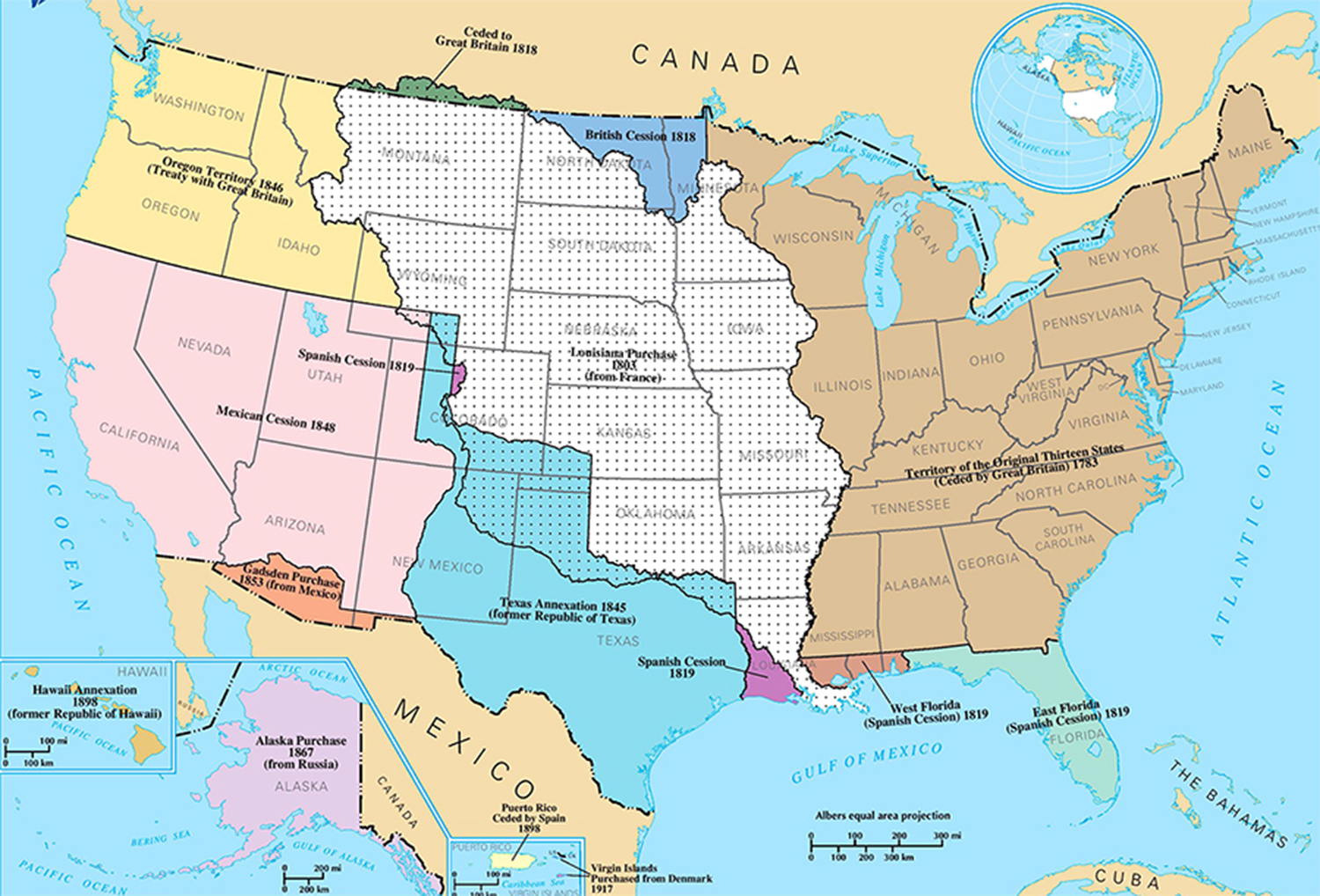
Finally, after years of debate and lobbying, the Hawaii Admission Act was signed into law by President Dwight D. Eisenhower on March 18, 1959. On August 21, 1959, Hawaii officially became the 50th state of the United States of America, concluding a long and tumultuous journey from sovereign kingdom to American state.
Hawaii Today: A Legacy of History and a Paradise for Travelers
Today, the State of Hawaii is a global icon for tourism, attracting millions with its pristine beaches, lush landscapes, vibrant culture, and world-class hospitality. While the islands thrive as a paradise for travelers, the complex history of their acquisition remains a significant part of their identity. Visitors to Hawaii can explore this rich past at numerous landmarks and historical sites.
From the solemn reflection at the Pearl Harbor National Memorial to the regal halls of ʻIolani Palace, the only official residence of a reigning monarch in the United States, the historical narrative is ever-present. Cultural centers across Oahu, Maui, Kauai, and the Big Island offer deep dives into ancient Hawaiian traditions, dance, music, and language, helping to preserve a heritage that persevered through immense change.
Modern Hawaii embraces its dual identity, a unique blend of Polynesian roots and American influence. Resorts like the Grand Hyatt Kauai Resort & Spa or the Four Seasons Resort Maui at Wailea integrate Hawaiian architecture and traditions into their luxurious offerings. Travelers seeking authentic experiences can partake in a traditional luau, learn to surf on the iconic waves of Waikiki, or hike through the volcanic landscapes of Hawaii Volcanoes National Park and Haleakala National Park.
Understanding how the United States acquired Hawaii is more than just learning a chapter of history; it’s about appreciating the resilience of a people, the complexities of international relations, and the enduring spirit of a culture that continues to thrive in the heart of the Pacific. It allows visitors to engage with the islands not just as a picturesque destination, but as a place with a profound and often poignant story.
LifeOutOfTheBox is a participant in the Amazon Services LLC Associates Program, an affiliate advertising program designed to provide a means for sites to earn advertising fees by advertising and linking to Amazon.com. Amazon, the Amazon logo, AmazonSupply, and the AmazonSupply logo are trademarks of Amazon.com, Inc. or its affiliates. As an Amazon Associate we earn affiliate commissions from qualifying purchases.