
The story of how Hawaii became the 50th state of the United States is a complex and fascinating journey, spanning centuries of rich history, political maneuvering, and cultural evolution. More than just a date on a calendar, it’s a narrative deeply interwoven with the islands’ unique identity, its strategic importance, and its enduring appeal as a world-class travel destination. For those planning a trip to this paradise, understanding its past enriches the experience of its vibrant present, where ancient traditions blend seamlessly with modern tourism.
A Journey Through Time: Hawaii’s Path to American Integration
The Hawaiian Islands, a volcanic archipelago isolated in the vast Pacific Ocean, boast a heritage as deep and awe-inspiring as their dramatic landscapes. This history laid the groundwork for the eventual integration into the United States, a process that was neither simple nor swift.
Ancient Roots and European Arrival
Long before any Western contact, the Hawaiian Islands were settled by intrepid Polynesian voyagers, who navigated thousands of miles across the ocean using sophisticated knowledge of stars, currents, and waves. These early settlers brought with them their distinct culture, language, and social structures, establishing a complex system of chiefs and priests, and developing a profound connection to the land and sea. This indigenous culture thrived for centuries, marked by intricate oral traditions, elaborate ceremonies, and a sustainable way of life that shaped the very identity of the islands.
The tranquil isolation of Hawaii was irrevocably altered in 1778 with the arrival of British explorer Captain James Cook. His landing marked the beginning of Hawaii’s exposure to the Western world, opening avenues for trade, but also introducing diseases that decimated the native population. Despite these devastating impacts, Cook’s arrival inadvertently set in motion a series of events that would propel Hawaii onto the global stage. His accounts of the islands and their people sparked European and American interest, eventually leading to increased contact and a gradual shift in the islands’ political and economic landscape.
The Kingdom of Hawaii
Following Captain Cook’s arrival, a powerful and visionary chief named Kamehameha I emerged. Through a series of strategic alliances and decisive battles, he unified the warring island chiefdoms, establishing the Kingdom of Hawaii in 1810. King Kamehameha I proved to be an astute leader, skillfully navigating relations with powerful foreign nations like Great Britain and the United States, ensuring the kingdom’s sovereignty and fostering economic growth. He understood the need to embrace certain aspects of Western technology and governance while striving to preserve Hawaiian culture and independence.
The subsequent monarchs of the Kingdom of Hawaii continued this delicate balancing act. They established a constitutional monarchy, created a legal code, and developed a system of education. The capital city of Honolulu grew into a bustling port, serving as a crucial stop for whaling ships and a center for international trade. This era saw the construction of magnificent structures like Iolani Palace, the only official residence of royalty in the United States, which stands today as a testament to the sophistication and grandeur of the Hawaiian monarchy and is a must-visit landmark for history enthusiasts.
Growing American Influence
As the 19th century progressed, Hawaii’s strategic location in the Pacific Ocean became increasingly important to the United States. American missionaries, primarily from New England, began arriving in the 1820s, bringing with them not only their religious beliefs but also Western education, medicine, and forms of government. While their intentions were often benevolent, their presence undeniably contributed to the erosion of traditional Hawaiian customs and beliefs.
Concurrently, American businessmen, particularly those involved in the lucrative sugar and pineapple industries, started acquiring vast tracts of land. Plantations thrived, drawing in immigrant laborers from China, Japan, Portugal, and the Philippines, creating the diverse cultural mosaic that defines modern Hawaii. These powerful American economic interests, with strong ties to Washington D.C., began to exert considerable political influence over the Hawaiian government. The desire for stability, protection of their investments, and ultimately, integration with the larger American market, fueled their efforts to bring Hawaii into the American fold.
The Overthrow and Annexation: A Tumultuous Transition
The late 19th century marked a period of profound instability for the Kingdom of Hawaii, culminating in events that would forever alter its destiny. This era, marked by political upheaval and external pressures, directly paved the way for American annexation.
The Bayonet Constitution and Queen Liliʻuokalani
By the late 1880s, the power of the Hawaiian monarchy was increasingly challenged by a growing faction of American and European businessmen and residents. These individuals, often descendants of missionaries or wealthy plantation owners, sought greater political control to protect their economic interests. In 1887, they orchestrated a coup, forcing King Kalākaua to sign the “Bayonet Constitution” under duress. This document drastically limited the monarch’s power, disenfranchised most native Hawaiians, and granted voting rights primarily to wealthy foreign landowners. It was a significant blow to Hawaiian sovereignty and a clear indication of the rising foreign dominance.
When Queen Liliʻuokalani ascended to the throne in 1891, she recognized the precarious position of her kingdom. A passionate advocate for her people, she sought to restore power to the monarchy and Hawaiians by drafting a new constitution. Her efforts, however, were met with fierce opposition from the Annexation Club, a group of powerful American residents determined to integrate Hawaii into the United States. Her determination to protect Hawaiian independence made her a formidable, yet ultimately tragic, figure in this chapter of history. Today, the story of Queen Liliʻuokalani resonates deeply with visitors seeking to understand the local culture and history, often explored through visits to cultural centers and historical sites in Honolulu.
The Overthrow of the Monarchy
The conflict between Queen Liliʻuokalani’s attempts to restore Hawaiian sovereignty and the annexationists’ desire for American control reached its climax in January 1893. Supported by the presence of armed U.S. Marines from the USS Boston, the Committee of Safety, composed primarily of American and European businessmen, staged a coup. They declared the monarchy overthrown and established a provisional government, without the consent of the majority of the Hawaiian people. Queen Liliʻuokalani, recognizing the futility of armed resistance and wishing to prevent bloodshed, surrendered under protest, appealing to the United States for justice and restoration of her government.
This act of overthrow sparked a contentious debate within the United States. President Grover Cleveland, upon reviewing the evidence, condemned the actions of the American minister and acknowledged the illegal nature of the overthrow. He even attempted to restore Queen Liliʻuokalani to her throne, but the provisional government in Hawaii, led by Sanford B. Dole, refused to comply.
The Republic of Hawaii and U.S. Annexation
With President Cleveland’s administration unwilling to use force to restore the monarchy, the provisional government declared itself the Republic of Hawaii in 1894, with Sanford B. Dole as its president. This independent republic, however, was explicitly formed with the goal of eventual annexation by the United States.

The political climate in the United States shifted dramatically a few years later. The strategic importance of Hawaii became acutely clear during the Spanish-American War in 1898, as the islands served as a crucial coaling station for American ships en route to the Philippines. This military necessity, coupled with renewed imperialistic fervor, swayed public and political opinion. On July 7, 1898, President William McKinley signed the Newlands Resolution, officially annexing Hawaii as a U.S. territory. Though framed as a mutual agreement, it was a move heavily debated and largely against the wishes of native Hawaiians, who had petitioned against annexation. So, the direct answer to “When did Hawaii become part of the United States?” as a territory is July 7, 1898.
From Territory to Statehood: Solidifying the Bond
Annexation was a significant milestone, but it was not the final step. Hawaii would spend over six decades as a territory before achieving full statehood, a period marked by profound economic development, military build-up, and persistent calls for equal representation.
The Territorial Period and Economic Growth
After annexation, the Organic Act of 1900 established Hawaii as an incorporated territory of the United States, granting its residents U.S. citizenship but without the right to vote in presidential elections or have full congressional representation. This period saw massive expansion of the sugar and pineapple industries, transforming the islands into an agricultural powerhouse. Companies like the Dole Plantation, now a popular tourist attraction on Oahu, symbolized this economic boom.
Crucially, Hawaii’s strategic military importance grew exponentially. The construction of massive naval and army bases, most notably at Pearl Harbor on Oahu, solidified its role as a vital outpost for American power projection in the Pacific Ocean. The influx of military personnel and their families further Americanized the islands, while also highlighting the racial and economic disparities that existed.
World War II and the Push for Statehood
The events of December 7, 1941, when Pearl Harbor was attacked by Japan, profoundly impacted Hawaii’s journey to statehood. The attack thrust Hawaii into the heart of World War II, demonstrating its irreplaceable value to national security. The islands were placed under martial law, and Hawaiian residents, despite being U.S. citizens, often faced discrimination and suspicion.
However, the war also galvanized a stronger push for statehood. Thousands of Hawaiian citizens, many of Asian descent, served valiantly in the U.S. armed forces, proving their loyalty and commitment to the nation. This sacrifice and dedication fueled arguments that Hawaii, with its diverse population and strategic significance, deserved full political equality. The post-war era saw increasing bipartisan support for Hawaiian statehood, viewed as a way to correct historical injustices and strengthen America’s presence in the Pacific.
Hawaii Becomes the 50th State
After decades of petitions, political campaigns, and congressional debates, the dream of statehood finally materialized. On March 12, 1959, the U.S. Congress passed the Hawaii Admission Act, which was then signed into law by President Dwight D. Eisenhower. A plebiscite was held in Hawaii on June 27, 1959, where over 93% of the voters cast their ballot in favor of statehood.
The culmination of this long and intricate process came on August 21, 1959, when President Eisenhower signed a proclamation officially admitting Hawaii into the Union as the 50th state. This date definitively answers the question: “Hawaii became a state of the United States on August 21, 1959.” The event was met with widespread celebration in Hawaii and across the nation, marking a new chapter for the islands.
Hawaii Today: A Beloved Destination and Cultural Gem
Today, Hawaii stands as a testament to its vibrant history and diverse cultural heritage. Its integration into the United States has only amplified its global appeal, drawing millions of visitors each year who come to explore its natural beauty, immerse themselves in its unique culture, and experience its unparalleled hospitality. For those dreaming of a Hawaiian escape, the islands offer an intoxicating blend of adventure, relaxation, and cultural discovery.
Iconic Landmarks and Natural Wonders
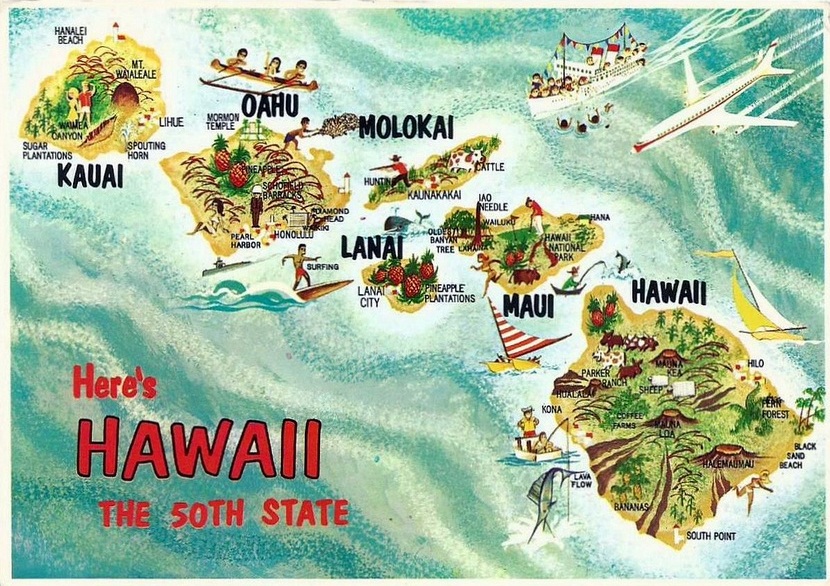
The Hawaiian Islands are renowned for their breathtaking natural beauty and a wealth of iconic landmarks. On Oahu, beyond the historical significance of Pearl Harbor and the USS Arizona Memorial, lies the world-famous Waikiki Beach, a haven for surfers and sun-seekers alike. Dominating the skyline is the volcanic crater of Diamond Head, offering panoramic views of the coastline and Honolulu after a rewarding hike. Further west, the Chinatown, Honolulu district buzzes with historical charm, vibrant markets, and tantalizing food experiences.
Venturing to other islands reveals even more wonders. Maui beckons with the majestic sunrise over Haleakala National Park and the scenic drive along the Road to Hana. Kauai, the “Garden Isle,” enchants with the dramatic cliffs of the Na Pali Coast and the vast Waimea Canyon, often called the “Grand Canyon of the Pacific.” The Big Island of Hawaii offers the unique experience of exploring active volcanoes like Kilauea and stargazing from the summit of Mauna Kea, home to some of the world’s most powerful telescopes. Each island presents its own distinct allure, making Hawaii a destination of endless discovery.
A Mosaic of Cultures and Experiences
Hawaii’s history of migration and cultural exchange has created a wonderfully diverse society, where Hawaiian traditions blend with influences from Asia, Europe, and mainland America. This cultural fusion is evident in everything from the local cuisine, a delightful mix of fresh seafood, Pacific Rim flavors, and traditional Hawaiian dishes, to the vibrant arts and music scene. Visitors can delve into local culture by attending a traditional luau, learning to hula, or exploring museums like the Bishop Museum, which houses an unparalleled collection of Polynesian artifacts.
Whether you’re an adventurer seeking world-class surfing at the North Shore of Oahu, a nature lover exploring the pristine waters of Hanauma Bay, or a food enthusiast eager to sample fresh poke bowls and shave ice, Hawaii offers a range of activities. From luxury travel experiences with private helicopter tours to budget-friendly adventures hiking volcanic trails, the islands cater to every lifestyle and preference. The “Aloha Spirit” — a philosophy of kindness, hospitality, and mutual respect — permeates daily life, making every interaction a memorable one for tourists.
Unforgettable Accommodations and Lifestyle Choices
The accommodation options in Hawaii are as diverse as its landscapes, catering to every type of traveler. From opulent resorts like The Royal Hawaiian, a Luxury Collection Resort on Waikiki Beach or the family-friendly Aulani, A Disney Resort & Spa in Ko Olina, to charming boutique hotels, cozy vacation rentals, and budget-conscious apartments, there is a perfect place to stay for every budget and preference. Many establishments, such as the Hyatt Regency Waikiki Beach Resort and Spa, offer stunning ocean views, world-class amenities, and easy access to attractions.
Travelers can choose from a multitude of experiences: a romantic getaway to Maui’s secluded beaches, an action-packed family trip exploring Oahu’s historical sites and theme parks, or a tranquil long-term stay in a Kailua-Kona villa on the Big Island. Reviews and comparisons of accommodations often highlight unique features, such as proximity to landmarks like the Aloha Tower, access to pristine shores like Hapuna Beach, or immersive cultural activities. Whether you seek luxury travel, an adventurous itinerary, or a peaceful retreat, Hawaii offers the ideal backdrop for creating unforgettable memories, deeply rooted in its captivating past and vibrant present.
In conclusion, Hawaii’s journey to becoming part of the United States was a long and often contentious path, culminating in its annexation as a territory in 1898 and finally achieving statehood on August 21, 1959. This rich history, with its tales of ancient kingdoms, political drama, and cultural resilience, continues to shape the identity of this extraordinary destination. For travelers, understanding this profound heritage only deepens the appreciation for the islands’ unique allure, making a visit to Hawaii an enriching experience that transcends mere tourism.
LifeOutOfTheBox is a participant in the Amazon Services LLC Associates Program, an affiliate advertising program designed to provide a means for sites to earn advertising fees by advertising and linking to Amazon.com. Amazon, the Amazon logo, AmazonSupply, and the AmazonSupply logo are trademarks of Amazon.com, Inc. or its affiliates. As an Amazon Associate we earn affiliate commissions from qualifying purchases.