
The story of Hawaii’s integration into the United States is a complex tapestry woven with threads of exploration, diplomacy, economic ambition, and political upheaval. Far from a simple historical footnote, the annexation of Hawaii marks a pivotal moment that profoundly shaped the islands’ destiny, transforming them from an independent kingdom into a modern-day American state and a world-renowned travel destination. Understanding this history is not merely an academic exercise; it enriches the experience of every visitor, revealing the layers of culture, the significance of iconic landmarks, and the unique lifestyle that defines this Pacific Ocean paradise today.
The question “When was Hawaii annexed?” often elicits a specific date, but the full answer lies in a tumultuous period spanning decades, culminating in a critical summer at the close of the 19th century. This journey explores the vibrant era of the Hawaiian monarchy, the growing foreign influence that ultimately undermined its sovereignty, and the definitive acts that led to its annexation, forever altering its path and establishing the foundation for the enchanting destination we know and love.
The Journey to Annexation: A Kingdom Transformed
The Hawaiian Islands, isolated in the vast Pacific Ocean, thrived for centuries under a sophisticated indigenous culture. Their unique societal structure and deep connection to the land persisted largely untouched by the outside world until the late 18th century.
Early Encounters and the Rise of the Monarchy
The first documented European contact with Hawaii occurred in 1778, when British explorer Captain James Cook stumbled upon the archipelago. His arrival initiated an era of increasing interaction with Western powers, forever changing the trajectory of the islands. Despite initial conflicts and Cook’s eventual demise, the Hawaiians quickly adapted, integrating Western technology and ideas into their society. This period saw the meteoric rise of King Kamehameha I, a visionary leader who, through strategic alliances and military prowess, unified the warring chiefdoms of the islands into a single, sovereign entity: the Kingdom of Hawaii, by 1810.
Under the Kamehameha dynasty, the Kingdom of Hawaii flourished, establishing itself as a recognized nation-state with its own flag, currency, and diplomatic relations with major global powers. The monarchy built strong ties with the United States and European nations, becoming a vital stop for whaling ships and a strategic outpost in the Pacific Ocean’s burgeoning trade routes. This early period of independence fostered a rich cultural identity that visitors still encounter today, from the reverence for ancient sites to the enduring spirit of aloha.
Increasing Foreign Influence and Internal Strife
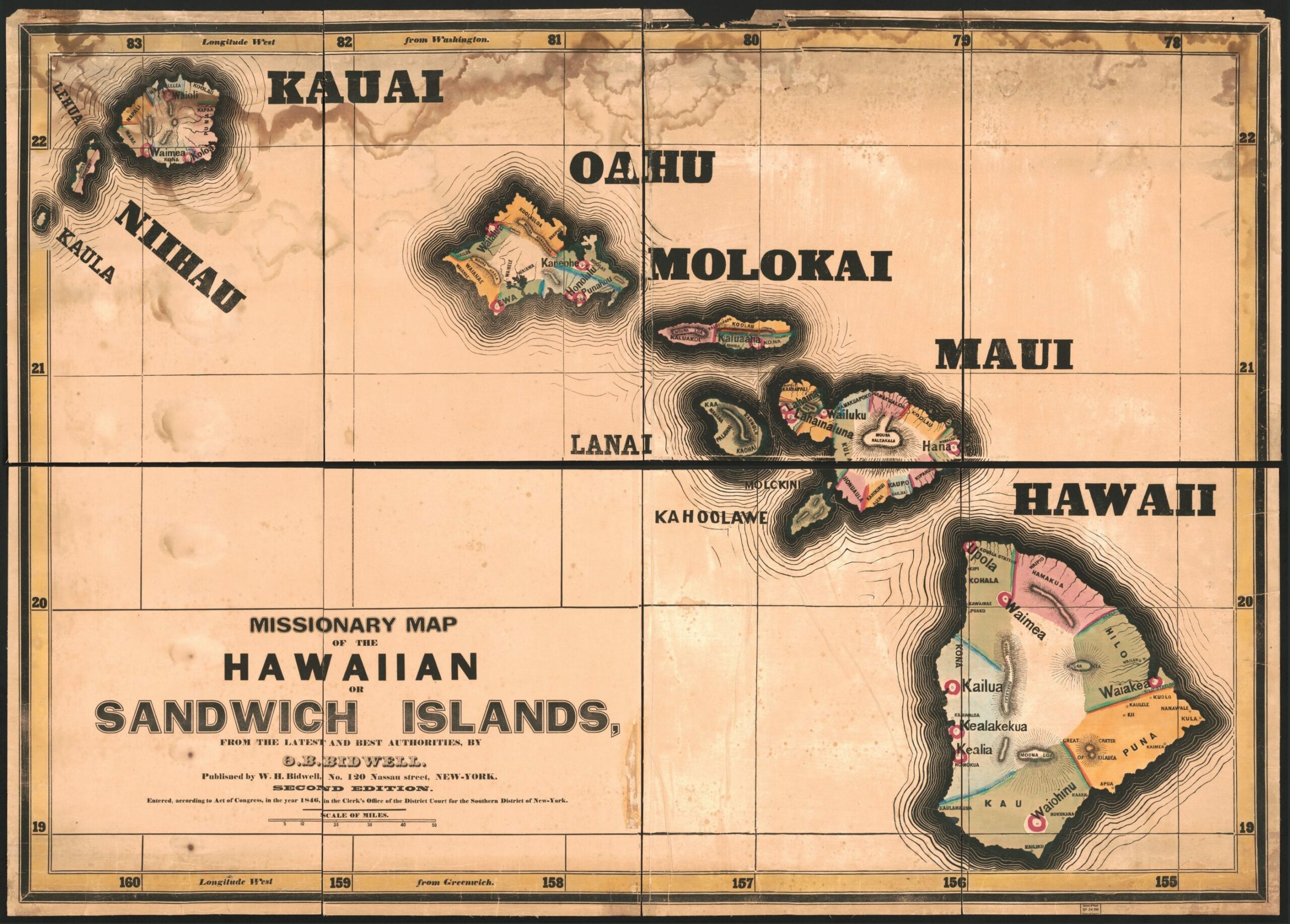
As the 19th century progressed, the idyllic existence of the Kingdom of Hawaii faced increasing pressure from foreign interests, particularly from the [United States](https://lifeoutofthebox.com/united states). American missionaries arrived, bringing Christianity and Western education, while entrepreneurs, primarily sugar planters, saw immense economic potential in Hawaii’s fertile lands. These American residents, many of whom became powerful landowners and business figures, began to exert considerable political influence within the kingdom.
The economic ties deepened significantly with the Reciprocity Treaty of 1875, which allowed Hawaiian sugar to enter the United States duty-free, bolstering the islands’ sugar industry. However, this economic dependence also gave American planters greater leverage. Their growing power culminated in the “Bayonet Constitution” of 1887. This document, imposed on King Kalākaua under duress by a militia of armed, non-Hawaiian businessmen and citizens, severely curtailed the monarch’s power, transferred much authority to the cabinet, and disenfranchised many native Hawaiians and Asian immigrants by establishing property and literacy qualifications for voting. This pivotal moment drastically shifted power away from the monarchy and towards a white, American-dominated elite, setting the stage for the dramatic events that would follow.
The Overthrow of the Monarchy and the Republic
The erosion of monarchical power and the increasing foreign dominance ignited a fierce struggle for Hawaiian sovereignty, led by the last reigning monarch.
Queen Liliuokalani’s Fight for Sovereignty
Upon her accession to the throne in 1891, Queen Liliuokalani inherited a kingdom in crisis. A strong and determined leader, she understood the immense pressure her nation was under and dedicated herself to restoring the power of the monarchy and the rights of her people. Her primary goal was to promulgate a new constitution that would replace the humiliating Bayonet Constitution, thereby restoring voting rights to native Hawaiians and diminishing the influence of foreign (primarily American) businessmen.
Queen Liliuokalani’s attempts to assert Hawaiian sovereignty were met with fierce opposition from the “missionary party” — a powerful bloc of American and European residents who controlled much of Hawaii’s wealth and political machinery. They viewed her efforts as a threat to their economic interests and their ultimate goal: annexation by the United States. Her courageous stand for her people’s self-determination is remembered today at landmarks like Iolani Palace in Honolulu, the only official residence of royalty in the United States, which stands as a poignant reminder of Hawaii’s regal past.
The Coup d’état and the Provisional Government
The conflict between the Queen and the annexationist faction reached its boiling point in January 1893. On January 17, a group of primarily American and European residents, calling themselves the Committee of Safety, initiated a coup d’état. They claimed to be protecting American lives and property, and, significantly, were aided by the landing of US Marine troops from the USS Boston, ostensibly for that very purpose. While the US Minister to Hawaii, John L. Stevens, denied direct involvement, the presence of armed American troops effectively intimidated the royal forces and prevented any resistance.
Facing superior force and hoping to avoid bloodshed, Queen Liliuokalani reluctantly surrendered her authority under protest, appealing to the United States government for justice. The Committee of Safety quickly established a Provisional Government of Hawaii, with Sanford B. Dole, an American lawyer and judge who had lived in Hawaii, as its president. Dole, a staunch proponent of annexation, immediately sought to bring Hawaii into the United States.

However, not all in the United States supported this move. President Grover Cleveland, upon reviewing the circumstances of the overthrow, condemned it as an illegal act perpetrated by American citizens with the tacit support of US military forces. He called for the restoration of the monarchy and refused to consider annexation, sending a clear signal that the actions of the Provisional Government of Hawaii were illegitimate.
The Republic of Hawaii
Despite President Grover Cleveland’s opposition, the Provisional Government of Hawaii persisted. When it became clear that the United States Congress would not act to restore the monarchy, the provisional government moved to solidify its power. On July 4, 1894, they formally established the Republic of Hawaii, with Sanford B. Dole continuing as its president.
This new republic, though internationally recognized, was largely controlled by the same small group of wealthy, non-native businessmen who had orchestrated the overthrow. It maintained a strong pro-annexation stance, relentlessly lobbying Washington D.C. to accept Hawaii into the United States. This period of the Republic of Hawaii represented a crucial interim phase, a political holding pattern until the opportune moment for annexation could arise. It highlights the determination of the annexationists and the complex geopolitical forces at play that would eventually lead to the formal absorption of the islands.
The Moment of Annexation: Joining the United States
The question “When was Hawaii annexed?” specifically points to the legal and official act of its integration into the United States. This critical moment was largely influenced by shifting political tides in Washington and the strategic implications of a global conflict.
A Shifting Political Landscape
The annexation of Hawaii gained renewed momentum with the election of William McKinley as President of the United States in 1896. Unlike his predecessor, Grover Cleveland, President William McKinley was an ardent expansionist and a strong supporter of acquiring Hawaii. The strategic value of the islands, particularly for naval and commercial purposes, became increasingly apparent as the United States looked beyond its continental borders.
The decisive factor that pushed annexation forward was the outbreak of the Spanish-American War in April 1898. During this conflict, Hawaii’s geographical position transformed it into an indispensable coaling station and naval base for American forces en route to the Philippines. The war underscored the military and economic advantages of having a secure foothold in the mid-Pacific Ocean, bolstering the arguments of annexation proponents who emphasized national security and strategic projection of power.
The Newlands Resolution
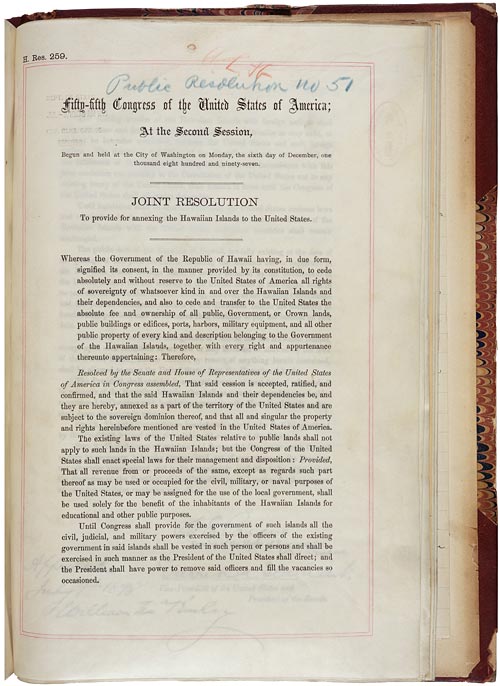
With the political will aligned and a compelling strategic rationale provided by the Spanish-American War, the path to annexation was cleared. Rather than a treaty, which would have required a two-thirds majority vote in the Senate and faced significant opposition due to the controversial circumstances of the monarchy’s overthrow, Congress opted for a joint resolution.
On July 7, 1898, President William McKinley signed the Newlands Resolution, effectively annexing the Republic of Hawaii to the United States. This legislative act formally incorporated the islands into American territory. The actual transfer of sovereignty took place on August 12, 1898, with a ceremony at Iolani Palace where the Hawaiian flag was lowered and the American flag was raised. This date, August 12, 1898, is the precise answer to “When was Hawaii annexed?”, marking the official end of its status as an independent nation and the beginning of its new chapter as an American territory.
The annexation was met with mixed reactions. While celebrated by the annexationists and many in the United States, it was a somber day for native Hawaiians and loyalists of the monarchy, who viewed it as an illegitimate act of theft and a betrayal of their sovereignty. This unresolved tension and the memory of the fallen kingdom remain a powerful undercurrent in Hawaiian culture and politics even today.
Hawaii’s Evolution: Territory to Statehood and a Modern Paradise
Following the annexation, Hawaii embarked on a new trajectory, evolving from a strategic outpost to a fully integrated part of the American Union, shaping its unique appeal as a global travel destination.
The Territorial Years and World War II
After its annexation, Hawaii was organized into the Territory of Hawaii on June 14, 1900, establishing a territorial government with a governor appointed by the US President. During this period, the islands experienced significant economic growth, driven by the expanding sugar and pineapple industries, which attracted a diverse immigrant population from Asia and other parts of the world. This influx further diversified Hawaii’s already rich cultural mosaic.
Militarily, the Territory of Hawaii became an increasingly vital strategic asset for the United States, primarily due to its pivotal naval base at Pearl Harbor on the island of Oahu. The strategic importance of Pearl Harbor was tragically underscored on December 7, 1941, when it became the target of a surprise attack by the Imperial Japanese Navy, marking the United States’ entry into World War II. The attack and the subsequent war years deeply integrated Hawaii into the American national consciousness, solidifying its place as an essential part of the nation’s defense and identity. The memory of this event is powerfully preserved at the USS Arizona Memorial at Pearl Harbor, a solemn and vital landmark for visitors today.
The Road to Statehood
In the aftermath of World War II, the movement for Hawaiian statehood gained significant momentum. Decades of economic and social integration, coupled with the islands’ patriotic contributions during the war, strengthened the argument that Hawaii deserved full representation in the United States Congress. After years of advocacy, debate, and several congressional hearings, the necessary legislation was finally passed.
On March 12, 1959, the United States Congress passed the Hawaii Admission Act, which President Dwight D. Eisenhower signed into law. Following a popular vote in Hawaii where residents overwhelmingly approved statehood, President Eisenhower officially signed the proclamation admitting Hawaii to the Union. Thus, on August 21, 1959, Hawaii officially became the 50th state of the United States, marking the final political transformation of the islands and cementing their place in the American fabric.
The Enduring Legacy: Hawaii as a Global Travel Destination
The long and intricate journey of Hawaii from an independent kingdom to a US state has profoundly shaped its identity, making it one of the world’s most unique and cherished travel destinations. This history isn’t just confined to textbooks; it’s woven into the very fabric of the islands, enriching the experiences of millions of visitors each year.
Historical Landmarks and Cultural Preservation
For travelers, Hawaii’s history provides an unparalleled backdrop for exploration. Travel and Tourism to Hawaii are deeply intertwined with its past. Iconic Landmarks such as Iolani Palace offer a direct window into the grandeur of the Hawaiian monarchy and the somber moments of its overthrow. The USS Arizona Memorial at Pearl Harbor stands as a powerful testament to World War II and Hawaii’s role in American history, drawing millions annually for a reflective and educational experience.
Beyond these tangible sites, the legacy of annexation has spurred significant efforts in Local Culture preservation. Native Hawaiian language, hula, traditional arts, and ancient customs are actively promoted and revived, creating authentic Experiences for visitors. The Polynesian Cultural Center on Oahu, for example, offers immersive insights into the diverse cultures of Polynesia, including that of Hawaii. The vibrant Food scene in Hawaii is also a testament to its multicultural history, blending traditional Hawaiian flavors with Asian, American, and other global influences, offering a culinary journey as diverse as its people.
Modern Hawaii: A Blend of History and Hospitality
Today, Hawaii stands as a beacon of natural beauty and cultural richness, offering a diverse array of Destinations and Attractions. Honolulu, the capital, pulsates with urban energy and historical charm. The world-famous Waikiki Beach on Oahu combines stunning natural beauty with luxurious Accommodation and vibrant Lifestyle options. Hiking to the summit of Diamond Head Crater offers panoramic views and a connection to the island’s volcanic origins.
Beyond Oahu, other islands like Maui, Kauai, and Hawaii Island (often called the Big Island) offer their own unique allure, from the lush rainforests of Kauai to the active volcanoes of Kilauea on Hawaii Island. The range of Accommodation options reflects this diversity, from opulent Luxury Travel resorts like the Four Seasons Resort Oahu at Ko Olina or the Grand Hyatt Kauai Resort & Spa, which seamlessly blend modern amenities with Hawaiian-inspired design, to charming boutique hotels, vacation rentals, and even Budget Travel options.
The Lifestyle in Hawaii is one of unparalleled beauty and relaxed sophistication, catering to everything from romantic honeymoons and adventurous family trips to serene wellness retreats and thriving Business Stays. For responsible Tourism, understanding the historical context of Hawaii’s annexation and its subsequent journey not only enriches the visitor’s experience but also fosters a deeper appreciation for the resilience of its people and the preservation of its precious heritage. The islands invite travelers not just to witness their beauty, but to engage with a history that continues to shape their vibrant present.
In conclusion, the annexation of Hawaii on August 12, 1898, was a defining moment in its history, concluding centuries of independent monarchy and initiating a new era as part of the United States. This complex past has forged a destination unlike any other, where the echoes of royalty, the scars of war, and the spirit of aloha converge to create an unforgettable experience for every traveler seeking to explore its breathtaking landscapes, immerse in its rich culture, and enjoy its world-class hospitality.
LifeOutOfTheBox is a participant in the Amazon Services LLC Associates Program, an affiliate advertising program designed to provide a means for sites to earn advertising fees by advertising and linking to Amazon.com. Amazon, the Amazon logo, AmazonSupply, and the AmazonSupply logo are trademarks of Amazon.com, Inc. or its affiliates. As an Amazon Associate we earn affiliate commissions from qualifying purchases.