
The story of Texas‘s independence from Mexico is a captivating saga of cultural clashes, determined resistance, heroic sacrifices, and ultimately, the birth of a nation. For travelers exploring the vast and vibrant landscapes of the Lone Star State, understanding this pivotal period is essential to appreciating its unique identity, rich heritage, and numerous historical landmarks. On March 2, 1836, delegates gathered at Washington-on-the-Brazos declared Texas an independent republic, severing ties with Mexico and setting it on a remarkable path towards sovereignty, and eventually, statehood within the United States. This declaration was not merely a political act; it was the culmination of decades of simmering tensions, revolutionary fervor, and the unwavering resolve of those who sought to forge their own destiny.
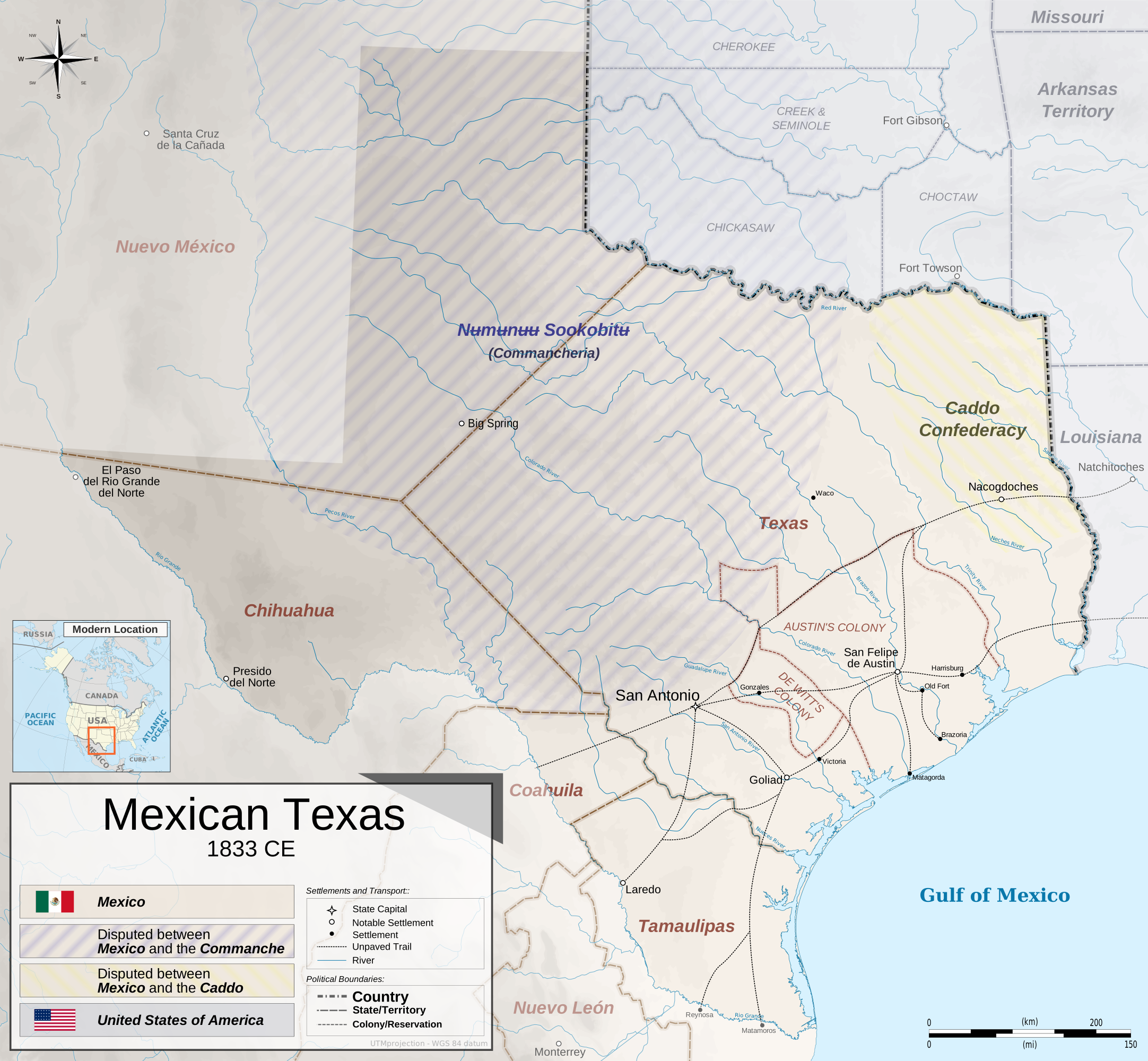
This historical journey offers more than just dates and names; it provides a framework for understanding the deep-rooted cultural fabric that defines Texas today. From the bustling streets of Houston to the historic charm of San Antonio, remnants of this struggle and the subsequent era of the Republic of Texas are woven into the very landscape. For those planning a trip, exploring these historical sites offers an unparalleled opportunity for immersive tourism, connecting visitors directly with the events that shaped this extraordinary region.
The Road to Revolution: A Clash of Cultures and Ambitions
The seeds of the Texas Revolution were sown long before any shots were fired, stemming from a complex interplay of immigration, governance, and irreconcilable cultural differences between Anglo-American settlers and the Mexican government. Understanding these foundational elements is key to grasping why independence became an inevitable conclusion for many.
Early Settlements and Mexican Governance
Following Mexico’s own independence from Spain in 1821, its vast northern frontier, particularly Texas, remained sparsely populated and vulnerable to Native American raids. To encourage development and create a buffer zone, the Mexican government adopted an empresario system, granting land contracts to individuals who would bring settlers to the region. The most famous of these empresarios was Stephen F. Austin, who in 1825 brought the first 300 Anglo-American families, famously known as the “Old Three Hundred,” to settle along the Brazos River. These settlers were attracted by generous land grants, fertile soil, and the promise of a new beginning, far from the economic downturns affecting parts of the United States.
Initially, this arrangement was mutually beneficial. The settlers swore allegiance to Mexico, agreed to convert to Catholicism (though many merely paid lip service to this requirement), and learned to navigate the Mexican legal system. Texas was administratively merged with the state of Coahuila to form Coahuila y Tejas, and settlers enjoyed a degree of autonomy that allowed their communities to flourish. However, the cultural and linguistic divides, though initially manageable, would eventually prove to be insurmountable.
Seeds of Discontent and Growing Tensions
As more Anglo-American settlers poured into Texas – by 1830, they outnumbered Tejanos (Mexicans living in Texas) by a significant margin – friction began to mount. The settlers brought with them their Anglo-Saxon legal traditions, Protestant faiths, and a reliance on enslaved labor, all of which clashed with Mexican law and cultural norms. Mexico had outlawed slavery, albeit with some loopholes, a policy that was deeply unpopular with the largely Southern American immigrants.
Furthermore, Mexico’s political landscape was unstable, with frequent changes in government and a growing trend towards centralization. In 1830, concerned by the influx of American settlers and their growing distinctiveness, Mexico passed the Law of April 6, 1830, which effectively halted further immigration from the United States, cancelled unfulfilled empresario contracts, and imposed customs duties on goods from the U.S., among other restrictions. This law was a direct affront to the settlers’ economic interests and their perceived rights.
The situation escalated dramatically when General Antonio López de Santa Anna seized power in Mexico, abolished the federalist constitution of 1824, and established a centralized dictatorship. This move stripped states, including Coahuila y Tejas, of their autonomy and alarmed settlers who had come to value their self-governance. Appeals for separate statehood for Texas were rejected, and Stephen F. Austin himself was imprisoned in Mexico City for attempting to negotiate such changes. By 1835, the stage was set for armed conflict, as many Texans felt their petitions and diplomatic efforts had been exhausted.
The Texas Revolution Ignites: Key Battles and Declarations
The shift from political protest to armed rebellion was swift, marked by iconic battles that forged a new identity and a desperate determination for independence. These events, though often tragic, solidified the Texan resolve to break free.
The Spark of Conflict: From Gonzales to San Antonio
The first shots of the Texas Revolution were fired on October 2, 1835, in the town of Gonzales. Mexican soldiers were sent to reclaim a small cannon that had been given to the settlers for defense against Native Americans. The Texans, however, famously refused, hoisting a flag emblazoned with a cannon and the defiant slogan, “Come and Take It.” This skirmish, known as the Battle of Gonzales, is widely regarded as the start of the revolution.
Following this initial confrontation, Texian forces, a mix of Anglo-American volunteers and Tejanos, began to organize and achieve early victories. They captured Goliad in October and, after a prolonged siege, forced a Mexican surrender at San Antonio in December 1835. These early successes fueled optimism and solidified the notion that a small, determined force could stand against the Mexican army.
The Siege of the Alamo and the Goliad Massacre
However, Santa Anna was not to be underestimated. Enraged by the Texian victories, he personally led a massive army north to crush the rebellion. His first major objective was San Antonio, where a small force of Texian defenders occupied the former mission-turned-fortress, the Alamo. For 13 days, from February 23 to March 6, 1836, fewer than 200 Texians, including legends like Davy Crockett and James Bowie, bravely defended the Alamo against thousands of Mexican soldiers. The siege culminated in a brutal final assault, leaving all the Texian defenders dead.
Just weeks later, another tragic event unfolded at Goliad. Colonel James Fannin and his approximately 400 men were captured by Mexican forces after the Battle of Coleto Creek. Despite surrendering with the expectation of being treated as prisoners of war, Santa Anna ordered their execution, resulting in the brutal Goliad Massacre on March 27, 1836. These devastating defeats, though heavy blows, ignited an even fiercer resolve among the remaining Texians, who rallied behind the cries of “Remember the Alamo! Remember Goliad!”
Birth of a Nation: The Declaration of Independence
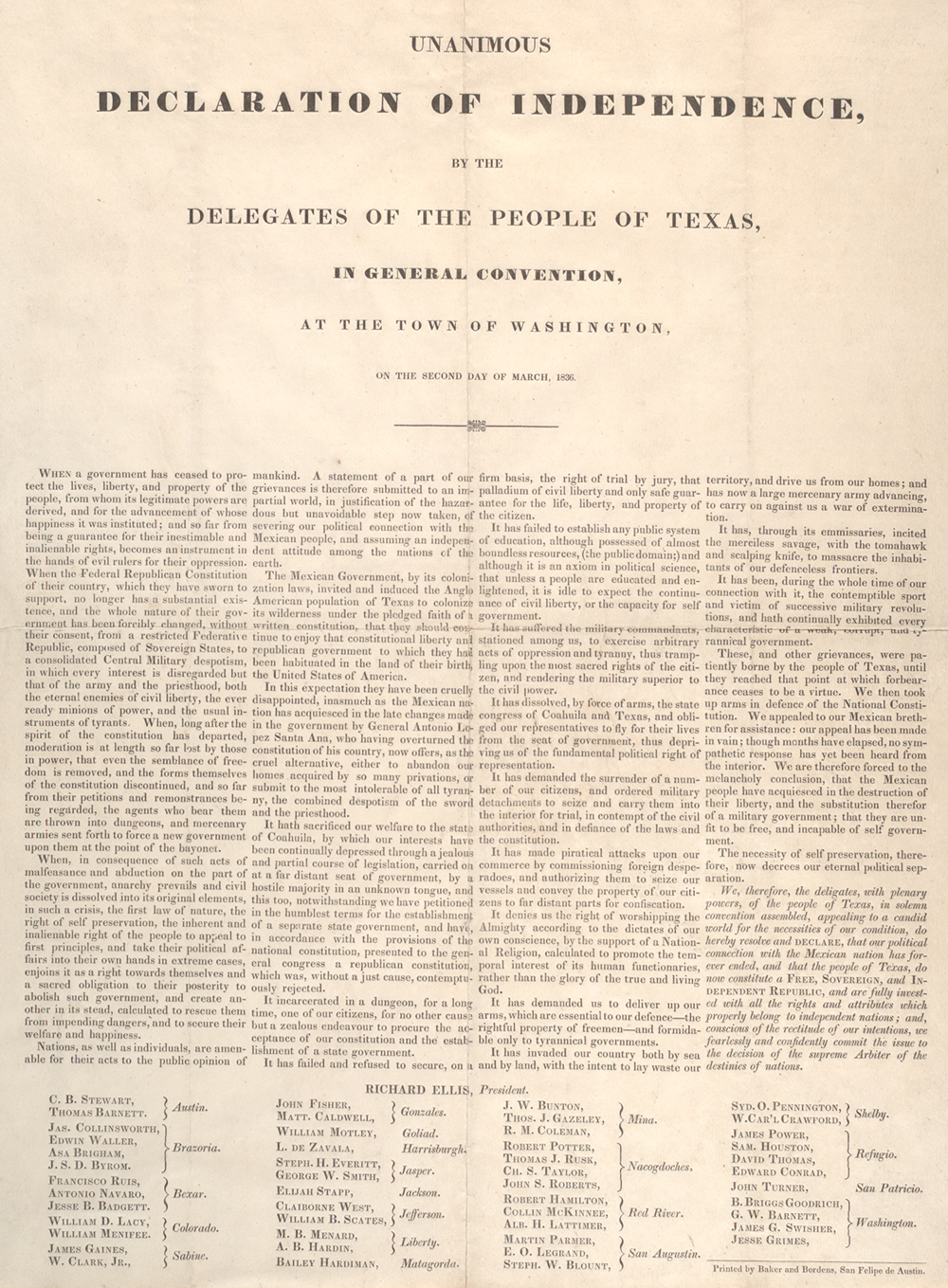
Amidst these grim battles, a political movement was also underway. On March 1, 1836, delegates convened at Washington-on-the-Brazos, a hastily constructed settlement far from the fighting. These 59 delegates, representing various parts of Texas, knew the gravity of their task. The very next day, March 2, 1836, they adopted the Texas Declaration of Independence.
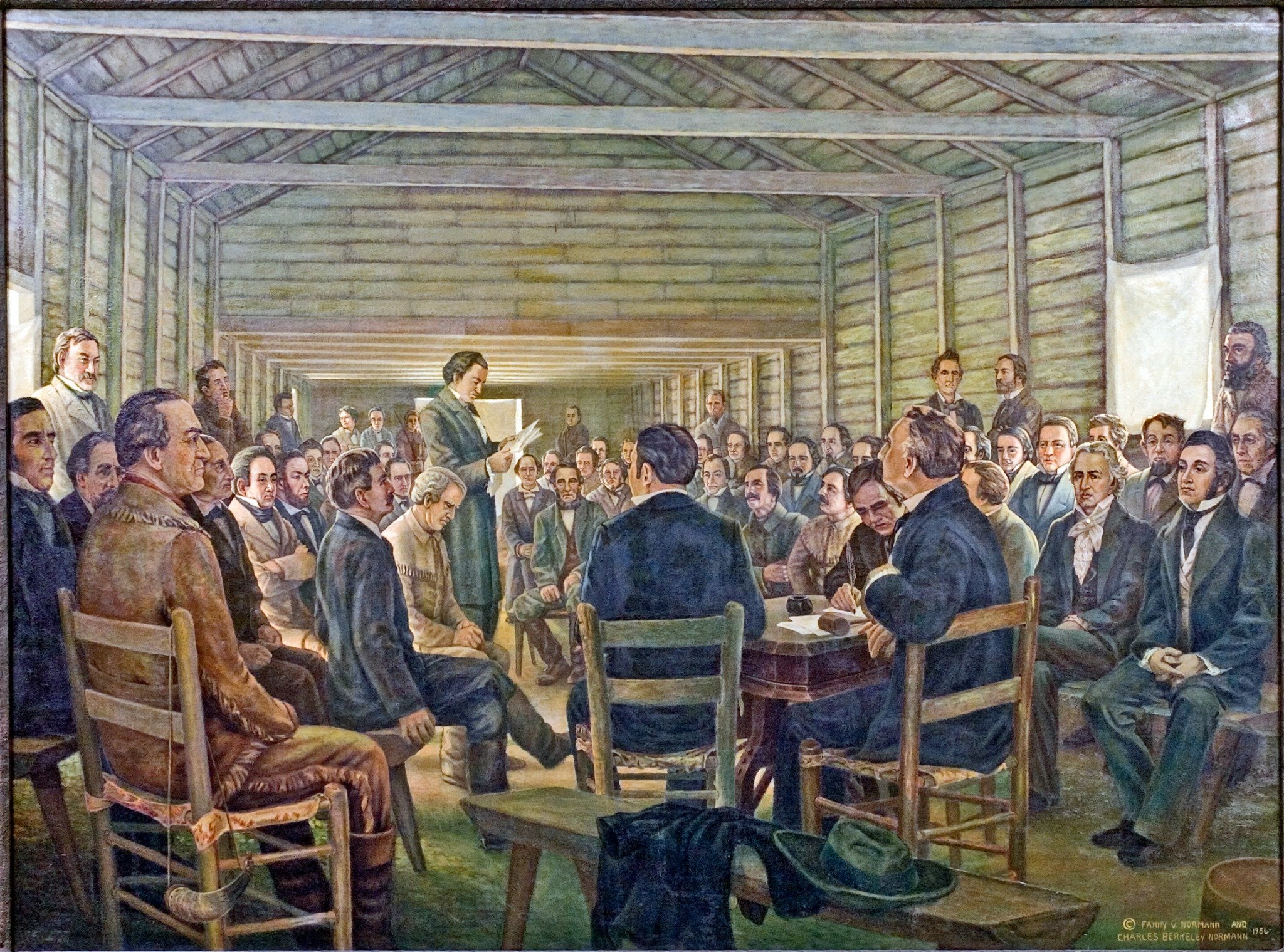
Modeled closely after the United States Declaration of Independence, the Texas document eloquently listed grievances against the Mexican government, particularly Santa Anna’s tyrannical rule and the abrogation of constitutional rights. It declared Texas a free and independent republic, officially severing all political ties with Mexico. While the declaration was a bold act of sovereignty, its ultimate success hinged on the Texian forces’ ability to defeat Santa Anna’s army on the battlefield. An interim government was quickly established, appointing David G. Burnet as interim president and Sam Houston as commander-in-chief of the Texian Army.
Victory at San Jacinto and the Birth of the Republic
The declaration of independence was a powerful statement, but it was the dramatic and decisive victory at San Jacinto that cemented Texas’s claim to freedom and ushered in a decade of self-governance.
Sam Houston’s Strategic Retreat and Decisive Victory
Following the disasters at the Alamo and Goliad, the Texian cause seemed dire. Sam Houston, with a relatively small and ill-equipped army, made the controversial decision to retreat eastward, drawing Santa Anna’s forces further into Texas and away from his supply lines. This period, known as the “Runaway Scrape,” saw thousands of civilians flee alongside Houston’s army, fearing the wrath of the Mexican forces. Despite criticism, Houston’s strategy was calculated. He aimed to train his raw recruits, deplete the enemy’s resources, and await the opportune moment to strike.
That moment arrived on April 21, 1836. Santa Anna, confident of victory and perhaps complacent, had divided his forces and encamped near the San Jacinto River without proper sentries. Houston seized the initiative, launching a surprise attack on the Mexican camp in the late afternoon. With cries of “Remember the Alamo! Remember Goliad!”, the Texian Army, numbering around 900 men, overwhelmed Santa Anna’s force of approximately 1,200 in a battle lasting only 18 minutes. The victory was astonishingly decisive, with hundreds of Mexican soldiers killed, wounded, or captured, while the Texian casualties were minimal.
The Capture of Santa Anna and the Treaties of Velasco
The day after the battle, Santa Anna himself was discovered hiding in the tall grass and captured. His capture proved to be the turning point that secured Texas’s independence. Held captive, Santa Anna was forced to sign the Treaties of Velasco on May 14, 1836. There were two treaties: a public treaty that declared an end to hostilities and stipulated the withdrawal of Mexican troops south of the Rio Grande, and a secret treaty in which Santa Anna agreed to lobby the Mexican government to recognize Texas’s independence.
While Mexico later repudiated the treaties, arguing that a captive president had no authority to sign such agreements, the practical effect was that Mexican forces retreated, leaving Texas free to establish its independent government. The Battle of San Jacinto definitively secured the de facto independence that the declaration had proclaimed.
The Republic of Texas: A Decade of Sovereignty (1836-1845)
With independence secured, Texas embarked on a ten-year journey as the Republic of Texas. Sam Houston was overwhelmingly elected its first president. The new republic faced immense challenges: an empty treasury, continued threats from Mexico (which refused to acknowledge its independence), diplomatic struggles for international recognition, and ongoing conflicts with Native American tribes.
Despite these hurdles, the republic established its government, developed its legal system, and began to attract new settlers. Mirabeau B. Lamar, Houston’s successor, pursued more aggressive policies, particularly against Native Americans and towards asserting Texas’s territorial claims. Throughout its existence, annexation by the United States was a constant debate, complicated by the issue of slavery and potential war with Mexico. Ultimately, on December 29, 1845, Texas officially became the 28th state of the United States, bringing an end to its decade as an independent nation.
Legacy and Lasting Impact: Exploring Independent Texas Today
The struggle for independence and the subsequent era of the Republic of Texas left an indelible mark on the state, shaping its culture, landscape, and identity. For modern travelers, this rich history provides a compelling narrative that enhances any visit to Texas, offering deep insights into its character.
Historic Landmarks and Museums: A Traveler’s Guide
Today, numerous sites across Texas allow visitors to walk in the footsteps of those who fought for independence. A trip focusing on these landmarks is a true journey through time:
- The Alamo: Located in downtown San Antonio, the Alamo is undoubtedly the most iconic symbol of the revolution. Visitors can explore the historic mission, its beautiful grounds, and the museum that tells the story of its heroic defenders. It’s a powerful and poignant experience.
- San Jacinto Battleground State Historic Site: Situated near Houston, this site commemorates the decisive victory that secured independence. The towering San Jacinto Monument offers panoramic views from its observation deck, and the adjacent museum provides detailed exhibits on the battle and the Republic of Texas.
- Washington-on-the-Brazos State Historic Site: Known as the “Birthplace of Texas,” this site allows visitors to see where the Declaration of Independence was signed. Reconstructed buildings, including Independence Hall and the Anson Jones Museum, provide an immersive look at the convention and the lives of the early settlers.
- Goliad State Park and Historic Site: Here, travelers can visit the reconstructed Mission Espíritu Santo and the Presidio La Bahía, where Fannin’s men were held before the massacre. The site offers a somber yet important reflection on the sacrifices made during the revolution.
- Texas State History Museum (Austin): In the state capital, the Bullock Texas State History Museum offers comprehensive exhibits spanning thousands of years, with significant sections dedicated to the revolution and the republic era.
- The Texas Republic Museum (Nacogdoches): Located in the historic eastern Texas town of Nacogdoches, this museum delves into the local context of the revolution and the subsequent years.
For those planning their travel, these destinations offer not just historical insights but also opportunities to explore vibrant cities and serene natural landscapes. Many hotels and resorts in San Antonio, Houston, and Austin are conveniently located near these landmarks, providing luxurious accommodations or charming boutique experiences for history enthusiasts.
Experiencing Texan Culture and Heritage
The legacy of Texas’s independence extends far beyond historical sites; it permeates the very fabric of Texan culture. The state’s fierce independent spirit, its blend of Southern hospitality, Western grit, and deep Mexican roots, are all direct results of this formative period.
Travelers can experience this heritage through:
- Culinary Delights: Tex-Mex cuisine, a fusion born from the cultural intermingling, is a prime example. From authentic tacos and enchiladas to the iconic chili con carne, food tells a story of cultural exchange and adaptation. BBQ, a staple across the state, often evokes the rugged individualism tied to Texan identity.
- Festivals and Events: Throughout the year, communities across Texas host festivals celebrating its unique history, often featuring reenactments, traditional music, and dance that harken back to the days of the republic. March 2nd, Texas Independence Day, is celebrated with particular fervor.
- Music and Arts: From country music to Tejano sounds, the music of Texas reflects its diverse heritage. Live music venues in Austin and Dallas frequently showcase this rich tapestry.
- The “Six Flags Over Texas” Identity: While the theme park of the same name is a popular attraction, the phrase itself refers to the six governments whose flags have flown over Texas – Spain, France, Mexico, the Republic of Texas, the United States, and the Confederate States of America. This historical journey underscores the profound sense of place and identity that Texans hold dear.
In conclusion, Texas officially gained independence from Mexico on March 2, 1836, with the signing of the Declaration of Independence at Washington-on-the-Brazos. This date marks the culmination of a dramatic struggle that shaped not only the political destiny of the region but also forged the enduring spirit and unique culture of the state. For any traveler seeking an authentic and enriching experience, delving into this history is an essential part of exploring the heart and soul of Texas. From the hallowed grounds of the Alamo to the monumental victory site of San Jacinto, the echoes of independence resonate, inviting visitors to connect with a truly extraordinary past that continues to define the present.
LifeOutOfTheBox is a participant in the Amazon Services LLC Associates Program, an affiliate advertising program designed to provide a means for sites to earn advertising fees by advertising and linking to Amazon.com. Amazon, the Amazon logo, AmazonSupply, and the AmazonSupply logo are trademarks of Amazon.com, Inc. or its affiliates. As an Amazon Associate we earn affiliate commissions from qualifying purchases.