
Embarking on a Southern California adventure often involves a strategic decision: how to best experience the magic of both [Disneyland Resort] and [Universal Studios Hollywood]? For many families and theme park enthusiasts, these two iconic destinations are high on the itinerary. Understanding the geographical relationship between them is crucial for efficient planning, transportation, and maximizing your time in the Golden State. This guide delves into the distance, travel times, and key considerations for navigating between these world-renowned attractions.
Understanding the Distance: A Tale of Two Southern California Icons
The question of “how far” is more than just mileage; it encompasses travel time, traffic patterns, and the most efficient modes of transit. [Disneyland Resort] is nestled in the heart of [Anaheim], Orange County, a sprawling entertainment complex synonymous with classic Disney magic. In contrast, [Universal Studios Hollywood] is located in the San Fernando Valley area of [Los Angeles], a city known for its film industry heritage and diverse attractions. While both are quintessential Southern California experiences, they are separated by a significant, yet manageable, distance.
The Kilometers and Miles Between Anaheim and Los Angeles
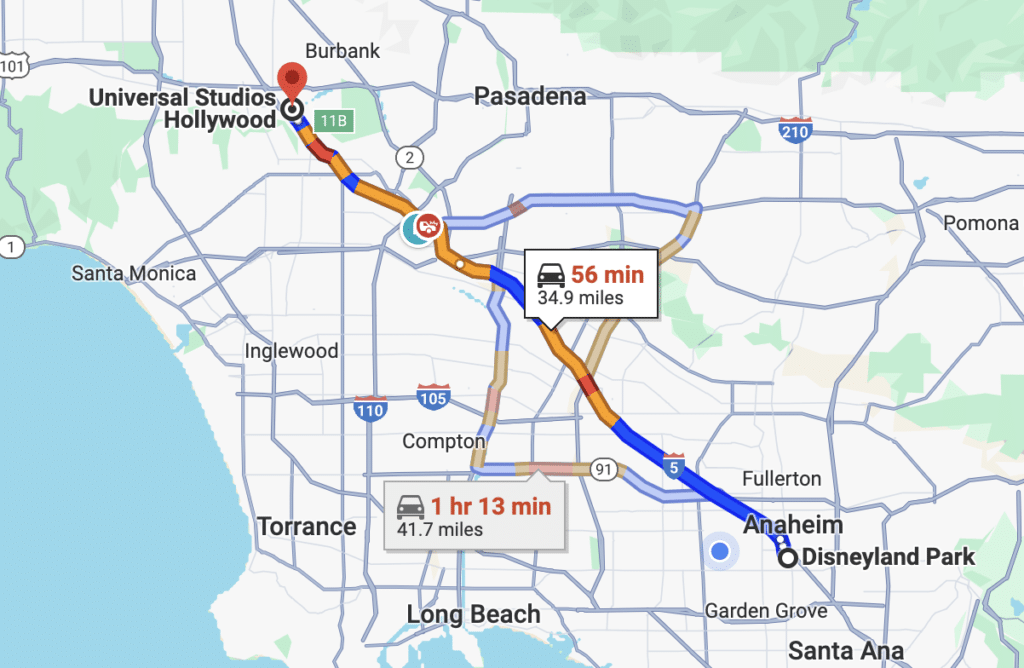
The direct distance between [Disneyland Resort] in [Anaheim] and [Universal Studios Hollywood] in [Los Angeles] is approximately 40 to 50 miles (65 to 80 kilometers), depending on the specific starting and ending points within each complex. This distance places them within the broader Southern California metropolitan area, but far enough apart that spontaneous travel between them without prior planning is not ideal. The journey primarily traverses major freeways, which can be subject to significant traffic, especially during peak hours.
Factors Influencing Travel Time
Several factors significantly influence the actual time it takes to travel between [Disneyland Resort] and [Universal Studios Hollywood]:
- Time of Day: This is arguably the most critical factor. Traveling during rush hour (typically 6 AM to 10 AM and 3 PM to 7 PM on weekdays) can easily double or even triple travel times due to congestion on freeways like the Santa Ana Freeway and the Hollywood Freeway. Traveling early in the morning or late at night can offer considerably faster transit.
- Day of the Week: Weekends, especially during holiday periods or special events, can also experience heavy traffic, though often less predictable and intense than weekday rush hours.
- Mode of Transportation: The chosen method of travel will impact both time and cost. Each option presents its own set of advantages and disadvantages.
- Specific Route Taken: While major freeways are the most direct, route-planning apps can sometimes suggest alternative surface streets or less congested freeway segments, which may or may not save time depending on real-time conditions.
Navigating the Journey: Transportation Options
Given the distance, selecting the right mode of transportation is paramount for a smooth transition between the enchanting world of [Disneyland] and the cinematic thrills of [Universal Studios]. Each option offers a different experience and budget consideration.
Driving: The Freedom of the Open Road (and Potential Traffic Jams)
Driving offers the ultimate flexibility, allowing you to depart and arrive on your own schedule. If you have rented a car or are using your own vehicle, this is a straightforward option.
- Route: The most common route involves taking the [Santa Ana Freeway] (I-5 North) to connect with the [Golden State Freeway] (I-5 North) and then transitioning to the [Hollywood Freeway] (US-101 North) towards [Universal City]. Alternatively, you might use the [Pomona Freeway] (SR 60 West) to connect with the [Hollywood Freeway] (US-101 North). GPS navigation apps are highly recommended to find the most efficient route based on current traffic conditions.
- Parking: Both [Disneyland Resort] and [Universal Studios Hollywood] offer extensive parking facilities. Be prepared for parking fees, which can be a significant daily expense. [Disneyland] has large parking structures and a tram system to transport guests to the parks, while [Universal Studios Hollywood] also has multi-level parking garages with a moving walkway to the park entrance.
- Considerations: The primary drawback of driving is the potential for significant delays due to traffic. Factor in ample buffer time, especially if you have advance ticket bookings or dining reservations. Renting a car can also be costly, and navigating [Los Angeles] traffic can be stressful for some drivers.
Ride-Sharing Services: Convenience at Your Fingertips

Services like [Uber] and [Lyft] provide a convenient door-to-door transportation solution, eliminating the need to worry about parking or navigating unfamiliar roads.
- Process: Simply open the app, enter your destination (either [Disneyland Resort] or [Universal Studios Hollywood]), and a driver will be dispatched. Many drivers are familiar with the routes and local conditions.
- Cost: The cost of ride-sharing can fluctuate based on demand, time of day, and distance. For the journey between [Anaheim] and [Universal City], it can range from a moderate to a higher price point, especially during peak times. It’s often more economical for groups than individual taxi services.
- Pick-up/Drop-off Points: Both parks have designated ride-sharing pick-up and drop-off zones, which are clearly marked for ease of use.
Public Transportation: A Budget-Conscious Approach
While not as direct or fast as driving or ride-sharing, public transportation is a viable and budget-friendly option for reaching [Universal Studios Hollywood] from the [Anaheim] area.
- Train Travel: The most efficient public transport method involves taking a train. You can typically catch an Amtrak or Metrolink train from the [Anaheim Station] or [Fullerton Station] heading towards [Los Angeles Union Station]. From [Los Angeles Union Station], you can transfer to the [Los Angeles Metro B Line (Red Line)] subway directly to the [Universal City Station]. The [Universal City Station] is conveniently located near [Universal Studios Hollywood], with shuttle buses or a short walk to the park entrance.
- Bus Travel: While possible, bus routes can be complex and time-consuming, often involving multiple transfers and longer travel durations. This is generally recommended only for those with ample time and a desire to minimize costs as much as possible.
- Benefits: Public transportation offers a significant cost saving compared to other methods. It also allows you to relax and avoid driving stress.
- Drawbacks: The primary drawbacks are the longer travel times and the need for multiple transfers. You’ll also need to factor in travel time to and from the train/bus stations at both ends of your journey.
Optimizing Your Itinerary: Tips for Seamless Transitions
To make the most of your visit to both [Disneyland] and [Universal Studios], careful planning of the transition between them is essential. Here are some tips to ensure a seamless experience.
Strategic Stay: Choosing Your Base Camp
The location of your accommodation can significantly impact your travel time and convenience.
- Staying in [Anaheim]: If your primary focus is [Disneyland Resort], staying in [Anaheim] is logical. This allows for easy access to the theme parks, often within walking distance or a short shuttle ride from many [Anaheim hotels]. From [Anaheim], you would then plan your day trip to [Universal Studios Hollywood].
- Staying in [Los Angeles] (near Universal City): Conversely, if [Universal Studios Hollywood] is a higher priority, basing yourself in [Los Angeles], perhaps in areas like [Universal City], [Studio City], or even closer to Hollywood, makes sense. From here, a day trip to [Disneyland] would be planned.
- Splitting Your Stay: For those who want to dedicate ample time to both destinations, consider splitting your stay. You could spend a few nights in [Anaheim] to fully immerse yourself in the Disney experience, then relocate to a hotel in the [Los Angeles] area for your [Universal Studios] adventure. This minimizes travel time on your park days.
Timing is Everything: Scheduling Your Park Visits
The order in which you visit each park can also affect your travel experience.
- [Disneyland] First, then [Universal Studios]: Many visitors opt to start their Southern California trip with the classic magic of [Disneyland]. After a few days in [Anaheim], they can then travel to [Los Angeles] for [Universal Studios Hollywood]. This often means traveling on a weekday when traffic patterns might be slightly more predictable.
- [Universal Studios] First, then [Disneyland]: An alternative is to begin your adventure in [Los Angeles], exploring the movie magic of [Universal Studios], and then head south to [Anaheim] for the enchantment of [Disneyland]. This might be beneficial if you want to get the longer freeway drive out of the way early in your trip.

Making the Most of Your Travel Day
- Pack Accordingly: Ensure you have everything you need for a full day at the next park, including comfortable shoes, sunscreen, and any essential medications.
- Utilize Travel Time Wisely: If using ride-sharing or public transport, use the travel time to review park maps, check show schedules, or simply relax. If driving, use a navigation app to stay updated on traffic.
- Book Tickets in Advance: Regardless of which park you’re visiting, always book your tickets online in advance. This saves time at the gate and often secures better pricing.
- Consider Park Hopper Options (if applicable): While not directly applicable for traveling between these two distinct resorts, understand that a “Park Hopper” option typically refers to visiting multiple parks within the same resort (e.g., [Disneyland Park] and [Disney California Adventure Park]). traveling between [Disneyland Resort] and [Universal Studios Hollywood] requires separate admission to each.
By understanding the distances, exploring various transportation options, and strategically planning your itinerary, you can easily navigate the journey between [Universal Studios California] and [Disneyland], ensuring a memorable and efficient Southern California theme park experience.
LifeOutOfTheBox is a participant in the Amazon Services LLC Associates Program, an affiliate advertising program designed to provide a means for sites to earn advertising fees by advertising and linking to Amazon.com. Amazon, the Amazon logo, AmazonSupply, and the AmazonSupply logo are trademarks of Amazon.com, Inc. or its affiliates. As an Amazon Associate we earn affiliate commissions from qualifying purchases.