
For anyone planning to explore the sun-kissed beaches, vibrant cities, or stunning natural landmarks of California, understanding the nuances of identification documents is paramount. While a driver’s license has long been the standard form of ID, the advent of the Real ID has introduced a new layer of consideration for travelers and residents alike. In an era where seamless travel and secure access are increasingly important, the Real ID has emerged as a critical document, especially for domestic air travel within the United States.
This comprehensive guide delves into what a Real ID is specifically in California, why it’s become so vital for navigating modern life and travel, and how you can obtain one. Whether you’re a long-time California resident, a new arrival, or simply planning your next exciting California adventure, this information will equip you with the knowledge needed to ensure your journeys remain smooth and hassle-free. From checking into hotels to boarding flights, your identification plays a crucial role in your overall travel and lifestyle experience.
Understanding the Real ID Act: More Than Just a Driver’s License
The concept of a Real ID stems from a federal mandate designed to enhance the security of state-issued driver’s licenses and identification cards. It’s not merely an upgrade to your existing license; it represents a fundamental shift in how identification is verified across the United States.
The Genesis of the Real ID Act
The Real ID Act was passed by the U.S. Congress in 2005, following the recommendations of the 9/11 Commission. The commission identified the need for more secure government-issued identification to prevent terrorist acts and ensure national security. The Act established minimum security standards for state-issued driver’s licenses and identification cards that federal agencies, like the Transportation Security Administration (TSA), can accept for purposes such as boarding federally regulated commercial aircraft and entering federal facilities.
Before the Real ID Act, states had varying standards for issuing identification, leading to potential vulnerabilities. The new law aimed to standardize the process, requiring applicants to provide more stringent proof of identity, residency, and legal presence in the United States. This federal legislation transformed how states, including California, would issue and manage their identification documents, moving towards a more uniform and secure system. While the implementation deadline has been extended multiple times, the core principle remains: a higher standard for identification for specific federal purposes.
Distinguishing a Real ID from a Standard California Driver’s License
In California, you essentially have two options for your driver’s license or ID card: a Real ID compliant card or a standard federal non-compliant card. The primary difference lies in their acceptance by federal agencies.
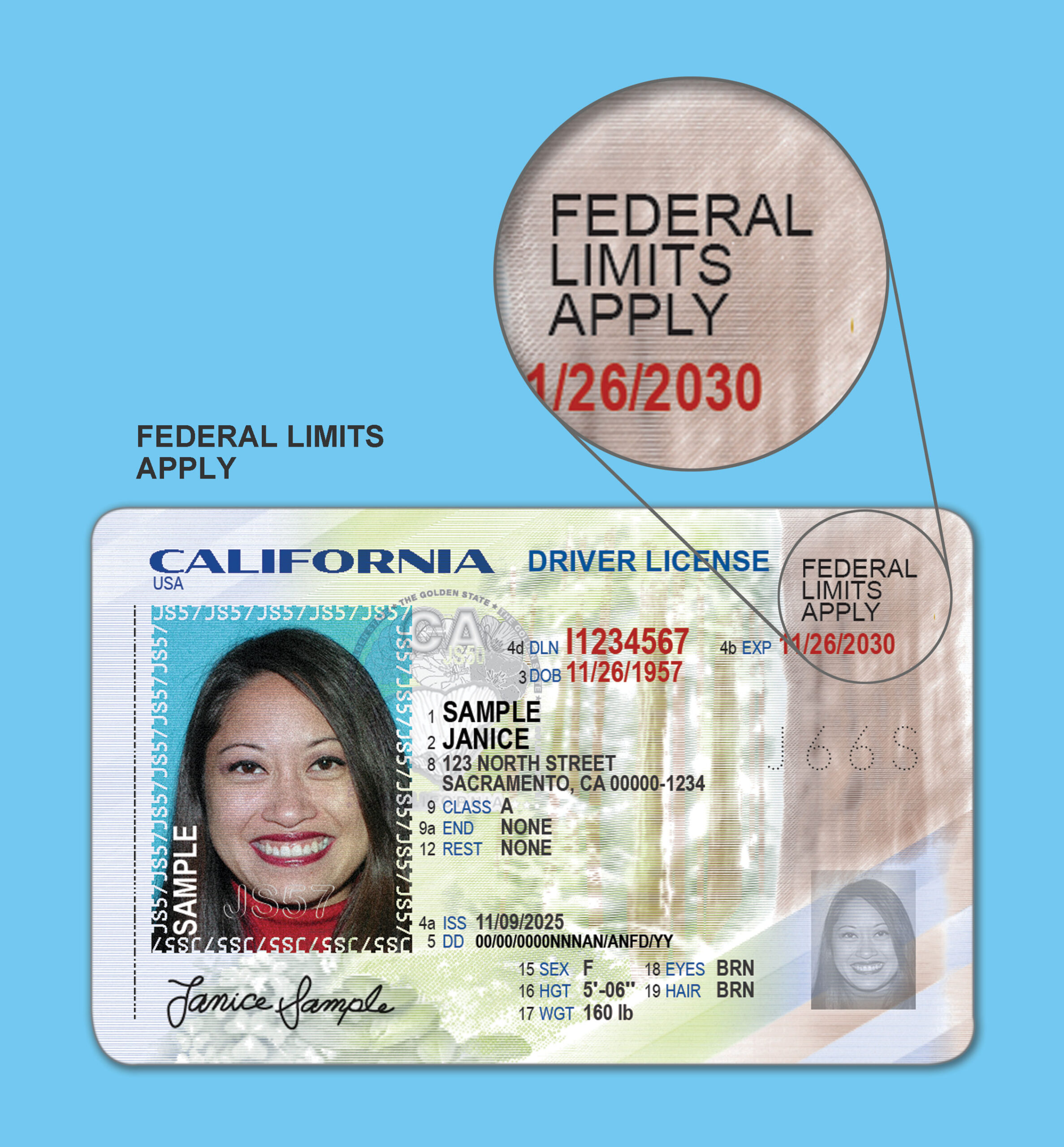
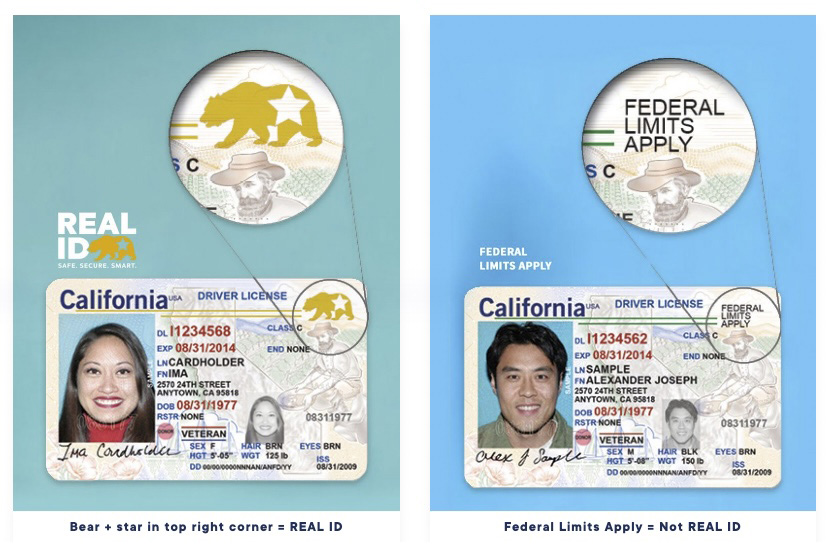
Visually, a California Real ID is easily identifiable by a golden bear with a star in the upper right-hand corner of the card. A standard California driver’s license or ID, which is not Real ID compliant, will typically have “FEDERAL LIMITS APPLY” printed in that same corner.
The purpose of each card also differs significantly. A Real ID is specifically designed to meet federal requirements for identification. This means it can be used to board domestic flights, access secure federal facilities (like military bases or federal courthouses), and is generally accepted for any scenario requiring federally compliant identification. On the other hand, a standard California driver’s license or ID card is perfectly valid for driving, voting, purchasing alcohol, and other state-level identification purposes. However, it will not be accepted by the TSA for domestic air travel or by federal agencies for entry into their facilities after the enforcement deadline.
Understanding this distinction is crucial for travelers, as it directly impacts your ability to fly domestically without needing an alternative form of identification, such as a U.S. passport. For those prioritizing smooth travel and convenience, obtaining a California Real ID is often the preferred choice.
Why You Need a Real ID for Seamless Travel and Access
The move towards Real ID compliance has been primarily driven by the need for enhanced security and streamlined processes at critical checkpoints. For residents of California and visitors alike, understanding the implications of the Real ID is vital for stress-free experiences, particularly when it comes to travel and interaction with federal entities.
Domestic Air Travel: Navigating Airports with Ease
Perhaps the most significant impact of the Real ID Act for the general public revolves around domestic air travel. As per the Department of Homeland Security requirements, after the final enforcement deadline (which is currently May 7, 2025), all individuals flying domestically will need a Real ID compliant driver’s license or another acceptable form of identification, such as a U.S. passport, to pass through TSA checkpoints.
For the avid traveler, this means that your standard California driver’s license will no longer suffice for boarding flights within the United States. Imagine arriving at Los Angeles International Airport or San Francisco International Airport for a much-anticipated trip to New York or Florida, only to find your ID isn’t accepted. This could lead to missed flights, significant delays, and immense frustration – a scenario no one wants to experience, especially when embarking on a relaxing vacation or an important business trip.
Having a Real ID eliminates this concern. It ensures a smoother, more efficient experience at airport security, allowing you to focus on the excitement of your destination rather than worrying about identification compliance. For frequent flyers or those planning multiple trips, the Real ID becomes an indispensable tool for seamless travel.
Accessing Federal Facilities and Military Bases
Beyond air travel, a Real ID is also required for accessing certain federal facilities and military bases after the enforcement date. This applies to various government buildings that require visitors to present a federally compliant form of identification for entry. While this might not affect every California resident or visitor, it’s a critical consideration for those whose work or personal circumstances require access to such locations.
For example, individuals visiting a military base in San Diego or a federal courthouse in Sacramento would need a Real ID compliant card, a U.S. passport, or another approved federal ID. The goal is to ensure that only authorized individuals with properly vetted identification can enter these sensitive areas, further bolstering national security. For military families, contractors, or those conducting business with federal agencies, the Real ID provides the necessary credential for uninterrupted access.
Beyond Travel: Everyday Benefits and Peace of Mind
While the most talked-about applications of the Real ID are tied to air travel and federal access, having one also brings a general sense of peace of mind. It signifies that your primary form of identification meets the highest federal security standards, reducing the likelihood of issues in any situation where robust ID verification is required.
Although a Real ID is not necessary for activities like driving, voting, applying for federal benefits, or purchasing age-restricted items, its broad acceptance means less confusion about what ID is valid where. For tourists enjoying California’s diverse tourism offerings, or residents simply going about their daily lives, the convenience of a universally accepted identification document simplifies many interactions. It’s an investment in your personal security and an assurance of hassle-free navigation through many aspects of public life.
The Application Process: Your Guide to Obtaining a California Real ID
Obtaining a California Real ID is a straightforward process, though it requires careful attention to documentation. The California Department of Motor Vehicles (DMV) has streamlined the application to ensure compliance with federal regulations while making it as accessible as possible for residents.
Essential Documents: Gathering Your Proof
The most critical step in applying for a Real ID is gathering all the necessary documentation. Unlike a standard driver’s license renewal, the Real ID requires you to present original documents or certified copies to verify your identity, residency, and legal presence in the United States. It’s highly recommended to use the DMV’s interactive document checklist online to confirm precisely what you need, but generally, you will require:
- Proof of Identity: This establishes who you are. Acceptable documents include an original U.S. birth certificate, a valid U.S. passport or passport card, a certificate of naturalization, or a permanent resident card. The name on this document must match your current legal name. If your name has changed due to marriage or other reasons, you will also need to provide official legal documents (like a marriage certificate or court order) to show the name change.
- Proof of Social Security Number (SSN): This verifies your Social Security Number. You must present your original Social Security card, a W-2 form, a Social Security Administration (SSA) statement, or a pay stub with your name and SSN. A printed number or a photo of your card is generally not accepted.
- Proof of California Residency (Two Different Documents): This demonstrates that you live in California. You need two different documents, each showing your California street address. Examples include utility bills (electricity, gas, water, cell phone), rental agreements or lease documents, mortgage statements, bank statements, medical documents, or employment documents. P.O. Box addresses are generally not accepted for proof of residency.
- Proof of Signature (if name has changed): If your current name differs from your identity document, you’ll need documents proving your legal name change (e.g., marriage certificate, divorce decree, adoption papers).
Collecting these documents beforehand is crucial to avoid multiple trips to the DMV and ensure a smooth application process.
Navigating the DMV: Online Application and In-Person Visit
The application for a California Real ID is a two-step process:
- Start Online: The DMV strongly encourages applicants to complete the online Real ID application before visiting a field office. This online portal allows you to input your information and upload digital copies of your documents. This pre-application saves a significant amount of time during your in-person visit. Once completed, you’ll receive a confirmation code.
- Schedule an Appointment: After completing the online application, it’s highly recommended to schedule an appointment at your local DMV field office. Walk-ins are accepted, but wait times can be exceptionally long, especially in popular California cities like Los Angeles, San Francisco, or San Jose. An appointment ensures quicker service and minimizes inconvenience.
What to Expect at the DMV
When you arrive at your scheduled appointment, be prepared for the following:
- Document Verification: You will present your original documents (identity, SSN, and two proofs of residency) to a DMV representative. They will verify that all information matches and meets the Real ID requirements.
- Photo and Fingerprinting: Like any driver’s license or ID application, you will have your photo taken for the card and provide a thumbprint.
- Vision Test: If you are applying for a driver’s license, you will also undergo a vision test.
- Signature: You will sign your application and confirm the accuracy of the information.
- Temporary ID: Upon successful completion of the process, you will typically receive a temporary paper Real ID that is valid immediately. Your permanent card will then be mailed to you within a few weeks.
The entire process, from gathering documents to the in-person visit, can take some planning, but the outcome is a secure and federally compliant identification card that simplifies domestic travel and interaction with federal agencies, enhancing your overall lifestyle and travel experiences in and beyond California.
Real ID for Visitors and Non-Residents: What You Should Know
While the primary focus of the Real ID is on residents and their ability to comply with federal identification standards, it also has implications for individuals visiting California or residing in other states. Understanding these nuances is crucial for smooth journeys and experiences, whether you’re traveling for tourism or business.
Out-of-State Travelers
If you are visiting California from another U.S. state, the Real ID Act still applies to you, but with a different perspective. When flying out of a California airport or any other U.S. airport, you will need to present a Real ID compliant driver’s license or ID card issued by your home state, or another acceptable federal ID such as a U.S. passport.
This means that if your home state has not yet issued you a Real ID compliant identification, or if you opted for a standard license in your state, you will need to use an alternative form of identification for domestic air travel. Many travelers choose to carry their U.S. passport as a backup, regardless of whether their state ID is Real ID compliant. This is a particularly important consideration for those planning multi-state trips or flying into California for a vacation and then planning to fly to another domestic destination from within the state.
The TSA website provides a comprehensive list of all acceptable forms of identification for domestic air travel, which serves as an invaluable resource for out-of-state visitors to ensure their travel plans remain uninterrupted. For instance, if you’re flying into Los Angeles to visit Disneyland and then plan to catch a flight to Las Vegas, you’ll need that compliant ID.
International Visitors
For international visitors to California, the Real ID requirements do not directly apply in the same way they do for U.S. citizens and legal residents. A Real ID is a domestic identification document.
International visitors typically use their valid passport from their home country for identification purposes, including boarding domestic flights within the United States. Their foreign passport is a federally recognized document and is accepted by the TSA for air travel. Additionally, depending on their visa status and duration of stay, some international visitors might obtain a California driver’s license or ID card. These cards would typically be marked with “FEDERAL LIMITS APPLY” and would not be Real ID compliant, meaning the foreign passport would still be required for domestic air travel.
Therefore, international travelers exploring California’s attractions, from the Golden Gate Bridge to Yosemite National Park, should always carry their passport as their primary form of identification, especially when flying domestically. This ensures seamless travel and avoids any confusion at airport security or other federal checkpoints. The Real ID system is primarily an internal U.S. security measure, not an international travel document like a passport.
The Future of Identification: Real ID’s Role in a Secure World
The introduction and gradual implementation of the Real ID Act represent a significant step in the evolution of identification standards within the United States. It underscores a commitment to enhancing national security while simultaneously striving to maintain efficiency in crucial sectors like travel and public services.
Enhancing Security and Streamlining Travel
The core objective of the Real ID is to create a more secure and reliable system for verifying identity. By requiring more rigorous documentation and standardization across states, it makes it more difficult for individuals to obtain fraudulent identification documents, thereby bolstering the security of domestic air travel and access to sensitive federal facilities. This enhanced security is a preventative measure, aimed at safeguarding the public and critical infrastructure.
For the everyday traveler, this translates into a more streamlined experience once the initial hurdle of obtaining the Real ID is overcome. With a Real ID compliant card, the process of moving through TSA checkpoints becomes more predictable and efficient. There’s less ambiguity about whether your ID will be accepted, allowing you to breeze through security and focus on the excitement of your destination, whether it’s a relaxing beach holiday in Malibu or a business conference in Silicon Valley. The peace of mind that comes with knowing your identification is federally compliant is an invaluable asset in today’s fast-paced world of travel and tourism.

Planning Your Next California Adventure
For those with a passion for travel and exploration, especially within the vast and varied landscapes of California, ensuring your identification is up to date and compliant is a foundational step in planning any adventure. From discovering the majestic beauty of Lake Tahoe to immersing yourself in the cultural vibrancy of San Diego, seamless journeys often begin before you even leave your home.
As you consider your next escape, remember to check your identification status. If you’re a California resident, proactively applying for and obtaining your Real ID will save you potential headaches down the line. If you’re an out-of-state visitor, ensure your home state’s ID is compliant, or simply plan to carry your U.S. passport. For international visitors, your passport remains your key to unlocking the wonders of the Golden State.
In conclusion, the Real ID in California is more than just a piece of plastic; it’s a gateway to hassle-free domestic travel and secure access in an increasingly interconnected world. By understanding its purpose, the application process, and its implications for various types of travelers, you can ensure your focus remains on creating unforgettable memories, exploring new destinations, and enjoying all the rich experiences that California and beyond have to offer.
LifeOutOfTheBox is a participant in the Amazon Services LLC Associates Program, an affiliate advertising program designed to provide a means for sites to earn advertising fees by advertising and linking to Amazon.com. Amazon, the Amazon logo, AmazonSupply, and the AmazonSupply logo are trademarks of Amazon.com, Inc. or its affiliates. As an Amazon Associate we earn affiliate commissions from qualifying purchases.