
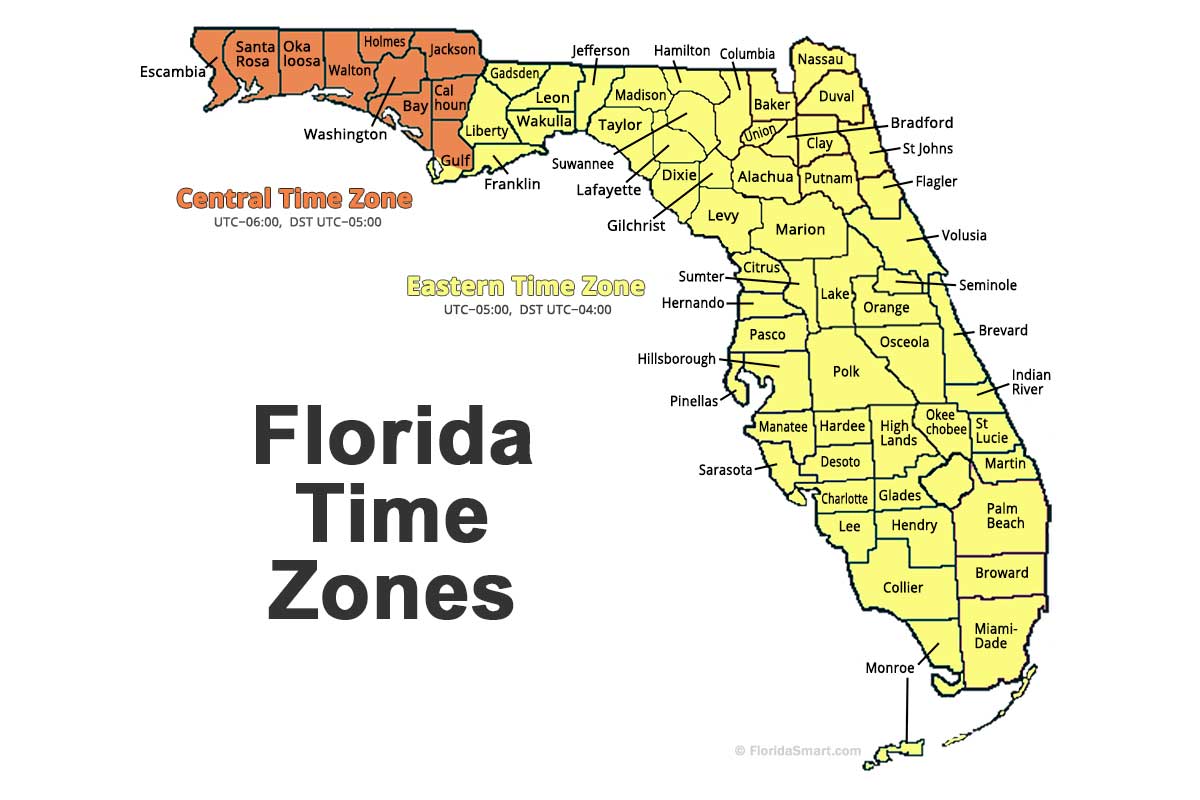
The seemingly straightforward question, “What time is it in Florida?”, unveils a fascinating geographical detail that savvy travelers and residents alike must consider. More than just a simple query, understanding [Florida]’s time zones is paramount for seamless travel planning, effective communication, and maximizing every moment of your visit to the Sunshine State. [Florida] is unique in that it straddles two distinct time zones: Eastern Time (ET) and Central Time (CT). While the vast majority of the state, including its most popular tourist destinations, observes [Eastern Time], a significant portion of its western [Panhandle] region operates on [Central Time]. This seemingly minor difference can have considerable implications for everything from flight schedules and hotel check-ins to theme park visits and business meetings.
For anyone planning to explore [Florida]’s diverse landscapes – from the magical theme parks of [Orlando] to the vibrant beaches of [Miami], the historic streets of [St. Augustine], or the tranquil shores of [Destin] – being aware of these time zones is not just a convenience, it’s a necessity. This comprehensive guide will delve into the specifics of [Florida]’s time zones, highlight their practical impact on various aspects of travel and lifestyle, and offer essential tips to ensure your [Florida] adventure is perfectly timed and effortlessly enjoyable, regardless of where you are in the state.
Navigating Florida’s Dual Time Zones
[Florida]’s unique geographical shape, extending far to the west at its northern reaches, dictates its division into two time zones. Understanding this split is the first step in mastering your itinerary.Eastern Time (ET): The Heart of Florida’s Tourism
The overwhelming majority of [Florida] operates on [Eastern Time]. This encompasses all of the peninsula and extends westward to include major cities and prime tourist magnets. When people think of [Florida]’s time, they are generally referring to [Eastern Time]. This zone adheres to Eastern Standard Time (EST) during the winter months, which is UTC-5. During the warmer months, the state transitions to Eastern Daylight Time (EDT) (UTC-4) as part of Daylight Saving Time.
Cities and regions within the [Eastern Time] zone include, but are not limited to:
- [Orlando], home to world-renowned theme parks like Walt Disney World Resort and Universal Orlando Resort.
- [Miami] and [Miami Beach], famous for their vibrant culture, nightlife, and stunning coastlines.
- [Tampa] and [St. Petersburg], offering beautiful Gulf Coast beaches, cultural attractions, and family-friendly entertainment.
- [Fort Lauderdale], known as the “Venice of America” with its extensive canal system.
- The entire [Florida Keys] archipelago, including [Key West].
- The historic city of [St. Augustine].
- Most of the [Florida Panhandle] up to the [Apalachicola River].
This means that if you’re planning a trip primarily focused on these popular destinations, your devices will likely display the correct local time automatically, aligning with the rhythm of theme park opening hours, dining reservations, and sunset cruises. The consistency within this large zone simplifies planning significantly for most visitors.
Central Time (CT): Florida’s Western Frontier
While smaller in landmass, the portion of [Florida] that observes [Central Time] is crucial for anyone traveling to the westernmost parts of the [Florida Panhandle]. This region adheres to Central Standard Time (CST) (UTC-6) in winter and Central Daylight Time (CDT) (UTC-5) during [Daylight Saving Time]. The difference between [Central Time] and [Eastern Time] is always one hour, with [Central Time] being one hour behind [Eastern Time].
The counties that fall within the [Central Time] zone are:
- [Escambia] County, which includes the city of [Pensacola].
- [Santa Rosa] County.
- [Okaloosa] County, home to [Destin].
- [Walton] County.
- And the westernmost part of [Bay County], specifically west of the [Apalachicola River]. This river acts as a natural, albeit informal, boundary for the time zone change.
For instance, cities like [Pensacola] and [Destin] are firmly in [Central Time]. If you are driving east from [Pensacola] towards Panama City Beach, which is in [Eastern Time], you will “lose” an hour as you cross the time zone boundary. This shift is particularly important for those flying into [Pensacola International Airport (PNS)] or visiting the pristine white-sand beaches along this part of the Gulf Coast. Understanding this distinction is vital to avoid missing appointments, check-ins, or other time-sensitive activities when traversing the [Panhandle].
The Impact of Time Zones on Your Florida Travel Experience
The seemingly simple matter of “what time it is” transcends mere curiosity when planning a trip to [Florida]; it becomes a foundational element of logistics and enjoyment. From transportation to dining and attractions, time zones dictate the rhythm of your vacation.
Seamless Travel Planning and Logistics
Precise time management is the bedrock of stress-free travel, and [Florida]’s dual time zones add an extra layer of consideration.
- Flights and Transportation: One of the most critical areas affected by time zones is air travel. When booking flights, especially if your journey involves a layover or destination in the [Florida Panhandle], always double-check the time zone listed for departure and arrival. A flight arriving at [Pensacola International Airport (PNS)] at 2 PM local time will be 3 PM [Eastern Time], which could impact connecting flights or ground transportation arrangements if you’re not paying attention. Similarly, travelers flying into major hubs like [Orlando International Airport (MCO)], [Miami International Airport (MIA)], or [Tampa International Airport (TPA)] should be mindful of the time differences with their home location, especially if coordinating with friends or family still in different time zones. Missing connections or arriving late due to a time zone miscalculation can derail the start of your trip.
- Accommodation Check-in/Check-out: Hotels, resorts, villas, and apartments all adhere to strict check-in and check-out times. A reservation at a stunning property like the [Fontainebleau Miami Beach] or the family-friendly [Walt Disney World Swan and Dolphin Resort] will operate on [Eastern Time]. However, if you’re driving from [Orlando] to a resort in [Destin], like the [Sandestin Golf and Beach Resort], and forget about the time change, an expected 3 PM arrival could turn into 4 PM local time, potentially incurring late check-in fees or delaying your access to amenities. Always confirm the local check-in time for your specific accommodation to avoid any surprises.
- Activity Bookings and Reservations: [Florida] is brimming with activities, and many require advance booking. Whether it’s a coveted dining reservation in [South Beach], a thrilling show at [Universal Orlando Resort], a boat tour departing from [Key West], or a tee time at a championship golf course, all bookings are time-zone specific. Arriving an hour late for a [Magic Kingdom] FastPass or a fishing charter in [Destin] because you miscalculated the time change can lead to missed experiences and forfeited payments. Always confirm the time zone when making reservations, especially for high-demand attractions or tours.
Maximizing Your Florida Tourism & Lifestyle
Beyond logistics, time zones play a crucial role in how you experience [Florida]’s diverse tourism offerings and integrate into its local lifestyle.

- Attraction Opening Hours: Every attraction, from the [Kennedy Space Center Visitor Complex] to [Everglades National Park] and the historical sites of [St. Augustine’s Historic District], operates on specific hours. While most will be in [Eastern Time], if you venture to the [Panhandle], attractions like the [National Naval Aviation Museum] in [Pensacola] will follow [Central Time]. Knowing the correct local time ensures you arrive when gates open, maximize your visit, and avoid disappointment.
- Local Culture and Events: [Florida]’s vibrant calendar of festivals, concerts, and sporting events, such as a [Miami Heat] game at [Kaseya Center], are all scheduled according to local time. If you’re coordinating with locals or planning to attend a time-sensitive event, being aware of the precise local time is essential for a smooth and enjoyable experience.
- Dining Experiences: [Florida]’s culinary scene is a highlight for many, from upscale dining to casual beachfront eateries. Making reservations at popular restaurants, especially during peak season, requires punctuality. A missed reservation due to time zone confusion could mean missing out on a unique gastronomic experience.
- Business Travel: For business travelers, time zone awareness is paramount. Scheduling virtual meetings with colleagues in different parts of the country or internationally requires careful calculation. If you’re based in [California], an 8 AM meeting in [Orlando] means a 5 AM start for you. Conversely, if you’re working remotely from [Destin] and collaborating with a team on the East Coast, remember that they are an hour ahead. This impacts productivity and work-life balance during your business stay.
Experiencing Florida’s Diverse Destinations Through a Time-Conscious Lens
[Florida]’s geographical span across two time zones creates distinct experiences depending on your chosen destination. Understanding these nuances allows for more informed and enjoyable travel planning.East Coast Gems: Orlando, Miami, and Beyond
The vast majority of [Florida]’s most famous destinations, particularly along the Atlantic coast and the central peninsula, fall within [Eastern Time]. This simplifies planning for many, as the “Florida time” generally refers to this zone.
- [Orlando]: As the theme park capital of the world, [Orlando]’s schedule revolves entirely around [Eastern Time]. Early starts are common for visitors aiming to be among the first through the gates of [Magic Kingdom] or to queue for popular attractions at [Universal Studios Florida]. Park hours, parade times, dining reservations at resorts like [Hyatt Regency Grand Cypress], and evening spectaculars are all meticulously planned to this time zone. Families, especially, will find that understanding this consistent time allows for better management of children’s sleep schedules and activity planning.
- [Miami]: The vibrant pulse of [Miami] and [Miami Beach] also beats to [Eastern Time]. Whether you’re planning a morning on [South Beach], an afternoon exploring the Art Deco architecture, an evening of gallery hopping in [Wynwood], or a late-night club experience, all local times are [ET]. This consistency is crucial for enjoying the city’s dynamic lifestyle, from fashion shows to food festivals.
- [St. Augustine]: [Florida]’s oldest city, [St. Augustine], with its rich history, iconic landmarks like the [Castillo de San Marcos], and charming cobblestone streets, is firmly in [Eastern Time]. Ghost tours, historical reenactments, and museum opening hours all adhere to this zone, allowing visitors to immerse themselves fully in the past without modern-day time confusion.
- [Florida Keys]: From the bohemian charm of [Key West] to the natural wonders of [John Pennekamp Coral Reef State Park] in [Key Largo], the entire [Florida Keys] chain operates on [Eastern Time]. This means sunset cruises, fishing charters, and snorkeling trips all run on a consistent schedule, making island hopping and water activities straightforward to plan.
Panhandle Paradise: Pensacola, Destin, and the Central Time Zone Shift
The [Florida Panhandle] offers a different pace and stunning Gulf Coast scenery, but it also introduces the crucial time zone shift. Destinations here require an extra layer of awareness.
- [Pensacola]: Located on the westernmost tip of [Florida], [Pensacola] is a beautiful city with a rich military history, picturesque [Pensacola Beach], and attractions like the [National Naval Aviation Museum]. All of these operate on [Central Time]. If you’re flying into [Pensacola International Airport (PNS)] or driving from a neighboring state like [Alabama], the [Central Time] zone will feel natural. However, for those traveling from other parts of [Florida], remembering to adjust your clock back one hour is essential.
- [Destin]: Known as the “World’s Luckiest Fishing Village” and celebrated for its emerald green waters and white-sand beaches, [Destin] is another key destination in the [Central Time] zone. Visiting [Henderson Beach State Park], booking a deep-sea fishing charter, or checking into a beachfront resort like the [Sandestin Golf and Beach Resort] will all be governed by [Central Time]. The one-hour difference can be particularly noticeable when dining out, as a “6 PM reservation” in [Destin] is an hour earlier than what someone arriving from [Panama City Beach] (which is in [Eastern Time]) might expect.
- The Crucial “Time Change Line”: The drive from areas like [Panama City Beach] to [Destin] often means crossing the [Apalachicola River], which roughly marks the unofficial time zone boundary. Travelers embarking on road trips across the [Panhandle] must be acutely aware of this transition. Missing an hour (traveling west to east) or gaining an hour (traveling east to west) can impact everything from scheduled pit stops and meal breaks to arriving on time for hotel check-ins or pre-booked activities.
Practical Tips for Managing Time Across Florida’s Zones
Successfully navigating [Florida]’s time zones requires more than just knowing which areas belong to which zone; it demands proactive strategies and the use of modern tools. These practical tips will help ensure your trip remains on schedule and free of time-related mishaps.
Essential Tools and Strategies for Travelers
Staying on schedule in [Florida] is easy with a few simple habits and technological aids.
- Set Your Devices Automatically: Most smartphones, smartwatches, and GPS devices are designed to automatically update their time zone when you travel. This is your first and best line of defense against time confusion. However, it’s always wise to perform a quick manual check upon arrival or before crossing a known time zone boundary. Just because your phone should update doesn’t mean it always does immediately, especially in remote areas.
- Confirm All Bookings with Time Zones in Mind: When making any reservation – be it for flights, hotels, car rentals, theme park tickets, or dining – always verify the time zone. Instead of just noting “6 PM,” make it “6 PM ET” or “6 PM CT.” This explicit clarification removes any ambiguity, particularly for bookings made weeks or months in advance when your memory of specific time zones might fade. This is crucial for accommodations found through platforms covering diverse options, from luxury resorts to budget-friendly apartments.
- Utilize a World Clock App: For quick reference, especially if you’re coordinating with family or business associates outside of [Florida], a world clock app on your smartphone can be invaluable. It allows you to simultaneously view the time in different cities, including [Orlando], [Pensacola], and your home city, at a glance. This is particularly helpful for managing business stays or communicating with those back home.
- Plan Your Cross-Zone Travel Carefully: If your itinerary involves driving between [Eastern Time] and [Central Time] zones, build extra buffer time into your schedule. Understand that crossing the [Apalachicola River] from east to west will “give” you an hour, which can be a pleasant surprise, but going from west to east will “take” an hour, requiring you to adjust your internal clock and physical schedule. Factor this into meal times, fuel stops, and estimated arrival times for attractions or hotels.
- Communicate Clearly: When making plans with others, especially if they are in a different time zone within [Florida] or outside the state, always specify the time zone. For example, “Let’s meet at 7 PM [Eastern Time]” or “The tour starts at 6 PM [Central Time]” leaves no room for misunderstanding.
- Mind [Daylight Saving Time]: Remember that [Florida], like most of the United States, observes [Daylight Saving Time]. Clocks “spring forward” in March and “fall back” in November. While [Florida] has passed legislation to permanently remain on [Daylight Saving Time] ([Eastern Daylight Time]), federal law currently prevents this, meaning the state still adjusts its clocks twice a year. Be aware of these transitions, as they can temporarily add another layer of confusion.
Lifestyle Considerations: From Jet Lag to Productivity
Time zone management extends beyond mere punctuality; it impacts your well-being and the overall quality of your travel experience.
- Minimizing Jet Lag: For visitors arriving from significant distances, particularly from the West Coast (e.g., [California], [Hawaii]) or international destinations, adjusting to [Florida]’s [Eastern Time] can induce jet lag. The three-hour difference from [California], for example, means your body might feel like it’s still early morning when it’s already lunchtime in [Orlando]. Strategies like gradual adjustment to your sleep schedule before departure, staying hydrated, getting natural light exposure upon arrival, and avoiding heavy meals can help mitigate its effects and ensure you’re energized for your vacation.
- Family Travel: Managing children’s sleep patterns and routines during time zone changes is crucial for a smooth family trip. A well-rested child is a happy traveler, and understanding how time shifts affect their internal clocks can make a big difference, especially when visiting demanding attractions like theme parks.
- Business Stays: For those on a business trip or working remotely from [Florida], efficient time management is key to maintaining productivity. Scheduling virtual meetings, coordinating with teams across different time zones, and ensuring you’re available during critical work hours requires diligent planning. [Florida]’s accessible time zones (relative to the East Coast) can be an advantage for business travelers based in other eastern regions.
- Budget Travel vs. Luxury Travel: Regardless of your travel style, time is a valuable commodity. For budget travelers, efficient planning around time zones can mean catching early bird specials, arriving promptly for free activities, or maximizing your time at cost-effective attractions. For luxury travelers, perfectly timed reservations, private tours, and seamless transitions between experiences ensure that every moment of your high-end getaway, from a lavish resort stay to a gourmet dining experience, is enjoyed without logistical hitches.

Conclusion
The question, “What time is it in [Florida]?”, is more than a trivial detail; it’s a fundamental aspect of successful travel planning and experiencing the Sunshine State to its fullest. With the majority of its iconic destinations operating on [Eastern Time] and a distinct segment of its western [Panhandle] observing [Central Time], [Florida] presents a unique geographical rhythm that visitors must understand.
From ensuring you catch your flight from [Orlando International Airport (MCO)] on time, to making a timely check-in at your [Miami Beach] hotel, or arriving punctually for a deep-sea fishing charter in [Destin], time zone awareness underpins the smooth execution of your itinerary. It impacts everything from logistics and local culture immersion to business productivity and the simple enjoyment of a sunset. By utilizing automatic device settings, confirming all bookings with explicit time zone references, planning for cross-zone travel, and being mindful of personal adjustments like jet lag, travelers can transform potential confusion into a perfectly timed and effortlessly enjoyable adventure.
Whether you’re seeking the thrills of [Walt Disney World Resort], the vibrant nightlife of [South Beach], the historical charm of [St. Augustine], or the serene beauty of the [Florida Panhandle] beaches, a time-conscious approach will unlock the best of what [Florida] has to offer, ensuring every moment of your journey is as bright and boundless as the [Florida] sun itself.
LifeOutOfTheBox is a participant in the Amazon Services LLC Associates Program, an affiliate advertising program designed to provide a means for sites to earn advertising fees by advertising and linking to Amazon.com. Amazon, the Amazon logo, AmazonSupply, and the AmazonSupply logo are trademarks of Amazon.com, Inc. or its affiliates. As an Amazon Associate we earn affiliate commissions from qualifying purchases.