
The question of when Hawaii was annexed by the United States often sparks curiosity, not just for its historical significance but also for understanding the unique cultural tapestry and political journey of one of the world’s most beloved travel destinations. The formal date of annexation by the United States was August 12, 1898. However, this seemingly straightforward date belies a complex, often contentious, and deeply emotional history spanning decades, involving the overthrow of a sovereign kingdom, international diplomacy, and the aspirations of both native Hawaiians and foreign residents.
Today, Hawaii is renowned globally as a premier destination for travelers seeking idyllic beaches, volcanic landscapes, and vibrant Polynesian culture. From luxury resorts in Waikiki to serene retreats on the Big Island or Maui, the Hawaiian Islands offer a lifestyle of unparalleled beauty and adventure. Yet, beneath the surface of this paradise lies a rich historical narrative that profoundly shaped its identity and continues to influence its tourism and local culture. To truly appreciate Hawaii – its landmarks, its people, and its spirit – one must delve into the events leading up to that pivotal day in 1898.

The Dawn of a Pacific Kingdom: Hawaii Before Annexation
Long before it became a United States territory or state, the Hawaiian Islands were a self-sufficient and thriving Polynesian kingdom with a sophisticated social structure, rich traditions, and a deep connection to the land and sea.
A Rich Cultural Heritage and Early Encounters
The history of human settlement in Hawaii dates back over a thousand years, with skilled Polynesian navigators arriving from other Pacific Ocean islands. These early settlers developed a unique culture, language, and spiritual practices centered on harmony with nature. By the late 18th century, the islands were governed by various chiefs, often engaged in inter-island conflicts.
It was against this backdrop that Captain James Cook arrived in 1778, marking the first known contact between Hawaiians and Europeans. While his arrival brought new technologies and ideas, it also inadvertently introduced diseases that would decimate the native population. Following Cook’s visit, the islands became a significant stop for whaling ships and traders, opening them up to the wider world.
A pivotal figure emerged from this era: King Kamehameha I. Through strategic alliances, military prowess, and diplomatic skill, he unified the warring chiefdoms, establishing the Kingdom of Hawaii in 1810. Kamehameha’s reign brought peace and stability, setting the stage for a period of both independence and increasing foreign engagement. The kingdom’s capital, Honolulu, quickly grew into a bustling port city, attracting merchants and missionaries alike.
The Growing Influence of Foreign Powers
The 19th century witnessed a dramatic increase in foreign influence in Hawaii. American Protestant missionaries from New England began arriving in 1820, bringing with them not only Christianity but also Western education, legal systems, and cultural norms. Their descendants often stayed, becoming prominent figures in commerce and politics. Landmarks like Kawaiahaʻo Church in Honolulu stand today as testament to their early influence.
The fertile volcanic soil and favorable climate made Hawaii ideal for cultivating sugarcane. American entrepreneurs established vast sugar plantations, which quickly became the driving force of the Hawaiian economy. This industry brought immense wealth to a small group of foreign landowners, but it also necessitated a massive influx of contract laborers from Asia, further diversifying Hawaii’s population and altering its social fabric. The strategic location of the Hawaiian Islands in the mid-Pacific Ocean also caught the eye of various global powers, particularly the United States, which saw the islands as crucial for trade routes and military defense. This economic and strategic interest laid the groundwork for future political interventions.
The Seeds of Change: Overthrow and Provisional Government
The growing disparity between the native Hawaiian monarchy and the powerful foreign business interests eventually led to a collision course, culminating in the controversial overthrow of the kingdom.
The Bayonet Constitution and Waning Monarchy
The increasing power of American and European businessmen, coupled with their desire for political influence commensurate with their economic stake, led to direct confrontations with the Hawaiian monarchy. A critical turning point occurred in 1887 with the imposition of the “Bayonet Constitution.” This document, forced upon King Kalākaua under duress by an armed militia known as the Hawaiian League (predominantly American and European residents), severely curtailed the monarch’s power and disenfranchised many native Hawaiians and Asian immigrants, while granting voting rights to non-citizen Caucasians. This event effectively transformed Hawaii into a constitutional monarchy dominated by foreign interests.
Following Kalākaua’s death in 1891, his sister, Queen Liliʻuokalani, ascended to the throne. A fiercely nationalistic and educated leader, she understood the erosion of Hawaiian sovereignty and sought to restore power to the monarchy and the native people. Her primary goal was to promulgate a new constitution that would revoke the “Bayonet Constitution” and empower the Hawaiian populace. This move, however, was seen as a direct threat by the powerful, annexationist-leaning Committee of Safety.
The Overthrow of Queen Liliʻuokalani
The queen’s efforts to enact a new constitution provided the pretext for the Committee of Safety to act. On January 17, 1893, with the open support of United States Minister John L. Stevens and the landing of U.S. Marines from the USS Boston in Honolulu (ostensibly to protect American lives and property), the Committee of Safety orchestrated a bloodless coup. Queen Liliʻuokalani, to avoid bloodshed, yielded her authority under protest, appealing to the United States government for justice and restoration.
The overthrow led to the establishment of a Provisional Government, led by Sanford B. Dole, a prominent American businessman and former judge. This new government immediately sought annexation by the United States. However, the legitimacy of these actions was highly questionable, and the event remains a deeply sensitive and contested topic in Hawaiian history. The native Hawaiian population largely opposed the overthrow, viewing it as an illegal act of aggression. Organizations like the Hawaiian Patriotic League quickly formed to protest and fight for the restoration of the monarchy and national independence.
The Path to Union: Republic and Annexation
The period following the overthrow was marked by intense political maneuvering, both in Hawaii and Washington, D.C., as the fate of the Hawaiian Islands hung in the balance.
The Struggle for Restoration vs. Annexation
Upon learning of the overthrow, then-President Grover Cleveland of the United States was deeply troubled by the circumstances. After conducting an investigation (the Blount Report), he concluded that the overthrow was illegal and that the United States had acted improperly. President Cleveland famously opposed annexation, believing it to be an act of “wrong and dishonor.” He urged the Provisional Government to restore Queen Liliʻuokalani to her throne, even attempting to negotiate her peaceful return. However, the Provisional Government, led by Sanford B. Dole, flatly refused.
Seeing their path to immediate annexation blocked by President Cleveland, the Provisional Government declared the establishment of the Republic of Hawaii on July 4, 1894, with Sanford B. Dole as its first and only president. This move solidified their control and ensured that only a complete reversal of U.S. policy would allow for the monarchy’s restoration. The native Hawaiian resistance continued, with thousands signing petitions, such as the Kuaihelani petition, protesting annexation and appealing for self-determination. These efforts, while powerful expressions of national sentiment, ultimately faced an uphill battle against the prevailing political tides in Washington, D.C.
The Newlands Resolution and Formal Annexation
The political climate in the United States shifted dramatically with the election of President William McKinley in 1896, a staunch advocate for American expansionism. The outbreak of the Spanish-American War in April 1898 provided the ultimate catalyst for annexation. Suddenly, the strategic importance of Hawaii as a mid-Pacific Ocean naval base and coaling station became undeniably apparent, vital for supplying U.S. forces operating in the Philippines and beyond. The war transformed Hawaii from a distant diplomatic dilemma into an urgent military necessity for American power projection.
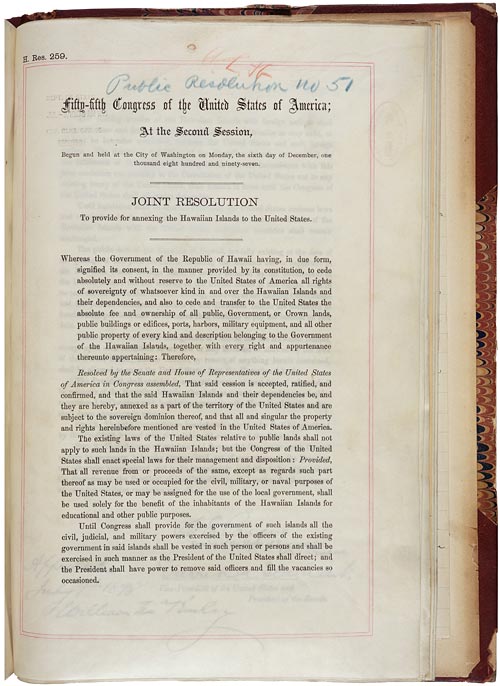
Recognizing that a formal treaty of annexation would require a two-thirds majority vote in the U.S. Senate (which was difficult to secure due to anti-imperialist sentiment and concerns about the illegitimacy of the overthrow), annexationists opted for a different legislative route: a Joint Resolution of Congress. This circumvented the treaty process, requiring only a simple majority vote in both the House and Senate.
On July 7, 1898, President William McKinley signed the Newlands Resolution, effectively annexing the Republic of Hawaii to the United States. The formal transfer of sovereignty took place on August 12, 1898, in a solemn ceremony on the grounds of Iolani Palace, the former residence of the Hawaiian monarchs. The Hawaiian flag was lowered, and the American flag was raised, marking the end of an independent kingdom and the beginning of a new chapter as an American territory. Queen Liliʻuokalani, still under house arrest at the palace, refused to acknowledge the ceremony, considering it an illegal act.
Hawaii’s Enduring Legacy: From Territory to Statehood and Tourist Paradise
The annexation of Hawaii set the stage for its eventual integration into the United States and its rise as a world-renowned destination.
The Evolution of a Pacific Gem
Following annexation, Hawaii became an organized incorporated territory of the United States under the Organic Act of 1900. This period saw significant economic growth, particularly in the sugar and pineapple industries, spearheaded by companies like Dole Plantation, and increasing military presence, most notably at Pearl Harbor. The attack on Pearl Harbor on December 7, 1941, thrust Hawaii into the forefront of World War II, further cementing its strategic importance to the United States.
Decades of advocacy by Hawaiian residents, many of whom served valiantly in both World Wars, eventually led to statehood. On August 21, 1959, Hawaii officially became the 50th state of the United States. This momentous event opened the floodgates for mass tourism, transforming the islands into the iconic vacation spot we know today. However, even with statehood, the complex legacy of the overthrow and annexation continues to resonate. Modern Hawaii actively engages in a cultural renaissance, with dedicated efforts to preserve the Hawaiian language, traditions, and a deeper understanding of its pre-annexation history.
Exploring History and Culture in Modern Hawaii
For contemporary travelers, Hawaii offers a unique opportunity to immerse oneself not just in breathtaking natural beauty and thrilling adventures, but also in a profound historical narrative. Understanding the story of annexation enriches any visit, allowing for a deeper appreciation of the islands’ distinct cultural identity and the resilience of its people.
Landmarks and Historical Sites to Explore:
- Iolani Palace (Oahu): The only official residence of royalty in the United States, this magnificent palace in Honolulu offers tours that transport visitors back to the era of the Hawaiian monarchy, providing intimate insights into the lives of King Kalākaua and Queen Liliʻuokalani. It’s a poignant reminder of the kingdom that was.
- Kawaiahaʻo Church (Oahu): Located near Iolani Palace, this historic church, often called “the Westminster Abbey of the Pacific,” was built by Protestant missionaries and served as the official church of the Hawaiian royalty. Its architecture and history provide a glimpse into the missionary influence.
- Pearl Harbor (Oahu): While chronologically after annexation, a visit to the USS Arizona Memorial and other sites at Pearl Harbor offers a powerful look into Hawaii’s role in modern American history and global events.
- Bishop Museum (Oahu): As the premier museum of Hawaiian and Pacific cultural and scientific artifacts, the Bishop Museum provides an invaluable context for understanding the rich indigenous history and traditions that existed long before foreign contact.
- Huliheʻe Palace (Big Island): On the Big Island (officially Hawaii Island), this former vacation residence of Hawaiian royalty in Kailua-Kona offers another perspective on royal life outside the capital.
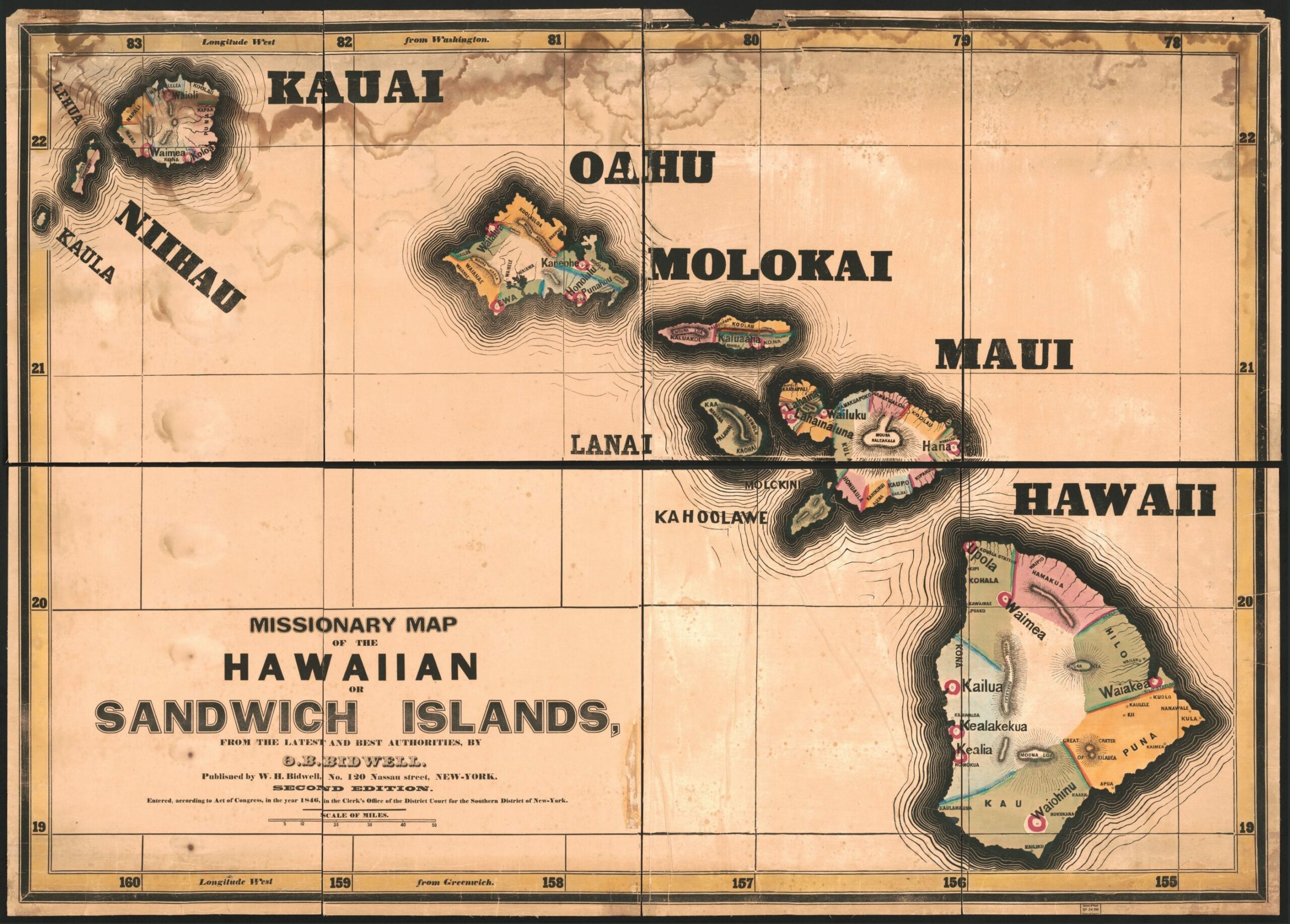
Beyond historical sites, Hawaii offers a diverse range of experiences. On Oahu, explore the bustling city of Honolulu, climb Diamond Head for panoramic views, or enjoy the world-famous beaches of Waikiki, where luxury hotels and vibrant nightlife converge with surfing legends. Maui beckons with its scenic Road to Hana and stunning sunsets from Haleakala National Park. The Big Island captivates with the active volcanoes of Hawaii Volcanoes National Park. Each island—Kauai, Lanai, Molokai, Niihau, and Kahoolawe—holds its own unique charm and story.
Whether you’re planning a family trip, a luxury escape, or an adventure-filled budget travel experience, Hawaii’s accommodation options range from grand resorts to quaint vacation rentals. Immersing oneself in local culture, savoring the unique food, and participating in activities like a luau or a visit to the Polynesian Cultural Center are essential for a complete experience. Understanding the annexation, its controversies, and its long-term impact on Hawaiian identity allows visitors to engage with the islands’ vibrant spirit on a much deeper, more respectful level. It’s an invitation to explore a destination where paradise and profound history intertwine, creating a truly unforgettable travel experience.
LifeOutOfTheBox is a participant in the Amazon Services LLC Associates Program, an affiliate advertising program designed to provide a means for sites to earn advertising fees by advertising and linking to Amazon.com. Amazon, the Amazon logo, AmazonSupply, and the AmazonSupply logo are trademarks of Amazon.com, Inc. or its affiliates. As an Amazon Associate we earn affiliate commissions from qualifying purchases.