
For many travelers seeking an enchanting blend of rich history, vibrant culture, and breathtaking natural beauty, Puerto Rico stands out as a premier destination. This captivating Caribbean island, a territory of the United States, boasts a unique identity shaped by centuries of colonial influence and a complex political evolution. Its status as a crossroads of cultures is deeply rooted in the historical moment when its sovereignty shifted from Spain to America. Understanding “when” this control was gained isn’t just a matter of historical date; it unlocks the narrative of the island’s distinctive heritage, its architectural wonders, its people’s spirit, and the very fabric of its appeal as a global tourism hub.
The story of Puerto Rico’s transition to American oversight is intertwined with a pivotal international conflict at the close of the 19th century. This event dramatically reshaped geopolitical landscapes and set the stage for the island’s modern identity, inviting visitors to explore a past that continues to resonate in its present-day charm and dynamic lifestyle.
The Dawn of American Influence: The Spanish-American War of 1898
The year 1898 marks the definitive turning point in Puerto Rico’s history, signaling the end of more than four centuries of Spanish colonial rule and the beginning of American influence. This seismic shift was a direct consequence of the Spanish-American War, a conflict that, though relatively brief, had profound and lasting global implications, particularly for Spain’s remaining overseas territories.
A World in Flux: Spain’s Declining Empire
By the late 19th century, the once-mighty Spanish Empire was a shadow of its former self, clinging to a few scattered possessions, primarily Cuba, Puerto Rico, and the Philippines. These remaining jewels were increasingly restive, grappling with internal independence movements and external pressures from burgeoning global powers, most notably the United States. American expansionist sentiment, coupled with humanitarian concerns over Spanish treatment of Cuban rebels and the mysterious sinking of the USS Maine in Havana Harbor, ignited public opinion and ultimately led to a declaration of war on April 25, 1898.
While Cuba was the primary flashpoint, the war quickly expanded to target all of Spain’s vulnerable colonial holdings. For the United States, securing naval and strategic advantages in the Caribbean Sea and the Pacific Ocean became paramount. Puerto Rico, with its strategic location guarding the Mona Passage, was seen as a crucial acquisition, offering an ideal coaling station and a gateway to future Latin American trade routes.
The Invasion of Puerto Rico: A Swift Campaign
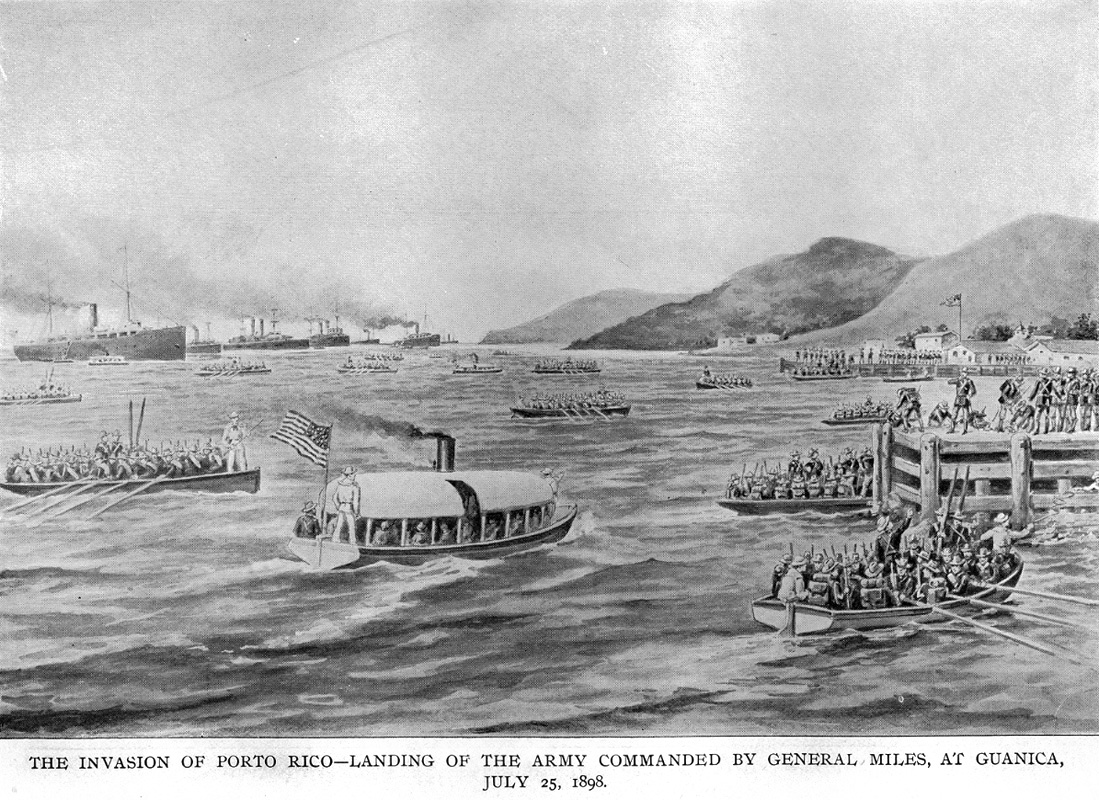
The invasion of Puerto Rico commenced on July 25, 1898, with the landing of American forces led by Major General Nelson A. Miles at Guánica Bay on the island’s southwestern coast. The choice of Guánica was strategic; it was an unprotected port, far from the heavily fortified capital of San Juan. The American forces, numbering around 16,000 men, were met with little sustained resistance from the Spanish and local volunteers, many of whom were already disillusioned with Spanish rule.
The campaign was relatively swift, lasting only 19 days. American troops advanced across the island, engaging in a series of skirmishes rather than major battles. Notable encounters occurred near Ponce, Coamo, and Aibonito. The advance towards San Juan was underway when news of an armistice between Spain and the United States reached the island on August 13, 1898. This armistice effectively halted hostilities, signaling the end of the Spanish-American War and, crucially, the end of Spanish dominion over Puerto Rico. The invasion itself had a relatively low casualty count but profoundly altered the island’s destiny, paving the way for a new era under American control. This period set the foundation for many of the historic landmarks and cultural practices that visitors can explore today, from military fortifications to the layout of colonial towns.
Formalizing Control: The Treaty of Paris and Early American Rule
The cessation of hostilities merely paved the way for the formal transfer of sovereignty. The true moment America gained control of Puerto Rico was solidified not on the battlefield, but at the negotiation table in Paris, followed by the establishment of an American civil government.
The Terms of Cession: A Post-War Reckoning
The official transfer of Puerto Rico to the United States was formalized by the Treaty of Paris, signed on December 10, 1898. This landmark treaty concluded the Spanish-American War and stipulated that Spain would cede Cuba, Puerto Rico, and Guam to the United States and sell the Philippines for $20 million. From this date forward, Puerto Rico officially became a territory of the United States.
For the residents of Puerto Rico, this transition was abrupt and without their direct input. The treaty effectively transferred sovereignty over the island and its inhabitants without consulting the Puerto Rican people themselves. This lack of self-determination at such a crucial juncture has remained a contentious issue throughout the island’s history, influencing its political status debates to this very day. However, for American travelers, this historical shift means that visiting Puerto Rico feels both familiar and exotically distinct, offering the ease of domestic travel with the allure of international discovery.
The Foraker Act of 1900: Establishing Civil Government
Following the Treaty of Paris, Puerto Rico was initially governed by a military administration. This transitional period was marked by the establishment of American institutions and the introduction of new policies. However, it quickly became clear that a more permanent civil structure was needed. This led to the passage of the Foraker Act of 1900, also known as the Organic Act of 1900.

The Foraker Act officially established a civilian government in Puerto Rico. It declared the island an unincorporated territory of the United States, meaning that while it belonged to the U.S., it was not considered an integral part of the nation, and the full provisions of the U.S. Constitution did not automatically apply. The Act provided for a governor appointed by the U.S. President, an executive council (also appointed by the President), and a House of Delegates elected by the people of Puerto Rico. Crucially, the inhabitants of Puerto Rico were designated as “citizens of Puerto Rico,” not U.S. citizens, although they were afforded protection by the United States. This early framework set the stage for subsequent political developments, creating a unique legal and political relationship that continues to shape the island’s governance and its distinct cultural identity.
The Evolution of Status: Citizenship, Self-Governance, and the Commonwealth
The initial phase of American control was merely the beginning of a dynamic and evolving relationship. Over the subsequent decades, the political status of Puerto Rico would undergo significant changes, driven by both American policy and the aspirations of the Puerto Rican people. These developments, particularly the granting of U.S. citizenship, have profoundly impacted the island’s socioeconomic landscape and its connection to the American mainland, influencing everything from the ease of travel to the unique cultural blend experienced by visitors.
The Jones-Shafroth Act of 1917: Granting U.S. Citizenship
One of the most significant milestones in Puerto Rico’s relationship with the United States was the passage of the Jones-Shafroth Act in 1917. This act superseded the Foraker Act and brought several crucial changes. Most notably, it granted U.S. statutory citizenship to all Puerto Ricans born on or after April 11, 1899. This was not a constitutional grant of citizenship, meaning it could theoretically be revoked by Congress, but it nonetheless had monumental implications.
The granting of U.S. citizenship meant that Puerto Ricans could now travel freely between the island and the mainland United States without passports. It also made them eligible for military service, a factor that became particularly relevant with America’s entry into World War I just months after the act’s passage. While the act also introduced a bill of rights and a popularly elected Senate, the executive power remained largely with the U.S.-appointed governor. Despite its limitations, the Jones-Shafroth Act was a pivotal step, integrating Puerto Ricans more deeply into the American national fabric while retaining their distinct cultural identity. For today’s travelers, this means a seamless experience for U.S. citizens, offering the excitement of an international getaway without the need for currency exchange or customs clearance.
Crafting the Commonwealth: A Unique Political Arrangement
The desire for greater self-governance continued to grow throughout the mid-20th century. This culminated in 1950 with the passage of Public Law 600, which authorized Puerto Rico to draft its own constitution. After a constitutional convention and a referendum, the Puerto Rico Commonwealth Constitution was approved by the U.S. Congress and enacted in 1952. This established the “Commonwealth of Puerto Rico” (Estado Libre Asociado in Spanish), a unique political status that continues to define the island’s relationship with the United States.
Under this commonwealth status, Puerto Rico exercises a significant degree of local autonomy, managing its internal affairs, electing its own governor and legislative assembly. However, it remains subject to U.S. federal laws, defense, and foreign policy, and its residents do not have voting representation in the U.S. Congress nor can they vote in U.S. presidential elections, despite being U.S. citizens. This intricate balance of self-rule and federal oversight creates a compelling political backdrop that adds depth to any visit. Understanding this unique arrangement helps visitors appreciate the dual identity of the island – both distinctly Puerto Rican and undeniably American – reflected in its legal system, economy, and the daily lives of its people. The ongoing debate over statehood, independence, or enhanced commonwealth status remains a vibrant part of the island’s political landscape, influencing the rich intellectual and cultural discourse that travelers can observe and engage with.
Puerto Rico Today: A Legacy of History, a Haven for Travelers
The historical journey from Spanish colony to an American territory with commonwealth status has profoundly shaped modern Puerto Rico. Today, the island stands as a testament to its multifaceted past, offering travelers an unparalleled opportunity to immerse themselves in a destination where centuries of history blend seamlessly with a vibrant contemporary lifestyle. It is this rich tapestry, born from its unique political evolution, that makes Puerto Rico a truly exceptional place to visit.
Immersive Cultural Experiences and Historic Landmarks
The echoes of 1898 and the centuries that preceded it are palpable throughout Puerto Rico. Old San Juan, a UNESCO World Heritage Site, is a living museum, its cobblestone streets and colorful colonial buildings whispering tales of Spanish conquistadors and American soldiers alike. Visitors can explore El Morro (Fuerte San Felipe del Morro) and Castillo San Cristóbal, massive fortresses that have stood guard over San Juan Bay for centuries. These iconic landmarks, once crucial strategic points during both Spanish and American rule, now offer panoramic views and fascinating insights into military architecture and the island’s defensive history.
Beyond the fortifications, the cultural landscape is a vibrant fusion. The island’s rich gastronomy reflects its Taíno, Spanish, and African roots, enhanced by American influences, offering a delectable journey through its history. From the bustling markets to the serene churches, every corner of Puerto Rico tells a story. Even beyond the historical sites, the island offers natural wonders like the lush El Yunque National Forest, the only tropical rainforest in the U.S. National Forest System, and mesmerizing Bioluminescent Bays, showcasing the island’s diverse natural allure alongside its historical depth.

Planning Your Visit: Accommodation and Lifestyle on the Island
For travelers from the United States, visiting Puerto Rico is refreshingly convenient. As a U.S. territory, no passport is required for U.S. citizens, and the currency is the U.S. dollar, simplifying travel logistics significantly. This ease of access, combined with a diverse range of accommodation options, makes it an ideal choice for various lifestyle preferences.
Whether you’re seeking luxury travel at world-class resorts like the Dorado Beach, a Ritz-Carlton Reserve or the historic elegance of the Condado Vanderbilt Hotel, or if you prefer budget travel through charming boutique hotels and guesthouses, Puerto Rico caters to every taste. Family trips will find countless attractions from beaches to museums, while business stays benefit from modern infrastructure and welcoming hospitality. The island’s dynamic tourism sector thrives on its unique identity, offering everything from adrenaline-pumping water sports to serene beach relaxation, all set against a backdrop of compelling history and genuine warmth.
In conclusion, America gained control of Puerto Rico in 1898, a consequence of the Spanish-American War and solidified by the Treaty of Paris. This historical turning point ushered in an era of American influence that, over a century, has evolved into the unique commonwealth status we see today. This journey from colonial possession to a self-governing U.S. territory has created an island rich in historical narratives, cultural depth, and breathtaking natural beauty. For any traveler, exploring Puerto Rico is not just a vacation; it’s an immersive experience into a living history, a vibrant culture, and a destination that truly embodies the confluence of its distinctive past and dynamic present.
LifeOutOfTheBox is a participant in the Amazon Services LLC Associates Program, an affiliate advertising program designed to provide a means for sites to earn advertising fees by advertising and linking to Amazon.com. Amazon, the Amazon logo, AmazonSupply, and the AmazonSupply logo are trademarks of Amazon.com, Inc. or its affiliates. As an Amazon Associate we earn affiliate commissions from qualifying purchases.