
Embarking on a journey of identity often involves making significant personal choices, and for many in the Lone Star State, that includes changing their name. Whether driven by marriage, divorce, a desire for a fresh start, or deeply personal reasons, navigating the legal intricacies of a name change in Texas can seem daunting. This comprehensive guide aims to demystify the process, offering a clear roadmap for residents seeking to alter their legal designation. Beyond the paperwork, we’ll also explore how to make the practical aspects of this transition, including any necessary travel or accommodation, as smooth and comfortable as possible, aligning with the lifestyle of our readers who appreciate both efficiency and the opportunity to experience new destinations.

The act of changing one’s name is more than just an administrative task; it’s a profound personal declaration. It touches upon various facets of one’s life, from legal documents and financial records to social interactions and personal identity. While the process can vary slightly depending on the specific circumstances and the county in which you reside, the fundamental steps remain consistent across Texas. Our goal is to provide a detailed, easy-to-follow guide that empowers you to confidently undertake this important life change.
Navigating the Texas Name Change Landscape
Understanding the reasons behind a name change and the general requirements sets the foundation for a successful application. Texas law provides pathways for individuals to change their name, but it’s crucial to distinguish between various scenarios and their corresponding procedures.
Understanding the “Why”: Reasons for a Name Change
The motivations behind changing a name are as diverse as the individuals themselves. The most common reasons include:
- Marriage: Traditionally, one spouse, typically the wife, may choose to adopt the other spouse’s surname. This is often a relatively straightforward process initiated when applying for a marriage license or subsequently with the Social Security Administration.
- Divorce: Individuals may wish to revert to a maiden name or a previous name as part of their divorce decree. This is frequently handled within the divorce proceedings itself, making it a more streamlined change than a general petition.
- Personal Preference/Fresh Start: Many individuals simply desire a different name for personal reasons—perhaps disliking their birth name, seeking to honor an ancestor, or marking a significant life transition. This category typically requires the most formal legal process.
- Safety and Protection: In cases of domestic violence or threats, a name change can be a critical step for an individual’s safety and to create distance from an abusive past.
- Cultural or Religious Reasons: Some individuals change their names to align with cultural traditions, religious conversions, or to better reflect their heritage.
- Gender Transition: For individuals undergoing gender transition, changing their legal name to match their affirmed gender identity is a vital step in their journey.
- Correction of Errors: Occasionally, a name change is necessary to correct a spelling error or discrepancy on birth certificates or other official documents.
Regardless of the reason, the commitment to legally change one’s name requires careful consideration and adherence to Texas statutes.
General Requirements and Initial Steps
Before you even fill out a form, it’s important to understand the basic prerequisites:
- Residency: Generally, you must be a resident of Texas and file your petition in the county where you have legally resided for at least six months. This could mean filing in a bustling metropolitan area like Houston, Dallas, or Austin, or a smaller, more rural county.
- Age: Adults (18 years or older) can petition for their own name change. For minors, the process involves additional steps and considerations for parental consent, which we will discuss later.
- No Intent to Defraud: The most critical requirement is that you must not be changing your name to defraud creditors, evade criminal prosecution, or for any other unlawful purpose. The court will scrutinize your intent to ensure it is legitimate.
- Clean Criminal Record (for certain cases): For an adult seeking a name change not connected to marriage or divorce, the court will typically require a criminal background check to ensure there are no disqualifying offenses. This is a measure to prevent individuals from changing their names to escape legal obligations.
The initial steps often involve consulting your local District Clerk’s office or County Clerk’s office—depending on the specific type of name change and the county—to obtain the correct forms and understand local filing procedures. While the overall process is statewide, minor procedural differences can exist from one county to another.
The Formal Process for Adults: A Step-by-Step Guide
For adults seeking a name change outside of marriage or divorce proceedings, the process generally involves filing a petition with the court, undergoing a background check, and attending a hearing.
Petitioning the Court: Filing Your Request
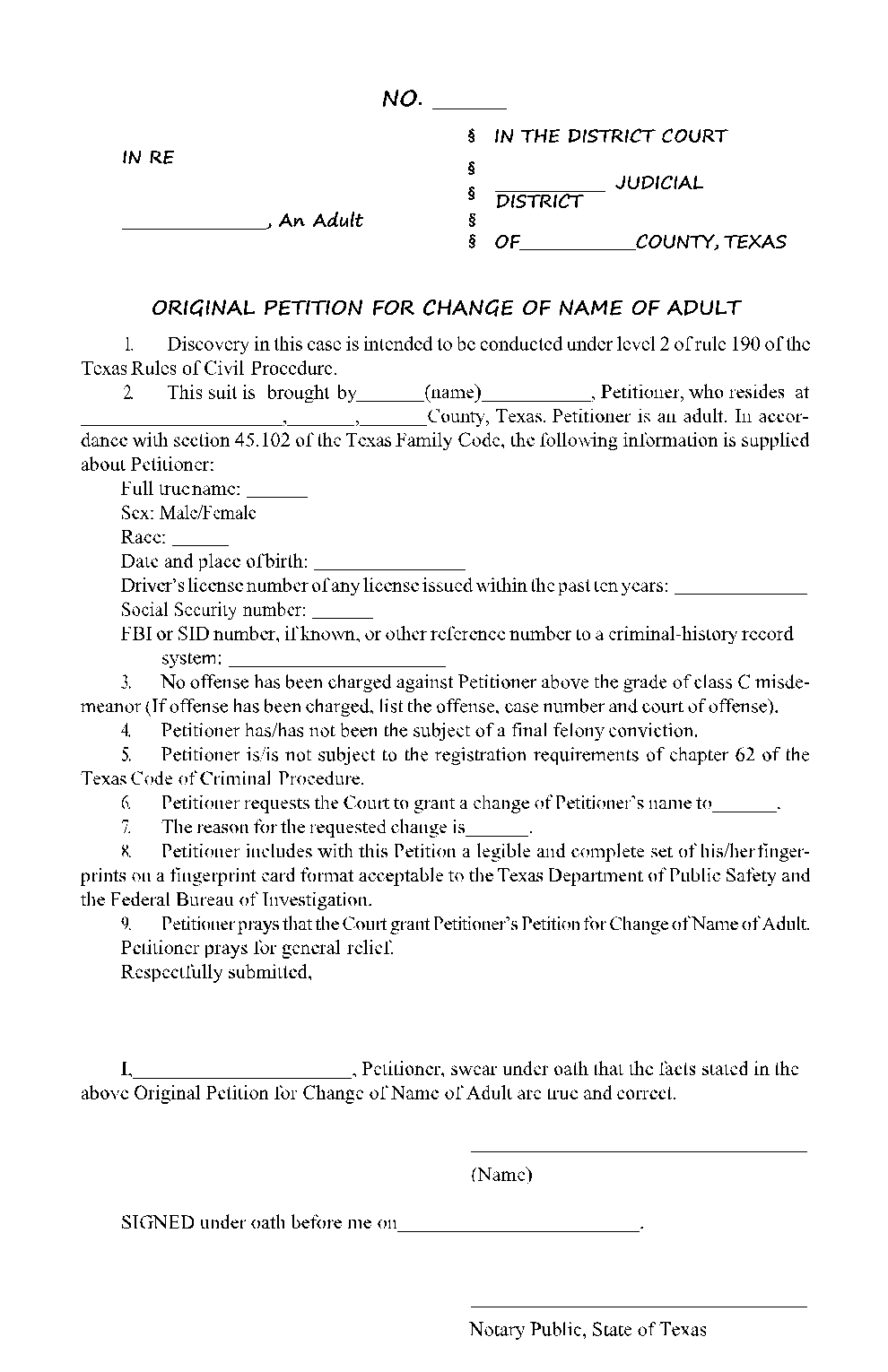
The cornerstone of an adult name change in Texas is the Petition for Change of Name. This is a formal legal document that you will file with the District Clerk in the county where you reside.
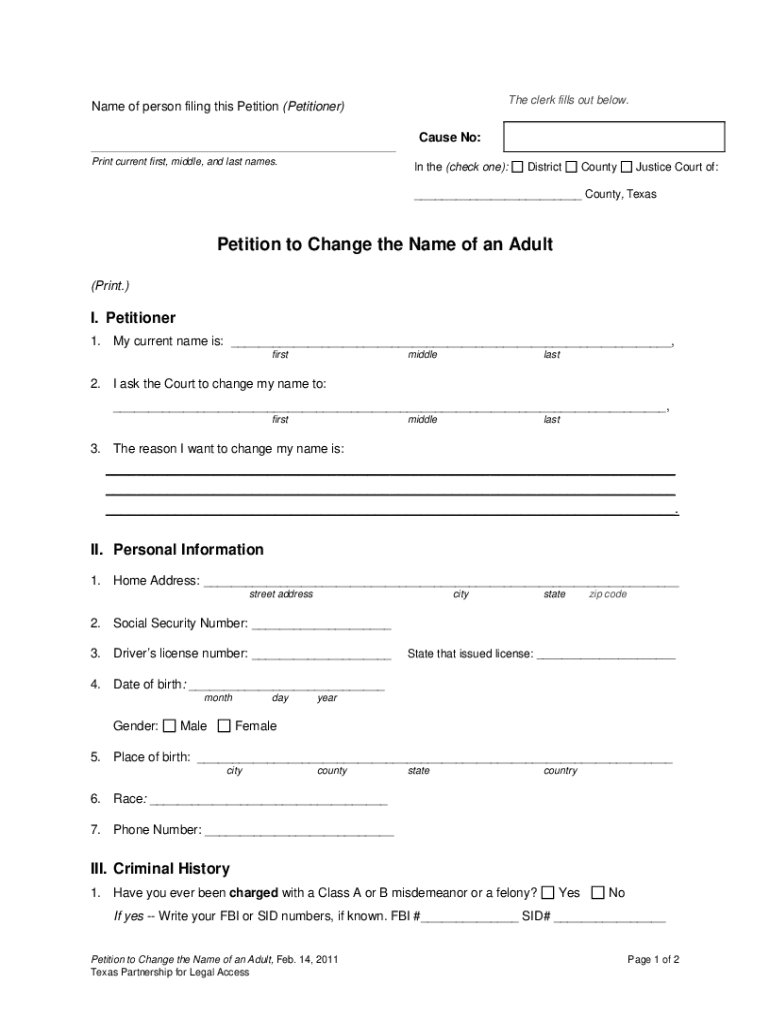
- Obtain the Correct Forms: You can usually find the necessary forms on your county’s District Clerk website or in person at their office. Some counties, like those in Harris County (serving Houston) or Travis County (serving Austin), may have specific forms tailored to their local courts. Ensure you have the “Petition for Change of Name of an Adult” form.
- Complete the Petition: This document will require you to provide your current full legal name, your desired new name, your date of birth, place of birth, current address, and the specific reasons for the name change. It will also ask for declarations about your intent (e.g., that you are not changing your name to avoid creditors or criminal prosecution). Fill out all sections accurately and thoroughly.
- Attach Required Documents: You will typically need to attach copies of your current government-issued identification (such as a driver’s license or state ID) and possibly your birth certificate.
- File the Petition and Pay Fees: Once completed, take the petition and any attachments to the District Clerk’s office for filing. There will be a filing fee, which can vary by county but usually ranges from $250 to $350. If you cannot afford the fee, you may be able to file a Statement of Inability to Afford Payment of Court Costs.
- Service of Process (Rare for Adults): In most adult name changes, there’s no need to “serve” anyone, as you are the sole petitioner. However, if there’s any interested party (e.g., a former spouse if the name change impacts alimony or child support agreements), they might need to be notified.
The Importance of Fingerprints and Background Checks
For adult name changes not associated with marriage or divorce (where documentation typically suffices), Texas law mandates a criminal history check. This is a crucial step to ensure the name change is not for illicit purposes.
- Fingerprinting: After filing your petition, the court will generally order you to obtain fingerprints. You will receive instructions on where to go for this, often through a designated vendor or law enforcement agency. The cost for fingerprinting is separate from the filing fee.
- Criminal Background Check: These fingerprints are then submitted for a thorough criminal background check through state and federal databases. The results are sent directly to the court. If your background check reveals any serious criminal history, especially for felonies, the court may deny your petition or require further explanation and evidence of rehabilitation. The court prioritizes public safety and ensures the name change does not facilitate any illegal activities.
Public Notice and Court Hearings
Depending on your county and the specific circumstances, you might be required to publish notice of your intent to change your name in a local newspaper. This allows any interested parties to raise objections.
- Publication (If Required): Your county clerk will inform you if publication is necessary. This step typically involves publishing a notice in a legal newspaper circulated in your county for a specified period (e.g., once a week for two consecutive weeks). This process incurs additional costs.
- Court Hearing: After all documents are filed, fees paid, and the background check completed, the court will schedule a hearing.
- What to Expect: Attend the hearing on time and be prepared to answer questions from the judge regarding your reasons for the name change, your identity, and your intent. The judge will review your petition, background check, and ensure all legal requirements have been met.
- Obtaining the Order: If the judge approves your petition, they will sign an Order Changing Name. This is the official legal document that formally changes your name. Ensure you obtain several certified copies of this order from the District Clerk’s office, as you will need them for updating all your identification and records. There is usually a small fee per certified copy.
For those traveling to a major judicial hub like Austin or Houston for their court date, planning your visit carefully can alleviate stress. Consider staying overnight if you have an early morning hearing, perhaps at a conveniently located property like the Hyatt Regency Austin or the Marriott Marquis Houston, which offer excellent amenities and are often close to downtown courthouses. This turns a potentially stressful day into a more manageable experience, allowing you to focus on the legal proceedings without worrying about travel logistics.
Special Circumstances: Minors, Marriage, and Divorce
While the general petition process applies to many adults, specific life events offer alternative, often more streamlined, pathways for name changes.
Changing a Minor’s Name: Parental Consent and Best Interests
Changing a child’s name is a more complex process designed to protect the child’s best interests.
- Who Can File: Usually, a parent or legal guardian initiates the petition.
- Parental Consent: If both parents are living and their parental rights have not been terminated, both typically must consent to the name change. If one parent objects, the court will hold a hearing to determine if the name change is in the child’s best interest.
- Service of Process: The non-petitioning parent must be formally served with notice of the petition, giving them an opportunity to respond or object.
- Best Interest of the Child: The judge’s primary consideration will always be the “best interest of the child.” Factors considered include the child’s wishes (if they are old enough to express a reasoned preference), the child’s relationship with each parent, the impact of the name change on the child’s sense of identity, and any potential confusion or harm.
- No Criminal History Check: Generally, a criminal background check is not required for a minor’s name change, as the focus is on the child’s welfare.
This process requires careful navigation, and seeking legal counsel is highly recommended, especially in cases where one parent objects or is difficult to locate.
Streamlined Processes: Name Changes via Marriage or Divorce
These are typically the easiest ways to change your name in Texas, as they are usually handled through administrative channels rather than a full court petition.
- Marriage:
- When applying for a marriage license in Texas, you can indicate your intention to change your surname.
- After your marriage is solemnized and the license returned to the county clerk, you will use your certified marriage certificate as proof of your name change.
- You then present this certificate to the Social Security Administration (SSA) to update your Social Security card, and subsequently to the Department of Public Safety (DPS) for your driver’s license/state ID, and the U.S. Passport Agency for your passport. No separate court petition is usually required.
- Divorce:
- If you wish to revert to a maiden name or a prior legal name, you can request this directly within your divorce decree.
- The judge will include an order in the final divorce decree restoring your previous name.
- A certified copy of the divorce decree then serves as your legal proof for updating your name with the SSA, DPS, and other entities. This avoids the need for a separate petition for name change.
After the Name Change: Updating Your Identity
Obtaining the court order or divorce decree is just the first step. The real work begins afterward: updating all your official documents and records to reflect your new legal name. This phase is critical to ensure your new identity is recognized everywhere.
Essential Government Agencies to Notify
Promptly notifying key government agencies is paramount to avoid inconsistencies and future complications.
- Social Security Administration (SSA): This should be your first stop. Take your certified Order Changing Name (or marriage certificate/divorce decree) and your current Social Security card, driver’s license, and proof of U.S. citizenship (e.g., birth certificate or passport) to your local SSA office. They will issue you a new Social Security card with your updated name. This is crucial because many other agencies verify your name against SSA records.
- Department of Public Safety (DPS) – Driver’s License/State ID: Once you have your new Social Security card, visit a Texas DPS office to update your driver’s license or state identification card. You will need your certified name change order (or marriage certificate/divorce decree), your new Social Security card, and current ID. You may need to pay a small fee for a replacement card.
- U.S. Passport Agency: If you have a passport, you must update it. The process and required forms (Form DS-11 or Form DS-82) depend on how recently your current passport was issued and if it was issued in your old name. Visit the official U.S. Department of State website for detailed instructions and forms. Timely passport updates are vital, especially for those who travel internationally, to prevent delays or issues at border control points.
Practical Adjustments: Banks, Employers, and Beyond
Beyond the core government IDs, a multitude of other entities require notification of your name change. Creating a checklist can be incredibly helpful.
- Financial Institutions: Banks, credit unions, credit card companies, and investment firms.
- Employer/HR Department: For payroll, benefits, and official records.
- Insurance Providers: Health, auto, home, and life insurance.
- Utilities: Electric, gas, water, internet, and phone companies.
- Medical Providers: Doctors’ offices, hospitals, and pharmacies.
- Educational Institutions: Schools, colleges, and universities (for diplomas, transcripts, etc.).
- Professional Licensing Boards: If you hold a professional license (e.g., nurse, lawyer, teacher).
- Voting Registration: Update your voter registration with your county election administrator.
- Property Records: If you own real estate, consult your county clerk or an attorney to see if any deeds or titles need updating.
- Mail and Subscriptions: Inform postal services and any magazines or online subscriptions.
- Online Accounts: Social media, email, and other online services.
This phase is about diligently working through every aspect of your life that uses your name. It can take time and requires attention to detail, but thoroughness now will prevent complications later. A new name can usher in a new sense of identity and freedom, potentially influencing your lifestyle choices, from how you travel to how you engage with new experiences. Ensuring all your documents are consistent will make future adventures, whether a local Texas road trip or an international escape, completely seamless.
Making Your Texas Journey Seamless: Travel and Accommodation Tips
For individuals who might need to travel to a county seat for court appearances or to access specific administrative offices, integrating the name change process into a broader travel plan can make it a less arduous and more engaging experience. Our readers, who value exploration and comfort, can find opportunities even within these necessary trips.
Planning Your Visit to Texas’s Judicial Hubs
Texas boasts several major cities that serve as significant judicial centers, each with its own unique charm and attractions. If your legal process requires you to visit one, consider it an opportunity for a mini-exploration.
- Austin: The state capital, known for its vibrant live music scene and tech industry. If your legal matters bring you here, you might extend your stay to explore Zilker Park or the Texas State Capitol.
- Houston: Texas’s largest city, a hub for energy, space exploration, and a diverse culinary scene. While here, you could visit Space Center Houston or the Museum District.
- Dallas: A dynamic metropolis known for its arts, fashion, and business. Consider a visit to the Dallas Arts District or the Dallas World Aquarium.
- San Antonio: Rich in history and culture, home to the iconic The Alamo and the beautiful Riverwalk. A name change trip could easily transform into a historical getaway.
- Fort Worth: Known for its Western heritage and cultural districts. The Fort Worth Stockyards National Historic District offers a unique glimpse into the cowboy lifestyle.
Planning your travel during off-peak times can sometimes offer better rates on flights or fuel, and fewer crowds if you plan to do some sightseeing.
Selecting Your Ideal Accommodation
Your choice of accommodation can significantly impact the comfort and convenience of your name change journey. Given the potential stress of legal proceedings, a well-chosen hotel or apartment can provide a welcome respite.
- Luxury Stays: For those who prefer to combine necessary travel with indulgence, Texas major cities offer superb luxury hotels. The Four Seasons Austin, The Post Oak Hotel at Uptown Houston, or The Ritz-Carlton Dallas offer exquisite amenities, fine dining, and proximity to downtown judicial centers. These provide a tranquil environment to prepare for your hearing or unwind afterward.
- Mid-Range and Boutique Options: Many cities have excellent mid-range hotels that balance comfort and cost. Look for hotels with business centers, reliable Wi-Fi, and convenient access to public transportation or parking near the courthouses. Boutique hotels can offer a more personalized experience, often reflecting the local character.
- Extended Stay and Apartments: If your process requires multiple visits or a longer stay, considering extended-stay options or serviced apartments can be more economical and provide amenities like a kitchen, offering a home-away-from-home feel. This is particularly useful if you’re traveling with family or require more space.
- Budget-Friendly Options: For those mindful of costs, there are numerous reputable budget-friendly hotels and motels that offer clean, comfortable stays without breaking the bank. Booking in advance, especially outside of major event seasons, can secure better rates.
Always check for amenities like complimentary breakfast, fitness centers, and quiet workspaces, which can enhance your overall experience during what might otherwise be a taxing trip.
Exploring Local Culture and Landmarks
While the primary purpose of your trip might be a legal one, allow yourself time to experience the local culture and landmarks. This aligns with a lifestyle that values both necessity and enjoyment.
- Culinary Delights: Texas is renowned for its diverse food scene. Indulge in authentic barbecue in Lockhart, savor Tex-Mex in San Antonio, or explore the international flavors of Houston. Food can be a wonderful way to connect with a new place.
- Historical Sites: Visit a mission in San Antonio, learn about the state’s storied past at the Texas State History Museum in Austin, or explore the presidential libraries.
- Natural Beauty: Take a stroll along the Austin Lady Bird Lake trail, enjoy the urban green spaces, or explore nearby state parks if time permits.
By thoughtfully planning your travel and accommodation, you can transform the practicalities of a name change in Texas into an opportunity for personal growth and a deeper appreciation of the state’s vibrant destinations.
Changing your name in Texas is a significant undertaking that requires careful attention to legal procedures and subsequent administrative updates. While the process demands diligence, it ultimately leads to a refreshed identity that aligns with your true self. By following this guide, whether you’re navigating court filings, updating vital documents, or planning your travel to a judicial center, you can approach each step with confidence. Embrace this new chapter with thorough preparation and, where possible, infuse a sense of exploration into your journey, making your experience in the Lone Star State truly memorable.
LifeOutOfTheBox is a participant in the Amazon Services LLC Associates Program, an affiliate advertising program designed to provide a means for sites to earn advertising fees by advertising and linking to Amazon.com. Amazon, the Amazon logo, AmazonSupply, and the AmazonSupply logo are trademarks of Amazon.com, Inc. or its affiliates. As an Amazon Associate we earn affiliate commissions from qualifying purchases.