
The vast expanse of Texas, the second-largest state in the United States, is a land of unparalleled diversity, rich history, and vibrant culture. From the arid plains of the west to the piney woods of the east, and from the bustling metropolises to the serene coastal towns, Texas offers an incredible tapestry of experiences for every traveler. For anyone planning a journey through this magnificent state, whether for leisure, business, or a long-term stay, understanding its geographical layout is paramount. And, surprisingly, one of the most practical and insightful ways to grasp this layout is through its area codes. Far more than just prefixes for phone numbers, Texas area codes serve as implicit guides, delineating regions, hinting at local lifestyles, and even influencing travel planning and accommodation choices.
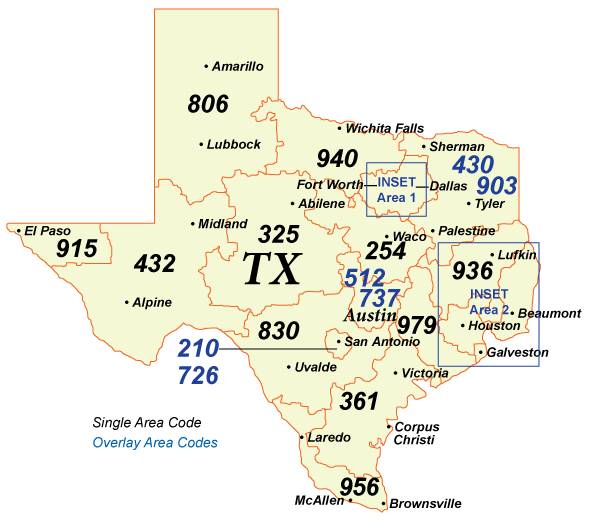
In a state as massive and populous as Texas, the telecommunication landscape has evolved dramatically over the decades, mirroring the state’s explosive growth and development. What began with a handful of codes to cover its immense territory has expanded into a complex web of overlays and splits, each reflecting the density and expansion of specific urban centers and surrounding rural areas. For those immersed in the world of travel, tourism, and accommodation, these digits offer a unique lens through which to explore Texas. They can help identify distinct destinations, anticipate the local ambiance, and even inform decisions about where to book a luxury suite in Dallas or a cozy villa near Austin’s Hill Country. This article will delve into the dynamic world of Texas area codes, showcasing their historical evolution and, more importantly, how they serve as an invaluable tool for navigating the state’s premier travel destinations, its diverse accommodation options, and its myriad of unforgettable experiences.
The Dynamic Landscape of Texas Area Codes: A Historical Perspective
The story of Texas’s area codes is inextricably linked to its phenomenal population growth and economic development, particularly since the mid-20th century. When the North American Numbering Plan (NANP) was first established in 1947, Texas was initially assigned just four area codes, reflecting its vast geographic size but relatively dispersed population at the time. These original codes — 214, 713, 512, and 915 — were strategically distributed to cover the state’s burgeoning urban centers and extensive rural territories.
- 214 served a significant portion of North Texas, anchored by the rapidly growing city of Dallas.
- 713 encompassed the Houston metropolitan area and much of the southeastern Texas coast.
- 512 covered Austin, San Antonio, and a large segment of the central and southern parts of the state.
- 915 was assigned to the expansive and sparsely populated West Texas region, including El Paso.
As the state’s population exploded, fueled by the oil industry, technological advancements, and a booming economy, these initial codes quickly became insufficient. The demand for new phone numbers necessitated the introduction of additional codes, primarily through two methods: splits and overlays. A “split” occurs when a single area code is divided into two or more distinct geographical regions, each receiving a new, separate area code. An “overlay,” on the other hand, introduces a new area code to the same geographical region already served by an existing code, meaning that dialing requires ten digits even for local calls. Texas has experienced both extensively, resulting in the rich tapestry of area codes we see today.
The Evolution of Texas’s Telecommunications Map
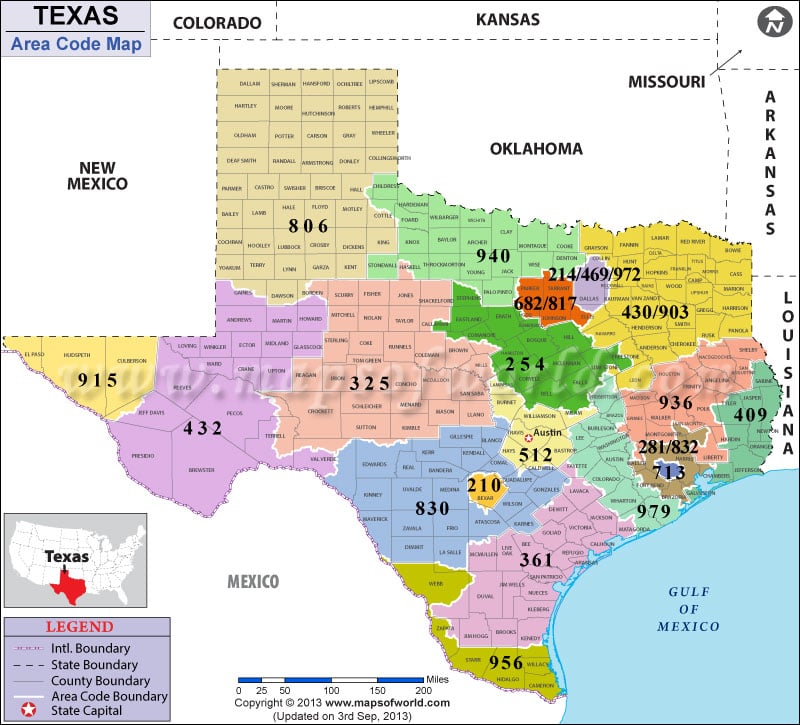
The first significant split occurred in 1954 when 817 was carved out of 214 to serve Fort Worth and much of the western part of the original 214 territory. This set a precedent for future expansions. By the 1990s, with the advent of cell phones and the internet, the pace of area code introduction accelerated dramatically. The late 20th and early 21st centuries saw the introduction of numerous new codes, such as 281 and 832 overlaying 713 in Houston, and 469 and 972 overlaying 214 in Dallas. Similarly, 210 was split from 512 to specifically serve San Antonio and its surrounding areas, with 726 later overlaying it. Austin eventually received its own overlay, 737.
Today, Texas boasts a large number of active area codes, each marking a unique geographical region or an overlay of a densely populated area. These codes are more than just numbers; they are markers of development, population density, and, for the discerning traveler, indicators of the type of experience one might expect in a particular Texas locale. Understanding this historical progression helps frame the present-day distribution and significance of these digits in the context of travel and lifestyle choices across the Lone Star State.
Navigating Texas: Area Codes as Guides to Iconic Destinations
For travelers and tourism enthusiasts, Texas area codes offer a subtle yet effective way to segment the state and focus on specific regions. Each cluster of codes often corresponds to a major metropolitan area or a distinct geographical and cultural zone, guiding visitors toward specific destinations and attractions.
Houston and Its Surrounding Grandeur: 713, 281, 832, 346
The Houston metropolitan area, a global hub for energy, healthcare, and aerospace, is primarily covered by a multi-code overlay: 713, 281, 832, and more recently, 346. These codes signify a vast, sprawling urban landscape teeming with attractions and opportunities. When planning a trip to Houston, these codes immediately tell you you’re entering one of the largest and most diverse cities in the United States.
Visitors to Houston can explore the fascinating Space Center Houston, a landmark of human endeavor, or delve into the rich cultural offerings of the Museum District, home to institutions like the Museum of Fine Arts, Houston and the Houston Museum of Natural Science. For accommodation, Houston offers everything from luxury hotels in Downtown Houston like The Post Oak Hotel at Uptown Houston to boutique stays in neighborhoods like Montrose. The city’s culinary scene is globally recognized, reflecting its diverse population. For business travelers, Houston’s extensive convention facilities and business-friendly hotels cater to all needs, emphasizing a lifestyle that blends professional ambition with ample leisure.
Dallas-Fort Worth Metroplex: A Hub of Culture and Commerce: 214, 469, 972, 817, 682
North Texas is dominated by the sprawling Dallas-Fort Worth Metroplex, a conurbation so vast it necessitates multiple area codes. Dallas and its immediate suburbs are served by 214, 469, and 972, while its sister city, Fort Worth, and its surrounding communities use 817 and 682. This distinction highlights the unique identities of these two major cities within one massive urban area.
In Dallas, visitors can explore the poignant history at the Sixth Floor Museum at Dealey Plaza, marvel at the impressive Dallas Arts District, or indulge in high-end shopping and dining. Accommodation ranges from opulent resorts like The Ritz-Carlton, Dallas to stylish apartments ideal for long-term stays. Fort Worth, often dubbed “Where the West Begins,” offers a different flavor with its historic Stockyards National Historic District, world-class museums in its Cultural District, and a vibrant rodeo scene. Hotels in Fort Worth often embrace its Western heritage, providing a unique tourism experience. The Dallas-Fort Worth codes signify a dynamic region offering both sophisticated urbanity and authentic Texan charm.
Austin and San Antonio: Hill Country Charms: 512, 737, 210, 726
The heart of Texas, encompassing the picturesque Hill Country, is home to two of the state’s most beloved cities: Austin and San Antonio. Austin, the state capital, uses 512 and its overlay 737. San Antonio is served by 210 and its overlay 726. These codes delineate distinct cultural experiences that are quintessential Texas.
Austin, known as the “Live Music Capital of the World,” offers a vibrant, eclectic lifestyle that appeals to creatives, tech professionals, and nature lovers alike. Visitors can explore the iconic Texas State Capitol, enjoy outdoor activities on Lady Bird Lake, or immerse themselves in the thriving food truck scene. Accommodation in Austin ranges from trendy boutique hotels downtown to charming bed-and-breakfasts nestled in the Hill Country.
Just a short drive south, San Antonio offers a deeply rooted historical and cultural experience. Its area codes point to a city rich in heritage, famed for the legendary Alamo and the enchanting River Walk. San Antonio is a top tourism destination, with its Spanish colonial missions (a UNESCO World Heritage Site) and vibrant Mexican culture. Hotels along the River Walk provide unparalleled access to dining, shopping, and entertainment, embodying the city’s unique charm and hospitality. These central Texas area codes promise a blend of history, nature, and modern vibrancy.
The Expansive Reach: West Texas, Gulf Coast, and Beyond: 915, 432, 806, 361, 956, 409, 903, 430, 940, 325, 254, 936, 979, 830
Beyond the major metropolises, Texas is a mosaic of diverse regions, each with its own character and corresponding area codes. These codes open up possibilities for different types of travel, from rugged adventure to serene coastal getaways.
- West Texas (915, 432, 806): Codes like 915 for El Paso and the far western edge, 432 for the Permian Basin cities of Midland and Odessa, and 806 for the Panhandle cities like Lubbock and Amarillo, point to a landscape of vast plains, desert beauty, and rich cowboy heritage. Here, travelers can explore national parks like Big Bend, experience authentic ranch stays, or delve into the history of the oil boom. Accommodation here often includes charming local motels, budget-friendly hotels, and unique cabins.
- Gulf Coast (361, 956, 409): The codes 361 for Corpus Christi and the Coastal Bend, 956 for the Rio Grande Valley (including Brownsville and McAllen), and 409 for Galveston and Beaumont signify sun-drenched beaches, rich Mexican-American culture, and abundant wildlife. These regions are perfect for family trips, fishing excursions, and exploring coastal natural beauty. Resorts and beachfront accommodations are plentiful, offering diverse options for every budget.
- East and Central Texas (903, 430, 940, 325, 254, 936, 979, 830): Codes like 903 and 430 for East Texas (home to cities like Tyler and Longview), 940 for North Texas beyond DFW (e.g., Wichita Falls), 325 for Abilene and San Angelo, 254 for Waco and Killeen, 936 and 979 for other parts of Southeast Texas, and 830 for the outer Hill Country and South Central Texas (e.g., New Braunfels, Fredericksburg) cover an enormous range of landscapes from pine forests to rolling hills. These areas offer tranquil escapes, historical towns, and outdoor recreation, with accommodation often featuring charming bed-and-breakfasts, cabin rentals, and smaller, locally owned hotels.
Each of these area code regions tells a story about the local culture, the available activities, and the kind of travel experience awaiting the visitor. For those seeking local culture, authentic food, or specific types of lodging, the area code can be a quick and easy indicator of what lies ahead.
Planning Your Texas Journey: Area Codes for Seamless Travel and Accommodation
In the intricate dance of travel planning, every detail contributes to a seamless and memorable experience. While perhaps not the first consideration, Texas area codes can play a surprisingly practical role in organizing your trip, enhancing your understanding of local nuances, and making informed choices about accommodation.
Making Connections: How Area Codes Enhance Your Travel Experience
For the modern traveler, area codes are more than just phone prefixes; they are geographic signposts. When you encounter a phone number with a specific Texas area code, it immediately grounds that business, attraction, or contact person to a particular region. This knowledge can be incredibly useful:
- Local Business Identification: If you’re looking for local restaurants, tour operators, or unique shops, a local area code confirms their geographic proximity to your desired destination. For example, seeing a 512 number for a barbecue joint instantly signals it’s an Austin establishment, aligning with the city’s renowned food scene and helping you integrate into the local culture.
- Emergency Services and Local Information: While 911 handles emergencies, knowing the local area code can be helpful for non-emergency services, local police departments, or city information lines. It also aids in quick online searches for local services, helping you narrow down results to the specific area you’re visiting.
- Understanding Dialing Conventions: With the prevalence of overlay codes, especially in major metro areas like Houston (713/281/832/346) and Dallas (214/469/972), ten-digit dialing for all local calls is standard. Being aware of the local codes prevents confusion and ensures successful connections, which is crucial for booking tours, confirming reservations, or communicating with local guides.
- Mapping Your Itinerary: As highlighted earlier, distinct area codes often correspond to distinct travel experiences. Seeing an 806 code might prompt thoughts of West Texas ranch adventures, while a 409 code would guide you towards coastal escapes in Galveston. This can subtly inform your itinerary planning, ensuring you allocate appropriate travel time and align your activities with the region’s offerings.
For those planning extended stays or even considering relocating, understanding the area code distribution offers a glimpse into the local demographics and connectivity. It’s a small detail, but one that contributes to a more informed and streamlined travel experience.
Choosing Your Stay: Area Codes and Accommodation Choices
The influence of area codes extends directly to accommodation planning, helping travelers navigate the vast array of hotels, resorts, apartments, and villas available across Texas.
- Targeted Hotel Searches: When searching for hotels or vacation rentals, having an idea of the area code for your desired location can refine your search. For instance, if you’re looking for a luxury resort near San Antonio’s River Walk, knowing it’s covered by 210 or 726 helps verify that a listing is genuinely local and not in a distant suburb.
- Matching Accommodation to Lifestyle: Area codes often correlate with specific lifestyles and associated accommodation types.
- Urban Sophistication: Codes like 214 (Dallas) or 713 (Houston) typically lead to options for luxury travel, including high-rise suites, business hotels, and serviced apartments with extensive amenities catering to both discerning leisure travelers and business stays.
- Creative and Bohemian: An Austin 512 or 737 code might suggest trendy boutique hotels, eco-friendly lodges, or unique Airbnb rentals that align with the city’s “Keep Austin Weird” ethos.
- Historic Charm: In areas like San Antonio (210, 726), you might find charming historic hotels or guesthouses that reflect the city’s rich past, often near landmarks.
- Rural Escapes and Family Trips: For codes like 830 (Hill Country) or 361 (Coastal Bend), you’d likely find more family-friendly resorts, cabins, or vacation villas suited for outdoor activities and longer, more relaxed stays.
- Long-Term Stay Planning: For individuals considering extended visits or temporary relocation, knowing the area codes of potential neighborhoods helps in comparison shopping for apartments or understanding utility service areas. It’s a small but significant piece of the puzzle for a seamless transition.
In essence, while not explicitly designed for travel planning, Texas area codes offer an unspoken guide to the state’s geography, culture, and available services. By understanding their distribution and significance, travelers can navigate the Lone Star State with greater confidence, make more informed decisions about where to go and where to stay, and ultimately enrich their overall Texas experience.

Conclusion
The vast and vibrant state of Texas truly is a world unto itself, offering an unparalleled range of experiences for every type of traveler. From the dynamic urban centers pulsating with economic activity and cultural innovation to the serene natural landscapes that invite adventure and reflection, Texas consistently delivers unforgettable journeys. At first glance, the state’s telephone area codes might seem like a mere technicality. However, as we’ve explored, these numerical prefixes serve as much more than just dialing instructions; they are insightful geographical markers, historical indicators, and practical tools for navigating the diverse tapestry of the Lone Star State.
Understanding the distribution and evolution of Texas area codes — from the foundational 214, 713, 512, and 915 to the numerous splits and overlays necessitated by relentless growth — provides a unique lens through which to appreciate the state’s development. For those planning a trip, these codes become an invaluable, albeit subtle, guide. They help identify distinct regions, from the sophisticated allure of the Dallas-Fort Worth Metroplex to the energetic pulse of Houston, and the eclectic charm of Austin to the rich historical tapestry of San Antonio. Beyond the major cities, area codes also point to the wild beauty of West Texas, the relaxed vibes of the Gulf Coast, and the serene expanses of East and Central Texas.
Whether you are seeking a luxury lifestyle experience in a five-star resort, a budget-friendly adventure exploring local culture, or a comfortable long-term stay in a spacious apartment, the area codes subtly inform your choices. They streamline your search for accommodation that perfectly matches your desired location and lifestyle, from opulent suites to charming villas. Furthermore, this knowledge enhances your interaction with local businesses and services, making your travel more efficient and enjoyable.
In essence, when you dial a Texas phone number, you’re not just connecting with another person; you’re connecting with a piece of Texan geography and history. So, as you plan your next journey through the Lone Star State, remember that its area codes offer a unique and practical roadmap, helping you unlock the full potential of your Texas experience, one region, one city, and one remarkable adventure at a time.
LifeOutOfTheBox is a participant in the Amazon Services LLC Associates Program, an affiliate advertising program designed to provide a means for sites to earn advertising fees by advertising and linking to Amazon.com. Amazon, the Amazon logo, AmazonSupply, and the AmazonSupply logo are trademarks of Amazon.com, Inc. or its affiliates. As an Amazon Associate we earn affiliate commissions from qualifying purchases.