
Navigating the complexities of marital dissolution can be one of life’s most challenging journeys. For couples in California facing marital issues, a full divorce isn’t always the desired or immediate solution. Legal separation offers an alternative, allowing spouses to formalize arrangements regarding their children, property, and finances without ending the marriage entirely. This option provides a structured path for couples who need a legal framework for their separation but wish to remain legally married, perhaps due to religious beliefs, health insurance benefits, or the hope of reconciliation. Understanding how to file for legal separation in the Golden State is crucial for making informed decisions during such a pivotal time.
California law provides a clear process for obtaining a legal separation, similar in many ways to a divorce but with distinct outcomes. While the journey through the California Superior Court system can seem daunting, breaking it down into manageable steps can help individuals approach the process with greater clarity and confidence. Whether you reside in the bustling metropolis of Los Angeles, the vibrant cultural hub of San Francisco, the sunny shores of San Diego, or the serene landscapes of Orange County, the procedural requirements remain largely consistent across the state’s judicial districts. This guide will walk you through the essential steps, considerations, and legal implications of filing for legal separation in California, offering a roadmap for navigating this significant life transition.
Understanding Legal Separation in California
Before embarking on the filing process, it’s essential to grasp the fundamental nature of legal separation in California and how it differs from other forms of marital dissolution. This foundational understanding will help you determine if legal separation is indeed the right path for your specific circumstances and what implications it carries for your future.
What is Legal Separation?
A legal separation in California is a court order that formalizes the separation of a married couple while keeping their marital status intact. Unlike a divorce, which legally terminates the marriage, a judgment of legal separation means the couple remains legally married. However, the court makes binding orders regarding issues such as child custody and visitation, child support, spousal support (alimony), and the division of community property and debts. These orders are legally enforceable, just as they would be in a divorce judgment.
The primary purpose of legal separation is to allow couples to live separate lives with a court-ordered framework for their shared responsibilities without dissolving the marriage bond. This can be particularly appealing for couples who are unsure about divorce, have religious objections to divorce, or wish to maintain certain benefits like health insurance, social security, or tax advantages that might be lost upon divorce. It offers a period of formal separation, allowing both parties to adjust to their new circumstances while retaining the option to reconcile or proceed with a divorce at a later date.
Legal Separation vs. Divorce: Key Differences
While the legal processes for obtaining a judgment of legal separation and a divorce in California are remarkably similar, their outcomes are fundamentally different. Understanding these distinctions is paramount for making an informed choice.
The most significant difference lies in the marital status:
- Legal Separation: You remain legally married. Neither spouse can marry anyone else.
- Divorce (Dissolution of Marriage): Your marriage is legally terminated. Both spouses are free to remarry.
Other key distinctions include:
- Residency Requirements: For a legal separation, there are no residency requirements for either spouse in California. This means you can file for legal separation even if you’ve recently moved to the state or if your spouse lives elsewhere. In contrast, to file for divorce in California, at least one spouse must have lived in California for at least six months and in their specific county of filing for at least three months.
- Irreconcilable Differences: While a divorce requires a finding of “irreconcilable differences” that have led to the breakdown of the marriage, a legal separation does not necessarily require such a finding. The court simply needs to approve the terms of the separation.
- Future Actions: A legal separation can be converted into a divorce later, typically without having to restart the entire process, though some additional paperwork and fees would be required. A divorce, once final, cannot be reverted to a legal separation.
- Property Division Date: In a legal separation, the date of separation is often established, which can impact the division of community property and debts. However, the formal termination of the marital community for future earnings and acquisitions is typically associated with the date of legal separation, much like in a divorce.
The choice between legal separation and divorce often hinges on individual circumstances, long-term goals, and emotional readiness. It is advisable to consult with a family law attorney to fully understand which option best suits your unique situation and objectives. Many legal professionals across California, from the bustling offices of San Jose to the historical buildings of Sacramento, are equipped to guide you through this decision-making process.
The Step-by-Step Process for Filing
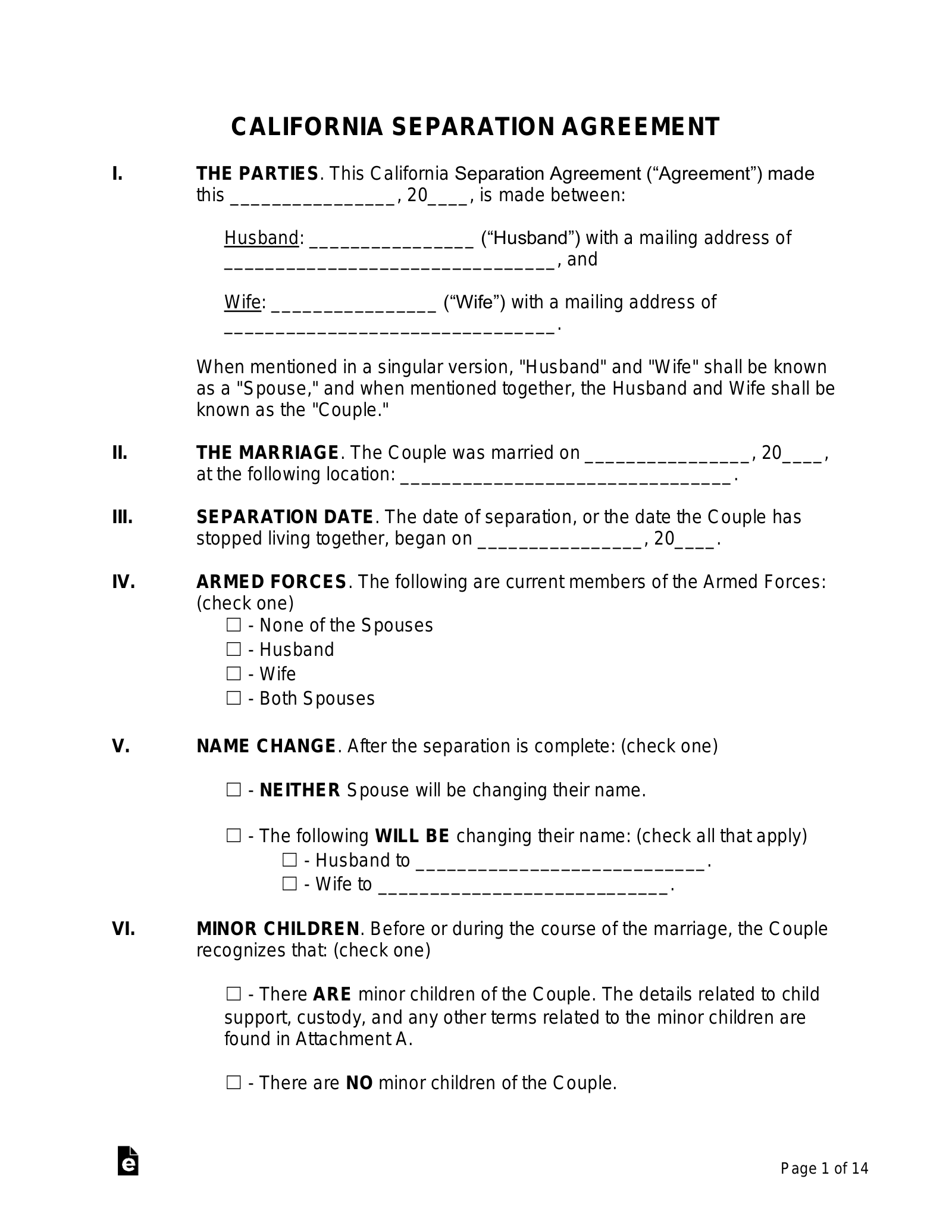
Filing for legal separation in California involves a structured series of steps, starting with initial paperwork and culminating in a court judgment. While the specifics can vary based on individual circumstances and the complexity of your case, the general framework remains consistent. This section outlines the typical stages of the filing process.
Initial Petitions and Documents
The journey begins by filing a Petition for Legal Separation (Form FL-100) with the California Superior Court in the county where one of the spouses resides. Although, as mentioned, there are no specific residency requirements for legal separation itself, it’s generally filed in the county where the petitioner lives.
Key steps in this initial phase include:
- Complete the Petition (Form FL-100): This document formally requests the court to issue a judgment of legal separation. It asks for basic information about the spouses, their marriage, children, and the desired outcomes regarding property, custody, and support. It’s important to accurately complete all sections, indicating what orders you are asking the court to make.
- Fill out Summons (Form FL-110): This form officially notifies your spouse that a legal separation case has been filed against them and informs them of their rights and responsibilities.
- File with the Court: Take the completed Petition and Summons to the clerk’s office at your local Superior Court of California. You will pay a filing fee, which can be substantial (currently over $400). If you cannot afford the fee, you may apply for a fee waiver (Form FW-001).
- Serve Your Spouse: After filing, you must legally “serve” your spouse with copies of the filed Petition and Summons, along with other mandatory forms like the Blank Response (Form FL-120) and a copy of any Fee Waiver request if applicable. Service must be done by someone other than yourself, who is at least 18 years old. This can be a professional process server, a sheriff’s deputy, or even a friend or family member. Proof of Service (Form FL-330 or FL-335) must then be filed with the court to confirm that your spouse was properly notified.
Financial Disclosures
Financial transparency is a cornerstone of family law proceedings in California. Both parties are required to fully disclose all their assets, debts, income, and expenses to ensure a fair and equitable division of property and the calculation of appropriate support orders. This exchange of information is known as “preliminary declarations of disclosure.”
The necessary forms include:
- Declaration of Disclosure (Form FL-140): This form acts as a cover sheet for all other financial disclosures.
- Schedule of Assets and Debts (Form FL-142): This detailed form requires you to list all community and separate property assets and debts, including real estate, bank accounts, investments, vehicles, and liabilities like credit card debt or loans.
- Income and Expense Declaration (Form FL-150): This form provides a comprehensive overview of your monthly income from all sources and your monthly expenses.
- Tax Returns: You must provide copies of your last two years of federal and state income tax returns.
Both spouses must complete and exchange these documents. The purpose is to provide a complete and accurate financial picture to the court and to each other, which is essential for negotiating a settlement or for the court to make informed decisions regarding property division and support. Failure to provide complete and accurate disclosures can result in severe penalties, including monetary sanctions or setting aside parts of a judgment.
Reaching an Agreement
Once initial filings are complete and financial disclosures exchanged, the next crucial phase involves negotiating and reaching an agreement on the terms of the legal separation. Ideally, spouses can work together to settle issues amicably, minimizing the need for extensive court intervention.
Methods for reaching an agreement include:
- Direct Negotiation: Spouses can discuss and agree upon terms directly, either on their own or with the help of their respective attorneys.
- Mediation: A neutral third-party mediator can facilitate discussions and help spouses reach mutually acceptable agreements on complex issues like child custody, support, and property division. This is often a less adversarial and more cost-effective approach than litigation. Many couples in areas like Palo Alto and Santa Monica find mediation beneficial.
- Collaborative Law: This is a process where both spouses and their attorneys agree to resolve issues outside of court. If an agreement cannot be reached, the attorneys must withdraw, and the parties must find new counsel if they decide to litigate.
- Litigation: If spouses cannot agree, the case may proceed to court. A judge will then hear arguments and evidence from both sides and make decisions on outstanding issues. This is typically the most expensive and emotionally draining option.
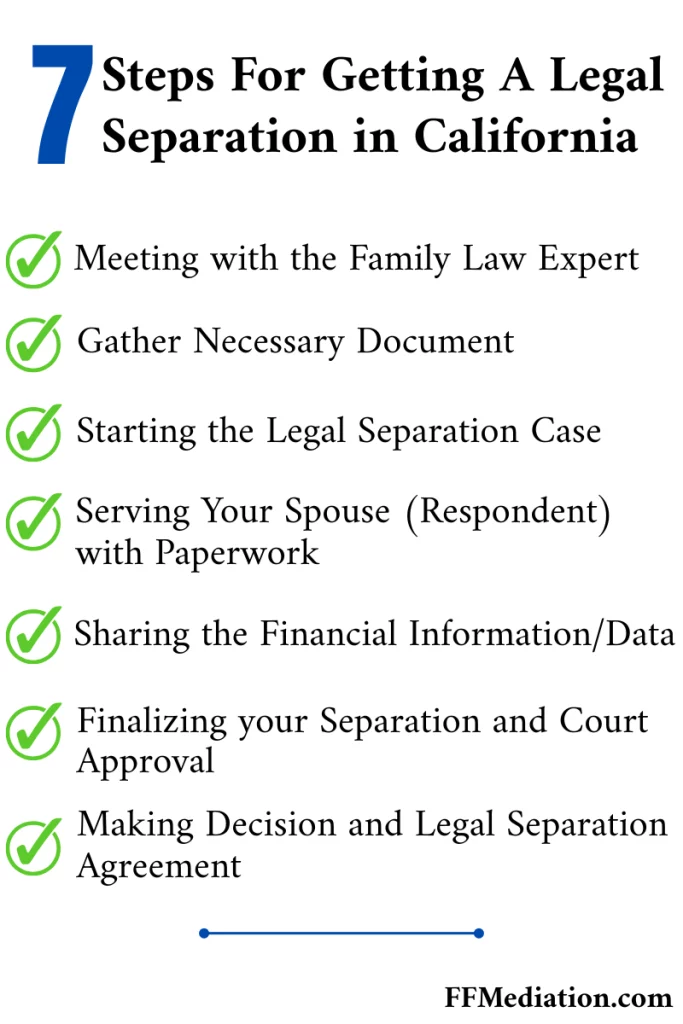
Once an agreement is reached, it must be drafted into a formal document called a “Marital Settlement Agreement” (MSA) or “Stipulated Judgment.” This comprehensive document outlines all the agreed-upon terms regarding child custody, visitation, child support, spousal support, division of assets and debts, and any other relevant matters.
Court Approval
The final step in the legal separation process is obtaining court approval of your agreement or, if no agreement is reached, having the court issue a judgment after a trial.
- Uncontested Cases (Agreement Reached): If you and your spouse have reached a full agreement, you will submit your Marital Settlement Agreement (or Stipulated Judgment) to the court. Along with this, you’ll typically need to file a Request for Judgment (Form FL-180) and a Declaration for Default or Uncontested Dissolution (Form FL-170). The court will review your paperwork to ensure it is complete, legally sound, and fair, especially concerning children’s best interests. If everything is in order, the judge will sign the judgment, making your legal separation official.
- Contested Cases (No Agreement): If you cannot reach an agreement, your case will proceed to trial. A judge will hear evidence, testimony, and arguments from both sides and then issue a judgment deciding all contested issues. This process can be lengthy and involves multiple court appearances, including status conferences, settlement conferences, and finally, a trial.
Once the judgment is signed by the judge and filed with the court clerk, the legal separation is final. While there is no six-month waiting period like there is for a divorce in California, the process can still take several months or even longer, depending on the complexity of the issues and the court’s calendar.
Key Considerations and Outcomes
A judgment of legal separation in California has profound implications for a couple’s future, particularly concerning their children, financial obligations, and shared property. It’s crucial to understand how the court addresses these vital aspects.
Child Custody and Support
For couples with minor children, decisions about child custody, visitation, and child support are paramount. In a legal separation, the court’s primary focus is always the “best interests of the child,” just as it would be in a divorce case.
- Custody: California law recognizes two types of custody:
- Legal Custody: Refers to the right and responsibility to make decisions about the health, education, and welfare of the child. It can be joint (both parents make decisions together) or sole (one parent makes all decisions).
- Physical Custody: Determines where the child lives. It can be joint (children spend significant time with both parents) or sole (children live primarily with one parent, with visitation for the other).
The court often encourages parents to reach a joint custody agreement, as co-parenting is generally viewed as beneficial for children. If parents cannot agree, the court will make these decisions after considering various factors, sometimes after a child custody recommendation assessment or mediation.
- Visitation: A visitation schedule outlines when each parent will spend time with the children. This can range from highly structured schedules (e.g., specific weekdays, weekends, holidays) to more flexible arrangements, depending on the parents’ ability to co-parent effectively.
- Child Support: Both parents have a legal obligation to support their children financially. California uses a statewide guideline formula to calculate child support, which considers factors such as each parent’s income, the amount of time children spend with each parent, tax deductions, and health insurance costs. The court will issue orders for child support that are legally binding and enforceable.
These orders remain in effect until the children emancipate (typically at age 18 or 19 if still in high school) or until a new court order modifies them.
Spousal Support (Alimony)
Spousal support, often referred to as alimony, may be ordered in a legal separation case to provide financial assistance to one spouse from the other. The purpose is to help the supported spouse maintain a similar standard of living to that enjoyed during the marriage, at least for a transitional period.
- Temporary Spousal Support: During the pendency of the legal separation case, the court can issue temporary support orders to help maintain the status quo until a final judgment is reached. This is often calculated using a guideline formula, similar to child support, though it can vary by county.
- Permanent Spousal Support (Long-Term): For long-term spousal support, California Family Code Section 4320 outlines a comprehensive list of factors a judge must consider. These factors include:
- The marketable skills of the supported spouse and the job market for those skills.
- The extent to which the supported spouse’s earning capacity is impaired by periods of unemployment during the marriage to devote time to domestic duties.
- The extent to which the supporting spouse’s ability to pay takes into account their earning capacity, earned and unearned income, assets, and standard of living.
- The needs of each party based on the standard of living established during the marriage.
- The duration of the marriage.
- The age and health of the parties.
- Any history of domestic violence.
- The balance of hardships to each party.
- The goal that the supported spouse shall be self-supporting within a reasonable period (generally half the length of the marriage for marriages less than 10 years).
Unlike child support, there is no strict formula for long-term spousal support. The court has broad discretion, making each case unique. Spousal support orders can be modified if there is a significant change in circumstances for either party.
Division of Assets and Debts
California is a community property state, meaning that generally, all assets and debts acquired by either spouse during the marriage (from the date of marriage to the date of separation) are considered “community property” and are owned equally by both spouses. In a legal separation, the court is mandated to divide this community property and debt equally, unless the spouses agree otherwise in a fair manner.
- Community Property: Includes earnings, real estate (e.g., the family home in Malibu or an investment property in Palm Springs), bank accounts, retirement accounts, businesses, and vehicles acquired during the marriage.
- Separate Property: Property owned by either spouse before the marriage, or acquired during the marriage by gift, inheritance, or certain personal injury awards, is considered separate property and belongs solely to that spouse.
- Community Debts: Debts incurred during the marriage, such as mortgages, car loans, credit card balances, or student loans taken out by either spouse, are typically considered community debts and are equally divided.
The process of division involves identifying, valuing, and then distributing these assets and debts. This can be complex, especially with significant assets like businesses, multiple properties, or complex investment portfolios. Professional appraisals may be necessary for real estate or business valuations. The court aims for an “in-kind” division where possible, but often assets are sold, or one spouse “buys out” the other’s interest.
A judgment of legal separation permanently resolves these property and debt issues, meaning that once the order is final, those assets and debts are divided, and neither party typically has a further claim on the other’s share unless there was fraud or undisclosed assets.

Seeking Professional Guidance
Navigating the legal intricacies of separation in California can be overwhelming, especially when dealing with the emotional toll of marital breakdown. While it is possible to represent yourself (“pro per”), the complexity of family law, the strict procedural rules, and the significant impact of the outcome on your future finances and relationship with your children make legal representation highly advisable.
An experienced family law attorney can:
- Provide Legal Advice: Explain your rights and obligations under California law.
- Prepare Documents: Ensure all forms are accurately completed and filed correctly and on time, preventing costly errors or delays.
- Negotiate on Your Behalf: Advocate for your best interests in discussions with your spouse or their attorney, aiming for a fair settlement.
- Represent You in Court: If an agreement cannot be reached, an attorney will represent you effectively during mediation, hearings, and trial.
- Clarify Complex Issues: Help you understand and navigate complicated matters such as business valuations, intricate retirement accounts, or high-conflict child custody disputes.
Many resources are available for those seeking legal assistance. Legal aid organizations across California offer free or low-cost services for eligible individuals. County bar associations can provide referrals to qualified family law specialists. Additionally, many attorneys offer initial consultations, allowing you to discuss your case and understand your options without an immediate financial commitment. For example, law firms in major cities like Oakland or Long Beach specialize in family law and can provide tailored advice.
Ultimately, choosing to file for legal separation is a significant decision. By understanding the process, preparing diligently, and seeking appropriate legal guidance, individuals can navigate this challenging period with greater confidence and work towards a structured and stable future in California.
LifeOutOfTheBox is a participant in the Amazon Services LLC Associates Program, an affiliate advertising program designed to provide a means for sites to earn advertising fees by advertising and linking to Amazon.com. Amazon, the Amazon logo, AmazonSupply, and the AmazonSupply logo are trademarks of Amazon.com, Inc. or its affiliates. As an Amazon Associate we earn affiliate commissions from qualifying purchases.