
Florida, a state synonymous with sunshine, pristine beaches, and a vibrant cultural tapestry, has a rich and complex history that predates its modern allure. The question of “Who founded Florida?” is not a simple one answered by a single individual or a definitive founding date. Instead, it’s a narrative woven from the exploration, colonization, and subsequent development by various European powers, with the Indigenous peoples of the region playing a crucial, albeit often overlooked, role as the original inhabitants.
The story of Florida’s founding is intrinsically linked to the Age of Exploration, a period of intense global curiosity and competition among European nations to discover new lands, establish trade routes, and expand their empires. This era saw mariners from across the Atlantic charting unknown waters, driven by a potent mix of economic ambition, religious zeal, and a thirst for discovery. While Indigenous communities had thrived in the Florida peninsula for millennia, their histories are a separate, vital chapter, preceding and coexisting with the European chapters of its ‘founding.’
The Arrival of Europeans: Claiming a New World
The initial European claims and explorations in what is now Florida were primarily driven by the desire to find a westward passage to Asia, establish new territories, and, for some, to spread Christianity. These early ventures, though fraught with peril and often ending in tragedy for the explorers, laid the groundwork for future colonization and fundamentally altered the course of the region’s history.
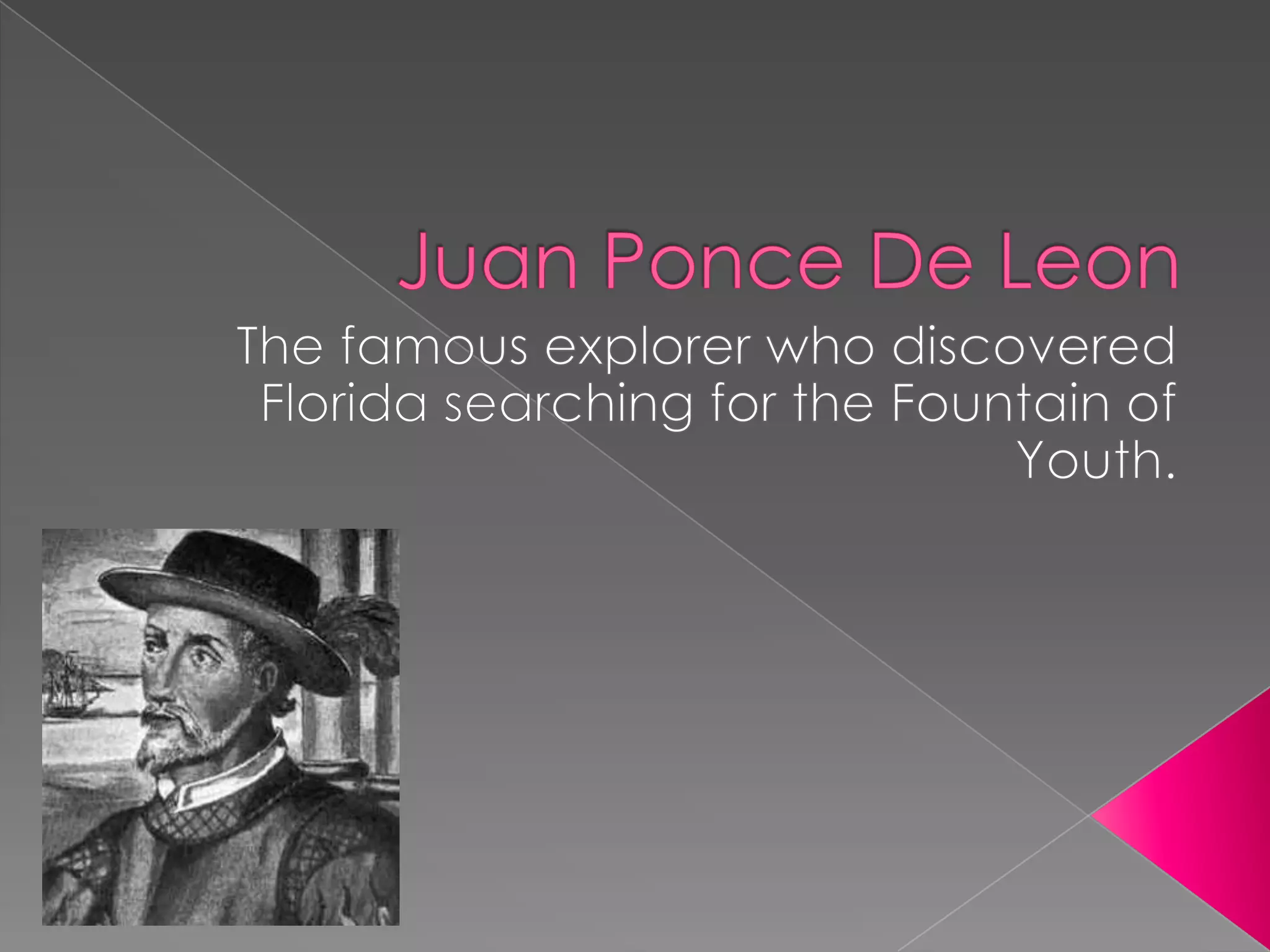
Juan Ponce de León and the Spanish Claim
The commonly accepted narrative credits the Spanish explorer Juan Ponce de León with the first European landing in Florida in 1513. Sailing under the Spanish flag, he named the land “La Florida” in honor of the Easter season, “Pascua Florida,” and its abundant vegetation. His expedition, though initially seeking new lands and possibly the mythical Fountain of Youth, marked the beginning of Spanish influence in the region. Ponce de León’s arrival was not an uninhabited land discovery; the area was home to various Indigenous tribes, including the Calusa and the Timucua, who had complex societies and well-established settlements. These encounters set a precedent for the interactions that would define Florida’s early colonial period.
Early Spanish Expeditions and Settlements
Following Ponce de León’s initial landing, other Spanish explorers ventured into Florida. Pánfilo de Narváez led a disastrous expedition in 1528, which resulted in the loss of most of his men. However, one survivor, Álvar Núñez Cabeza de Vaca, embarked on an incredible eight-year journey across much of North America, providing the first European accounts of the continent’s interior. Another significant Spanish figure was Hernando de Soto, whose expedition from 1539 to 1542 was a brutal quest for gold and glory, traversing large parts of what is now the southeastern United States, including Florida. De Soto’s expedition, while not establishing permanent settlements, had a devastating impact on Indigenous populations through violence, disease, and disruption of their way of life.
The first permanent European settlement in what is now the United States was established by the Spanish in 1565: St. Augustine. Founded by Pedro Menéndez de Avilés, this formidable fortress city was intended to protect Spanish interests, protect the lucrative treasure fleets sailing from the Americas to Spain, and serve as a base for further exploration and missionary work. St. Augustine remains the oldest continuously inhabited European-established settlement in the continental United States, a testament to the enduring legacy of Spanish colonization.
Shifting Tides: French and British Influence

The Spanish presence in Florida was not unchallenged. Other European powers recognized the strategic and economic importance of the region, leading to periods of conflict and territorial shifts. These rivalries, fueled by competing colonial ambitions, would further shape Florida’s identity.
The French Intrusion and Counter-Response
In the mid-16th century, the French made their own attempts to establish a foothold in Florida. In 1564, French Huguenots (Protestants) founded Fort Caroline on the banks of the St. Johns River. This settlement was seen as a direct threat to Spanish claims and Catholic dominance in the region. In response, Pedro Menéndez de Avilés was dispatched by the Spanish Crown to expel the French. In 1565, he successfully attacked and destroyed Fort Caroline, executing most of the French settlers. This decisive action reinforced Spanish control but also highlighted the ongoing European competition for North American territories.
The British Ascendancy and Transfer of Power
The 18th century witnessed a significant shift in power dynamics. After Spain’s dominance for over two centuries, the British began to assert their influence. During the Seven Years’ War (known as the French and Indian War in North America), Great Britain captured Havana, Cuba, from Spain. In the subsequent peace treaty, the Treaty of Paris (1763), Spain ceded Florida to Great Britain in exchange for Havana. This marked the first time Florida was under British rule. The British divided the territory into East Florida and West Florida and encouraged settlement through land grants. However, their control was relatively short-lived. During the American Revolutionary War, Florida remained loyal to the British Crown. When the war concluded, Spain, allied with France against Britain, reclaimed Florida through the Treaty of Paris (1783).
The United States Era: Statehood and Modern Foundation
The re-establishment of Spanish rule in the late 18th century was a transitional period. As the United States expanded westward, its interest in acquiring Florida grew. A combination of diplomatic pressure, border disputes, and indigenous conflicts eventually led to the United States’ annexation of Florida.
The Adams-Onís Treaty and American Acquisition
Tensions between the United States and Spain over Florida’s borders and its role as a haven for Native American raiders and escaped slaves escalated throughout the early 19th century. The Seminole Wars in particular highlighted the instability of Spanish authority. In 1819, under the leadership of John Quincy Adams for the U.S. and Luis de Onís y González-Vara for Spain, the Adams-Onís Treaty was signed. This treaty officially transferred ownership of Florida from Spain to the United States. In exchange, the U.S. assumed claims against Spain totaling up to $5 million and renounced its own claims to territory in what is now Texas. Florida officially became a territory of the United States in 1821, with Andrew Jackson serving as its first military governor.
Statehood and Beyond
Following a period as a U.S. territory, Florida was admitted to the Union as the 27th state on March 3, 1845. The process of statehood involved establishing a constitution, government, and legal framework. The state’s early years were marked by continued conflicts with the Seminole people and the development of its agricultural economy, particularly sugar cane and cotton. Florida’s story of “founding” is thus a continuous process of settlement, governance, and development, shaped by Indigenous heritage, European colonization, and eventual integration into the United States. While Juan Ponce de León may be credited with the first European encounter and naming, the true founding of Florida as a recognizable entity is a multi-faceted narrative of conquest, diplomacy, and the eventual establishment of a modern American state.
LifeOutOfTheBox is a participant in the Amazon Services LLC Associates Program, an affiliate advertising program designed to provide a means for sites to earn advertising fees by advertising and linking to Amazon.com. Amazon, the Amazon logo, AmazonSupply, and the AmazonSupply logo are trademarks of Amazon.com, Inc. or its affiliates. As an Amazon Associate we earn affiliate commissions from qualifying purchases.