
Nestled in the heart of the Pacific Ocean, the Hawaiian Islands are a beacon of natural beauty, vibrant culture, and unparalleled hospitality. For many, a trip to Hawaii is a dream vacation, offering sun-drenched beaches, volcanic landscapes, and unforgettable adventures. Yet, beyond the picturesque scenery and luxurious resorts, lies a profound cultural tapestry, intricately woven with the threads of its indigenous language: ʻŌlelo Hawaiʻi. More than just a means of communication, the Hawaiian language is a living repository of history, values, and identity, offering a deeper understanding of this extraordinary destination for any discerning traveler.
For those planning to immerse themselves in the local culture, learning about ʻŌlelo Hawaiʻi provides a unique gateway to authentic experiences. From understanding the lyrical names of famous landmarks to appreciating the stories behind traditional chants and songs, a basic grasp of the language can transform a casual visit into a deeply enriching journey. This article will explore the fascinating history of the Hawaiian language, its ongoing revitalization, and how visitors can engage with this beautiful linguistic heritage, enhancing their appreciation of the islands’ unique spirit.
A Journey Through Time: The History of ʻŌlelo Hawaiʻi
The story of the Hawaiian language is one of resilience, suppression, and a remarkable rebirth. It’s a testament to the enduring spirit of the Hawaiian people and a crucial element for any traveler seeking to understand the true essence of the islands.
Roots and Evolution
The origins of ʻŌlelo Hawaiʻi can be traced back thousands of years to the ancient Polynesian voyagers who navigated vast stretches of the Pacific Ocean using sophisticated knowledge of stars, currents, and wildlife. These intrepid explorers, arriving in the Hawaiian archipelago sometime between 300 and 800 CE, brought with them their distinct language, customs, and knowledge systems. Over centuries of isolation, the proto-Polynesian language evolved into the unique and melodious ʻŌlelo Hawaiʻi we know today, characterized by its limited number of sounds and its beautiful, rhythmic quality. This linguistic evolution mirrored the development of a distinct Hawaiian culture, deeply connected to the land (ʻāina), the ocean, and the celestial sphere. Early Hawaiian society thrived, developing complex social structures, spiritual beliefs, and artistic expressions, all articulated and preserved through the spoken word. The oral tradition was paramount, with genealogies, myths, legends, and historical accounts passed down through generations of chanters and storytellers, embodying the very soul of the Hawaiian Kingdom.
The Era of Suppression
The arrival of Captain James Cook in 1778 marked a pivotal turning point for the Hawaiian Islands, ushering in an era of increasing foreign influence. While initial interactions brought new technologies and ideas, they also introduced diseases that decimated the native population and, eventually, cultural and linguistic challenges. The 19th century saw the arrival of missionaries who, despite their efforts to transcribe the Hawaiian language into a written form, also contributed to its gradual decline by promoting the English language.
The most significant blow to ʻŌlelo Hawaiʻi came after the overthrow of the Hawaiian Kingdom in 1893 and the subsequent annexation of Hawaii by the United States. In 1896, the provisional government enacted a law banning the use of Hawaiian in schools and most public settings. This policy, enforced with severe penalties, aimed to assimilate Hawaiians into American culture, leading to generations of children being prohibited from speaking their ancestral tongue. Parents, fearing their children would be punished or disadvantaged, often stopped speaking Hawaiian at home. This systematic suppression pushed ʻŌlelo Hawaiʻi to the brink of extinction, with its fluent speakers dwindling to a small number, primarily on the more remote island of Niʻihau. This period represents a stark reminder of the fragile nature of cultural heritage and the devastating impact of colonial policies on indigenous languages.
Revitalization and Renaissance
Against all odds, the late 20th century witnessed an extraordinary resurgence of the Hawaiian language, often referred to as the Hawaiian Renaissance. Fueled by a growing sense of cultural pride and activism, a dedicated movement began in the 1970s to reclaim and revitalize ʻŌlelo Hawaiʻi. Key milestones included the establishment of Hawaiian immersion schools (Pūnana Leo) in the 1980s, where children from preschool through high school are taught entirely in the Hawaiian language. These schools have been instrumental in creating a new generation of fluent speakers, demonstrating a powerful commitment to preserving their heritage.
In 1978, a landmark decision was made when the state of Hawaii officially recognized Hawaiian as an official language alongside English, a constitutional amendment that affirmed its vital role in the state’s identity. This recognition provided legal backing for revitalization efforts and spurred greater public awareness and support. Today, the language is experiencing a vibrant revival. Hawaiian language courses are offered in universities, media outlets broadcast in Hawaiian, and cultural events proudly feature ʻŌlelo Hawaiʻi. This renaissance not only preserves a critical piece of Hawaiian heritage but also offers a powerful example of how a community can collectively bring a language back from the brink, making it an inspiring story for global travelers and cultural enthusiasts alike.
Encountering Hawaiian Language as a Traveler
For visitors to Hawaii, the Hawaiian language is not merely an academic subject; it’s an integral part of the travel experience. Engaging with it, even superficially, can significantly enrich your trip, allowing for deeper cultural immersion and more meaningful interactions.
Beyond Aloha: Essential Phrases for Visitors
While most interactions in Hawaii will be in English, learning a few basic Hawaiian phrases demonstrates respect for the local culture and can open doors to warmer exchanges. The most ubiquitous word you’ll encounter is Aloha. Far more than just a greeting or farewell, Aloha embodies love, affection, peace, compassion, and mercy. Using it genuinely conveys a spirit of connection. Similarly, Mahalo means ‘thank you,’ and it’s always appreciated when offered with sincerity. When welcomed somewhere, you might hear E Komo Mai, meaning ‘welcome.’ Food is a huge part of Hawaiian culture, and if you find something delicious, you can say it’s ʻOno, meaning ‘delicious’ or ‘tasty.’
Other useful phrases include ‘A hui hou’ (until we meet again), ‘Kōkua’ (help or assistance), and ‘Pono’ (righteousness, balance, goodness). Even just a handful of these words can transform a transactional interaction into a moment of cultural connection, signaling your openness to embracing the local way of life. Many tour guides, hotel staff, and locals will appreciate your effort, and it’s a wonderful way to foster goodwill while exploring destinations like Waikiki or the lush landscapes of Maui.
Understanding Place Names
One of the most profound ways travelers encounter ʻŌlelo Hawaiʻi is through the names of places across the islands. Almost every city, beach, street, mountain, and natural landmark has a Hawaiian name, each carrying a story or description that reveals insights into the land’s history, geography, or significance. For instance, Waikiki on Oahu means ‘spouting waters,’ referring to the springs and streams that once fed the wetlands in the area. Diamond Head, the iconic volcanic tuff cone overlooking Waikiki, is known in Hawaiian as Leʻahi, meaning ‘brow of the tuna,’ a poetic description of its shape.
On The Big Island, Mauna Kea translates to ‘white mountain,’ a fitting name given its snow-capped summit during winter months. The city of Honolulu means ‘sheltered bay,’ perfectly describing its strategic harbor. Even smaller towns like Kailua-Kona (‘two seas running’) or Lahaina (‘cruel sun’) on Maui offer glimpses into their environmental characteristics or historical significance. Learning the meanings behind these names enhances your appreciation for the local environment and the deep connection Hawaiians have with their land. It turns navigation from a purely functional act into an educational journey through Hawaiian heritage, much like reading a historical map.
Cultural Experiences and Immersion

For those seeking deeper immersion, numerous opportunities exist to engage with Hawaiian language and culture. Many hotels and resorts, particularly those focused on authentic Hawaiian experiences, offer cultural programs that may include basic language lessons, lei-making workshops, or hula performances accompanied by chants in Hawaiian. Visiting cultural centers is an excellent way to learn more. The Polynesian Cultural Center on Oahu provides immersive experiences across various Polynesian cultures, with Hawaiian village presentations often featuring language demonstrations. The Bishop Museum in Honolulu is another treasure trove, housing vast collections of Hawaiian artifacts and offering insights into the language’s role in traditional practices.
Participating in a traditional luau, while often catering to tourists, can still offer glimpses of ʻŌlelo Hawaiʻi through songs and storytelling. Seeking out local events, such as hula competitions, cultural festivals, or even farmers’ markets, might provide authentic opportunities to hear the language spoken naturally. Supporting businesses that actively promote Hawaiian language and culture, such as local artisans or indigenous-owned tour operators, also contributes to the sustainability of these revitalization efforts. Such experiences go beyond typical tourism, offering a tangible connection to the heart and soul of Hawaii.
The Sound of the Islands: Pronunciation and Structure
The beauty of the Hawaiian language lies not just in its meanings but in its sound. Its pronunciation is relatively straightforward, making it accessible for visitors to learn a few phrases and appreciate its unique musicality.
A Simple Alphabet
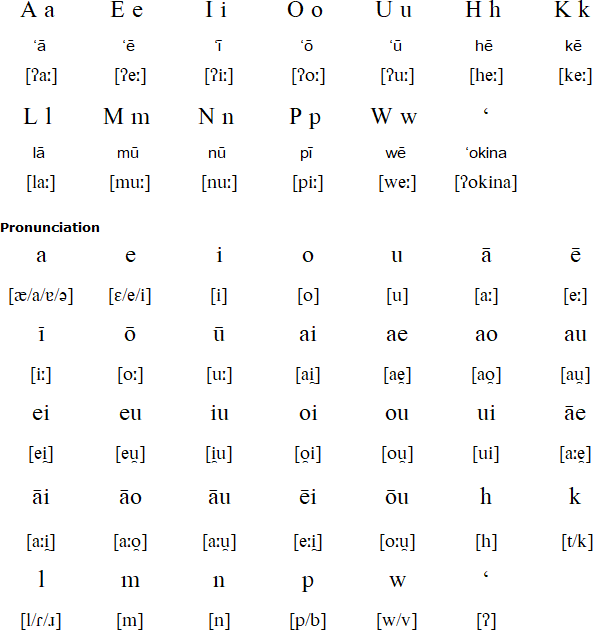
Unlike English with its complex phonetic rules, ʻŌlelo Hawaiʻi uses a remarkably concise alphabet, making its pronunciation quite consistent. It consists of only 13 letters: five vowels (a, e, i, o, u) and eight consonants (h, k, l, m, n, p, w). Each vowel has a specific sound, similar to Spanish or Italian vowels: ‘a’ as in ‘far’, ‘e’ as in ‘bed’, ‘i’ as in ‘machine’, ‘o’ as in ‘go’, and ‘u’ as in ‘flute’.
Crucially, there are two diacritical marks that are essential for correct pronunciation and meaning:
- The ʻokina (ʻ): This is a glottal stop, similar to the sound between the two ‘o’s in ‘uh-oh’. It indicates a brief pause and can change the meaning of a word entirely. For example, ‘moa’ means ‘chicken,’ while ‘moʻa’ means ‘cooked.’
- The kahakō (ā, ē, ī, ō, ū): This is a macron placed over a vowel, indicating that the vowel sound is elongated. For example, ‘pau’ means ‘finished,’ while ‘pāʻū’ means ‘skirt.’
Every syllable in Hawaiian ends in a vowel, and every consonant is followed by a vowel. This simple structure contributes to its melodic flow and makes it easier for learners to sound out words accurately. Understanding these basic rules unlocks the ability to correctly pronounce place names and common phrases, deepening your engagement with the islands.
Musicality and Flow
The consistent vowel sounds, the rhythm created by alternating consonants and vowels, and the presence of the ʻokina and kahakō give ʻŌlelo Hawaiʻi a distinct musicality. It’s a language that lends itself beautifully to song, chant (oli), and poetry. When spoken fluently, it flows with a gentle cadence, reminiscent of the ocean waves themselves. This inherent musicality is evident in traditional Hawaiian music, hula performances, and contemporary Hawaiian songs, which often feature powerful narratives and poetic imagery.
Many travelers are captivated by the sound of Hawaiian chants during a luau or a cultural performance. These chants are not merely entertainment; they are living histories, prayers, and expressions of deep cultural connection, often performed in a complex, rhythmic style. Listening to the language being spoken or sung provides a sensory connection to the culture that transcends mere translation. It offers a glimpse into the heart of the islands, reminding visitors that Hawaii is not just a collection of beautiful sights, but a vibrant, living culture with a soul expressed through its unique tongue. Appreciating this aspect of the language allows for a more profound understanding of the traditional arts and performances you might encounter, from the resorts of Kapalua to the historic streets of Hilo.
Beyond Words: Language as a Gateway to Hawaiian Culture
The Hawaiian language is far more than just a tool for communication; it is a repository of cultural knowledge, an expression of identity, and a profound connection to the land and ancestors. For the conscious traveler, understanding this depth transforms a visit into a pilgrimage.
Connecting with the Land (ʻĀina)
A core tenet of Hawaiian culture is the concept of mālama ʻāina, which means ‘to care for the land.’ This is not just an environmental slogan but a deep-seated philosophical principle, and the language itself reflects this intimate relationship. Hawaiian words often describe natural phenomena with rich detail and poetic nuance, highlighting the deep observation and respect the people have for their environment. For example, there are countless words for rain, wind, and various types of lava flows, each conveying specific characteristics and conditions. Learning these terms, or even just appreciating their existence, helps visitors understand the profound spiritual and physical connection Hawaiians have to their islands, whether it’s the lush valleys of Kauai or the volcanic landscapes of The Big Island.
This intrinsic link means that when you learn a Hawaiian word for a place or a natural element, you’re not just learning a label; you’re gaining insight into a worldview where humanity is an integral part of nature, not separate from it. This perspective encourages responsible tourism, reminding travelers to tread lightly and respect the delicate ecosystems and cultural sites they encounter. Understanding concepts like mālama ʻāina helps reinforce the idea that travelers are temporary guests in a sacred place, fostering a more mindful and appreciative approach to exploring the islands.
Preserving Identity and Heritage
For the Hawaiian people, the language is an indispensable thread connecting them to their ancestors, their history, and their unique identity. The revitalization of ʻŌlelo Hawaiʻi is not just about bringing back a spoken tongue; it’s about restoring a sense of self, pride, and continuity. It’s a powerful statement of cultural sovereignty and an assertion of indigenous rights. Through the language, stories that might otherwise be lost are kept alive, traditional knowledge is transmitted, and a distinct worldview is perpetuated.
When visitors hear Hawaiian spoken, whether in educational settings, cultural performances, or everyday conversations, they are witnessing this living heritage in action. It offers a powerful reminder that Hawaii is not just a tropical paradise, but a land with a deep and complex history, inhabited by a resilient people proud of their roots. Engaging with the language, even through simple greetings, acknowledges and honors this ongoing struggle and triumph. This connection to heritage can be profoundly felt at historical sites such as Iolani Palace, the only official residence of royalty in the United States, where the echoes of the Hawaiian monarchy and their language still resonate.
Responsible Tourism and Cultural Respect
As Hawaii continues to be a top travel destination, the concept of responsible tourism becomes increasingly vital. Embracing and respecting the Hawaiian language is a fundamental aspect of being a responsible traveler. It signifies an understanding that you are not just visiting a resort, but entering a living culture with its own traditions, values, and language. This means more than just avoiding littering or staying on marked trails; it means actively seeking to understand and honor the local way of life.
Supporting businesses and organizations that promote ʻŌlelo Hawaiʻi and Hawaiian culture, listening to local voices, and taking the time to learn a few words are all small but significant gestures. They demonstrate a commitment to engaging with Hawaii on its own terms, fostering a deeper, more respectful relationship between visitors and residents. By appreciating the language, travelers contribute to its ongoing revitalization and ensure that future generations will continue to enjoy the rich cultural tapestry that makes Hawaii truly unique. It’s an approach to travel that enriches not only the visitor but also the community they visit.
In conclusion, the Hawaiian language, ʻŌlelo Hawaiʻi, is a vibrant and essential component of the islands’ identity. Its journey from ancient Polynesian roots through a period of suppression to its current renaissance is a powerful story of cultural resilience. For travelers, understanding and engaging with this beautiful language offers an unparalleled opportunity to delve deeper into the heart of Hawaii. From recognizing the poetry in place names like Mauna Kea and Waikiki to using simple greetings like Aloha and Mahalo, every effort to connect with ʻŌlelo Hawaiʻi enriches the travel experience. It fosters a more respectful and immersive journey, allowing visitors to move beyond the superficial and connect with the profound cultural heritage that makes Hawaii not just a destination, but a truly sacred and unforgettable place.
LifeOutOfTheBox is a participant in the Amazon Services LLC Associates Program, an affiliate advertising program designed to provide a means for sites to earn advertising fees by advertising and linking to Amazon.com. Amazon, the Amazon logo, AmazonSupply, and the AmazonSupply logo are trademarks of Amazon.com, Inc. or its affiliates. As an Amazon Associate we earn affiliate commissions from qualifying purchases.