
Navigating the vast expanse of [Texas] requires more than just a map; it demands an understanding of its time zones. Often perceived as uniformly falling within the [Central Time] Zone, the Lone Star State actually straddles two distinct time zones, a detail crucial for travelers, businesses, and anyone planning an itinerary within this diverse region. For globetrotters and locals alike, being aware of these nuances is essential for seamless travel planning, timely appointments, and an overall smooth experience, whether you’re exploring vibrant cities, serene natural parks, or luxurious [resorts]. This guide delves into the specifics of [Texas]’s time zones, offering insights and tips to enhance your understanding and ensure your adventures are perfectly timed.
Understanding Texas Time Zones: Central vs. Mountain
The geographical breadth of [Texas], spanning over 800 miles from east to west, naturally leads to a division in its official timekeeping. The vast majority of the state operates on [Central Time], but a significant and distinctive portion in the far western reaches observes [Mountain Time]. This distinction isn’t just a technicality; it influences everything from flight schedules and hotel check-in times to coordinating dinner plans with friends across the state.
Central Standard Time (CST) and Central Daylight Time (CDT)
The predominant time zone for [Texas] is [Central Time]. During Standard Time, this is referred to as Central Standard Time, which is six hours behind Coordinated Universal Time (UTC-6). When Daylight Saving Time is in effect, typically from mid-March to early November, the state switches to Central Daylight Time, which is five hours behind Coordinated Universal Time (UTC-5). This shift means an hour is “lost” in spring and “gained” in fall.
Most major metropolitan areas and popular travel destinations in [Texas] fall within the [Central Time] Zone. This includes bustling hubs like [Houston], known for its [Space Center Houston] and diverse culinary scene; [Dallas], a center for finance and the arts with landmarks like the [Sixth Floor Museum] and [Dallas Arts District]; the live music capital [Austin], home to the [Texas State Capitol] and [Barton Springs Pool]; and the historic city of [San Antonio], famous for [The Alamo] and its picturesque [River Walk]. Other significant cities such as [Fort Worth], [Galveston], and the coastal areas along the [Gulf of Mexico] also adhere to [Central Time].
For visitors planning to explore these iconic destinations, all activities, bookings, and schedules will be aligned with [Central Time]. This includes everything from catching a flight at [Dallas/Fort Worth International Airport] to enjoying a [Dallas Cowboys] game, or embarking on a guided tour of the [San Antonio Missions National Historical Park]. Understanding this is vital for making the most of your travel experiences, ensuring you arrive on time for reservations at a [boutique hotel] or to secure a spot at a popular local eatery.
Mountain Standard Time (MST) and Mountain Daylight Time (MDT)
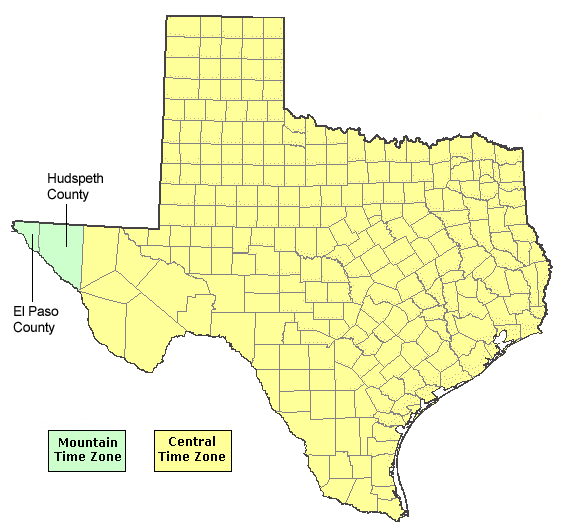
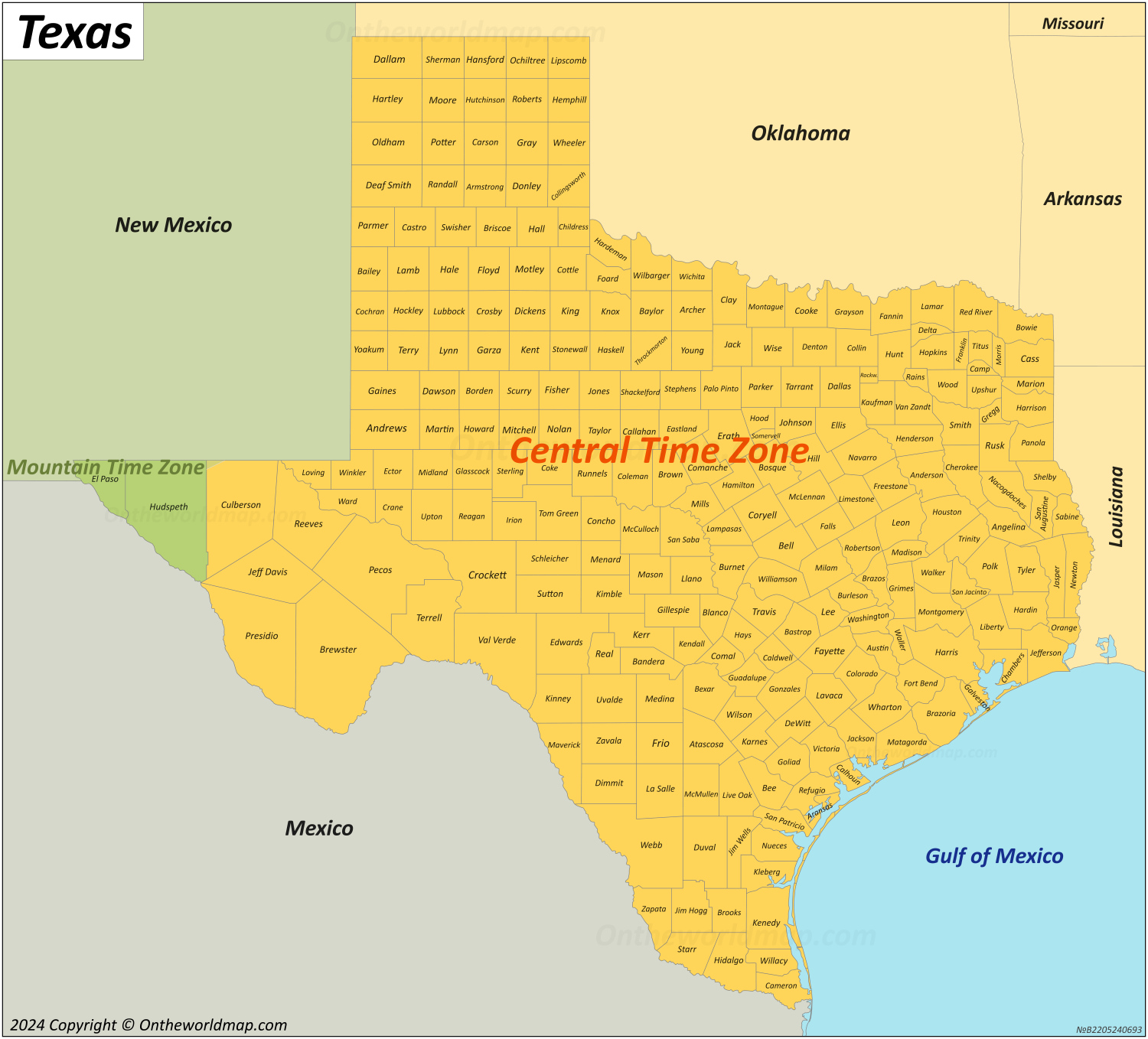
While the bulk of [Texas] is in [Central Time], the extreme western part of the state observes [Mountain Time]. This region primarily includes [El Paso County] and [Hudspeth County], which border [New Mexico] and [Mexico]. During Standard Time, this is known as Mountain Standard Time, which is seven hours behind Coordinated Universal Time (UTC-7). With the observance of Daylight Saving Time, it shifts to Mountain Daylight Time, becoming six hours behind Coordinated Universal Time (UTC-6).
The city of [El Paso] is the largest and most prominent city in [Texas] that operates on [Mountain Time]. This creates a one-hour time difference between [El Paso] and the rest of the major cities in [Texas]. For example, when it’s 10:00 AM in [Dallas], it’s 9:00 AM in [El Paso]. This time difference is significant and must be factored into any travel plans that involve moving between [West Texas] and [East Texas].

Travelers venturing to [El Paso] and its surrounding areas, perhaps to explore natural wonders like [Franklin Mountains State Park] or [Hueco Tanks State Park & Historic Site], will need to adjust their watches and schedules accordingly. This time zone peculiarity is a key aspect of [El Paso]’s identity, distinguishing it from the rest of the state and aligning it more closely with its western neighbors. Whether you’re flying into [El Paso International Airport] or driving in from [New Mexico], being aware of the [Mountain Time] Zone will prevent any scheduling mishaps.
Navigating Time Across Texas: Tips for Travelers and Tourists
The dual time zones of [Texas] can present a unique challenge for travelers, but with a little foresight and planning, you can navigate them effortlessly. The key is to integrate time zone awareness into every stage of your trip planning, from initial bookings to daily itinerary management. This not only prevents missed connections but also enhances your overall travel experience, allowing you to fully immerse yourself in the local culture and attractions without unnecessary stress.
Planning Your Itinerary and Booking Accommodation
When planning a trip across [Texas], especially one that might involve traveling between [El Paso] and other major cities like [Houston] or [Austin], always double-check the time zone for each segment of your journey. This is particularly critical for flights, train schedules, and bus services. A flight departing [Dallas] at 9:00 AM [Central Time] will arrive in [El Paso] at what feels like 9:00 AM [Mountain Time] if the flight duration is one hour, but your body clock might feel it’s 10:00 AM.
Accommodation bookings also require attention. Whether you’re reserving a room at a [luxury hotel] in [San Antonio], a [family-friendly resort] near [Galveston Island], or a [cozy apartment] in [El Paso], check-in and check-out times will always be specific to the local time zone of the property. Confirm these details to avoid early arrival or late departure fees. If you’re driving a long distance from [Central Texas] to [West Texas], factor in the one-hour time change for your estimated arrival time, ensuring you don’t miss your check-in window. Websites specializing in [accommodation booking] and [reviews] often specify the local time, but it’s always wise to confirm directly with the hotel.
Coordinating Activities and Experiences
The time difference becomes particularly relevant when coordinating activities, especially those with fixed schedules. Imagine booking a hot air balloon ride in [Austin] and a hiking tour in [El Paso] on consecutive days. You’ll need to remember the time shift to ensure you’re on time for both. Similarly, if you’re attending a business conference that spans multiple [Texas] cities, or trying to schedule a video call with contacts in different parts of the state, confirming the local time for all participants is paramount.
For [tourism]-related activities, such as reserving a table at a popular [Tex-Mex] restaurant, booking a spa treatment, or signing up for a guided historical tour, always confirm the scheduled time in the local zone. This is also important for live events, concerts, or sporting events. A concert advertised for 8:00 PM in [Dallas] will be at a different absolute time than an 8:00 PM event in [El Paso]. Being mindful of Daylight Saving Time changes is also important; while the transition happens uniformly on a specific date, it’s good practice to verify schedules if your trip falls around these periods.
Essential Tools for Time Management
To effortlessly manage time zones across [Texas], leverage technology. Modern smartphones automatically update to the local time zone, a feature that is incredibly helpful. However, it’s always a good idea to confirm this setting is enabled. Many apps also offer world clock functions that display multiple time zones simultaneously. Online time zone converters are another excellent resource for quickly checking the time difference between specific [Texas] cities or between [Texas] and your home location.
Before embarking on your journey, especially if you plan to traverse the state, consider creating a detailed itinerary that explicitly lists the local time for each event and location. This simple step can prevent confusion and ensure a smooth, enjoyable trip. Travel guides for [Texas] often highlight these geographical and temporal distinctions, providing valuable context for your adventure.
Texas Landmarks and Attractions Across Time Zones
[Texas]’s vastness means its attractions are spread far and wide, offering everything from bustling cityscapes to rugged natural beauty. Exploring these landmarks requires an appreciation for their geographical — and temporal — context. Understanding which time zone each falls into can enhance your planning and ensure you experience them fully.East Texas Wonders (Central Time Zone)
The majority of [Texas]’s most iconic destinations and vibrant urban centers are nestled within the [Central Time] Zone, offering a diverse array of experiences for every type of traveler.
- [Houston]: As the largest city in [Texas], [Houston] is a global hub for space exploration, energy, and medicine. Visitors flock to [Space Center Houston] to experience the wonders of NASA, explore the world-class institutions of the [Museum District], or relax on nearby [Galveston Island]’s beaches. The city’s dynamic lifestyle and rich cultural scene, from its diverse culinary offerings to its thriving arts community, make it a premier destination for [luxury travel] and [family trips] alike.
- [Dallas] & [Fort Worth]: These twin cities offer a blend of modern sophistication and cowboy heritage. [Dallas] boasts upscale shopping, a vibrant arts scene exemplified by the [Dallas Arts District] and [Klyde Warren Park], and historical sites like the [Sixth Floor Museum]. Just a short drive away, [Fort Worth] immerses visitors in the Old West with its historic Stockyards and rodeo shows. The region is also a major economic driver, attracting [business stays] and conferences.
- [Austin]: The capital city, [Austin], is renowned for its eclectic [live music scene], progressive culture, and beautiful natural surroundings. Visitors can explore the magnificent [Texas State Capitol], cool off at [Barton Springs Pool], or enjoy outdoor activities along Lady Bird Lake. [Austin]’s unique blend of outdoor adventure and urban cool caters to a wide range of lifestyles, from [budget travel] to more luxurious getaways.
- [San Antonio]: Rich in history and culture, [San Antonio] is home to [The Alamo], a symbol of Texan independence, and the enchanting [River Walk], a network of scenic walkways lined with shops and restaurants. The city also hosts the UNESCO World Heritage site [San Antonio Missions National Historical Park]. Its blend of historical significance, vibrant tourism, and unique local culture makes it a perennial favorite for travelers seeking immersive experiences.
West Texas Highlights (Mountain Time Zone)
Venturing into [West Texas] means stepping into a different landscape, both geographically and temporally. The [Mountain Time] Zone here brings with it a unique blend of rugged beauty and a slightly different pace of life.
- [El Paso]: The primary city in the [Mountain Time] Zone, [El Paso] offers a distinct [Southwest] experience. Nestled at the foot of the [Franklin Mountains State Park], the city provides stunning desert vistas and opportunities for outdoor adventure, including hiking the [Wyler Aerial Tramway]. [El Paso]’s rich bi-cultural heritage, influenced by its proximity to [Mexico], is evident in its cuisine, architecture, and vibrant arts scene. Accommodations range from modern hotels to charming local guesthouses, reflecting the city’s unique blend of tradition and progress.
- [Hudspeth County]: This expansive county, also in the [Mountain Time] Zone, is home to vast stretches of desert and unique natural attractions like [Hueco Tanks State Park & Historic Site], famous for its ancient pictographs and bouldering opportunities. Traveling through [Hudspeth County] offers a glimpse into the raw, untamed beauty of [West Texas], providing a stark contrast to the bustling cities further east. For those seeking solitude and connection with nature, this region offers unparalleled experiences.
The Lifestyle and Rhythm of Texas Time
The duality of [Texas]’s time zones subtly influences not just travel logistics but also the broader lifestyle and economic rhythm of the state. It’s a testament to the state’s incredible diversity, where different regions march to slightly different clocks, yet all contribute to the vibrant tapestry that is [Texas].
Business and Economy
For businesses operating across [Texas], the time zone split is a daily consideration. Companies with offices in both [El Paso] and [Dallas] must account for the one-hour difference when scheduling meetings, communicating between teams, or coordinating logistics. For industries like energy in [Houston] or tech in [Austin], which often interact with national and international markets, the [Central Time] Zone positions them advantageously for connecting with both [East Coast] and [West Coast] partners within standard business hours. The [Mountain Time] Zone in [El Paso] aligns more closely with [Arizona] and parts of [California], fostering regional economic ties. This adaptability is key to [Texas]’s robust economy and its appeal for [business stays] and investments.
Local Culture and Daily Life
The time zones also play a role in the local culture and daily life. While the difference is just an hour, it can contribute to the distinct sense of identity found in [West Texas]. The pace of life in [El Paso] might feel subtly different from the high-energy rush of [Houston] or [Dallas]. Dining habits, local event schedules, and even the natural rhythm of daybreak and sunset are all experienced differently across the state. Whether it’s enjoying a leisurely morning coffee on [Mountain Time] or catching an early morning flight on [Central Time], the local clock shapes the day for millions of Texans and their visitors. This awareness helps travelers appreciate the subtle yet significant cultural nuances that make each region of [Texas] unique.
In conclusion, understanding that [Texas] operates primarily on [Central Time] but includes a key region in [Mountain Time] is vital for anyone planning to visit or travel within the state. From booking [accommodation] and planning itineraries to simply coordinating with friends, being time-zone aware ensures a smooth and enjoyable [Texas] experience. So set your watch, plan ahead, and prepare to explore the incredible diversity that the Lone Star State has to offer, from its bustling metropolises to its rugged western frontiers, all on its own unique time.
LifeOutOfTheBox is a participant in the Amazon Services LLC Associates Program, an affiliate advertising program designed to provide a means for sites to earn advertising fees by advertising and linking to Amazon.com. Amazon, the Amazon logo, AmazonSupply, and the AmazonSupply logo are trademarks of Amazon.com, Inc. or its affiliates. As an Amazon Associate we earn affiliate commissions from qualifying purchases.