
Embarking on a new adventure in Texas, whether it’s a long-term relocation, an extended road trip, or the exciting prospect of acquiring a unique vehicle, often involves navigating various administrative pathways. For many travelers and new residents, owning a personal vehicle is not just a convenience but a necessity, unlocking the vast landscapes, vibrant cities, and hidden gems that the Lone Star State has to offer. From cruising through the bustling streets of Houston to exploring the serene beauty of Big Bend National Park, a reliable mode of transport is paramount to truly immersing oneself in the Texas experience.
However, sometimes the path to vehicle ownership isn’t straightforward, especially when crucial documentation, like the original vehicle title, is missing. This is where the concept of a “bonded title” comes into play – a vital mechanism that allows individuals to establish legal ownership of a vehicle when a standard title is unavailable. For those planning an extended stay, considering a budget-friendly used car purchase, or dealing with the aftermath of a lost title, understanding the bonded title process and its associated costs in Texas is essential. This comprehensive guide will demystify the expenses, outline the procedural steps, and illustrate how securing a bonded title seamlessly integrates into your travel, accommodation, and lifestyle aspirations in the heart of the United States.
Navigating Vehicle Ownership in the Lone Star State: Why a Bonded Title Might Be Your Travel Companion
For many, the allure of Texas lies in its expansive nature and diverse offerings, from cosmopolitan urban centers like Dallas and Austin to picturesque natural wonders. To fully explore these myriad destinations, a personal vehicle offers unparalleled freedom and flexibility, making it a cornerstone of the modern travel and lifestyle experience. Whether you’re a digital nomad settling into a charming apartment in San Antonio for a few months, a family embarking on an epic Texas road trip, or an adventurer looking to acquire a sturdy vehicle for off-grid exploration, the legalities of vehicle ownership must be addressed. A bonded title serves as a crucial safeguard, ensuring your investment is recognized and your journey across the state is legally sound.
Understanding the Essentials: What is a Bonded Title?
At its core, a bonded title in Texas is a certificate of title issued by the Texas Department of Motor Vehicles (TxDMV) when the applicant does not possess the original manufacturer’s certificate of origin or the previous owner’s assigned title. It’s essentially a temporary title backed by a surety bond, which acts as a form of insurance. This bond protects the state and any previous owners or lienholders from potential financial loss if it turns out the applicant was not the rightful owner of the vehicle. If, within a specific period (typically three years in Texas), a legitimate claim to the vehicle arises, the surety bond ensures that the claimant can be compensated, and the bond company will then seek reimbursement from the applicant.
For travelers, new residents, or those involved in the local tourism industry, understanding this mechanism is vital. It means that even if you purchase a classic car at a rural Texas auction with incomplete paperwork, or if a vehicle you’ve restored has a lost title history, a bonded title provides a legitimate pathway to registration and insurance. This ensures your vehicle is road-legal, allowing you to confidently drive it to your chosen accommodation, to historical landmarks, or on any adventure across the state.
When Do Travelers and Residents Need a Bonded Title in Texas?
The scenarios necessitating a bonded title are diverse and often arise in the context of travel and relocation:
- Lost or Stolen Original Title: This is perhaps the most common reason. If you’ve purchased a vehicle, or inherited one, and the original physical title is missing, damaged, or was never properly transferred to you, a bonded title can resolve this. Imagine finding the perfect vintage pickup for exploring the Hill Country, only to discover the seller lost the title years ago.
- Purchasing a Vehicle Without a Title: Sometimes, individuals acquire vehicles through unconventional means, such as an old farm truck, an abandoned project car, or a vehicle that was gifted without proper title transfer. In the context of budget travel or unique lifestyle choices (e.g., building a camper van), these untitled vehicles can be attractive, and a bonded title makes them legal.
- Vehicles Abandoned on Property: If you’re a property owner in Texas (perhaps a long-term rental or a vacation home) and an abandoned vehicle is left behind, a bonded title process can help you legally claim it.
- Mechanic’s Lien or Storage Lien: In situations where a vehicle owner fails to pay for repairs or storage, the mechanic or storage facility might be able to apply for a bonded title to sell the vehicle and recoup their costs. While less common for the average traveler, it can impact those involved in vehicle services.
- Erroneous Title Information: Occasionally, a title may have incorrect information or a defect that prevents proper transfer. A bonded title application can help correct such errors and issue a clean title.
For those planning to make Texas their temporary or permanent home, especially if acquiring a vehicle upon arrival, familiarity with these situations will save time and potential headaches, ensuring that your accommodation is easily accessible by your new, legally owned ride.
The Financial Roadmap: Unpacking the Costs of a Texas Bonded Title
Understanding the financial implications is paramount for any traveler or resident budgeting for a long-term stay or a significant purchase. While the concept of a bonded title might sound complex, the costs associated with it are generally manageable and predictable. They are primarily driven by the vehicle’s value and various administrative fees. For those seeking budget travel options or managing finances for an extended stay, these costs should be factored into the overall expenditure for vehicle acquisition and ownership in Texas.
The Surety Bond: Your Primary Investment
The most significant and unique cost associated with a bonded title is the surety bond itself. This isn’t a fixed fee but rather a premium paid to a surety bond company, which is a fraction of the total bond amount.
- Bond Amount Calculation: The required bond amount is typically 1.5 times the value of the vehicle, as determined by standard appraisal guides like Kelley Blue Book, NADA, or other recognized resources. For example, if your vehicle is valued at $10,000, you would need a surety bond of $15,000. This higher amount ensures ample coverage for any potential claims.
- Premium Cost: The actual premium you pay for this bond is usually a very small percentage of the total bond amount, often ranging from 1% to 5%. The exact percentage can vary based on factors like the surety company, the applicant’s credit score, and the value of the vehicle.
- For instance, if you need a $15,000 bond, your premium might be anywhere from $150 to $750. For an older, lower-value vehicle, the premium could be as low as $100-$200, making it an accessible option for budget travelers or those looking to restore a project car.
- It’s important to shop around and get quotes from multiple surety bond providers, many of whom operate online and can provide instant quotes.
This upfront cost is a one-time expense for the duration of the bond (usually three years). After this period, if no claims have been made, the bond expires, and the vehicle can typically be issued a standard, non-bonded title.
Administrative Fees and Application Costs
Beyond the surety bond premium, several other fees are part of the bonded title process in Texas:
- Application for Texas Certificate of Title (Form 130-U) Fee: The TxDMV charges a standard fee for processing title applications. This fee is typically around $33.00 for a new title.
- Vehicle Identification Number (VIN) Inspection: For vehicles that lack a proper title or have out-of-state titles, a VIN inspection might be required to verify the vehicle’s identity and ensure it hasn’t been stolen or significantly altered. This inspection can be performed by designated law enforcement officials (e.g., a sheriff’s deputy or police officer) or certified vehicle inspectors. The cost for a VIN inspection can vary but might range from $20 to $50, depending on the location and specific inspector.
- Notary Fees: Several documents in the bonded title process, including the application for a bonded title, may require notarization. Notary fees are usually quite low, often between $6 and $10 per signature in Texas.
- Vehicle Appraisal/Valuation: While often informal (using online guides), if your vehicle is unique or very old, you might need a formal appraisal to determine its value accurately for the bond calculation. Professional appraisal fees can range from $75 to $200, though this is not always necessary.
These administrative costs, while individually small, can add up, so it’s wise to keep a contingency in your travel or relocation budget.
Hidden Costs and Considerations for the Savvy Traveler
While the direct costs are relatively transparent, travelers and new residents should also consider other related expenses that, while not directly part of the bonded title application, are essential for making the vehicle road-legal and useful:
- Sales Tax: When you obtain a title for a vehicle in Texas, you will be subject to a motor vehicle sales tax of 6.25% of the vehicle’s value. This is a significant cost, especially for higher-value vehicles, and applies regardless of whether it’s a standard or bonded title. For example, a $10,000 car would incur $625 in sales tax.
- Registration and License Plates: Once you have a bonded title, you’ll need to register your vehicle and obtain license plates. Annual registration fees in Texas are typically around $50.75, plus any local county fees.
- Vehicle Inspection (Safety and Emissions): All vehicles registered in Texas must pass an annual safety inspection. Vehicles in certain counties (including major metropolitan areas like Dallas, Houston, and Fort Worth) also require an emissions inspection. The combined cost for these inspections typically ranges from $25 to $40.
- Vehicle Insurance: It is mandatory to have liability insurance to operate a vehicle in Texas. The cost of insurance can vary widely based on the vehicle, your driving record, and your chosen coverage, but it’s a continuous expense that should be factored into any long-term budget.
- Time and Effort: While not a monetary cost, the time and effort required to gather documents, visit various offices (TxDMV, law enforcement, bond agencies), and fill out paperwork can be considerable. For travelers on a tight schedule or those unfamiliar with local procedures, this “cost” can be significant.
In summary, for a vehicle valued at $10,000, you might anticipate the following approximate costs:
- Surety Bond Premium: $150 – $750 (for a $15,000 bond)
- TxDMV Title Application Fee: $33
- VIN Inspection: $20 – $50
- Notary Fees: $10 – $20
- Sales Tax: $625
- Registration and Plates: $50 – $70
- Annual Inspection: $25 – $40
Total Estimated Initial Costs: Approximately $913 – $1588 (excluding insurance and appraisal).
While this range provides a good estimate, it’s crucial to obtain specific quotes for the surety bond and verify current fees with the TxDMV and your local tax assessor-collector’s office.
The Journey to a Texas Bonded Title: A Step-by-Step Guide for Travelers and New Residents

Acquiring a bonded title in Texas is a structured process designed to protect all parties involved. For visitors and new inhabitants, approaching this as a series of well-defined steps can simplify what might initially seem daunting. Integrating this process into your travel itinerary or relocation plan will ensure a smooth transition to vehicle ownership, enabling you to fully embrace the Texas lifestyle.
Initial Steps: Gathering Your Documents and Vehicle Information
The foundation of a successful bonded title application lies in thorough preparation. Before you even approach the TxDMV or a surety company, you need to collect as much information as possible about the vehicle and your claim to it.
- Proof of Possession: This is critical. You’ll need to demonstrate how you came into possession of the vehicle. This could be a bill of sale (even if incomplete), a notarized statement from the previous owner (if available), photos of the vehicle, or a detailed narrative explaining the circumstances (e.g., finding an abandoned vehicle on your property).
- Vehicle Information: Gather all available details about the vehicle:
- Vehicle Identification Number (VIN)
- Make, Model, and Year
- License plate number (if any)
- Last known owner’s name and address (if applicable)
- Any old registration papers or insurance cards.
- Photos: Take clear, comprehensive photos of the vehicle from various angles, including the VIN plate, odometer reading, and any unique identifying marks.
- Lien Search: It’s highly advisable to perform a lien search on the vehicle through the TxDMV or a third-party service. This will reveal if there are any existing liens on the vehicle that could complicate your claim. Addressing these upfront can save significant time and money.
The Application Process with the TxDMV
Once you have your initial information, you’ll engage directly with the TxDMV.
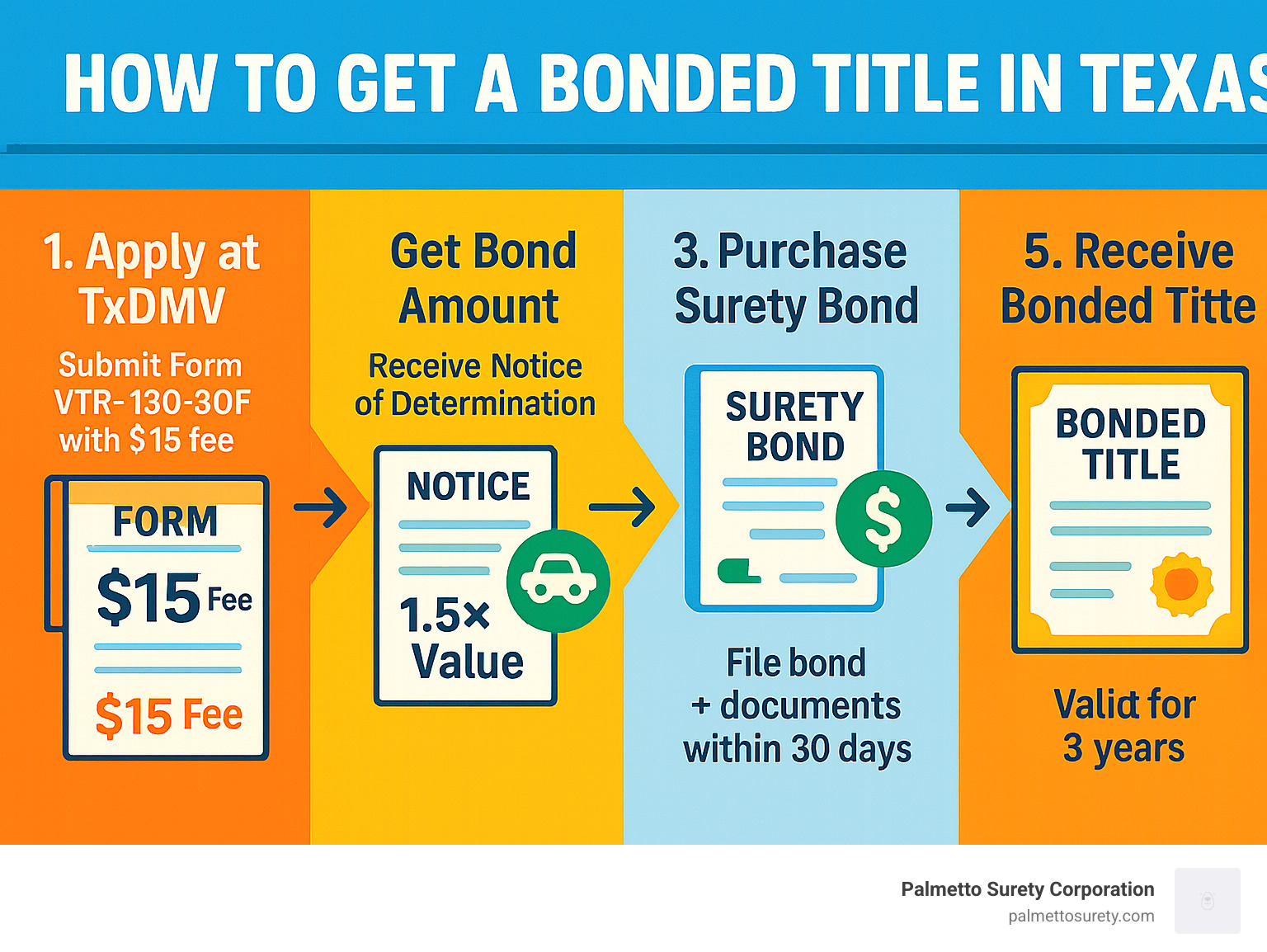
- Complete the Form VTR-130-SOF (Application for Bonded Title): This specialized form outlines your request for a bonded title. Be meticulous in filling out every section, providing as much detail as possible regarding the vehicle’s history and why a standard title is unavailable.
- Vehicle Inspection: As mentioned, a VIN inspection is often a mandatory step. This typically involves presenting the vehicle to a designated law enforcement officer or an authorized inspection station. They will verify the VIN matches your documentation and ensure the vehicle isn’t reported stolen.
- Vehicle Valuation: The TxDMV will use accepted valuation guides (like Kelley Blue Book or NADA) to determine the vehicle’s current market value. This value is crucial for calculating the required surety bond amount.
- Submission to TxDMV: Submit your completed Form VTR-130-SOF, proof of possession, inspection reports, and any other supporting documentation to the TxDMV. They will review your application and, if approved, issue a letter stating the required bond amount. This letter is essential for the next step.
Securing Your Surety Bond: Providers and Process
With the TxDMV’s determination of the bond amount, you can now secure the surety bond.
- Contact Surety Bond Companies: Reach out to several licensed surety bond providers in Texas. Many reputable agencies specialize in vehicle title bonds and can offer competitive quotes. You can often find these companies through an online search.
- Provide Information: You will need to provide the surety company with the TxDMV letter stating the required bond amount, your personal information, and details about the vehicle.
- Pay the Premium: Once you select a provider and agree to their terms, you’ll pay the premium (e.g., 1-5% of the total bond amount).
- Receive the Bond: The surety company will issue the official surety bond, which is a specific legal document that you will need to submit to the TxDMV.
Finalizing Your Title: Registration and Beyond
With the surety bond in hand, you’re on the home stretch.
- Submit Bond to TxDMV: Take the original surety bond, along with your original approved application, to your local Texas county tax assessor-collector’s office (which processes vehicle registrations for the TxDMV).
- Pay Fees and Taxes: At this point, you will pay the title application fee, sales tax (if applicable), and registration fees.
- Receive Your Bonded Title and Plates: Once all fees are paid and documentation is verified, you will be issued a bonded title and your new license plates. The title will clearly state it is a “bonded title.” This bonded status remains on the title for three years. If no claims are made against the bond during this period, you can then apply for a regular, non-bonded title at no additional cost.
- Secure Insurance: Do not forget to obtain mandatory liability insurance before driving your vehicle.
This systematic approach ensures that whether you’re planning an exciting road trip from Austin to South Padre Island, or settling down in a cozy Fort Worth apartment, your vehicle ownership is legitimate, and your Texas journey can proceed without legal complications.
Beyond the Bond: How Vehicle Ownership Enhances Your Texas Experience
For travelers, digital nomads, or those embarking on a long-term stay, the decision to obtain a vehicle, even one requiring a bonded title, often translates into an elevated and more authentic Texas experience. While the administrative steps are a part of the process, the ultimate reward is the freedom and opportunity to explore the state on your own terms, weaving together unique travel memories and enriching your lifestyle.
Unlocking Texas’s Iconic Destinations with Your Own Ride
The sheer size and diversity of Texas make personal transportation invaluable. Public transport options are limited outside of major city centers, meaning a vehicle is often the key to unlocking the true breadth of the state’s attractions.
- Road Trip Rhapsody: Imagine the open road leading you from the vibrant live music scene of Austin through the picturesque Hill Country to the historic Gruene Historic District, famous for its dance hall. With your own car, you can spontaneously stop at quaint towns, scenic overlooks, or charming local eateries.
- National Parks and Seashores: Accessing natural wonders like the remote beauty of Big Bend National Park or the pristine shores of Padre Island National Seashore is virtually impossible without a personal vehicle. These destinations offer incredible opportunities for hiking, wildlife viewing, and stargazing, all at your own pace.
- Urban Explorations: Even in cities, a vehicle provides flexibility. Explore the San Antonio Riverwalk, visit the historic Alamo, then easily drive to the NASA Johnson Space Center in Houston on the same trip. You can venture beyond tourist traps, discover local neighborhoods, and dine at hidden culinary gems.
- Quirky Landmarks: Texas is full of eccentric attractions, from the art installation of Cadillac Ranch near Amarillo to countless roadside attractions. These are best experienced with the freedom of your own car.
Having your own vehicle transforms your journey from a structured tour into an authentic adventure, allowing you to craft a personalized itinerary that aligns perfectly with your interests and spontaneous desires.
Long-Term Stays and the Comfort of Personal Transport
For those seeking long-term accommodation in Texas, a personal vehicle transitions from a travel amenity to a fundamental aspect of daily life. Whether you’re renting a charming apartment in Austin, a cozy home in Fort Worth, or a sprawling ranch in the countryside, a car offers unparalleled comfort and convenience.
- Daily Commutes and Errands: Navigating grocery runs, doctor’s appointments, or trips to local markets becomes effortless.
- Integrating into Local Culture: Attending local festivals, community events, or simply discovering your favorite coffee shop often requires traveling beyond immediate walking distance. A car facilitates deeper immersion into local Texas life.
- Enhanced Accommodation Choices: With a car, your choice of accommodation isn’t limited to areas with extensive public transport. You can opt for more secluded villas, tranquil resorts on the outskirts of cities, or charming Airbnb properties in rural settings, knowing you can easily access amenities and attractions. This opens up a wider range of housing options, from budget-friendly stays to luxury retreats.

A Lifestyle Choice: Budget-Friendly Exploration vs. Luxury Expeditions
Vehicle ownership itself is a lifestyle choice that can be adapted to various travel philosophies.
- Budget Travel: For those focused on budget travel, acquiring a used vehicle (even one needing a bonded title) can be significantly more economical than relying on ride-shares, taxis, or restrictive public transport over an extended period. The freedom to self-cater and avoid expensive guided tours further amplifies savings. The initial investment in a bonded title, though an upfront cost, quickly pays for itself in flexibility and reduced ongoing transport expenses.
- Luxury and Flexibility: For luxury travelers, having a personal vehicle, perhaps even one imported or acquired specifically for a Texas sojourn, offers an unmatched level of comfort and privacy. It allows for seamless transitions between high-end resorts, gourmet dining experiences, and exclusive attractions without relying on external schedules.
- Family Trips: Families benefit immensely from having their own vehicle, allowing for flexible schedules, easy transport of luggage and children, and the ability to carry all the necessary gear for day trips to parks, beaches, or historical sites.
Ultimately, whether your goal is to explore every corner of Texas, settle in for an extended period, or simply enjoy the freedom of the open road, understanding and navigating the bonded title process is a small investment for the immense opportunities it unlocks. It’s an administrative step that directly contributes to a richer, more independent, and fulfilling travel and lifestyle experience in the diverse and welcoming landscapes of Texas.
The costs associated with a bonded title are relatively minor compared to the overall value of a vehicle and the unparalleled access it grants to the wonders of the Lone Star State. With careful planning and adherence to the outlined steps, you can confidently obtain your bonded title, register your vehicle, and set off on your unforgettable Texas adventure, knowing your journey is secure and legitimate.
LifeOutOfTheBox is a participant in the Amazon Services LLC Associates Program, an affiliate advertising program designed to provide a means for sites to earn advertising fees by advertising and linking to Amazon.com. Amazon, the Amazon logo, AmazonSupply, and the AmazonSupply logo are trademarks of Amazon.com, Inc. or its affiliates. As an Amazon Associate we earn affiliate commissions from qualifying purchases.