
The question of when Texas was annexed by the United States is not merely a date to be memorized, but a pivotal moment in the history of both nations. It marks the culmination of a decade of complex negotiations, shifting political tides, and defining moments that shaped the geopolitical landscape of North America. The process was neither swift nor simple, fraught with debate over slavery, states’ rights, and the potential for war with Mexico. Understanding this historical transition provides crucial context for the cultural and political identity of modern-day Texas and its enduring relationship with the United States.
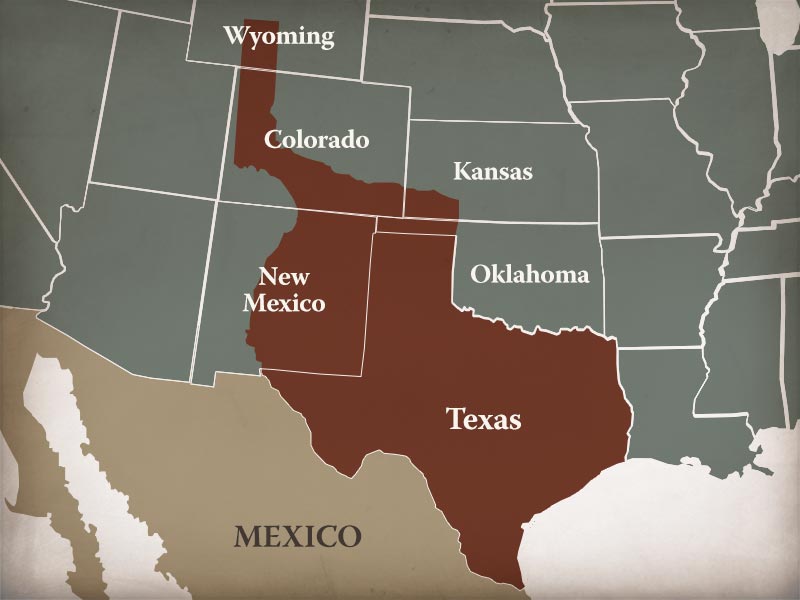
The Republic of Texas: A Decade of Independence
Following its hard-won independence from Mexico in 1836, the Republic of Texas embarked on a journey as a sovereign nation. This period, though brief, was characterized by a burgeoning identity and a desire for recognition on the international stage. The Texan government, led by figures like Sam Houston and Mirabeau B. Lamar, actively sought alliances and economic partnerships, navigating the turbulent waters of post-revolution nation-building.
Challenges of Nationhood
The newly formed Republic of Texas faced significant hurdles. Economically, it struggled with debt incurred during the Texas Revolution and with establishing a stable currency. Politically, maintaining internal unity amidst differing visions for the nation’s future proved challenging. Externally, Mexico refused to recognize Texas’s independence, posing a constant security threat. Furthermore, the issue of slavery, already a contentious topic across the United States, was central to Texas’s economy and social structure, creating a complex dynamic for any potential union with the increasingly abolitionist sentiment in the North.
Diplomatic Overtures and Growing Interest
Despite these challenges, the Republic of Texas actively pursued annexation by the United States. Texan diplomats engaged in extensive negotiations with Washington D.C., highlighting the potential benefits of joining the Union. These benefits included increased security, access to American markets, and the prospect of greater economic stability. For the United States, annexing Texas offered significant strategic advantages, including territorial expansion and control of valuable resources, but also brought the contentious issue of slavery to the forefront of national politics.
The Road to Annexation: Political Maneuvering and National Debate
The path to Texas’s annexation was paved with intense political debate and strategic maneuvering within the United States. The issue became a central point of contention in American presidential elections and congressional debates, reflecting the deep divisions over westward expansion and the expansion of slavery.
The Annexation Treaty of 1844 and its Defeat
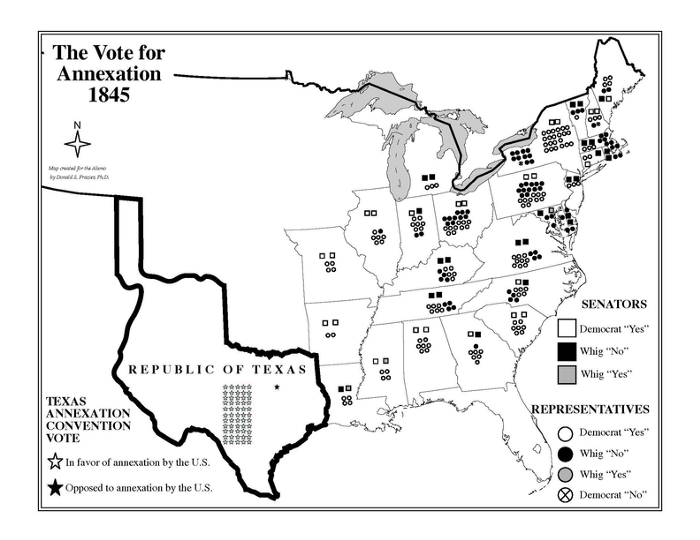
In April 1844, the United States and the Republic of Texas signed a treaty of annexation. This agreement was championed by President John Tyler, who saw it as a way to expand American territory and influence. However, the treaty faced formidable opposition in the U.S. Senate. Key arguments against it centered on the potential for war with Mexico, which still considered Texas a rebellious province, and the fact that the annexation would significantly increase the number of slaveholding states, upsetting the delicate balance of power between free and slave states in Congress. The treaty ultimately failed to achieve the required two-thirds majority for ratification in the Senate.
The Election of 1844: A Mandate for Expansion
The issue of Texas annexation loomed large over the 1844 U.S. Presidential election. The Democratic candidate, James K. Polk, a staunch advocate for westward expansion and the annexation of Texas, emerged victorious. Polk’s victory was widely interpreted as a public mandate to pursue annexation. His administration then took a different approach, seeking not a treaty but a joint resolution of Congress, which required only a simple majority in both the House of Representatives and the Senate.
The Final Act: Joint Resolution and Statehood
Following President Polk’s inauguration, the push for annexation gained renewed momentum. The congressional route proved more successful than the treaty approach, allowing the annexation to proceed with a simpler majority vote.
The Joint Resolution of Annexation
On February 28, 1845, the U.S. House of Representatives passed a joint resolution to annex Texas. The Senate followed suit on March 1, 1845. This legislative act effectively offered Texas the opportunity to join the United States under specific terms. President John Tyler, in one of his final acts in office, signed the resolution, setting the stage for the formal incorporation of Texas into the Union.

Texas’s Acceptance and Formal Admission
The Republic of Texas received the joint resolution with a mixture of celebration and careful deliberation. Texan leaders and citizens debated the terms of admission, ultimately voting to accept the terms of annexation in an election held in October 1845. This decision was formally conveyed to the United States. The official date of Texas’s annexation into the United States is December 29, 1845, when President James K. Polk signed the congressional act admitting Texas as the 28th state of the Union. This act marked the end of the Republic of Texas and its beginning as a state within the United States, a transition that profoundly impacted the future of both entities and the continent.
LifeOutOfTheBox is a participant in the Amazon Services LLC Associates Program, an affiliate advertising program designed to provide a means for sites to earn advertising fees by advertising and linking to Amazon.com. Amazon, the Amazon logo, AmazonSupply, and the AmazonSupply logo are trademarks of Amazon.com, Inc. or its affiliates. As an Amazon Associate we earn affiliate commissions from qualifying purchases.