
The question of proximity between Russia and Alaska often conjures images of vast, icy expanses and a shared Arctic frontier. While separated by a considerable body of water, the geographical and historical connections between these two northernmost territories are surprisingly intimate, marking them as neighbors in more ways than one. The closest point of separation is a mere 55 miles, a distance that, in the grand scheme of continental geography, is remarkably short. This narrow strait, known as the Bering Strait, is not just a physical boundary but a historical conduit, a pathway that played a pivotal role in the peopling of the Americas and the geopolitical dynamics of centuries past. Understanding this closeness requires delving into the geography, the history of exploration, and the cultural echoes that persist across the waters.

The Geography of Proximity: The Bering Strait
The Bering Strait is the defining geographical feature that bridges the gap between Russia and Alaska. It connects the Arctic Ocean to the Pacific Ocean and serves as the continental boundary between Asia and North America. The strait itself is named after the Danish explorer Vitus Bering, who sailed through it in the early 18th century.
The Diomede Islands: A Midpoint of Proximity
Floating within the Bering Strait are the Diomede Islands, a pair of small islands that lie almost exactly between the two continents. Big Diomede belongs to Russia, while Little Diomede is part of Alaska, United States. The distance between these two islands is less than two miles, making them a tangible symbol of how close the two nations truly are.
The International Date Line: A Temporal Divide
Adding another layer to the proximity of the Diomede Islands is the International Date Line. This imaginary line, which zigzags its way through the strait, separates the two islands chronologically. When it is day on Little Diomede, it is night on Big Diomede, creating a unique situation where one can theoretically step from one day into another in a matter of minutes. This temporal proximity, coupled with the physical closeness, makes the Diomede Islands a fascinating point of study for those interested in geography and international relations.
The Chukchi Sea and Bering Sea: Navigational Pathways
The waters surrounding the Bering Strait, namely the Chukchi Sea to the north and the Bering Sea to the south, have historically served as crucial navigational pathways. These seas are rich in marine life and have been traversed by indigenous peoples for millennia, as well as by explorers and traders from various nations.
Ice Bridges and Human Migration
During the Pleistocene epoch, a land bridge, known as Beringia, is believed to have connected Siberia and Alaska. This land bridge allowed for the migration of animals and, crucially, the first humans to populate the Americas. While this bridge has long since submerged, the geographical memory of that connection persists in the narrowness of the modern strait. Even today, during particularly harsh winters, temporary ice bridges can form, offering a fleeting, albeit treacherous, connection across the water.
Historical Encounters and the Sale of Alaska
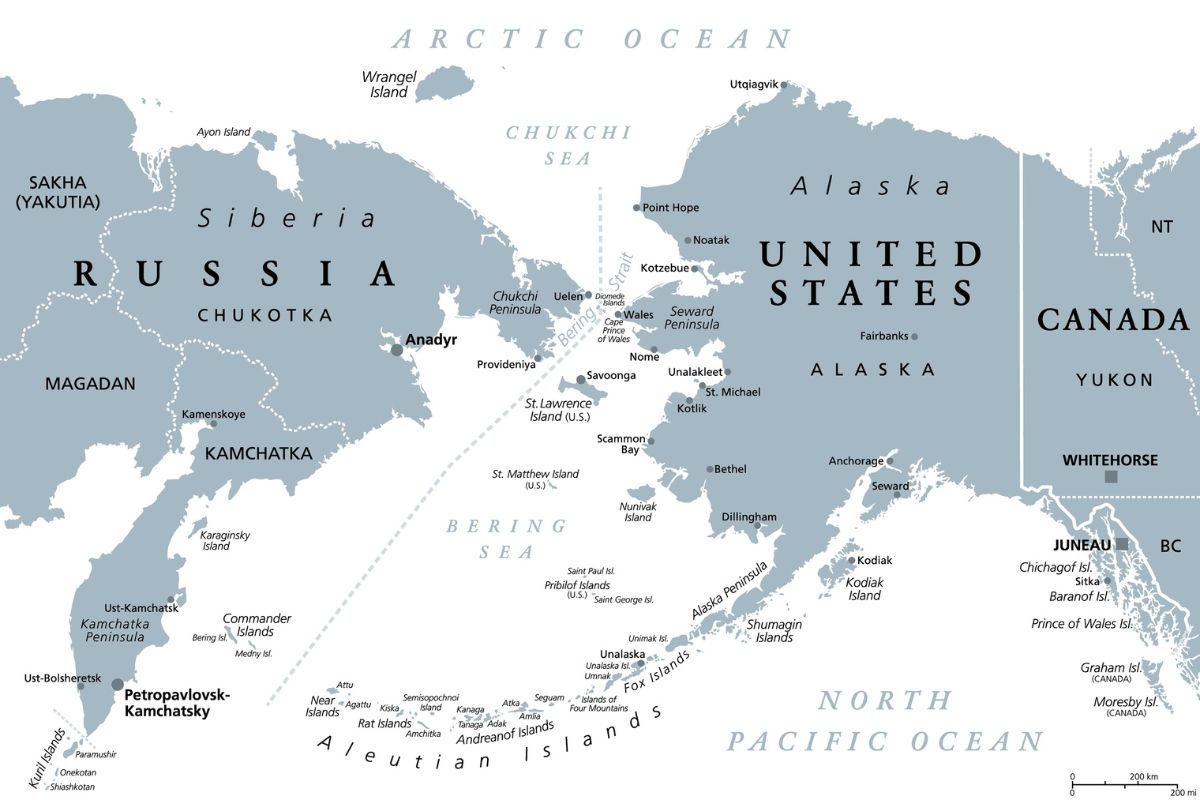
The perceived closeness between Russia and Alaska is also deeply rooted in historical events, most notably Russia‘s exploration and eventual sale of Alaska to the United States. For centuries, Russian explorers and fur traders ventured across the Bering Strait into the vast territories of Alaska.
Russian America: A Colonial Endeavor
From the mid-18th century onwards, Russian interest in Alaska grew significantly, driven by the lucrative fur trade. Companies like the Russian-American Company established settlements and trading posts, exerting Russian influence over much of the Alaskan coast. Cities like Sitka and Kodiak were founded as important centers of Russian colonial activity. This period, often referred to as Russian America, established a distinct Russian cultural and architectural imprint on parts of Alaska.
The Sale of Alaska in 1867
Despite its presence, Russia ultimately found it difficult to maintain and defend its Alaskan territory, especially after the Crimean War. The perceived lack of economic benefit and the growing threat of British expansion from neighboring Canada led Russia to consider selling Alaska. In 1867, Russia sold the territory to the United States for $7.2 million, a transaction famously known as the “Seward Purchase,” named after then-U.S. Secretary of State William Seward. This sale marked the end of Russian America but solidified the geopolitical connection between the two landmasses, albeit under a new sovereign.
Cultural and Environmental Echoes
The geographical and historical proximity has left indelible marks on the culture and environment of both Russia and Alaska, creating subtle yet significant echoes across the Bering Strait.
Indigenous Peoples and Shared Heritage
The indigenous peoples of Alaska, such as the Yup’ik and Inupiat, share ancestral ties with the indigenous populations of the Russian Far East, including the Chukchi and Siberian Yup’ik. These communities have historically maintained cultural and trade relationships across the strait, utilizing traditional knowledge and seafaring skills to navigate the often-harsh waters. Many linguistic and cultural similarities persist, testament to their shared heritage that predates any national borders.
Contemporary Crossings and Cultural Exchange
While formal travel between Russia and Alaska can be complex due to visa requirements and logistical challenges, informal cultural exchange continues. Indigenous communities on both sides maintain connections, and there are occasional joint scientific expeditions and cultural events that foster understanding. The shared Arctic environment also brings a common focus on issues such as climate change and wildlife conservation, uniting researchers and communities in both nations.

The Beringia Interpretive Centre and Museum
In Whitehorse, Yukon, the Beringia Interpretive Centre stands as a testament to the shared history and geographical connection between Russia and Alaska. While not directly on the border, it explores the ancient land bridge of Beringia and the migrations that shaped human history in the region. Such institutions highlight the scientific and cultural importance of understanding the links between these two vast territories.
In conclusion, while Russia and Alaska are separated by the considerable expanse of the Bering Strait, their closeness is a multifaceted concept. Geographically, the strait is a narrow passage, punctuated by the islands that lie within it. Historically, Russia‘s colonial presence and subsequent sale of Alaska have forged a unique bond. Culturally and environmentally, shared indigenous heritage and common Arctic concerns continue to bridge the waters. This perceived closeness is not just about miles but about the interwoven narratives of exploration, human migration, and enduring connections across a vital, shared frontier.
LifeOutOfTheBox is a participant in the Amazon Services LLC Associates Program, an affiliate advertising program designed to provide a means for sites to earn advertising fees by advertising and linking to Amazon.com. Amazon, the Amazon logo, AmazonSupply, and the AmazonSupply logo are trademarks of Amazon.com, Inc. or its affiliates. As an Amazon Associate we earn affiliate commissions from qualifying purchases.