
The allure of the Hawaiian Islands, a string of volcanic gems scattered across the vast Pacific Ocean, has captivated travelers for generations. From the iconic surf breaks of Oahu to the dramatic landscapes of the Big Island, Hawaii promises an unforgettable escape. But before you can feel the warm sand between your toes and breathe in the fragrant plumeria, you need to consider a fundamental aspect of your journey: travel time. “How long does it take to get to Hawaii?” is a question that echoes in the minds of many prospective visitors, and the answer, as with many travel queries, is wonderfully varied. It depends on a confluence of factors, including your starting point, your chosen mode of transportation, the specific island you’re aiming for, and even the time of year you plan to embark on your adventure.
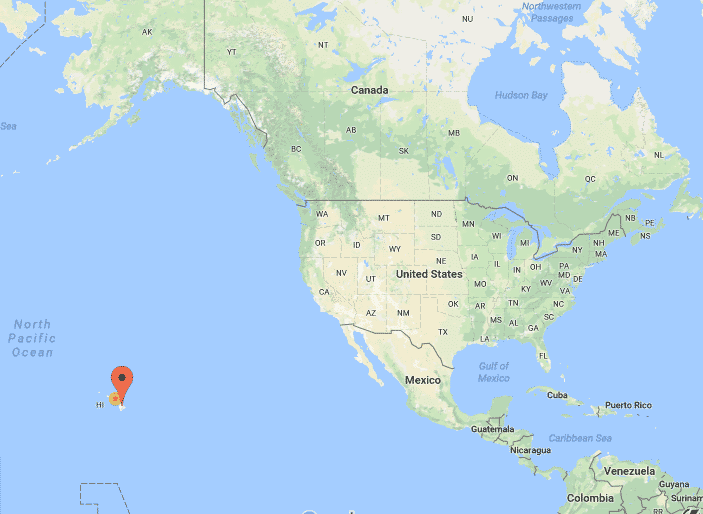
This comprehensive guide will delve into the intricacies of reaching the Hawaiian Islands, offering insights into flight durations, potential layovers, and considerations for making your journey as smooth and enjoyable as possible. Whether you’re dreaming of a luxurious resort stay in Maui or a budget-friendly exploration of Kauai’s natural wonders, understanding the travel time is the first crucial step in planning your perfect Hawaiian vacation. We’ll explore the primary gateway airports, the impact of different departure cities, and provide practical tips to help you navigate the logistics of reaching this tropical paradise.
The Journey Begins: Flights to the Aloha State
For most travelers, the primary method of reaching Hawaii is by air. The archipelago is served by several major airports, each acting as a gateway to its respective island. Understanding the flight durations from various major cities provides a crucial baseline for your travel planning.
Direct Flights: The Fastest Route to Paradise
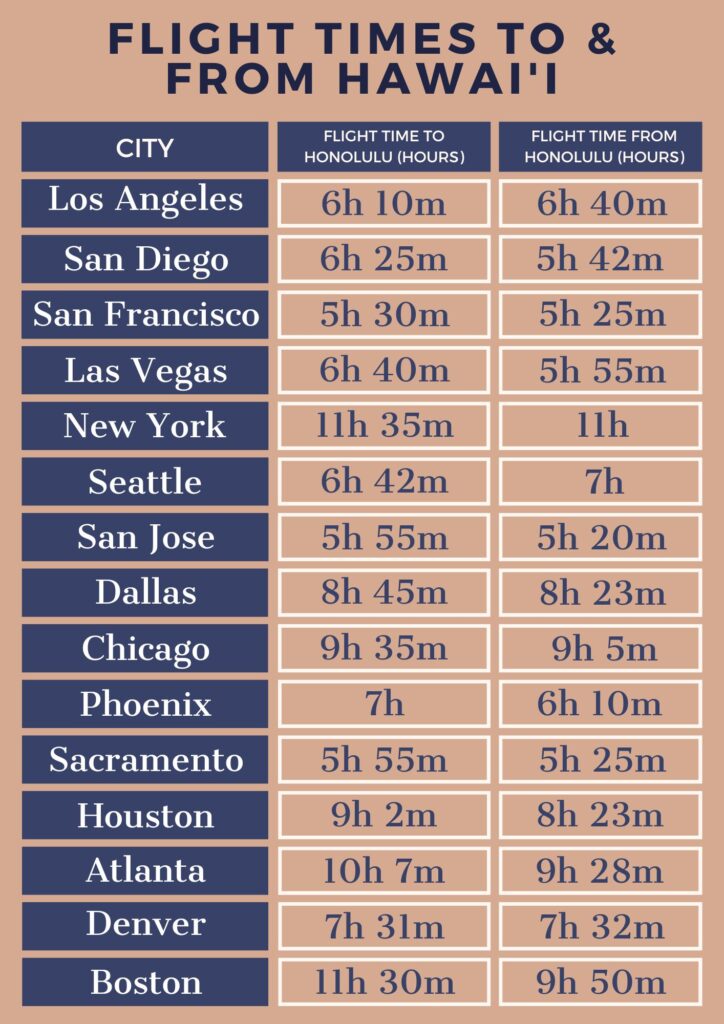
Direct flights are the most coveted option for those seeking to minimize their travel time. These flights whisk you directly from your departure city to one of Hawaii’s main airports without any stops. The duration of these direct flights is heavily influenced by your starting location.
-
West Coast of the United States: For those residing on the West Coast, the journey to Hawaii is considerably shorter. Flights from cities like Los Angeles, San Francisco, Seattle, and Portland typically range from 5 to 6 hours. This makes Hawaii an accessible destination for a long weekend or a shorter getaway. For example, a direct flight from Los Angeles International Airport (LAX) to Honolulu International Airport (HNL) on Oahu is often around 5.5 hours. Similarly, flights from Seattle-Tacoma International Airport (SEA) to Honolulu hover around 5 hours and 45 minutes.
-
Mountain and Central Time Zones: Travelers from cities in the Mountain or Central time zones, such as Denver, Dallas, or Chicago, will experience slightly longer direct flight times, generally falling between 7 to 8 hours. A direct flight from Denver International Airport (DEN) to Honolulu can take approximately 7.5 hours.
-
East Coast of the United States: The longest direct flights originate from the East Coast. Journeys from cities like New York City, Miami, or Boston can span 9 to 10 hours. For instance, a direct flight from John F. Kennedy International Airport (JFK) in New York to Honolulu is typically around 9 hours and 50 minutes.
-
International Departures: For international travelers, flight times vary even more dramatically.
- Canada: Flights from Vancouver to Honolulu are generally around 5.5 to 6 hours.
- Asia: Flights from major Asian hubs like Tokyo, Seoul, or Shanghai to Honolulu can range from 6 to 10 hours, depending on the specific city and airline.
- Australia and New Zealand: Traveling from Sydney or Auckland to Hawaii involves a longer journey, typically between 9 to 11 hours.
It’s important to note that these are approximate flight times and can be influenced by factors such as wind speed and direction, aircraft type, and air traffic control.
Flights with Layover: Adding Time to Your Travel
When direct flights are not available or are prohibitively expensive, many travelers opt for flights with one or more layovers. The duration of your trip can significantly increase with layovers, as you need to account for the time spent on the ground at the connecting airport, as well as the additional flight segments.
-
Connecting in the Continental U.S.: If you are flying from a city that does not offer direct flights to Hawaii, you will likely need to connect through a major hub on the West Coast, such as Los Angeles, San Francisco, or Seattle. In such cases, your total travel time can easily extend by 3 to 6 hours or more, depending on the length of your layover. For example, a flight from Chicago with a layover in Los Angeles could result in a total travel time of 10 to 12 hours, including the layover.
-
Connecting in Other International Hubs: International travelers might experience layovers in their respective regions before heading to Hawaii. For example, a traveler from Europe might have a layover in a major Asian hub like Tokyo before continuing to Honolulu. This can lead to total travel times of 20 hours or more, especially when factoring in significant layover durations.
When considering flights with layovers, it is crucial to pay close attention to the total journey time, not just the individual flight durations. Some booking platforms will clearly display the total travel time, while others may require you to add up the individual flight legs and layover periods.
Inter-Island Travel: Reaching Your Specific Hawaiian Destination
Once you arrive in Hawaii, you may need to take an inter-island flight to reach your final destination, especially if you plan to visit multiple islands or are flying into an airport on an island other than your primary focus. The major inter-island carriers, such as Hawaiian Airlines and Southwest Airlines, operate frequent flights between the islands.
- Honolulu (Oahu) to Maui (Kahului Airport – OGG): Approximately 35-40 minutes.
- Honolulu (Oahu) to Kauai (Lihue Airport – LIH): Approximately 40-45 minutes.
- Honolulu (Oahu) to the Big Island (Kona International Airport – KOA or Hilo International Airport – ITO): Approximately 50-60 minutes.
- Flights between other islands follow similar short durations.
These inter-island flights are quick and efficient, but you still need to factor in time for getting to and from the airports, check-in, security, and boarding. Therefore, it’s wise to allocate at least 3-4 hours for each inter-island travel segment.
Factors Influencing Your Travel Time
Beyond the geographical distance and direct vs. layover flights, several other elements can influence how long it takes to reach Hawaii. Understanding these can help you better manage your expectations and plan your itinerary accordingly.
Time Zones and Jet Lag
Hawaii observes Hawaii Standard Time (HST), which is UTC-10. This means that Hawaii is significantly behind most of the United States mainland.
- From the West Coast, the time difference is 3 hours.
- From the Mountain Time Zone, it’s 2 hours.
- From the Central Time Zone, it’s 1 hour.
- From the East Coast, the time difference is 5 hours.
This time difference contributes to jet lag, which can affect your well-being upon arrival. The longer the flight and the greater the time zone shift, the more pronounced the jet lag is likely to be. Planning to arrive a day or two before any major activities can help you adjust.
Seasonality and Booking in Advance
While seasonality doesn’t directly impact flight durations, it can influence flight availability and pricing, which in turn might lead you to choose flights with layovers or less convenient schedules. Peak travel seasons in Hawaii include the winter months (mid-December to mid-April) when many travelers from colder climates seek to escape the chill, and the summer months (June to August) for family vacations. During these periods, direct flights might be more scarce or expensive, potentially necessitating longer travel arrangements. Booking your flights well in advance, ideally 6 to 9 months prior to your travel dates, can secure better options and potentially reduce your overall travel time by ensuring you get direct flights.
Airline Choice and Aircraft Type
Different airlines may offer varying flight routes and schedules. Some may have exclusive partnerships or a more extensive network of direct flights to Hawaii. Additionally, the type of aircraft used can sometimes influence flight speed, although this is a minor factor compared to the others. Always compare options from multiple airlines when booking.
Making the Most of Your Journey to Hawaii
While the flight itself is a significant part of your travel time, there are ways to optimize your journey and ensure a positive experience.
Choosing the Right Airport
Hawaii has six major airports:
- Honolulu International Airport (HNL) on Oahu is the busiest and main international gateway.
- Kahului Airport (OGG) on Maui serves as a hub for the Valley Isle.
- Lihue Airport (LIH) on Kauai is the primary airport for the Garden Isle.
- Kona International Airport (KOA) on the Big Island is convenient for the western side.
- Hilo International Airport (ITO) on the Big Island serves the eastern side.
- Kapalua Airport (JHM) on Maui offers limited inter-island flights.
Your choice of arrival airport will depend on your chosen island. For instance, if your primary goal is to experience the vibrant city life and historical sites of Oahu, flying into HNL makes the most sense. If you’re drawn to the volcanic landscapes of the Big Island, consider flying into Kona (KOA) or Hilo (ITO).
Packing Smart for Long Flights
Long flights can be more comfortable with proper preparation. Pack essentials in your carry-on, such as:
- Comfortable clothing and layers
- Neck pillow, eye mask, and earplugs
- Entertainment (books, downloaded movies, music)
- Snacks and a reusable water bottle
- Any necessary medications
Considering Travel Packages and Travel Agents
For those who prefer a hands-off approach, travel agents can be invaluable. They have extensive knowledge of flight options, accommodation at places like the Grand Wailea Maui, A Waldorf Astoria Resort, and inter-island travel, and can often find packages that bundle flights and hotels, potentially saving you time and money.
Ultimately, the time it takes to get to Hawaii is a variable that requires careful consideration during your planning phase. By understanding the factors involved, comparing your options, and preparing adequately, you can ensure that your journey to these enchanting islands is as seamless and enjoyable as the destination itself. The anticipation of the Aloha State is part of the experience, and with a little planning, the journey will be a prelude to the unforgettable adventures that await you.
LifeOutOfTheBox is a participant in the Amazon Services LLC Associates Program, an affiliate advertising program designed to provide a means for sites to earn advertising fees by advertising and linking to Amazon.com. Amazon, the Amazon logo, AmazonSupply, and the AmazonSupply logo are trademarks of Amazon.com, Inc. or its affiliates. As an Amazon Associate we earn affiliate commissions from qualifying purchases.