
The vast expanse of the Pacific Ocean separates continents, yet sometimes, the closest points between landmasses are surprisingly near. The question of the distance between Alaska and Russia is one that often sparks curiosity, conjuring images of remote wilderness and the allure of crossing continents. While a direct land bridge doesn’t exist, the geographical proximity of Alaska, a U.S. state, to the Russian Federation is a fascinating subject, especially for those interested in travel, landmarks, and the unique lifestyle of exploring remote regions.
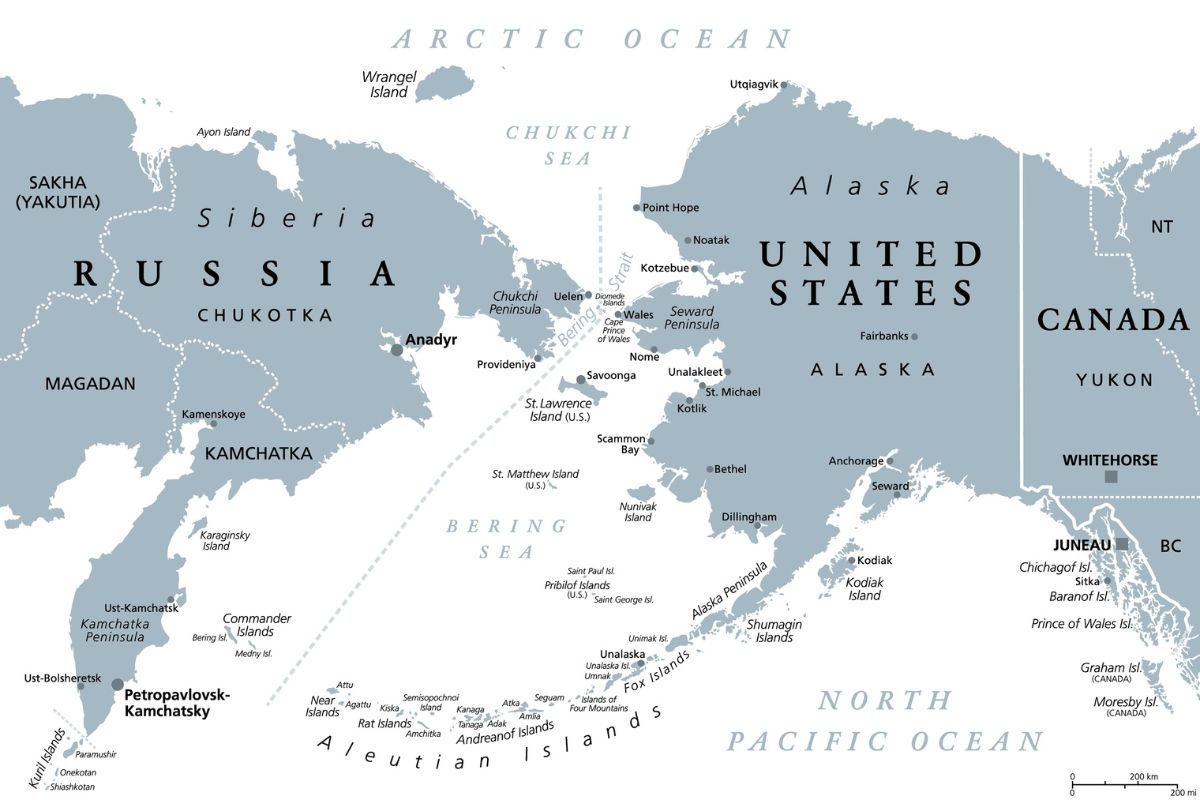
The most direct measurements of distance between Alaska and Russia point to a surprisingly narrow strait: the Bering Strait. This body of water is the key to understanding the proximity. At its narrowest point, the Bering Strait is only about 51 miles (82 kilometers) wide. This means that from the westernmost point of Alaska to the easternmost point of Russia, the distance is remarkably short.

The Bering Strait: A Gateway Between Continents
The Bering Strait is more than just a geographical feature; it’s a historical and cultural nexus. For millennia, it served as a land bridge during glacial periods, allowing for the migration of peoples and animals between Asia and North America. Today, it remains a vital waterway, separating the Chukchi Sea in the north from the Bering Sea in the south.
Diomede Islands: The Closest Neighbors
Within the Bering Strait lie two small islands that further emphasize the closeness of Alaska and Russia. These are the Diomede Islands.
- Big Diomede Island (Ostrov Ratmanova) belongs to Russia.
- Little Diomede Island (Inaliq) belongs to the United States, specifically Alaska.
These islands are separated by a mere 2.4 miles (3.8 kilometers) of water. More significantly, they are divided by the International Date Line and the maritime border between Russia and the United States. Standing on Little Diomede Island allows you to see Big Diomede Island clearly. The time difference between the two islands is significant due to the International Date Line; it’s almost a full day ahead on Big Diomede Island compared to Little Diomede Island. This is a mind-boggling aspect of travel for those who venture to this remote corner of the world.
The closest inhabited settlement in Alaska to Russia is the village of Wainwright, on the shores of the Chukchi Sea. From Wainwright, the distance to the Russian coast is still substantial, but the proximity of the Diomede Islands offers a tangible point of reference for the closeness.
The Journey: Challenges and Considerations
While the strait itself is narrow, the journey between Alaska and Russia is not a simple ferry ride or a short flight for most travelers. The primary reasons for this are:
- Limited Infrastructure: Both the Alaskan and Russian sides of the Bering Strait are incredibly remote. There are no major airports or ferry terminals directly on the strait designed for international passenger traffic.
- Visa Requirements: For most nationalities, traveling between the United States and Russia requires specific visas, which can be a complex and time-consuming process.
- Logistical Hurdles: Even for those with the necessary permits and visas, arranging transport across the Bering Strait involves significant logistical planning, often relying on chartered boats or small aircraft. The extreme weather conditions can also make travel unpredictable.
- Cost: Due to the remoteness and specialized nature of the travel, any journey across the Bering Strait would likely be expensive, catering to adventurous tourists interested in unique experiences and luxury travel in extreme environments.
Exploring the Alaskan Frontier
For many, the allure of the distance between Alaska and Russia is tied to the mystique of Alaska itself. This vast U.S. state is a land of unparalleled natural beauty and raw wilderness. Landmarks like Denali National Park and Preserve, with its towering Denali (formerly Mount McKinley), offer breathtaking vistas. The Inside Passage, a complex network of waterways along the coast, is renowned for its stunning fjords, glaciers, and abundant wildlife, making it a prime destination for cruises and adventure travel.
Juneau, the capital city, is a hub of activity, accessible only by air or sea. Visitors can explore its vibrant downtown, take a tram up Mount Roberts for panoramic views, or venture out to witness the magnificent Mendenhall Glacier. Further north, Anchorage serves as a major gateway to the state, offering a blend of urban amenities and access to the wilderness.
Accommodation options in Alaska range from rustic cabins and lodges nestled in remote areas to comfortable hotels and resorts in the larger cities. For those seeking a more immersive experience, booking a stay at a remote wilderness lodge can provide unparalleled access to nature and wildlife, fitting into the lifestyle of a true adventurer.
The Russian Arctic: A Contrasting Landscape
On the Russian side, the nearest landmass to Alaska is the Chukotka Autonomous Okrug. This is one of the most sparsely populated and remote regions of Russia. Its landscape is characterized by tundra, mountains, and a harsh Arctic climate.
- Provideniya Bay is a significant natural harbor and a gateway to the region.
- Anadyr is the administrative center and largest settlement in Chukotka.
The Russian Arctic offers a stark contrast to the more accessible parts of Alaska. Tourism here is not for the faint of heart and typically involves expeditions, often by ship, to explore the pristine wilderness and encounter unique Arctic wildlife such as polar bears, walruses, and various whale species.
Landmarks in this part of Russia are primarily natural wonders: vast stretches of undeveloped tundra, dramatic coastlines, and the raw power of the Arctic environment. The local culture is rich with indigenous traditions, particularly among the Chukchi and Eskimo peoples, who have inhabited this region for centuries. Experiencing this culture, sampling local food, and learning about their tips for survival in such an extreme environment would be a profound travel experience.
Accommodation in this region is extremely limited. Those undertaking expeditions might stay aboard specialized research vessels or in very basic guesthouses in settlements like Anadyr. This type of travel often falls under the umbrella of expedition tourism or extreme lifestyle travel, appealing to those seeking the ultimate adventure.

Understanding the Distance in Context
When we ask “How many miles is Alaska to Russia?”, the answer depends on what specific points we are measuring.
- Closest Points (Bering Strait): Approximately 51 miles (82 kilometers) across the water between the westernmost tip of mainland Alaska and the easternmost tip of mainland Russia.
- Diomede Islands: Just 2.4 miles (3.8 kilometers) separate Little Diomede Island (USA) from Big Diomede Island (Russia).
- Major Settlements: The distance between major population centers is significantly greater. For example, the distance between Nome, Alaska, and Provideniya, Russia, is several hundred miles. The distance between Anchorage, Alaska, and Anadyr, Russia, is even more substantial.
The geographical proximity across the Bering Strait is a fascinating anomaly. It highlights how continents can be so close, yet so far in terms of accessibility and the ease of travel. For the seasoned traveler or adventurer, the Bering Strait represents a frontier, a place where the boundaries of geography and culture meet. It’s a testament to the vastness of our planet and the diverse landscapes and experiences it offers, from the glaciers of Alaska to the remote tundra of Russia. Understanding this distance isn’t just about miles; it’s about appreciating the complex interplay of geography, history, and human endeavor that shapes our perception of the world.
LifeOutOfTheBox is a participant in the Amazon Services LLC Associates Program, an affiliate advertising program designed to provide a means for sites to earn advertising fees by advertising and linking to Amazon.com. Amazon, the Amazon logo, AmazonSupply, and the AmazonSupply logo are trademarks of Amazon.com, Inc. or its affiliates. As an Amazon Associate we earn affiliate commissions from qualifying purchases.