
Navigating the complexities of taking time off for family or medical reasons can be a significant concern for employees, especially when considering state-specific regulations. For those residing and working in the Golden State, understanding how the federal Family and Medical Leave Act (FMLA) interacts with California’s own leave laws is crucial. This article aims to demystify the process, providing a comprehensive overview of employee rights and employer responsibilities under both federal and state provisions. While the core principles of FMLA are national, its application in California is enhanced by state laws that offer broader protections and potentially longer leave periods. This blend of federal and state legislation creates a robust safety net for workers facing significant life events, from welcoming a new child to caring for a seriously ill family member or recovering from their own health issues.
Understanding the Federal Family and Medical Leave Act (FMLA)
The Family and Medical Leave Act (FMLA), a landmark federal law enacted in 1993, provides eligible employees of covered employers with unpaid, job-protected leave for specified family and medical reasons. Its primary purpose is to allow workers to balance their work and family responsibilities without jeopardizing their employment. This means that if you qualify for FMLA leave, your employer must hold your job open for you while you are on leave, and you are generally entitled to return to the same or an equivalent position upon your return.
Key Provisions of FMLA
To be eligible for FMLA leave, an employee must meet several criteria. First, they must work for a covered employer. This includes private-sector employers with 50 or more employees in the United States within a 75-mile radius, public agencies, and public or private elementary and secondary schools. Second, the employee must have worked for the employer for at least 12 months (though not necessarily consecutively), have worked at least 1,250 hours of service during the 12 months immediately preceding the commencement of the leave, and work at a worksite where the employer has at least 50 employees within 75 miles.
The qualifying reasons for FMLA leave are specific and include:
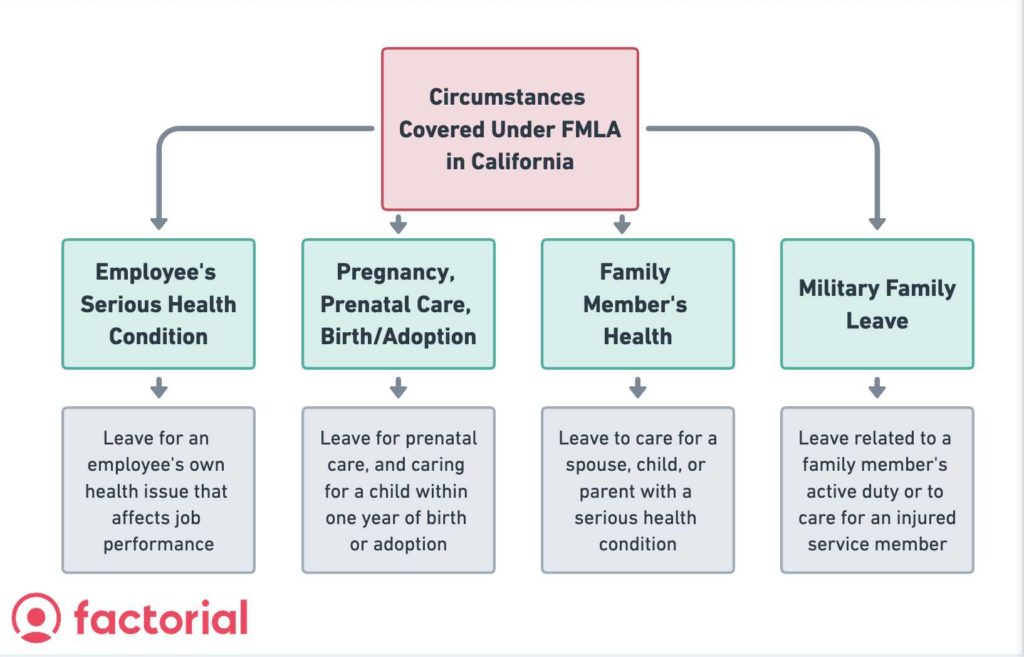
- The birth of a child and to care for the newborn child within one year of birth. This also applies to the placement of a child for adoption or foster care.
- To care for the employee’s spouse, son, daughter, or parent who has a serious health condition. A “serious health condition” is generally defined as an illness, injury, impairment, or physical or mental condition that involves inpatient care or continuing treatment by a healthcare provider.
- For a serious health condition that makes the employee unable to perform the functions of their job.
- For any qualifying exigency arising out of the fact that the employee’s spouse, son, daughter, or parent is a covered military member on “covered active duty.” This is part of the FMLA’s provisions for military families.
- To care for a covered servicemember with a serious injury or illness if the employee is the servicemember’s spouse, son, daughter, parent, or next of kin. This is known as military caregiver leave.
Eligible employees are entitled to a total of 12 workweeks of unpaid leave during any 12-month period for the first four qualifying reasons. For military caregiver leave, employees may be entitled to up to 26 workweeks of leave during a single 12-month period.
How FMLA Leave is Calculated
The 12-month period can be calculated in several ways, at the employer’s discretion:
- The calendar year.
- Any fixed 12-month period (e.g., fiscal year, year starting on an employee’s anniversary date).
- A rolling 12-month period measured backward from the date an employee uses any FMLA leave.
- A 12-month period measured forward from the date an employee first starts using FMLA leave.
The employer must choose one method and apply it consistently to all employees. This calculation is critical for determining the total amount of leave an employee has available.
California’s Additional Leave Protections: CFRA and Other Laws
While FMLA provides a foundational level of protection, California has enacted its own laws that often offer more comprehensive benefits and cover a broader range of employees. The most significant of these is the California Family Rights Act (CFRA).
The California Family Rights Act (CFRA)
The California Family Rights Act (CFRA) is the primary state law that mirrors and, in many aspects, expands upon the protections offered by FMLA. Enacted in 1991, CFRA allows eligible employees to take up to 12 workweeks of job-protected leave in a 12-month period for specific family and medical reasons.
Crucially, CFRA has historically had different eligibility requirements and covered a wider range of employers than FMLA. For instance, before recent amendments, CFRA applied to employers with 50 or more employees within a 75-mile radius, similar to FMLA. However, as of January 1, 2021, CFRA applies to employers with five or more employees. This expansion significantly broadens the reach of job-protected family leave in California, covering many small businesses that were not previously subject to FMLA.
Another key difference lies in the definition of family members for whom leave can be taken. While FMLA covers parents, spouses, and children, CFRA includes a broader definition of “family member,” which encompasses individuals in a registered domestic partnership, grandparents, grandchildren, and siblings. This expanded definition offers protection for a wider array of familial relationships.
Furthermore, CFRA is generally more inclusive regarding pregnancy-related leave. For example, pregnancy disability leave under California’s Pregnancy Disability Leave Law (PDL), which is a separate state law, runs concurrently with FMLA for up to 12 weeks but can be taken for longer periods if an employee is disabled by pregnancy. However, under CFRA, leave for bonding with a new child after birth, adoption, or foster care placement does not run concurrently with any pregnancy disability leave. This means an employee can potentially take up to 12 weeks of leave for pregnancy disability and an additional 12 weeks for baby bonding, effectively providing up to 24 weeks of protected leave in certain circumstances.
Other Relevant California Leave Laws
Beyond CFRA, California offers several other leave provisions that can be relevant to employees seeking time off for personal or family matters.
- Pregnancy Disability Leave (PDL): As mentioned, this law provides eligible employees with up to four months of unpaid leave per pregnancy if they are unable to work due to pregnancy, childbirth, or a related medical condition. PDL is administered separately from FMLA and CFRA and can run concurrently with FMLA for up to 12 weeks.
- Paid Family Leave (PFL): While not job-protected leave in the same way as FMLA or CFRA, California’s Paid Family Leave (PFL) program, administered by the Employment Development Department (EDD), provides partial wage replacement for eligible workers who need to take time off to care for a seriously ill child, parent, spouse, or registered domestic partner, or to bond with a new child. PFL is funded through employee payroll deductions. It is crucial to understand that PFL provides income replacement, while FMLA and CFRA provide job protection. Employees can often coordinate PFL with their job-protected leave under FMLA and CFRA.
- Kin Care Leave: This allows employees to use up to 40 hours of paid sick leave per year to care for a family member (child, grandchild, grandparent, sibling, spouse, or registered domestic partner) who is ill or needs medical care. This is a valuable supplement for shorter-term care needs.
Navigating the Interplay Between FMLA and California Laws
The existence of both federal and state leave laws can sometimes create confusion regarding which law applies and how they interact. In California, the general principle is that employees are entitled to the most favorable provisions of either federal or state law.
Concurrent Leave Provisions
For many qualifying reasons, FMLA and CFRA leave run concurrently. This means that if an employee is eligible for both FMLA and CFRA, their 12 weeks of leave will be counted against both federal and state entitlements simultaneously. However, as noted, there are instances where CFRA offers additional time, particularly for pregnancy disability and bonding.
The employer is responsible for determining which law applies and for informing the employee of their rights and obligations under both. When an employer designates an absence as FMLA-qualifying, it must also determine if the leave qualifies under CFRA or other applicable state laws.
Employer Responsibilities and Employee Rights
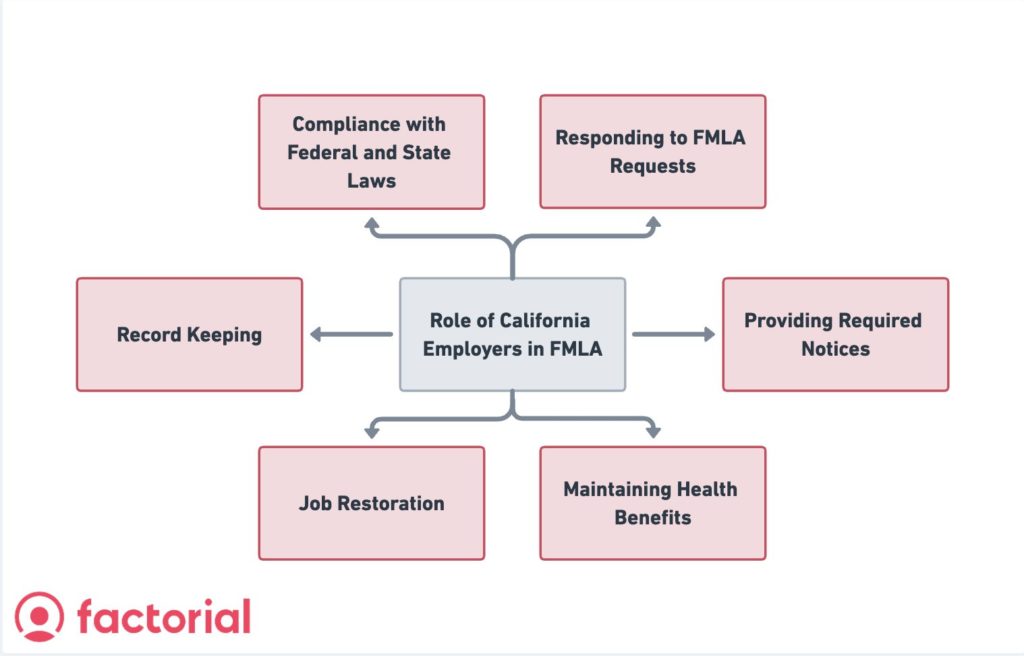
Employers in California must:
- Post FMLA and CFRA notices: Employers are required to display posters informing employees of their rights under both laws.
- Provide written notice: When an employee requests leave or when an employer learns that an employee’s absence may qualify for FMLA or CFRA leave, the employer must provide written notice detailing the employee’s rights and responsibilities.
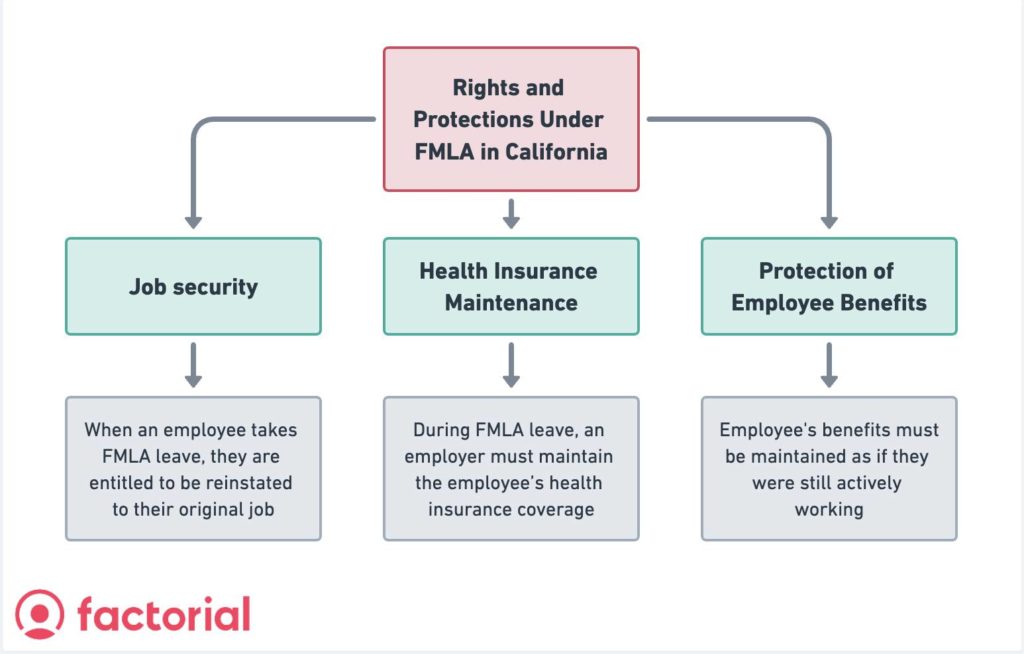
- Maintain health benefits: During FMLA or CFRA leave, employers must continue to provide the same group health benefits that would have been provided if the employee had continued to work.
- Return to equivalent employment: Upon returning from leave, employees are entitled to be reinstated to their original job or to an equivalent position, which means substantially similar duties, responsibilities, pay, and benefits.
Employees have the right to:
- Request leave: For qualifying reasons, employees can request FMLA/CFRA leave.
- Job protection: Their job is protected during the leave period.
- Continuation of health benefits: Their health insurance coverage must be maintained.
- Return to an equivalent position: They have the right to return to a comparable job.
It is advisable for employees to communicate clearly with their employers about their need for leave and to understand the specific requirements of both FMLA and California’s state laws. Consulting with the California Department of Industrial Relations or an employment law attorney can provide further clarity on individual situations. The goal of these intertwined laws is to support workers in California during critical life events, ensuring they can prioritize their health and families without undue financial or career repercussions, whether they are planning a trip to Disneyland, staying at a luxury resort in Napa Valley, or simply seeking to enjoy the diverse lifestyle options the state offers.
LifeOutOfTheBox is a participant in the Amazon Services LLC Associates Program, an affiliate advertising program designed to provide a means for sites to earn advertising fees by advertising and linking to Amazon.com. Amazon, the Amazon logo, AmazonSupply, and the AmazonSupply logo are trademarks of Amazon.com, Inc. or its affiliates. As an Amazon Associate we earn affiliate commissions from qualifying purchases.