
When embarking on a journey to explore the world, from the bustling streets of Tokyo to the ancient ruins of Machu Picchu, capturing the essence of your experiences through writing is a rewarding endeavor. Whether you’re crafting a detailed travelogue, a comprehensive destination guide, or a review of a luxurious resort, the accuracy and credibility of your information are paramount. This is where proper citation comes into play, and in the realm of academic and detailed non-fiction writing, the Chicago Manual of Style offers a robust framework. Specifically, understanding how to write Chicago Style footnotes is crucial for providing readers with clear, verifiable sources, enhancing the authority of your work, and avoiding any form of academic dishonesty.

This guide will demystify the process of creating Chicago Style footnotes, adapting its principles to the vibrant world of travel writing. We’ll cover the foundational elements, explore variations for different source types common in travel narratives, and offer practical tips to ensure your citations are as impeccable as your travel plans.
The Essence of Chicago Style Footnotes: Clarity and Credibility
At its core, the Chicago Style system of citation, whether through footnotes or endnotes, serves a dual purpose: it acknowledges the sources of your information and provides readers with the necessary details to locate those sources themselves. In travel writing, this might mean crediting a historical text that informed your description of a landmark, a specific guidebook that detailed a hiking trail in the Swiss Alps, or even an interview with a local artisan in Marrakech.
Footnotes, appearing at the bottom of the page on which the reference is made, offer readers an immediate link to the source without disrupting the flow of the main text. This makes them particularly useful for pieces where detailed explanations or a constant stream of attributions are beneficial, such as in in-depth travel guides or historical travel essays.
The Anatomy of a Chicago Style Footnote
A typical Chicago Style footnote comprises several key components, presented in a specific order and format. While variations exist depending on the source type, the fundamental structure remains consistent.
1. The Superscript Number:
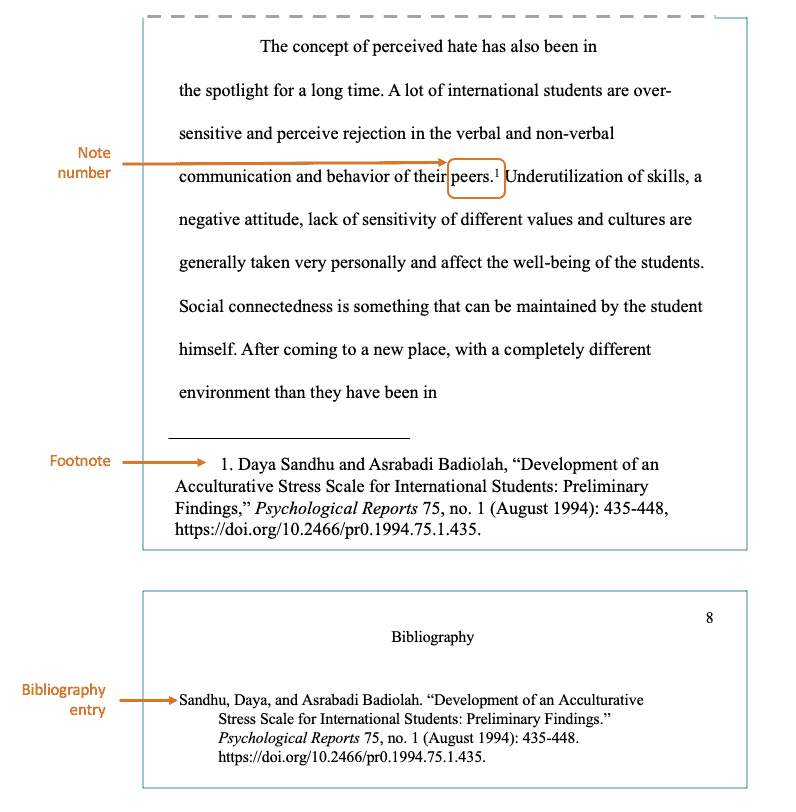
Each time you reference a source in your text, you’ll insert a superscript number immediately following the punctuation of the sentence or clause containing the referenced information. This number corresponds to a footnote entry at the bottom of the page.
Example in text: The ancient city, with its intricate network of canals, dates back centuries.1
2. The Footnote Entry:
At the bottom of the page, the corresponding footnote entry begins with the same number, not in superscript. The primary elements of a footnote entry for a book, a common source for travel writers, are:
- Author’s First Name Last Name: (e.g., Isabella Bird)
- Title of the Book (in italics): (e.g., A Lady’s Life in the Rocky Mountains)
- Publication Information: This includes the place of publication, the publisher, and the year of publication. (e.g., New York: G. P. Putnam’s Sons, 1879).
- Page Number(s): This specifies the exact page or pages from which the information was drawn (e.g., 55).
Example Footnote Entry (First Citation):
- Isabella Bird, A Lady’s Life in the Rocky Mountains (New York: G. P. Putnam’s Sons, 1879), 55.
Subsequent Citations:
When you cite the same source multiple times within your work, subsequent citations become shorter.
- Subsequent Footnote Entry: Author’s Last Name, Shortened Title, Page Number(s). (e.g., Bird, A Lady’s Life, 112).
Example Footnote Entry (Subsequent Citation):
- Bird, A Lady’s Life, 112.
This concise format prevents redundancy while still providing enough information for the reader to identify the source.
Adapting Chicago Style to Travel Writing Sources
The beauty of the Chicago Style system lies in its adaptability. Travel writing often draws from a diverse range of sources, each requiring specific citation formats. Let’s explore how to handle some of the most common ones you might encounter when documenting your adventures, from your stay at a boutique hotel in Paris to your explorations of national parks like Yellowstone.
Citing Books and E-books
Books are invaluable resources for travel writers, offering historical context, cultural insights, and practical advice. Whether you’re referencing a historical account of Rome or a contemporary guide to culinary experiences in Vietnam, the format for books remains largely consistent.
Full Citation for a Book:
Author’s First Name Last Name, Title of Book (Place of Publication: Publisher, Year), Page Number(s).
Example for a fictional travel guide:
- Sarah Miller, The Ultimate Guide to Exploring Patagonia (London: Wanderlust Press, 2023), 78.
Subsequent Citation for a Book:
Author’s Last Name, Shortened Title, Page Number(s).
Example:
- Miller, Ultimate Guide to Patagonia, 102.
Citing E-books:
When citing an e-book, the format is similar, but you often include a stable URL or DOI (Digital Object Identifier) if available, especially if there are no fixed page numbers.
Example for an e-book with a URL:
- David Chen, Adventures in Southeast Asia (e-book, Bangkok: Explorer Publications, 2022), accessed [Date of Access], https://www.exampleebooksite.com/davidchen/southeastasia.
Citing Online Articles and Websites
The internet is a treasure trove of travel information. From official tourism websites to blog posts detailing unique experiences, citing online sources requires precision.
Full Citation for an Online Article:
Author’s First Name Last Name (if available), “Title of Article,” Name of Website, Publication Date (if available), accessed [Date of Access], URL.
Example for a travel blog post:
- Alex Johnson, “Discovering Hidden Gems in Kyoto: A Local’s Perspective,” Wanderlust Diaries, October 15, 2023, accessed November 20, 2023, https://www.wanderlustdiaries.com/kyoto-hidden-gems.
Citing a Website Page without a Specific Article Title:
If you’re referencing general information from a website, and there isn’t a specific article, you can cite the page title or a descriptive name for the page.
Example for a tourism board page:
- Visit Scotland, “Planning Your Trip to the Scottish Highlands,” accessed November 20, 2023, https://www.visitsccotland.com/highlands-planning.
Important Note: When citing websites, always try to find a publication date. If none is available, the “accessed” date is crucial for indicating when you viewed the information, as online content can change.
Citing Interviews
Personal interviews can offer invaluable firsthand accounts and unique perspectives for your travel writing, whether you’re interviewing a hotel manager at the Ritz Paris or a local guide in the Galapagos Islands.
Full Citation for an Interview:
Interviewee’s First Name Last Name (followed by indication of interview), Date of Interview.
Example for a personal interview:
- Maria Garcia (personal interview with author), November 10, 2023.
Example for a transcribed interview:
- John Smith (interview by Jane Doe), October 25, 2023, transcript accessed via email.
The level of detail might vary based on the context and whether the interview is publicly accessible or private. For private interviews, simply identifying the interviewee and the date is often sufficient.
Mastering the Nuances: Formatting and Best Practices
Beyond the basic structure, several formatting conventions and best practices ensure your footnotes are professional and adhere to Chicago Style standards. Consistent application of these rules will elevate the credibility and readability of your travel narratives, whether you’re detailing your experience in a family-friendly resort or a budget-friendly hostel in Berlin.
Punctuation and Capitalization
- Commas: Commas are used to separate elements within a footnote entry. Pay close attention to their placement between the author’s name and the book title, and between the publication information and the page number.
- Periods: A period typically ends each footnote entry.
- Capitalization: Titles of books and articles are generally capitalized according to the rules of title case. Author names are capitalized as usual.
Handling Specific Cases
- No Author: If a work has no author, the title begins the entry.
Example: The Great Wall of China: A Traveler’s Companion (Beijing: Imperial Press, 2020), 30. - Multiple Authors: For two authors, list both. For three or more, list the first author followed by “et al.”
Example (two authors): Robert Green and Lisa Wong, Culinary Journeys Through Italy (Florence: Tuscan Flavors Publishing, 2021), 15.
Example (three authors): Emily Carter et al., Eco-Tourism in Costa Rica (San José: Green Path Books, 2019), 95. - Chapter in an Edited Book: When citing a specific chapter written by someone other than the editor, the format is:
Chapter Author’s First Name Last Name, “Title of Chapter,” in Title of Book, ed. Editor’s First Name Last Name (Place of Publication: Publisher, Year), Page Number(s).
Example: David Lee, “Exploring the Amazon Rainforest: A Biodiversity Hotspot,” in Global Adventures, ed. Susan Adams (New York: Globe Trotter Press, 2018), 210.
The Importance of Consistency
Perhaps the most critical aspect of using footnotes effectively is maintaining consistency. Once you establish a particular format for a type of source (e.g., how you cite books), stick to it throughout your entire piece. This uniformity not only makes your work easier for readers to navigate but also demonstrates your attention to detail.
Using footnotes for your travel writing allows you to weave in crucial details, historical facts, and attributions seamlessly. Whether you’re documenting your stay at the luxurious Marina Bay Sands in Singapore, detailing an adventure through the Canadian Rockies, or providing a historical overview of Cairo, mastering Chicago Style footnotes will imbue your writing with professionalism and authority. By following these guidelines, you can ensure that your travel narratives are not only engaging and informative but also rigorously sourced and credible.
LifeOutOfTheBox is a participant in the Amazon Services LLC Associates Program, an affiliate advertising program designed to provide a means for sites to earn advertising fees by advertising and linking to Amazon.com. Amazon, the Amazon logo, AmazonSupply, and the AmazonSupply logo are trademarks of Amazon.com, Inc. or its affiliates. As an Amazon Associate we earn affiliate commissions from qualifying purchases.