
The story of how the Hawaiian Islands became a part of the United States is a complex tapestry woven with threads of trade, political maneuvering, and ultimately, annexation. While often simplified, the path to U.S. acquisition involved a gradual increase in American influence, culminating in a pivotal moment that forever altered the destiny of this Pacific archipelago. To truly understand “When Did The U.S. Acquire Hawaii?”, we must delve into the historical context and the key events that led to this significant geopolitical shift.
Early American Encounters and Growing Influence
The initial interactions between the United States and the Hawaiian Islands were primarily driven by commerce. American whaling ships began visiting Hawaiian waters in the early 19th century, finding the islands a convenient place to resupply and seek refuge. This led to the establishment of trade relations, with Hawaii exporting sandalwood and later, agricultural products like sugar and pineapples, to the American market. As trade flourished, American missionaries also arrived, seeking to convert the native Hawaiian population to Christianity.
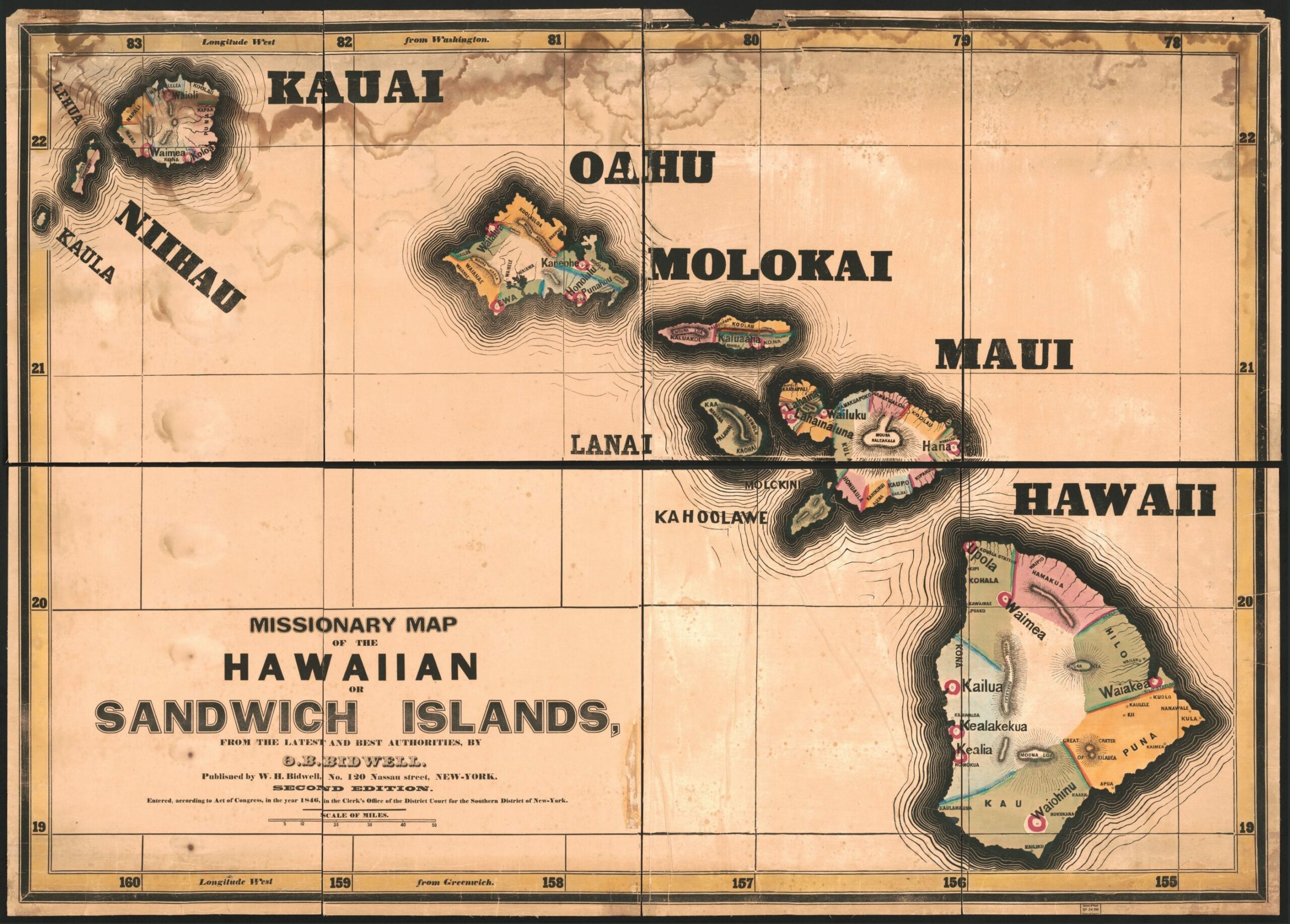
These missionaries and merchants gradually accumulated wealth and influence within the Hawaiian Kingdom. They established schools, businesses, and even began to intermarry with the Hawaiian nobility. This growing American presence created a powerful lobby advocating for closer ties with the United States. Many American businessmen saw the potential for vast profits in Hawaii, particularly in the burgeoning sugar industry, which benefited from favorable trade agreements with the U.S.
The Role of the Sugar Industry
The Hawaiian sugar industry became a central player in the island’s relationship with the United States. In 1875, the Reciprocity Treaty between the Hawaiian Kingdom and the U.S. granted Hawaiian sugar duty-free access to the American market. This was a massive boon to Hawaiian planters, many of whom were American citizens or had strong American business ties. In return, the treaty granted the U.S. exclusive rights to Pearl Harbor as a coaling and repair station for its naval vessels.
This treaty significantly deepened Hawaii’s economic dependence on the United States. As American planters gained more land and power, they began to exert considerable political influence. The Hawaiian monarchy, led by figures like King Kalākaua, found itself increasingly pressured by these economic forces. While the King sought to preserve Hawaiian sovereignty and culture, the economic realities, coupled with the growing American desire for political control, set the stage for future conflict. The Reciprocity Treaty was eventually renewed and then superseded by the McKinley Tariff in 1890, which removed the tariff preference for Hawaiian sugar, creating an economic crisis that further intensified calls for annexation by the United States.
The Overthrow of the Hawaiian Monarchy
The economic pressures and the increasing political clout of American businessmen, particularly those involved in the sugar industry, created a fertile ground for the overthrow of the Hawaiian monarchy. In 1887, a group of primarily American and European businessmen, often referred to as the “Committee of Safety,” forced King Kalākaua to sign the “Bayonet Constitution.” This constitution significantly reduced the monarch’s power, disenfranchised many native Hawaiians, and granted more political rights to foreign residents and property owners, many of whom were American.
Following King Kalākaua’s death in 1891, his sister, Queen Liliʻuokalani, ascended to the throne. She was determined to restore the power of the monarchy and the rights of the Hawaiian people. She drafted a new constitution that would have achieved these goals, but before she could enact it, the Committee of Safety, fearing the loss of their influence and economic interests, launched a coup.
The Annexation Movement and the Republic of Hawaii

On January 17, 1893, the Committee of Safety, with the support of U.S. Marines landed from the USS Boston, orchestrated the overthrow of Queen Liliʻuokalani. The U.S. minister to Hawaii, John L. Stevens, played a crucial role in recognizing the provisional government established by the conspirators, effectively siding with the American businessmen against the Hawaiian monarch.
Initially, the U.S. government, under President Grover Cleveland, condemned the overthrow and sought to restore Queen Liliʻuokalani to her throne. However, Cleveland’s efforts were ultimately unsuccessful. Following Cleveland’s presidency, Benjamin Harrison, who was more sympathetic to the annexationist cause, became president. During Harrison’s term, efforts to annex Hawaii were intensified.
In 1894, the Provisional Government declared the establishment of the Republic of Hawaii, with Sanford B. Dole, a prominent lawyer and businessman of American descent, as its president. This new republic, though nominally independent, was heavily influenced by American interests and continued to pursue annexation by the United States. The Republic of Hawaii served as a transitional period, a stepping stone towards formal U.S. control.
The Formal Annexation of Hawaii
The path to formal annexation was not immediate and faced some opposition. However, the strategic importance of Hawaii to the United States, particularly in the context of its growing Pacific ambitions and the Spanish-American War, became increasingly undeniable.
The Spanish-American War and Strategic Importance
The Spanish-American War, which began in 1898, proved to be a pivotal moment in the annexation of Hawaii. The United States recognized the immense strategic value of Hawaii as a naval base and coaling station for its Pacific fleet. The islands offered a crucial mid-Pacific location for projecting American power and defending its interests in Asia. The war highlighted the vulnerability of the U.S. Pacific coast without secure bases further west.
Admiral Alfred Thayer Mahan, a prominent naval strategist, had long advocated for the acquisition of strategic Pacific islands, and Hawaii was at the top of his list. The war provided the political will and the urgency needed to overcome lingering objections to annexation. Many in Congress and the public now saw Hawaii not just as a potential economic asset but as a vital military outpost.
The Annexation Resolution
Despite the establishment of the Republic of Hawaii and its persistent requests for annexation, the process was initially stalled in the U.S. Senate. However, with the outbreak of the Spanish-American War, the strategic argument for annexation became overwhelmingly persuasive.
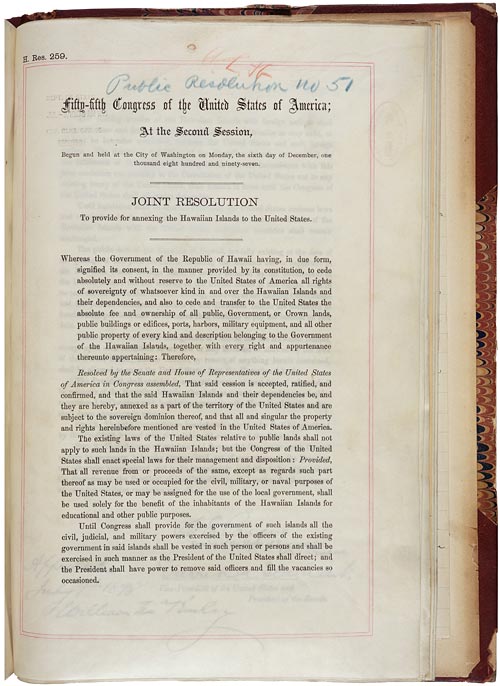
On July 7, 1898, President William McKinley signed the Newlands Resolution, which formally annexed Hawaii to the United States. This resolution, passed by Congress, bypassed the need for a treaty, which would have required a two-thirds majority in the Senate and likely faced greater resistance. The annexation was controversial, with many Hawaiians protesting the loss of their sovereignty.
The formal transfer of sovereignty from the Republic of Hawaii to the United States took place on August 12, 1898, at Iolani Palace in Honolulu. This date is often cited as the official date of U.S. acquisition, marking the end of Hawaii’s independence and its incorporation as a U.S. territory. In 1900, Hawaii was officially organized as a U.S. territory, paving the way for its eventual statehood in 1959. The acquisition of Hawaii was a significant turning point, transforming the United States into a Pacific power and fundamentally altering the political and cultural landscape of the islands.
LifeOutOfTheBox is a participant in the Amazon Services LLC Associates Program, an affiliate advertising program designed to provide a means for sites to earn advertising fees by advertising and linking to Amazon.com. Amazon, the Amazon logo, AmazonSupply, and the AmazonSupply logo are trademarks of Amazon.com, Inc. or its affiliates. As an Amazon Associate we earn affiliate commissions from qualifying purchases.