
The story of Hawaii’s annexation by the United States is a complex narrative woven from threads of economic ambition, political maneuvering, and the clash of cultures. While many associate Hawaii with its stunning natural beauty, pristine beaches, and vibrant Polynesian heritage, its history as an independent kingdom and its eventual absorption into the American political landscape is a crucial aspect of understanding this Pacific archipelago. The question of “When Was Hawaii Annexed To The United States?” delves into a pivotal moment that dramatically reshaped the islands’ destiny.
The Path to Annexation: A Shifting Political Landscape
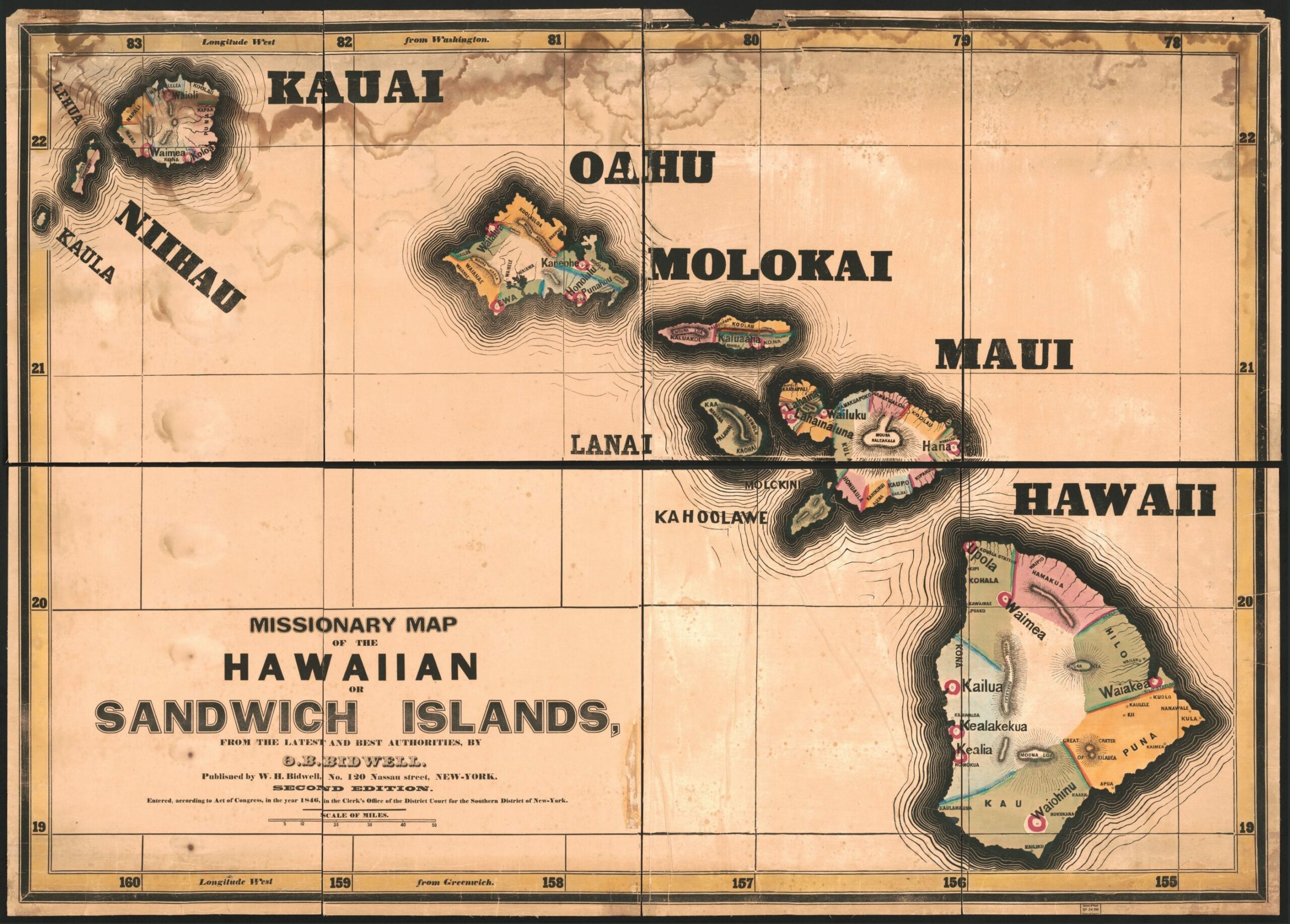
To truly understand the annexation, we must first look at the preceding decades and the gradual erosion of Hawaii’s sovereignty. For centuries, the Hawaiian Islands existed as an independent Polynesian kingdom, guided by its own monarchs and traditions. However, by the 19th century, the strategic and economic importance of Hawaii became increasingly apparent to foreign powers, particularly the United States and, to a lesser extent, Great Britain and France.
The Rise of American Influence
American missionaries were among the first significant foreign arrivals in Hawaii, establishing a strong presence and influencing education and religion. Following them came American businessmen, primarily involved in the sugar industry. The fertile volcanic soil and favorable climate made Hawaii an ideal location for sugarcane cultivation, and American entrepreneurs quickly recognized the immense profit potential. As Hawaiian sugar became a vital commodity in the United States, the economic ties between the two nations deepened.
This economic interdependence, however, began to exert political pressure. American businessmen, many of whom held significant sway over the Hawaiian economy, started to advocate for closer political ties with the United States. They sought to secure their investments and ensure favorable trade policies, which they believed would be best achieved through American annexation. The Reciprocity Treaty of 1875, which granted Hawaiian sugar duty-free entry into the United States in exchange for certain concessions, further solidified this dependence and amplified the influence of American economic interests. This treaty, while seemingly beneficial, also paved the way for increased American land ownership and a greater say in Hawaiian affairs.
The Overthrow of the Monarchy
The late 19th century saw a growing desire among many foreign residents and some Hawaiian elites for Hawaii to become part of the United States. This sentiment clashed with the desire of many native Hawaiians to preserve their independence and cultural identity. The monarchy, led by figures like Queen Liliʻuokalani, sought to assert Hawaiian sovereignty and reduce foreign influence. Queen Liliʻuokalani, in particular, attempted to enact a new constitution that would restore power to the monarchy and disenfranchise many of the foreign business interests.

This move was met with fierce opposition from the pro-annexation factions. In 1893, a group of predominantly American businessmen, with the tacit support of the U.S. Minister to Hawaii and the presence of U.S. Marines, orchestrated a coup d’état. They overthrew Queen Liliʻuokalani and established a provisional government. This event marked a dramatic turning point, effectively ending the Hawaiian monarchy and initiating a period of intense debate and political maneuvering regarding the future of the islands.
The Annexation Process: From Provisional Government to Republic to Statehood
Following the overthrow of the monarchy, the provisional government, led by Sanford B. Dole, immediately sought annexation by the United States. President Grover Cleveland, however, was opposed to the annexation, viewing the overthrow as an illegal act. He ordered the U.S. flag to be lowered and sought to restore Queen Liliʻuokalani to her throne. Despite Cleveland’s stance, the provisional government declared Hawaii a republic in 1894, with Dole as its president.
The Spanish-American War and Strategic Importance
The political climate surrounding Hawaii’s annexation shifted significantly with the outbreak of the Spanish-American War in 1898. Hawaii’s strategic location in the Pacific made it an invaluable coaling station and naval base for U.S. forces heading to the Philippines. This military necessity provided a powerful new argument for annexation, overriding many of the previous moral and political objections. The United States recognized that controlling Hawaii would significantly enhance its power projection in the Pacific and its ability to compete with other global powers.
The Newlands Resolution: The Official Annexation
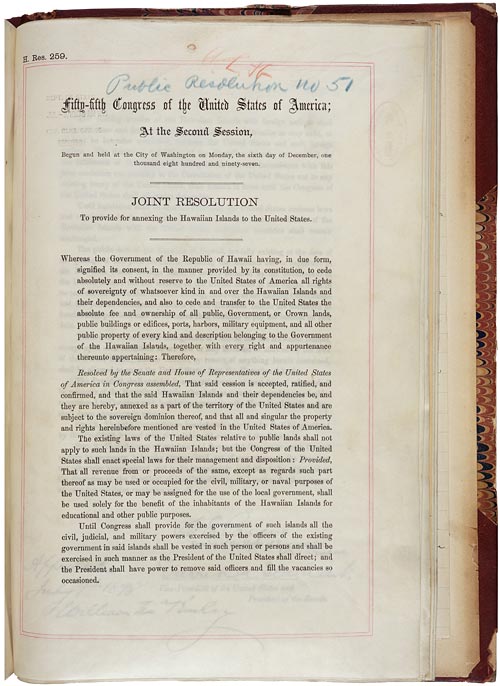
In this new geopolitical context, the push for annexation gained renewed momentum. Instead of a formal treaty, which would have required a two-thirds vote in the U.S. Senate and was unlikely to pass given the controversy surrounding the overthrow, a joint resolution of Congress was used. This method required a simple majority in both the House and the Senate. On July 4, 1898, the Newlands Resolution was signed into law by President William McKinley, officially annexing Hawaii to the United States. This marked the formal incorporation of the Hawaiian Islands into the territory of the United States. It is important to note that this annexation was not a peaceful or universally accepted event; it was a consequence of political machinations and a strategic imperative rather than a democratic expression of the Hawaiian people’s will.
The Long Road to Statehood
The annexation in 1898 did not immediately grant Hawaii statehood. For the next six decades, Hawaii existed as a U.S. territory. During this period, the islands continued to develop economically, with sugar and pineapple plantations dominating the landscape. The population also diversified significantly, with large numbers of immigrants arriving from China, Japan, and the Philippines to work on the plantations. This influx of diverse cultures profoundly shaped Hawaii’s unique social fabric and culinary traditions.
The desire for statehood grew over the years, fueled by a sense of second-class citizenship and the desire for full representation in the U.S. Congress. Various attempts were made to achieve statehood, facing political hurdles and, at times, racial prejudice. Finally, after a long and arduous struggle, Hawaii was admitted as the 50th state of the United States on August 21, 1959. This marked the culmination of a journey that began with a sovereign kingdom and ended with full integration into the American union, though the legacy of the annexation and its impact on the Hawaiian people continues to be a subject of reflection and discussion. The history of Hawaii’s annexation is a crucial chapter in American history, underscoring the complex interplay of commerce, power, and international relations that shaped the modern Pacific.
LifeOutOfTheBox is a participant in the Amazon Services LLC Associates Program, an affiliate advertising program designed to provide a means for sites to earn advertising fees by advertising and linking to Amazon.com. Amazon, the Amazon logo, AmazonSupply, and the AmazonSupply logo are trademarks of Amazon.com, Inc. or its affiliates. As an Amazon Associate we earn affiliate commissions from qualifying purchases.