
The story of Hawaii’s annexation by the United States is a complex tapestry woven with threads of economic ambition, political maneuvering, and a significant shift in American foreign policy at the turn of the 20th century. While the pristine beaches, lush landscapes, and vibrant local culture might be what first capture the imagination of travelers today, the historical context of this island paradise’s integration into the U.S. is a crucial part of understanding its present. This article delves into the primary motivations behind the U.S.’s decision to annex Hawaii, exploring the economic interests, the geopolitical strategy, and the domestic political forces that ultimately led to the end of the Hawaiian Kingdom.

The Lure of the Islands: Economic Drivers of Annexation
Long before it became a state, Hawaii was a vital hub for trade and commerce, particularly for American businessmen who had established significant economic footholds in the islands. These entrepreneurs were primarily involved in the sugar industry, a booming sector that found fertile ground and ideal conditions in Hawaii’s volcanic soil. By the late 19th century, American sugar planters, who controlled a substantial portion of Hawaii’s sugar production, had come to rely heavily on preferential trade agreements with the United States.
Sugar, Tariffs, and the Reciprocity Treaty
The cornerstone of American economic influence in Hawaii was the Reciprocity Treaty of 1875. This treaty, negotiated between the U.S. and the Kingdom of Hawaii, allowed Hawaiian sugar to enter the United States duty-free. In return, certain U.S. goods were granted free entry into Hawaii. For the American sugar planters, this was a golden opportunity. It removed a significant competitive disadvantage they faced compared to U.S. sugar producers on the mainland, who did not have to pay tariffs. This treaty led to an unprecedented boom in Hawaiian sugar production and a corresponding increase in the wealth and influence of American businessmen in the islands.
However, the treaty was not without its critics. Many in the U.S. felt that granting duty-free access to Hawaiian sugar was unfair to domestic producers. Furthermore, as American economic power grew in Hawaii, so did the desire for greater political control. The reliance on the reciprocity agreement created a sense of vulnerability among the planters, who feared that the treaty could be revoked or renegotiated, jeopardizing their lucrative business. Annexation offered a permanent solution, ensuring continued access to the American market without the uncertainties of treaty negotiations.
The Growing Influence of American Businesses
Beyond sugar, American interests extended to other areas of the Hawaiian economy, including whaling, shipping, and fruit production. American businesses invested heavily in infrastructure, such as railroads and ports, further solidifying their presence. This economic entanglement naturally led to a desire for political alignment. The American business community in Hawaii began to advocate for closer ties with the United States, seeing annexation as the logical next step to protect and expand their investments. They lobbied U.S. politicians, sending powerful messages about the economic benefits of integrating Hawaii into the American system.
Geopolitical Chessboard: The Strategic Importance of Hawaii
The annexation of Hawaii was not solely driven by economic imperatives; strategic considerations played an equally significant role. In the late 19th century, the world was becoming increasingly interconnected, and maritime power was crucial for global influence. Hawaii occupied a unique and highly advantageous position in the Pacific Ocean, making it a valuable asset for any nation seeking to project power in the region.
A Vital Naval Base in the Pacific
As the United States began to expand its presence and interests in the Pacific, particularly following the Spanish-American War, Hawaii emerged as an indispensable strategic location. The U.S. Navy recognized the immense value of Pearl Harbor as a coaling station and a naval base. Its deep, protected harbor offered an ideal place for ships to refuel, repair, and stage operations in the vast Pacific. The annexation would grant the U.S. permanent control over this critical asset, bolstering its naval capabilities and allowing it to better protect its growing trade routes and possessions in Asia and the Pacific.
The annexation of Hawaii was seen as a crucial step in building a robust Pacific presence, complementing other territorial acquisitions like Guam and the Philippines. This strategic positioning was vital for projecting American power, defending its coastlines, and ensuring its economic interests were secure in a region increasingly contested by other global powers, such as Great Britain, France, and Japan. The ability to station naval fleets in Hawaii provided a significant advantage in any potential conflict and facilitated trade and communication across the Pacific.
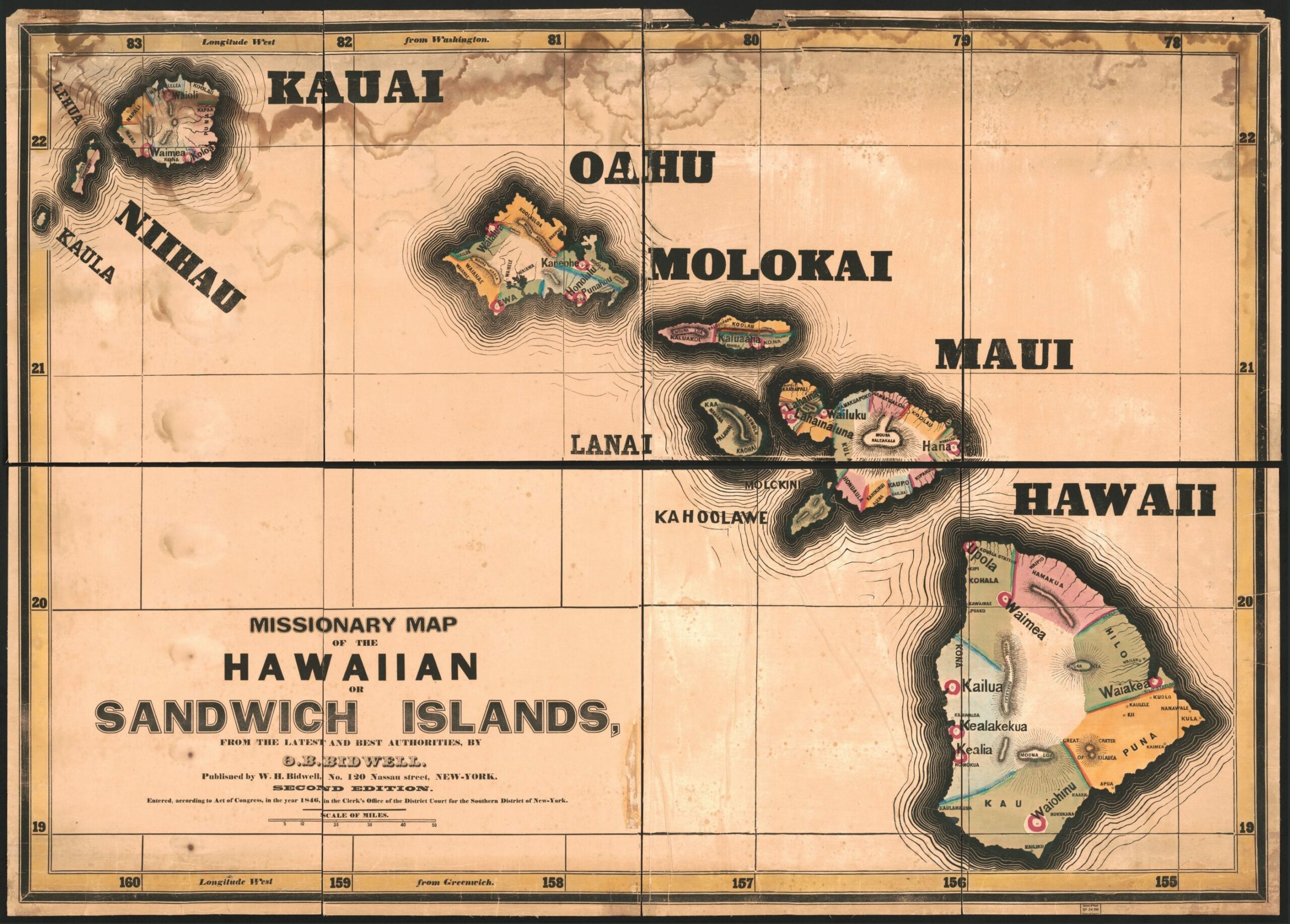
The Rise of American Imperialism
The annexation of Hawaii also occurred within the broader context of a burgeoning American imperialism. The U.S., having recently asserted its dominance in the Caribbean and the Pacific through the Spanish-American War, was increasingly looking outward. Influential figures and publications began to champion the idea of American expansionism, arguing that the U.S. had a manifest destiny to spread its influence and democratic ideals across the globe.
This imperialistic fervor found fertile ground in Hawaii. Proponents of annexation argued that it was the U.S.‘s duty to bring “civilization” and “progress” to the Hawaiian people, a paternalistic notion that often masked underlying economic and strategic ambitions. The idea of Hawaii as a stepping stone to Asia, a place to foster trade and exert influence, resonated with those who envisioned an American empire spanning the globe. The acquisition of Hawaii became a symbol of this new era of American global engagement and a tangible demonstration of its growing power on the world stage.
The Shifting Political Landscape: Internal Dynamics and the Overthrow of the Monarchy
The path to annexation was not a simple one, and it involved significant internal political shifts within Hawaii itself, alongside the external pressures from the United States. The decades leading up to 1898 were marked by growing tension between the native Hawaiian population and the increasingly powerful American and European business elite.
The Revolution of 1893 and the Provisional Government
The pivotal event that paved the way for annexation was the overthrow of Queen Liliuokalani in 1893. Queen Liliuokalani, the last monarch of the Hawaiian Kingdom, had attempted to reassert the monarchical authority and reduce the political power of foreign residents. In response, a group of prominent American and European businessmen, with the covert support of U.S. Minister to Hawaii John L. Stevens and the landing of U.S. Marines, orchestrated a coup.
This group, calling themselves the Committee of Safety, established a Provisional Government, effectively seizing control of the Hawaiian Kingdom. Their primary goal was annexation by the United States. While an initial attempt at annexation was thwarted by President Grover Cleveland, who was sympathetic to the Hawaiian Kingdom and viewed the overthrow as illegal, the situation remained volatile. The Provisional Government, led by Sanford B. Dole, continued to lobby for annexation, setting the stage for future political maneuvers.
The Role of Sanford B. Dole and the Republic of Hawaii
Following the overthrow, Sanford B. Dole, a prominent lawyer and businessman of American descent, became the leader of the Provisional Government and later the first President of the Republic of Hawaii. Under Dole’s leadership, the republic was established as a provisional entity with the explicit aim of achieving annexation. The republic’s government was largely composed of individuals with strong ties to American business interests.
The period of the Republic of Hawaii (1894-1898) was characterized by a sustained campaign to convince the U.S. Congress and public of the benefits of annexation. Supporters of annexation argued that it would bring stability, economic prosperity, and better governance to the islands. They also played on fears of foreign intervention, suggesting that if the U.S. did not annex Hawaii, another power, such as Japan, might. This propaganda, coupled with the strategic and economic arguments, gradually shifted public and political opinion in the United States.
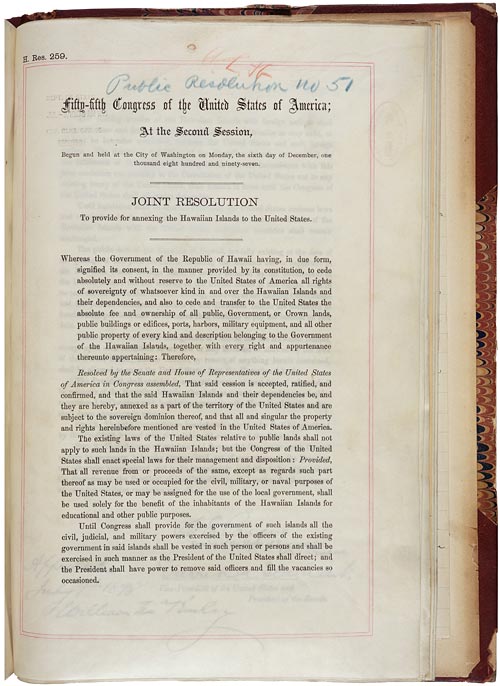
The Annexation Resolution of 1898
The final act of annexation was achieved not through a treaty, which requires Senate ratification, but through a joint resolution of Congress. This method was chosen by President William McKinley, who was a strong proponent of annexation, particularly in the context of the Spanish-American War. The resolution, passed in July 1898, formally annexed Hawaii as a territory of the United States. This marked the end of Hawaii’s sovereignty and the beginning of a new era under American rule.
The annexation of Hawaii remains a contentious issue, with many Native Hawaiians viewing it as an illegal act of dispossession. Understanding the motivations behind it – the potent combination of economic aspirations, strategic military planning, and the prevailing imperialist sentiment of the era – provides crucial insight into this significant chapter of American and Hawaiian history. For travelers visiting Hawaii today, appreciating this history adds a layer of depth to the experience of exploring its beautiful landmarks and immersing oneself in its rich culture. Whether one is staying at a luxurious resort like the Halekulani Hotel, exploring the historical significance of Iolani Palace, or simply enjoying the natural beauty of Diamond Head, the echoes of Hawaii’s past are an integral part of its present allure.
LifeOutOfTheBox is a participant in the Amazon Services LLC Associates Program, an affiliate advertising program designed to provide a means for sites to earn advertising fees by advertising and linking to Amazon.com. Amazon, the Amazon logo, AmazonSupply, and the AmazonSupply logo are trademarks of Amazon.com, Inc. or its affiliates. As an Amazon Associate we earn affiliate commissions from qualifying purchases.