
The story of how the vast and vibrant state of Texas became a part of the United States is a complex and captivating narrative, woven from threads of diplomacy, conflict, revolution, and ultimately, annexation. Far from being a simple acquisition, the path to Texas joining the Union was a long and tumultuous one, marked by shifting allegiances and a burgeoning sense of American identity. Understanding this history offers a profound insight into the territorial expansion of the United States and the unique character of Texas itself, a land that proudly retains its distinct heritage.
From Spanish Colony to Mexican Province
The origins of Texas as a distinct territory can be traced back to the early days of European exploration and colonization. Initially claimed by Spain in the 16th century, the region remained largely unpopulated and sparsely settled by the Spanish for centuries. Driven by a desire to secure its northern frontier from incursions by other European powers, particularly France, Spain established a few missions and presidios (forts) in the area. However, these efforts were met with limited success, and the native populations, such as the Comanche and Karankawa tribes, continued to be the dominant inhabitants of the land.
The Mexican Revolution and its Impact
The early 19th century brought significant political upheaval to the region. Mexico, after centuries of Spanish rule, fought and won its independence in 1821. Texas, along with the adjacent province of Coahuila, became part of the new Mexican nation. The newly formed Mexican government, eager to develop and populate its northern territories, adopted a more open immigration policy than its Spanish predecessors.
This policy change proved to be a pivotal moment. The Mexican government encouraged settlement by empresarios, individuals who were granted large tracts of land by the government and tasked with bringing in settlers, primarily from the United States. Among the most famous of these empresarios was Stephen F. Austin, who successfully brought hundreds of families, known as the “Old Three Hundred,” to settle in Texas. These early settlers, largely of American origin, brought with them their customs, language, and a strong desire for self-governance.
Growing Tensions and the Road to Revolution
Despite initial cooperative efforts, the relationship between the Anglo-American settlers and the Mexican government began to deteriorate. Several factors contributed to this growing friction.
Cultural and Political Differences
One of the primary sources of conflict was the fundamental difference in culture and governance. The settlers, accustomed to the democratic ideals and common law traditions of the United States, found the centralized, often autocratic, style of Mexican governance to be increasingly oppressive. The Mexican government’s attempts to impose its language, legal system, and Catholicism on the predominantly Protestant, English-speaking settlers were met with resentment. Furthermore, the issue of slavery became a significant point of contention. Many of the settlers from the southern United States brought enslaved people with them, a practice that was officially discouraged and eventually outlawed by the Mexican government, albeit with some temporary exemptions.
Centralization and Loss of Autonomy
The political landscape in Mexico during this period was unstable, characterized by frequent changes in government and a trend towards centralization. In 1835, under the leadership of President Antonio López de Santa Anna, the Mexican government moved to abolish the federalist constitution of 1824, which had granted significant autonomy to the states, including Coahuila y Tejas. This move was perceived by the settlers in Texas as a direct threat to their existing rights and freedoms. Protests and skirmishes began to erupt, signaling the impending conflict.
The Texas Revolution and Independence
The growing discontent culminated in the outbreak of the Texas Revolution in October 1835.

Early Battles and Key Events
The initial shots of the revolution were fired at the Battle of Gonzales, where Texan rebels, armed with a cannon, famously defied a Mexican demand for its return with the slogan “Come and Take It.” This act of defiance ignited a wider rebellion. Key events followed, including the capture of Goliad and the decisive Texan victory at the Battle of San Antonio (also known as the Siege of the Alamo), though this was a costly victory for the rebels.
The most iconic and tragic event of the revolution was the Battle of the Alamo. In March 1836, a small force of Texan defenders, including figures like William B. Travis and Davy Crockett, held out for 13 days against a much larger Mexican army led by Santa Anna at the Alamo mission in San Antonio. Though the defenders were ultimately overwhelmed and killed, the battle became a powerful symbol of courage and sacrifice, galvanizing support for the Texan cause.
The Declaration of Independence and the Battle of San Jacinto
Just days after the fall of the Alamo, on March 2, 1836, delegates from across Texas convened in Washington-on-the-Brazos and adopted the Texas Declaration of Independence, formally severing ties with Mexico. The newly formed Republic of Texas, under the leadership of Sam Houston, continued to fight for its survival.
The turning point of the revolution came on April 21, 1836, at the Battle of San Jacinto. In a swift and decisive engagement, Sam Houston’s forces surprised and routed Santa Anna’s army, capturing the Mexican president himself. This victory secured the independence of Texas, which was recognized by Mexico in the Treaties of Velasco, though the Mexican government would later dispute the validity of these treaties. The Republic of Texas now existed as an independent nation.
The Path to Annexation
For nearly a decade, Texas existed as an independent republic, a period often referred to as the “Lone Star Republic.” However, the young nation faced numerous challenges, including economic instability, ongoing threats from Mexico, and a desire for the security and prosperity that association with the United States might provide.
The Debate Over Annexation
The idea of annexing Texas into the United States was a highly contentious issue in the 1830s and 1840s. Proponents, known as “expansionists,” saw annexation as a natural and inevitable progression, a fulfillment of the concept of “Manifest Destiny” – the belief that the United States was divinely ordained to expand its dominion and spread democracy across the North American continent. They envisioned a stronger, larger nation and an opportunity to acquire valuable territory rich in resources.
Opponents, however, raised significant objections. The most prominent concern was the expansion of slavery. Texas was a slave state, and its annexation would upset the delicate balance of power between free and slave states in the United States Senate, potentially leading to increased sectional tensions and the threat of civil war. Additionally, some feared that annexation would provoke a war with Mexico, which still considered Texas a rebellious province.
The Annexation Process
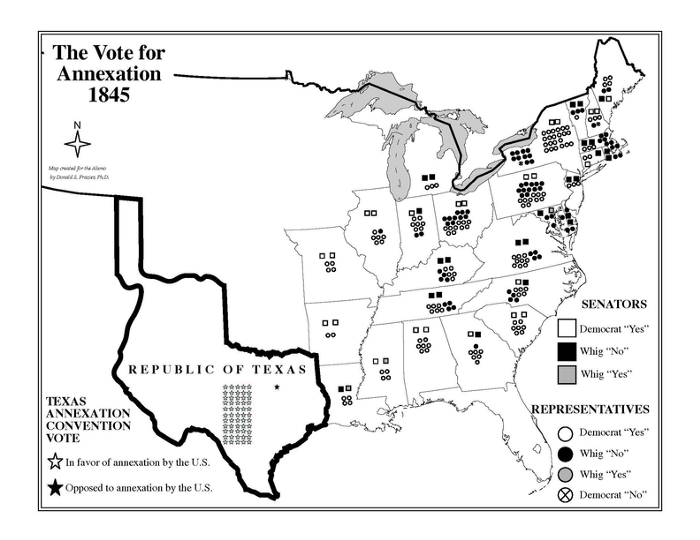
Despite the opposition, the movement for annexation gained momentum. President John Tyler was a strong advocate for annexation and made it a priority of his administration. He negotiated a treaty of annexation with the Republic of Texas in 1844, but the treaty was narrowly defeated in the U.S. Senate, largely due to concerns about slavery and potential conflict with Mexico.
However, the issue did not die. The election of President James K. Polk in 1844, who ran on a platform that explicitly supported the annexation of both Texas and the Oregon Territory, signaled a renewed push. Instead of seeking a treaty, which required a two-thirds majority in the Senate, Congress pursued annexation through a joint resolution, which required only a simple majority in both houses. After much debate and political maneuvering, both houses of Congress passed the annexation resolution in February 1845. On July 4, 1845, a convention of Texans officially accepted the terms of annexation. On December 29, 1845, President Polk signed the act admitting Texas as the 28th state of the United States.
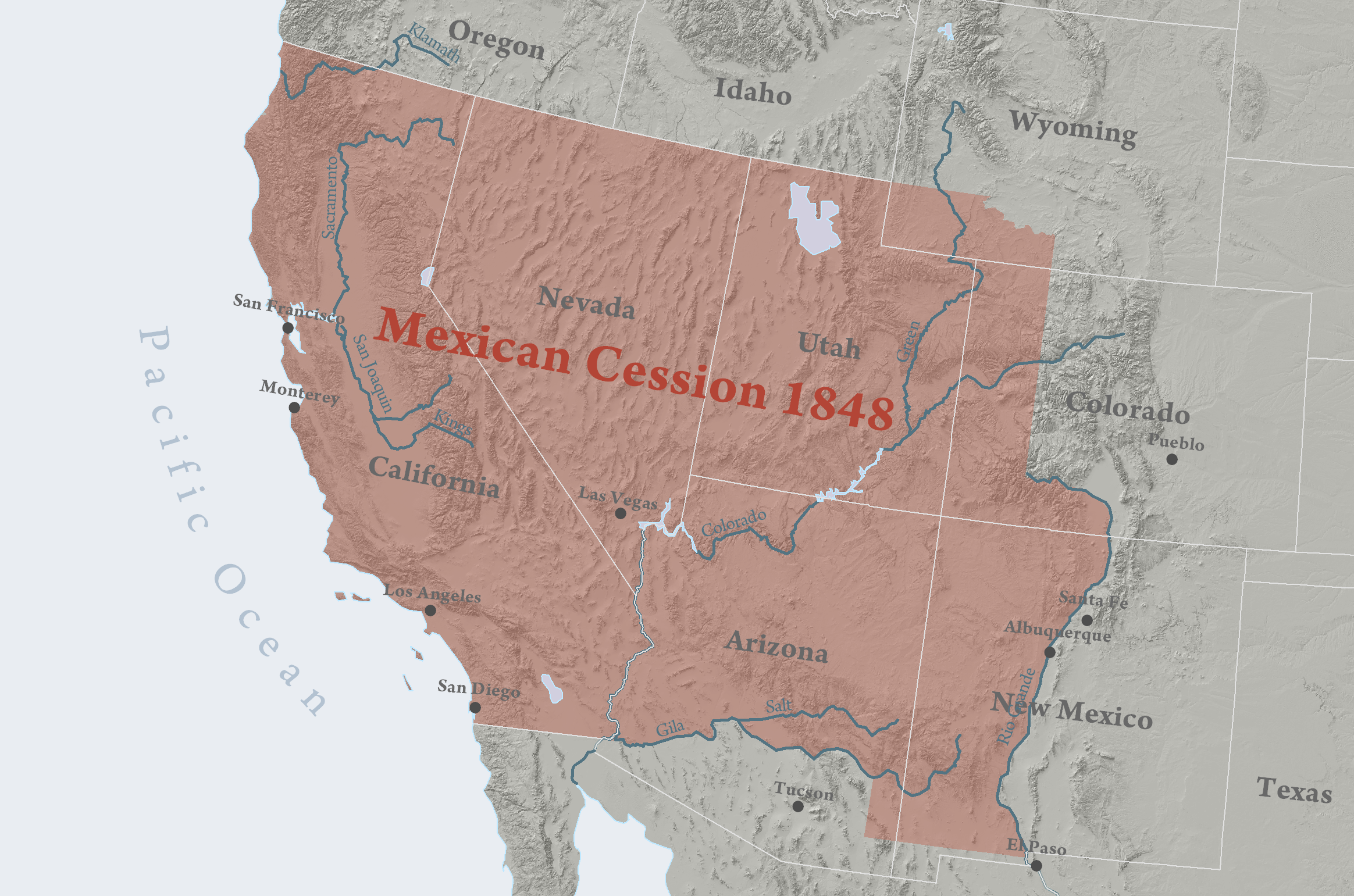
The annexation of Texas was a watershed moment, dramatically expanding the size and scope of the United States and setting the stage for further territorial expansion and the eventual outbreak of the American Civil War. The legacy of this acquisition continues to shape the identity and character of Texas today, a state that proudly embraces its history as an independent republic and its current status as a vital part of the nation. Travelers to Texas can still visit historical landmarks like the Alamo in San Antonio or explore the preserved sites of the revolution, offering tangible connections to this pivotal chapter in American history. The state’s vibrant culture, its sprawling landscapes, and its unique spirit are all deeply intertwined with the complex and dramatic story of how Texas became part of the United States.
LifeOutOfTheBox is a participant in the Amazon Services LLC Associates Program, an affiliate advertising program designed to provide a means for sites to earn advertising fees by advertising and linking to Amazon.com. Amazon, the Amazon logo, AmazonSupply, and the AmazonSupply logo are trademarks of Amazon.com, Inc. or its affiliates. As an Amazon Associate we earn affiliate commissions from qualifying purchases.