
For residents of Texas living with a disability, understanding the financial support available can be a complex but crucial endeavor. The question “How much is disability in Texas?” isn’t straightforward, as benefits vary significantly based on the type of disability program, an individual’s work history, income, and assets. Primarily, disability benefits are administered through federal programs, with additional state-level support and resources enhancing the overall lifestyle and well-being of Texans with disabilities. Navigating these systems requires a clear understanding of eligibility criteria, application processes, and the various financial and medical assistance programs designed to provide a safety net.
This comprehensive guide aims to demystify the landscape of disability benefits in the Lone Star State, providing insight into the federal programs that form the backbone of support, the factors influencing benefit amounts, and the additional resources available to ensure a stable and dignified lifestyle.
Understanding Federal Disability Programs in Texas
The vast majority of disability benefits received by Texans come from two main federal programs administered by the Social Security Administration (SSA): Social Security Disability Insurance (SSDI) and Supplemental Security Income (SSI). While both provide financial assistance to individuals with disabilities, their eligibility requirements and funding mechanisms are distinct.
Social Security Disability Insurance (SSDI)
Social Security Disability Insurance is a program for individuals who have worked a sufficient number of years and paid Social Security taxes. It functions much like an insurance policy, where your contributions during your working years entitle you to benefits if you become disabled and are unable to work.
Eligibility for SSDI
To qualify for SSDI, you must:
- Have a medical condition that meets the Social Security Administration’s definition of disability. This generally means your condition prevents you from engaging in any “substantial gainful activity” (SGA) and is expected to last for at least 12 months or result in death.
- Have accumulated enough “work credits.” Work credits are earned by working and paying Social Security taxes. The number of credits needed depends on your age when you become disabled. For most adults, this typically means having worked for about five of the last ten years before becoming disabled.
How SSDI Benefits Are Calculated
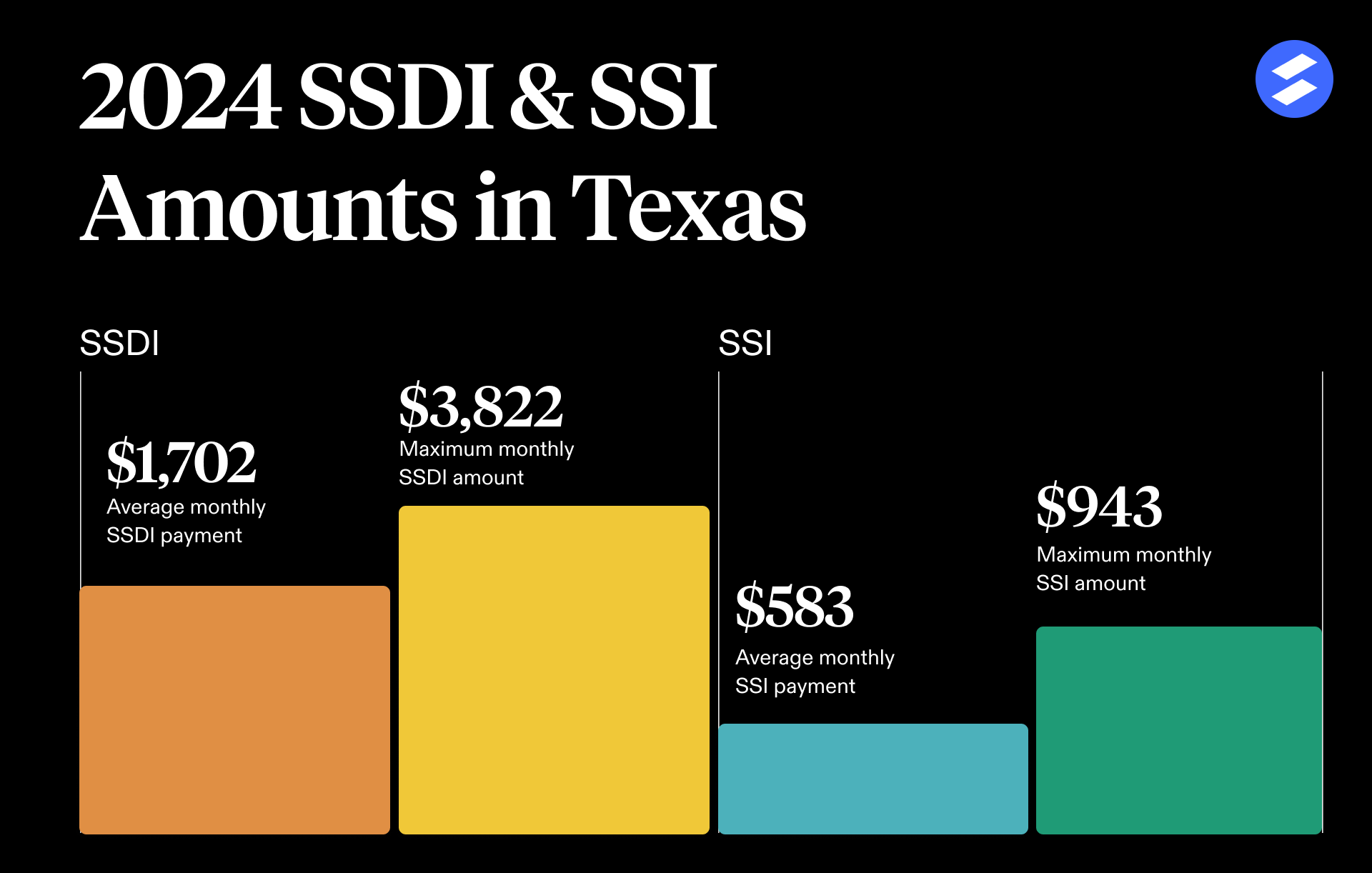
The amount of your SSDI benefit is based on your average lifetime earnings before your disability began. It’s not determined by the severity of your disability or your income and assets after becoming disabled. The higher your average earnings over your working life, the higher your monthly SSDI benefit will be. As of the current year, the national average SSDI payment is around $1,537 per month, but individual amounts can range from just a few hundred dollars to the maximum of approximately $3,822 per month for 2024. Texas does not have a separate state-specific calculation for SSDI benefits; the federal guidelines apply uniformly across all states.
Supplemental Security Income (SSI)
Supplemental Security Income is a needs-based program designed to provide financial assistance to aged, blind, or disabled individuals who have limited income and resources, regardless of their work history. It acts as a safety net for those who haven’t paid enough into the Social Security system to qualify for SSDI, or whose SSDI benefits are very low.
Eligibility for SSI
To qualify for SSI, you must:
- Meet the Social Security Administration’s definition of disability (same as for SSDI).
- Have limited income and resources. For an individual, countable resources (like bank accounts, cash, property other than your home) must not exceed $2,000. For a couple, the limit is $3,000. Income limits also apply, though not all income is counted.
How SSI Benefits Are Calculated
The maximum federal SSI benefit for an eligible individual in 2024 is $943 per month, and $1,415 for an eligible couple. However, your actual benefit amount may be reduced if you have other sources of income (e.g., wages, pensions, other government benefits). Texas does not provide a state supplement to the federal SSI payment, unlike some other states. This means that the maximum SSI benefit received by a qualified individual in Texas is typically the federal maximum, minus any countable income.

Complementary Support and Resources in Texas
Beyond direct financial benefits from SSDI and SSI, individuals with disabilities in Texas can access a range of other crucial programs and services that significantly contribute to their quality of life and financial stability. These often cover healthcare, housing, and vocational rehabilitation.
Healthcare Coverage: Medicaid and Medicare
Access to affordable healthcare is a cornerstone of managing a disability.
- Medicare: If you are approved for SSDI, you typically become eligible for Medicare after a 24-month waiting period from your entitlement date. This federal health insurance program covers hospital stays, doctor visits, prescription drugs, and other medical services.
- Medicaid: In Texas, recipients of SSI are generally automatically eligible for Medicaid, the state and federal program that provides free or low-cost health coverage to low-income individuals. For those not receiving SSI, Medicaid eligibility depends on meeting specific income and resource limits, which are stricter in Texas compared to states that have expanded Medicaid under the Affordable Care Act. Texas has not expanded Medicaid.
State-Specific Programs and Support
The Texas Health and Human Services (THHS) provides a wide array of services and programs for Texans with disabilities. While these don’t typically involve direct cash payments like SSDI or SSI, they offer invaluable support that impacts financial burdens and daily living.
- Waiver Programs: THHS administers several Medicaid waiver programs that provide home and community-based services as an alternative to institutional care. These can include personal care services, respite care, adaptive aids, and minor home modifications, greatly enhancing independent living.
- Vocational Rehabilitation: For individuals who wish to work, the Texas Department of Assistive and Rehabilitative Services (DARS), now integrated into THHS under the HHSC umbrella, offers vocational rehabilitation services. These services help people with disabilities prepare for, obtain, retain, or regain employment. This can include job training, education, assistive technology, and job placement assistance.
- Housing Assistance: While not specifically disability programs, general housing assistance programs (e.g., Section 8 Housing Choice Vouchers) can be crucial for individuals with disabilities. Eligibility for these is usually based on income and family size, and individuals with disabilities are often given preference.
- Food Assistance: The Supplemental Nutrition Assistance Program (SNAP), also administered by THHS, provides food benefits to eligible low-income individuals and families, including those with disabilities.
Navigating the Disability Application Process
Applying for disability benefits through the Social Security Administration can be a lengthy and challenging process. It often involves extensive documentation, medical evaluations, and multiple stages of review.
Steps in the Application Process
- Application Submission: You can apply for SSDI and SSI online, by phone, or in person at your local SSA office. The application requires detailed information about your medical condition, work history, and financial situation.
- Medical Review: The Social Security Administration sends your application to a state agency, the Disability Determination Services (DDS), which is part of Texas Health and Human Services. DDS gathers medical evidence from your doctors and may schedule you for a consultative examination with their own doctors.
- Initial Decision: Based on the medical and non-medical evidence, DDS makes an initial decision. A significant percentage of initial applications are denied.
- Appeals Process: If your application is denied, you have the right to appeal. The appeals process typically involves several stages:
- Reconsideration: A new reviewer at DDS reviews your case.
- Hearing by an Administrative Law Judge (ALJ): If reconsideration is denied, you can request a hearing before an ALJ. This is often the most critical stage, where you can present your case in person, usually with legal representation.
- Appeals Council Review: If the ALJ denies your claim, you can appeal to the SSA’s Appeals Council.
- Federal Court Review: As a last resort, you can file a lawsuit in federal district court.
Tips for a Successful Application
- Provide Thorough Medical Evidence: The most crucial factor is robust medical documentation. Ensure your doctors have detailed records of your diagnosis, treatment, prognosis, and how your condition limits your ability to perform work-related activities.
- Be Honest and Consistent: Provide accurate and consistent information throughout your application and appeals.
- Seek Professional Assistance: Consider consulting a disability attorney or advocate. They specialize in Social Security disability law and can significantly improve your chances of approval, especially at the hearing level. Many work on a contingency basis, meaning they only get paid if you win your case. The Office of the Attorney General of Texas also provides resources and information on legal services.
Impact on Lifestyle and Financial Planning in Texas
Receiving disability benefits profoundly impacts an individual’s lifestyle and requires careful financial planning. The monthly income, whether from SSDI or SSI, forms the bedrock of financial stability for many Texans with disabilities.
Managing Income and Expenses
For SSDI recipients, the benefit amount is fixed and can be a predictable source of income, allowing for budgeting and long-term financial planning. SSI recipients, often with very limited other income, rely heavily on their monthly payments for basic necessities. The absence of a state SSI supplement in Texas means that budgeting is even more critical for these individuals to cover costs in cities like Houston, Dallas, Austin, or San Antonio, where the cost of living can be substantial. Even in more affordable areas like El Paso, careful management of resources is essential.
Work Incentives and Employment
The Social Security Administration offers various “Work Incentives” designed to help individuals on SSDI or SSI return to work without immediately losing their benefits or Medicaid/Medicare coverage. Programs like the “Trial Work Period” for SSDI and “Plan to Achieve Self-Support” (PASS) for SSI can provide a pathway to greater financial independence, allowing individuals to explore employment opportunities and potentially enhance their lifestyle beyond basic disability payments. Utilizing vocational rehabilitation services through THHS is a vital step for those considering a return to the workforce.
Long-Term Planning
Long-term financial planning for individuals with disabilities in Texas should also consider:
- ABLE Accounts: Achieving a Better Life Experience (ABLE) accounts allow individuals with disabilities (onset before age 26) to save up to a certain amount (currently $18,000 annually) without affecting their SSI or Medicaid eligibility. These savings can be used for qualified disability expenses, such as education, housing, transportation, and healthcare.
- Special Needs Trusts: For larger assets or inheritances, a special needs trust can be established to hold funds for a person with a disability without disqualifying them from means-tested government benefits like SSI and Medicaid.
In conclusion, “how much is disability in Texas?” is a multifaceted question with answers rooted in federal programs and supplemented by state services. While direct cash benefits are primarily determined by the Social Security Administration based on work history or financial need, the overall support system in Texas encompasses crucial healthcare, vocational, and community-based services. Understanding and accessing these resources are paramount for individuals with disabilities to secure their financial well-being and live a full, independent lifestyle in the state.
LifeOutOfTheBox is a participant in the Amazon Services LLC Associates Program, an affiliate advertising program designed to provide a means for sites to earn advertising fees by advertising and linking to Amazon.com. Amazon, the Amazon logo, AmazonSupply, and the AmazonSupply logo are trademarks of Amazon.com, Inc. or its affiliates. As an Amazon Associate we earn affiliate commissions from qualifying purchases.