
The allure of the poker table, with its strategic depth and thrilling potential for a big win, draws people from all walks of life. Among the myriad of poker variations, Texas Hold’em stands as the undisputed king. It’s the game you see in movies, the game played in high-stakes tournaments, and the game that, with a little understanding, can be enjoyed by anyone. Whether you’re looking for an engaging way to spend an evening on your next vacation, perhaps in a sophisticated casino in Las Vegas or a more relaxed setting in a beach resort in Malta, or simply want to add a new skill to your repertoire, learning Texas Hold’em is a rewarding endeavor. This guide will walk you through the fundamentals, from the objective of the game to the intricacies of betting and hand rankings, ensuring you’re ready to take your seat at the virtual or physical felt.

The core objective in Texas Hold’em is deceptively simple: to win chips by having the best five-card poker hand at the showdown, or by convincing your opponents to fold their hands before the showdown. Unlike some other card games, you don’t necessarily need the absolute best hand to win; skillful betting and strategic bluffing can often lead you to victory. This adaptability is part of what makes Texas Hold’em so captivating, offering a blend of luck, skill, and psychology that keeps players on the edge of their seats. Imagine yourself in a cozy lodge in the Canadian Rockies after a day of exploring, or perhaps in a bustling city like Hong Kong, enjoying a friendly game with newfound friends. Understanding the rules is the first step to truly appreciating and participating in this dynamic game.
The Fundamentals of Texas Hold’em
At its heart, Texas Hold’em is a community card game played with a standard 52-card deck. Each player is dealt two private cards, known as “hole cards,” which only they can see. The game then proceeds through several rounds of betting, interspersed with the dealing of community cards. These community cards are shared by all players and are placed face-up in the center of the table. The goal is to use the best possible five-card combination from the seven available cards (your two hole cards and the five community cards) to form the strongest poker hand. This dynamic interplay between private and public information is what creates the strategic depth of Texas Hold’em. Whether you are in a luxurious suite at the Burj Al Arab or a more modest apartment booked for a longer stay in Paris, the game remains the same.
Dealing and Betting Rounds
The game begins with the player to the immediate left of the dealer button posting the small blind, and the player to their left posting the big blind. These are forced bets that help build the pot from the start. The dealer button rotates clockwise after each hand, ensuring everyone eventually posts blinds and acts in each position.
The first two cards are dealt face down to each player. This is the pre-flop betting round. Players have the option to “call” the big blind, “raise” to increase the bet, or “fold” and surrender their hand. Following the pre-flop round, the “flop” occurs. The dealer burns one card (discards the top card face down) and then deals three community cards face up in the center of the table. These three cards are available for all players to use.
Next comes the post-flop betting round. Players again have the opportunity to bet, call, raise, or fold. After this round, the “turn” card is dealt. The dealer again burns one card and deals a fourth community card face up. A third betting round follows.
Finally, the “river” card is dealt. The dealer burns one last card and deals the fifth and final community card face up. This is followed by the last betting round.
The Showdown
If there are two or more players remaining after the final betting round, a “showdown” occurs. The player who made the last aggressive action (a bet or a raise) typically shows their hand first. If no betting occurred on the river, the player closest to the left of the dealer button shows first. Players then reveal their hands in clockwise order, and the player with the best five-card poker hand wins the pot. The beauty of Texas Hold’em is that you can use any combination of your two hole cards and the five community cards to make your best hand – you can use both hole cards, one hole card and four community cards, or even all five community cards if they form the best hand (a situation known as “playing the board”). This versatility adds another layer of strategic consideration to every hand. Imagine the excitement of playing this game while staying in a charming villa in the Tuscan countryside or a historic hotel in Kyoto.
Understanding Hand Rankings in Texas Hold’em
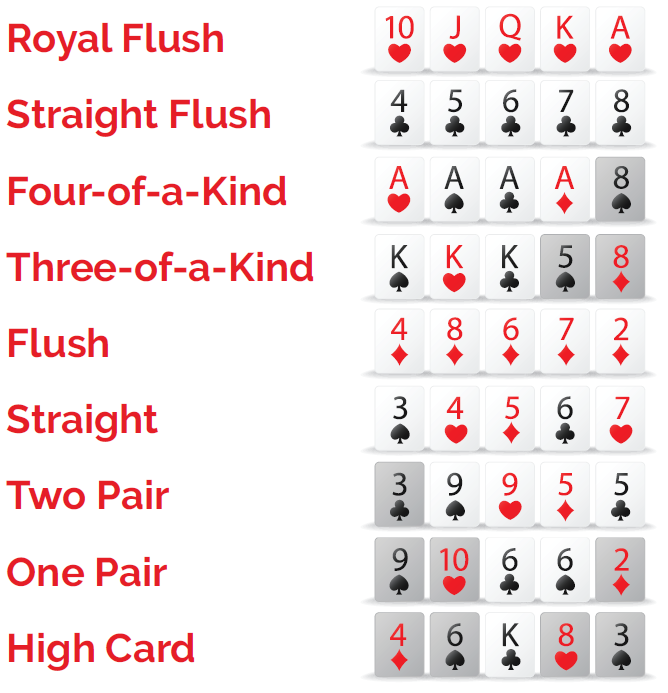
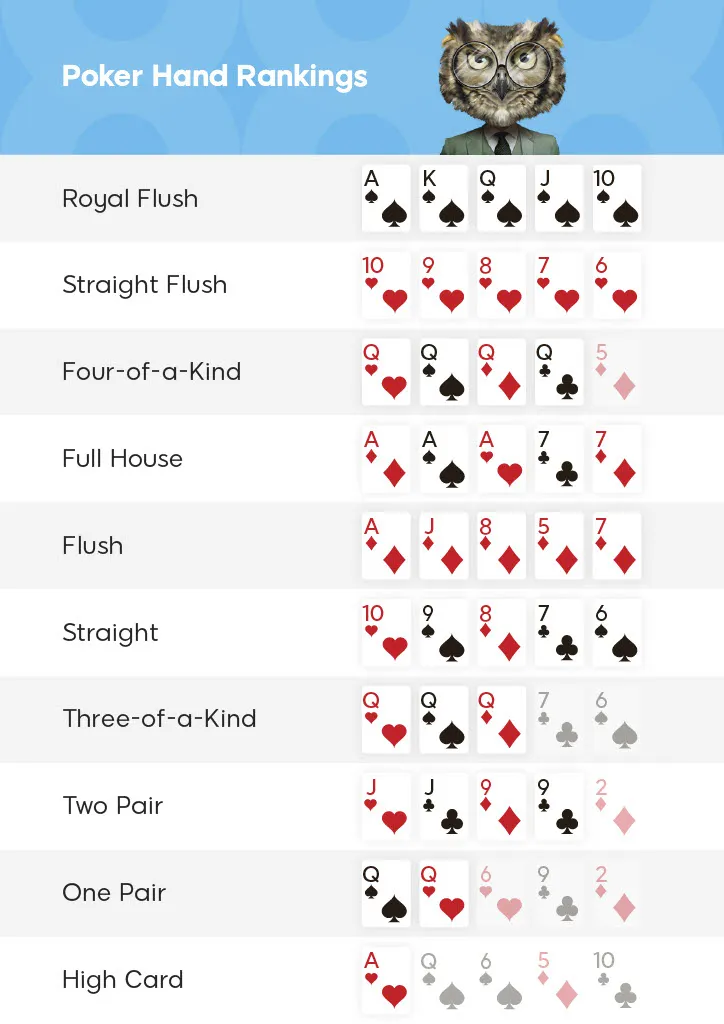
Mastering the hand rankings is fundamental to playing Texas Hold’em. Knowing the hierarchy of hands allows you to quickly assess the strength of your own hand and that of your opponents, informing your betting decisions. The rankings are consistent across most poker variations and are as follows, from highest to lowest:
The Pinnacle of Poker Hands
-
Royal Flush: This is the rarest and most powerful hand in poker. It consists of Ace, King, Queen, Jack, and 10 of the same suit. For example, Ace of Spades, King of Spades, Queen of Spades, Jack of Spades, and 10 of Spades. It’s a truly spectacular sight at the table, whether you’re at a glitzy casino in Macau or a relaxed pub game in Dublin.
-
Straight Flush: Five cards in sequence, all of the same suit. For instance, 9 of Hearts, 8 of Hearts, 7 of Hearts, 6 of Hearts, 5 of Hearts. A Straight Flush is incredibly strong, second only to a Royal Flush.
-
Four of a Kind: Four cards of the same rank, plus one other card (the kicker). For example, four Queens and a 7.
-
Full House: Three cards of one rank and two cards of another rank. For example, three Jacks and two 8s.
-
Flush: Five cards of the same suit, but not in sequence. For example, any five hearts that are not sequential.
-
Straight: Five cards in sequence, but not all of the same suit. For example, 7 of Diamonds, 6 of Clubs, 5 of Hearts, 4 of Spades, and 3 of Diamonds. An Ace can be used as either the highest card (A-K-Q-J-10) or the lowest card (5-4-3-2-A).
-
Three of a Kind: Three cards of the same rank, and two other cards of different ranks. For example, three Kings, a 9, and a 4.
-
Two Pair: Two cards of one rank, two cards of another rank, and one other card. For example, two Aces, two 6s, and a Queen.
-
One Pair: Two cards of the same rank, and three other cards of different ranks. For example, two Jacks, a 10, a 5, and a 2.
-
High Card: If no player has any of the above hands, the player with the highest-ranking card wins. The ranking of cards from highest to lowest is Ace, King, Queen, Jack, 10, 9, 8, 7, 6, 5, 4, 3, 2.
In cases where two or more players have the same hand ranking (e.g., two players both have a pair of Kings), the winner is determined by the highest kicker card. If kickers are also tied, the pot is split. Understanding these rankings is crucial for making informed decisions during betting rounds, whether you’re enjoying a game in a luxurious resort in Bali or a casual gathering in a friend’s apartment.
Strategic Elements for Aspiring Players
Beyond the basic rules and hand rankings, Texas Hold’em involves a significant amount of strategy, psychological play, and risk management. These elements are what elevate the game from a simple card game to a captivating intellectual pursuit. Even in a laid-back setting, perhaps a beach bungalow in the Bahamas or a cozy cabin in the Alps, employing these strategies can greatly enhance your enjoyment and success.
Position and Observational Skills
Your “position” at the table, which is determined by your proximity to the dealer button, is a critical strategic factor. Acting “in position” (acting later in a betting round) gives you an advantage because you have seen what your opponents have done before you have to make your decision. This allows you to gather more information about their hands. Conversely, acting “out of position” requires more caution.
Observing your opponents is equally vital. Pay attention to their betting patterns, how they react to certain cards, and any tells they might exhibit. Are they consistently betting big with strong hands? Do they seem nervous when they are bluffing? This information, gathered over time, can be as valuable as your own hole cards, whether you’re playing in a high-stakes tournament in Monaco or a friendly home game.
Bluffing and Reading Opponents
Bluffing is an integral part of Texas Hold’em, but it must be done judiciously. A well-timed bluff can win you a pot you wouldn’t otherwise have won. However, indiscriminate bluffing will quickly drain your chip stack. The art of bluffing is often intertwined with reading your opponents. If you can discern that an opponent has a weak hand, a well-placed bet might convince them to fold, allowing you to steal the pot.
Conversely, you need to be able to recognize when you are being bluffed. Look for inconsistencies in betting patterns, hesitant actions, or players who suddenly become very aggressive. Developing your ability to read your opponents’ intentions is a hallmark of a skilled Texas Hold’em player, whether you’re on a solo adventure exploring the ancient ruins of Machu Picchu or enjoying downtime at a family resort in Florida. The mental game is as important as the cards themselves, transforming a simple game into a captivating battle of wits.
LifeOutOfTheBox is a participant in the Amazon Services LLC Associates Program, an affiliate advertising program designed to provide a means for sites to earn advertising fees by advertising and linking to Amazon.com. Amazon, the Amazon logo, AmazonSupply, and the AmazonSupply logo are trademarks of Amazon.com, Inc. or its affiliates. As an Amazon Associate we earn affiliate commissions from qualifying purchases.