Navigating the landscape of firearm ownership in [California] can be a complex endeavor, especially for those unfamiliar with its intricate web of regulations. Renowned for having some of the most stringent gun laws in the [United States], [California] presents a unique set of requirements and procedures for individuals seeking to purchase a pistol. This guide aims to demystify the process, offering a clear, professional, and insightful overview for prospective handgun owners, ensuring they understand every step, from eligibility to responsible ownership. While the idea of owning a firearm is a significant lifestyle choice, understanding the legal framework is paramount to responsible citizenship in the Golden State.
Understanding California’s Strict Firearm Laws
[California’s] approach to firearm regulation is rooted in public safety concerns, leading to a legislative environment that is continuously evolving. Before even considering a purchase, it’s crucial to grasp the foundational laws that govern handgun sales and ownership in the state. These regulations are designed to control who can own a firearm, what types of firearms can be owned, and how they must be stored and used.A Brief Overview of Key Regulations
The state’s firearm laws cover a vast array of topics, including specific requirements for handgun models, mandatory waiting periods, and strict storage mandates. Unlike many other states, [California] maintains a “Roster of Handguns Certified for Sale,” which significantly limits the types of pistols that can be legally sold by Licensed Firearm Dealers within the state. This roster is frequently updated and is a critical hurdle for manufacturers and consumers alike. Additionally, a mandatory 10-day waiting period applies to all firearm purchases, regardless of the buyer’s background or previous ownership. Safe storage laws are also strictly enforced, requiring firearms to be secured to prevent unauthorized access, particularly by minors.
California’s Roster of Handguns
Perhaps the most distinctive and impactful regulation is the [California] Roster of Handguns Certified for Sale. This roster lists all handgun models that have passed specific safety tests and meet certain design criteria, making them eligible for sale to the public by [FFLs]. Over the years, the roster requirements have become increasingly stringent, including mandates for loaded chamber indicators, magazine disconnect mechanisms, and, most controversially, microstamping technology for new semi-automatic pistol models. The microstamping requirement, in particular, has effectively halted the addition of most new pistol models to the roster for years, as manufacturers have largely been unable or unwilling to implement the technology. This means that many popular, modern handgun models available in other states are simply not available for purchase through standard channels in [California].
Restrictions on Ammunition and Accessories
Beyond the firearms themselves, [California] also imposes significant restrictions on ammunition and accessories. Since July 1, 2019, all ammunition sales must go through an [FFL] and are subject to a background check, similar to firearm purchases. Furthermore, the state enforces a 10-round capacity limit on magazines for all firearms, including pistols. High-capacity magazines (those capable of holding more than 10 rounds) are generally prohibited, with very limited exceptions for law enforcement. These restrictions are vital for prospective pistol owners to understand, as they impact both the initial purchase and ongoing ownership experience.
Eligibility Requirements for Pistol Ownership
Before embarking on the purchasing journey, it is essential to confirm that you meet all legal eligibility criteria to own a pistol in [California]. These requirements are designed to ensure that firearms are only transferred to responsible individuals who are legally permitted to possess them.
Age and Residency
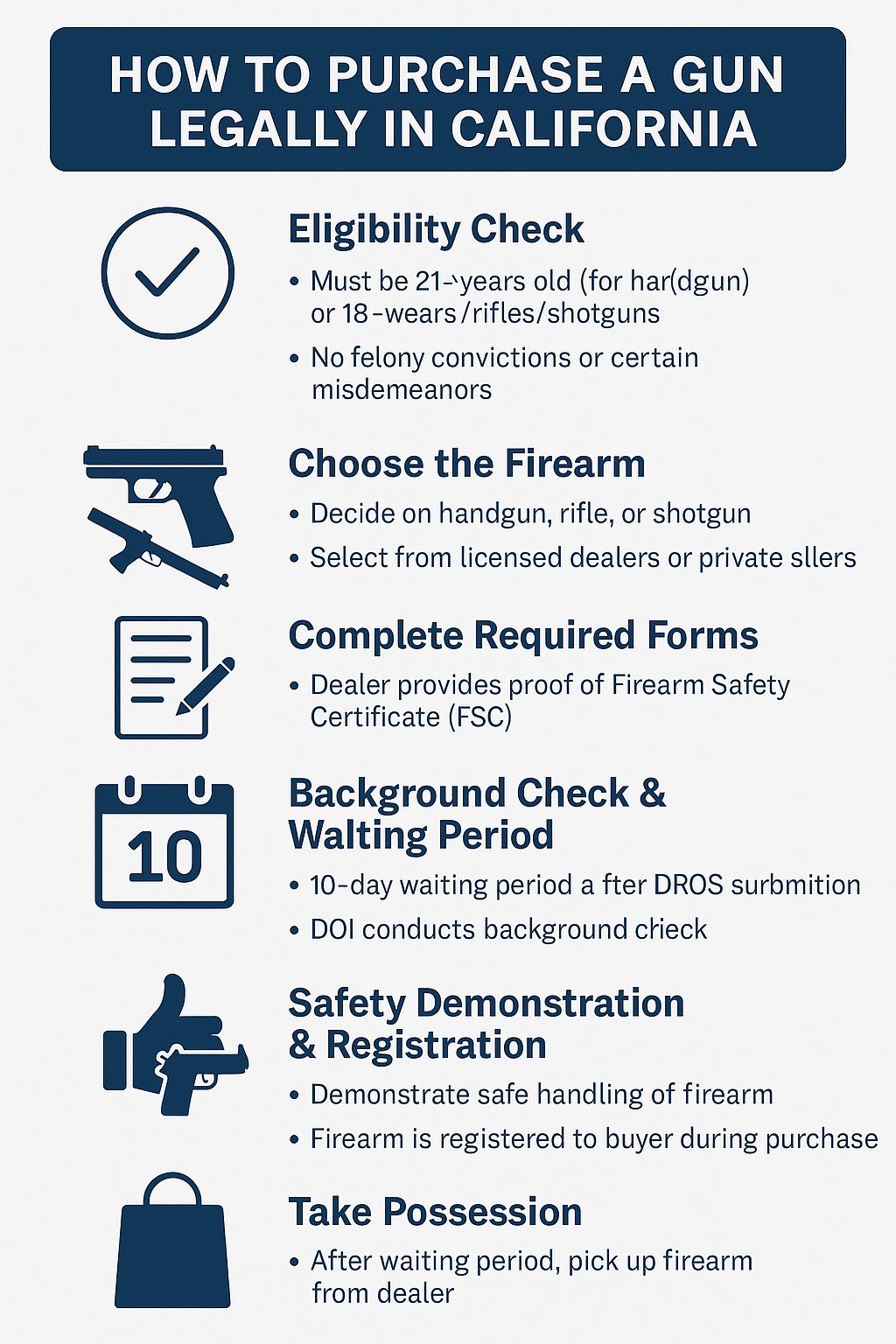
To legally purchase a handgun in [California], an individual must be at least 21 years old. This age requirement applies universally to all handgun purchases through an [FFL]. Additionally, the purchaser must be a bona fide resident of [California], which must be proven with acceptable documentation during the purchase process. Proof of residency typically involves a government-issued identification (like a [California] Driver’s License or ID card) supplemented by a utility bill, vehicle registration, or other state-approved document that clearly shows your current residential address.
Legal Disqualifications
[California] law outlines several categories of individuals who are prohibited from owning firearms. These disqualifications include, but are not limited to, persons convicted of a felony, certain violent misdemeanors (including domestic violence), those subject to domestic violence restraining orders, individuals with a history of mental health adjudications that deem them a danger to themselves or others, and individuals addicted to controlled substances. It is the responsibility of the prospective buyer to ensure they are not subject to any of these legal prohibitions. Attempting to purchase a firearm while legally disqualified can result in severe legal penalties.Firearm Safety Certificate (FSC)
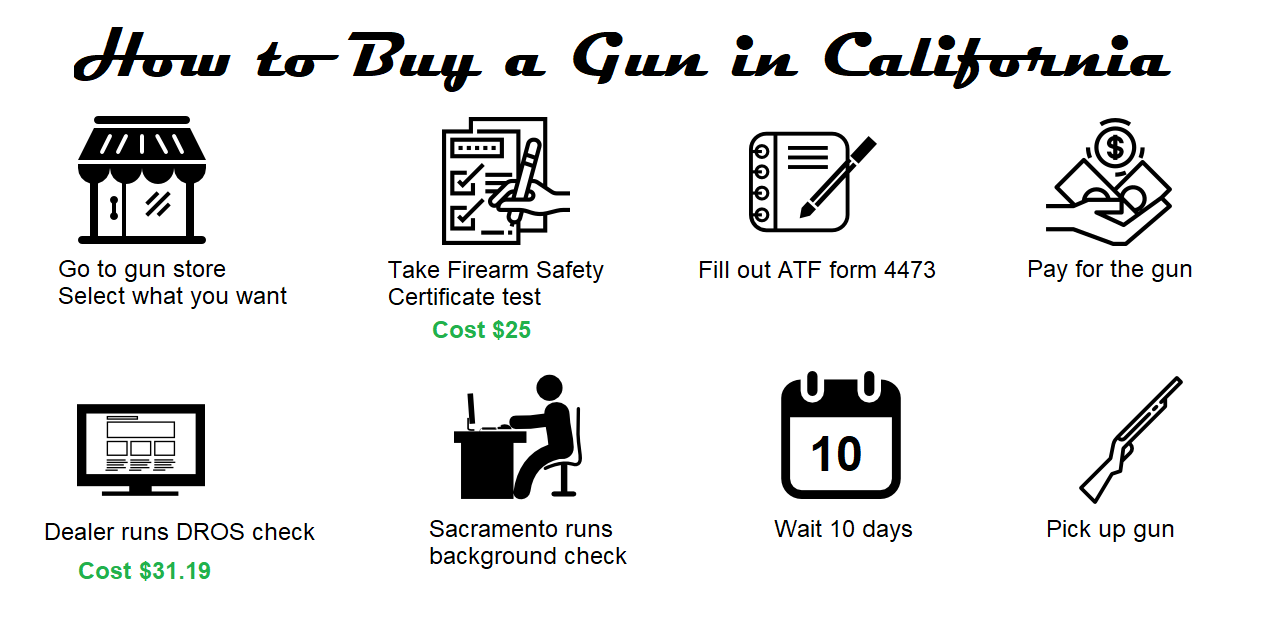
A cornerstone of handgun eligibility in [California] is the acquisition of a Firearm Safety Certificate. With very few exceptions (such as active law enforcement personnel or individuals holding a valid hunting license), every individual wishing to purchase a handgun must first obtain an [FSC]. This certificate demonstrates that the individual has passed a written test covering firearm safety, storage, and relevant laws. The test typically consists of 30 multiple-choice questions, requiring at least 23 correct answers to pass. [FSC] tests are administered by certified instructors, usually at [FFL] premises. Once obtained, an [FSC] is valid for five years. Studying the [California] Department of Justice’s Firearm Safety Certificate Study Guide is highly recommended before taking the test.
The Purchasing Process: Step-by-Step
Once you have confirmed your eligibility and obtained your [FSC], you can begin the actual purchasing process. This involves several distinct steps, each with specific requirements that must be met.
Finding a Licensed Firearm Dealer
All firearm purchases in [California], whether new or used, must go through a Licensed Firearm Dealer. This applies even to private party transfers between individuals, which must be facilitated by an [FFL] to ensure proper background checks and documentation. You can find reputable [FFLs] in various cities across [California], from bustling urban centers like [Los Angeles], [San Francisco], and [San Diego] to the state capital, [Sacramento]. It’s advisable to visit a few local gun stores to compare inventory, prices, and customer service, as they can also be valuable resources for information and advice.
Selecting Your Pistol
With the [California] Roster in mind, the selection process can be somewhat narrowed. When choosing a pistol, consider its intended use—whether for self-defense, sport shooting, or target practice—and factors such as caliber, ergonomics, and reliability. The [FFL] staff can guide you through the available options that comply with [California] law. Remember, any pistol you select must be on the current [California] Roster of Handguns Certified for Sale unless you are exempt (e.g., through an intra-familial transfer or as a law enforcement officer).
Paperwork and Background Check
Once you’ve selected your pistol, the real paperwork begins. You will need to complete several forms:
- Form 4473 (Federal Firearms Transaction Record): This is a federal document required for all firearm purchases from an [FFL] nationwide. It collects basic personal information and requires you to attest under penalty of perjury that you are legally eligible to own a firearm.
- DROS (Dealer Record of Sale): This is [California’s] state-level background check system. The [FFL] will input your information into the DROS system, which initiates a comprehensive background check conducted by the [California] Department of Justice. This check verifies your eligibility based on state and federal prohibitions.
- Proof of Residency: You will need to provide documentation to prove your [California] residency, as discussed earlier.
- Firearm Safety Certificate (FSC): Your valid [FSC] must be presented to the [FFL].
Be prepared to pay the DROS fee, which covers the state background check and registration, as well as the cost of your chosen pistol.
The 10-Day Waiting Period
After completing all the necessary paperwork and passing the initial checks, you will enter the mandatory 10-day waiting period. This period begins when your DROS is submitted to the state. During this time, you cannot take possession of your pistol. The waiting period is a non-negotiable requirement in [California] and is designed to provide a “cooling-off” period and allow ample time for the background check to be thoroughly completed. It is essential to note that the 10-day period is calculated in 24-hour increments, so if you submitted your DROS at 2 PM on a Monday, you generally cannot pick up your firearm until after 2 PM on the second Thursday.
Taking Possession and Safe Storage
Once the 10-day waiting period has elapsed and your background check has cleared, you will receive notification from the [FFL] that your pistol is ready for pickup. Upon pickup, the dealer will often conduct a “safe handling demonstration” to ensure you know how to safely operate and store your firearm. You are required to transport the pistol unloaded and in a locked container, separate from any ammunition, until you reach your home.
Immediately upon bringing the pistol home, it is imperative to adhere to [California’s] strict safe storage laws. This generally means the firearm must be stored in a locked container or disabled with a trigger lock when not in your immediate control. The goal is to prevent unauthorized access, especially by children or individuals who are prohibited from possessing firearms. Many pistols come with a gun lock, or you can purchase a dedicated gun safe.
Responsible Ownership and Ongoing Compliance
Acquiring a pistol in [California] is not the end of the journey; it marks the beginning of a lifelong commitment to responsible ownership and ongoing compliance with the state’s dynamic laws.
Safe Handling and Storage Practices
Beyond the legal requirements, ethical and practical safe handling and storage practices are paramount. Always treat every firearm as if it were loaded. Keep your finger off the trigger until your sights are on the target and you are ready to shoot. Be sure of your target and what is beyond it. When storing your pistol at home, invest in a quality gun safe that is properly secured. This not only fulfills legal obligations but also prevents tragic accidents and deters theft, which could lead to your firearm falling into the wrong hands. Educating all members of your household about gun safety, especially children, is a critical component of responsible ownership.
Continuing Education and Training
Firearm proficiency is a perishable skill, and laws can change. Regularly practicing at a shooting range is highly recommended to maintain and improve your accuracy and handling skills. Consider enrolling in advanced training courses that cover topics such as defensive shooting, marksmanship, and situational awareness. Understanding the nuances of self-defense laws in [California] is also crucial, as the legal framework for using a firearm in self-defense can be complex and has significant implications. Many reputable training organizations offer courses tailored to [California] residents.