
The story of the Chicago Cubs is one of baseball’s most captivating narratives, a tapestry woven with threads of deep-seated tradition, fervent loyalty, and, for a very long time, an almost mythical drought. As one of America’s oldest and most beloved sports franchises, the Cubs and their iconic home, Wrigley Field, stand as indelible landmarks, not just in the sporting world but within the cultural fabric of Chicago itself. Understanding their history, particularly their quest for baseball’s ultimate prize, is essential to grasping their unique place in the national consciousness.

For generations, the question “How many World Series have the Chicago Cubs won?” was often met with a knowing sigh, a roll of the eyes, and the simple answer: “Not since 1908.” That response, however, dramatically changed in 2016. In total, the Chicago Cubs have won three World Series championships: 1907, 1908, and 2016. Each victory represents a pivotal moment in the team’s sprawling history, punctuating eras and shaping the identity of a team and its city. Examining these triumphs not only answers a historical query but also illuminates the profound connection between a sports team and its community, solidifying their status as a living landmark.
A Legacy Forged in Time: The Early Dominance
Before the decades of struggle and the legendary “Curse of the Billy Goat,” the Chicago Cubs were a powerhouse. The early 20th century saw them dominate the National League, setting records that stand to this day and establishing a foundation of excellence that would, ironically, make their subsequent drought all the more poignant. These initial victories established the Cubs as a premier institution in a nascent sport, etching their name into baseball’s earliest annals of glory.
The First Triumph: 1907 World Series
The first taste of World Series glory for the Chicago Cubs came in 1907. Under the shrewd management of player-manager Frank Chance, the team boasted an intimidating roster featuring Hall of Famers like Joe Tinker at shortstop, Johnny Evers at second base, and the legendary Mordecai “Three Finger” Brown on the mound. The 1907 season saw the Cubs achieve an incredible 107-45 record, securing the National League pennant with ease.
Their opponents in the World Series were the Detroit Tigers, led by the formidable Ty Cobb. The series began unremarkably with a 12-inning, 3-3 tie in Game 1, a result that, under the rules of the time, meant the game was replayed. The Cubs then swiftly asserted their dominance, winning the next four games consecutively to clinch their first World Series title. Mordecai Brown was particularly stellar, pitching two complete-game victories and allowing just one earned run over 18 innings. This victory was more than just a championship; it was a definitive statement from a team at the pinnacle of its powers, marking a historic moment for a franchise that would soon become synonymous with perseverance.
Back-to-Back Champions: The 1908 World Series
The 1907 victory was no fluke. The 1908 season saw the Cubs once again atop the National League, though this time it was a much tighter race, famously culminating in the “Merkle’s Boner” incident that decided the pennant. With 96 wins, the Cubs edged out the New York Giants in a thrilling playoff game, setting the stage for a World Series rematch against the Detroit Tigers.
The 1908 World Series was a more hotly contested affair than the previous year, stretching to five games. The pitching staffs again dominated, with low-scoring contests defining the series. Mordecai Brown once again delivered a masterful performance, securing two wins, including the decisive Game 5 victory. The Cubs defeated the Tigers 4 games to 1, claiming their second consecutive World Series championship.
This back-to-back triumph solidified the team’s status as the dominant force of their era. For fans in Chicago, these early successes built an expectation of excellence, unaware that the next championship would not arrive for another 108 years. These two early World Series trophies, though gathering dust for over a century, remained foundational pieces of the Cubs’ identity, a historical benchmark against which all future teams would be measured, and a testament to the club’s inaugural landmark era.
The Century of Waiting: The “Curse” and the Beloved Losers
Following their back-to-back titles in 1907 and 1908, the Chicago Cubs embarked on one of the most prolonged championship droughts in professional sports history. This period, stretching over a century, transformed the team from early champions into the “lovable losers,” a unique landmark in sporting narrative marked by near-misses, legendary misfortunes, and unwavering fan devotion. This era forged an identity distinct from mere wins and losses, deeply embedding the team into the culture of Chicago.
Near Misses and Heartbreak: The Legend of the “Curse”
Over the 108 years between their second and third World Series titles, the Cubs had numerous opportunities to break the spell, only to fall short in often dramatic and heartbreaking fashion. Perhaps the most famous piece of this narrative is the “Curse of the Billy Goat,” supposedly placed upon the team by Billy Sianis, owner of the Billy Goat Tavern, after his goat was ejected from the 1945 World Series at Wrigley Field. The Cubs lost that series to the Detroit Tigers in seven games, and the legend of the curse took root.
Decades of struggle followed, punctuated by flashes of hope that always seemed to extinguish prematurely. The 1969 “Miracle Mets” season saw the Cubs collapse from a commanding lead in the division. The 1984 team, led by Ryne Sandberg, made it to the National League Championship Series (NLCS) but lost a commanding 2-0 lead to the San Diego Padres. The 1989 team also made the NLCS, falling to the San Francisco Giants.
However, the most excruciating near-miss of the modern era occurred in 2003. Just five outs away from reaching the World Series, the Cubs imploded in Game 6 of the NLCS against the Florida Marlins, a collapse famously highlighted by the “Steve Bartman incident.” This moment became another painful chapter in the team’s lore, cementing their reputation as a franchise perpetually on the brink of glory, yet eternally denied. These heartbreaks, rather than alienating fans, only deepened their bond, turning the Cubs into an enduring symbol of hope and resilience against seemingly impossible odds.
Wrigley Field: A Living Landmark
Throughout this century of waiting, Wrigley Field emerged as a landmark of unparalleled character and charm. Opened in 1914, it is the second-oldest ballpark in Major League Baseball and a vibrant monument to America’s pastime. Its ivy-covered outfield walls, hand-operated scoreboard, and intimate neighborhood setting in Lakeview, Chicago, distinguish it from any other sports venue. Wrigley Field is more than just a stadium; it is a pilgrimage site for baseball fans, a historical artifact that has witnessed over a century of Cubs baseball.
The ballpark became synonymous with the team’s endearing struggles. Generations of fans brought their children and grandchildren to Wrigley Field, sharing stories of past heroes and hopeful dreams, often with the shared understanding that a championship might never come. Yet, they kept coming, drawn by the timeless atmosphere, the camaraderie, and the unique connection to history that only Wrigley Field could offer. It stands as a testament to the power of place, a physical landmark that embodies the spirit, history, and enduring hope of a beloved team and its city.
Breaking the Spell: The 2016 World Series
The weight of 108 years is an almost unimaginable burden for any professional sports franchise. Yet, the Chicago Cubs of 2016 did not just carry that weight; they shattered it in spectacular fashion, delivering a championship that transcended sports and became a cultural phenomenon. This victory was a landmark event, an eruption of joy that redefined a franchise and a city.
The Build-Up to Glory
The journey to the 2016 World Series was meticulously planned and executed by Theo Epstein, the President of Baseball Operations, who had famously ended the Boston Red Sox’s 86-year curse in 2004. Epstein built a team around a core of young, talented players like Kris Bryant, Anthony Rizzo, Javier Báez, and Kyle Schwarber, complementing them with veteran leadership such as Jon Lester and Ben Zobrist. Manager Joe Maddon’s unconventional approach and calm demeanor were perfect for guiding this talented roster.
The 2016 regular season was dominant, with the Cubs finishing with an MLB-best 103 wins. They then navigated a challenging postseason, defeating the San Francisco Giants in the National League Division Series and overcoming the Los Angeles Dodgers in the NLCS, finally clinching the National League pennant and their first World Series berth since 1945. The city was abuzz, a mixture of fervent hope and ingrained apprehension, preparing for what felt like an inevitable confrontation with destiny.
A Series for the Ages
The 2016 World Series pitted the Chicago Cubs against the Cleveland Indians, another team with a significant championship drought (68 years at the time). The series was an epic, back-and-forth battle that pushed both teams to their limits. The Cubs found themselves in a 3-1 deficit after four games, seemingly poised for another heartbreaking conclusion. However, they mounted an incredible comeback, winning Game 5 at Wrigley Field and then a decisive Game 6 in Cleveland, setting up a winner-take-all Game 7.
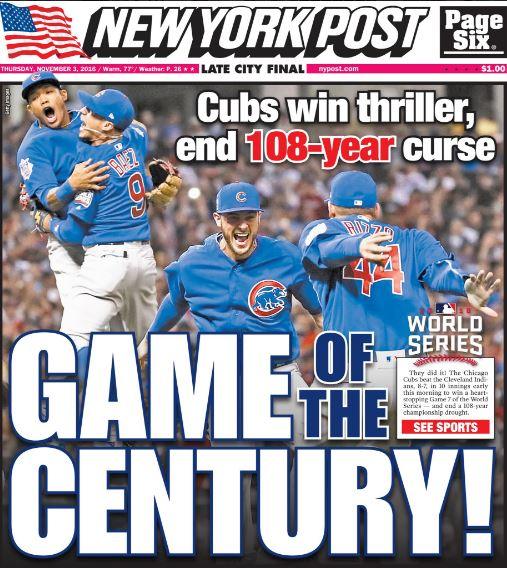
Game 7, played on November 2, 2016, at Progressive Field in Cleveland, became an instant classic. The Cubs took an early lead, but the Indians battled back, tying the game 6-6 in the eighth inning with a dramatic home run. A rain delay then added to the tension, momentarily pausing the game and allowing both teams to regroup. When play resumed, Ben Zobrist hit a crucial RBI double in the 10th inning, and Miguel Montero followed with another, giving the Cubs an 8-6 lead. Relief pitcher Mike Montgomery then sealed the victory, striking out Michael Martinez for the final out. The Chicago Cubs were World Series champions, finally ending their 108-year drought.
The Celebration: A City United
The immediate aftermath of the Game 7 victory was an outpouring of emotion unlike anything seen in Chicago in generations. Fans, many of whom had waited their entire lives, flooded the streets around Wrigley Field and across the city. The celebration was epic, culminating in a victory parade and rally on November 4, 2016, that drew an estimated five million people, making it one of the largest public gatherings in human history.
The parade route through the city, and the rally in Grant Park, transformed Chicago into a joyous sea of blue. The moment was not just about a baseball championship; it was about the collective catharsis of a city, the release of generations of hope and heartbreak. This event solidified the 2016 Cubs’ victory as a profound cultural landmark, a shared memory that will forever be etched into the identity of Chicago and its people. It was a victory not just for a team, but for a city, transforming its landscape of historical memory.
The Enduring Legacy of a Landmark Team
The Chicago Cubs’ two early World Series wins and their triumphant return to glory in 2016 are more than mere statistics in a record book. They are fundamental chapters in the ongoing saga of an American institution, a team whose history, struggles, and ultimate victory have carved a unique landmark status for them in the national psyche. Their story speaks volumes about resilience, the power of belief, and the unbreakable bond between a team and its community.
More Than Just Wins
The Chicago Cubs have always been more than just a baseball team. They are a cultural touchstone for Chicago, a symbol of persistence and a testament to the enduring human capacity for hope. The long drought, far from diminishing their appeal, ironically cemented it. Fans, often playfully self-deprecating about their team’s perennial struggles, found a shared identity in the unwavering support for the Cubs. This loyalty, passed down through generations, created a communal experience that transcended the win-loss column.
Their landmark status isn’t solely derived from their championships, but from the narrative arc of their existence. From early dominance to a century of near-misses and finally, a cathartic triumph, the Cubs’ story embodies the essence of human endeavor – the struggle, the faith, and the ultimate, exhilarating payoff. They represent the idea that even the longest waits can end, that curses can be broken, and that collective perseverance can yield the sweetest reward.

Future Prospects and Historical Resonance
With three World Series titles now proudly displayed, the Chicago Cubs continue to be a focal point in baseball. The 2016 victory not only erased the stain of the past but also inaugurated a new era, one where the expectation of winning has replaced the resignation of waiting. While subsequent seasons have had their ups and downs, the foundation of their identity has irrevocably shifted. The question is no longer if they will win, but when the next championship will come.
The historical resonance of the Chicago Cubs remains profound. Their story is told through the ivy-covered walls of Wrigley Field, in the cheers of generations of fans, and in the three World Series trophies that mark their journey. They are a living landmark, a testament to the enduring power of sports to capture the human spirit, weaving triumphs and tribulations into the very fabric of a city’s identity. The Cubs’ legacy, built on those three World Series wins, serves as a powerful reminder that history is not just about events, but about the stories we tell, and the hope we carry, through the generations.
In conclusion, the Chicago Cubs have etched their name into baseball history with three World Series championships: 1907, 1908, and the unforgettable 2016 victory. These triumphs are far more than just sporting achievements; they are integral chapters in the life of a revered landmark institution, reflecting the spirit and resilience of a city and its devoted fanbase.
LifeOutOfTheBox is a participant in the Amazon Services LLC Associates Program, an affiliate advertising program designed to provide a means for sites to earn advertising fees by advertising and linking to Amazon.com. Amazon, the Amazon logo, AmazonSupply, and the AmazonSupply logo are trademarks of Amazon.com, Inc. or its affiliates. As an Amazon Associate we earn affiliate commissions from qualifying purchases.