
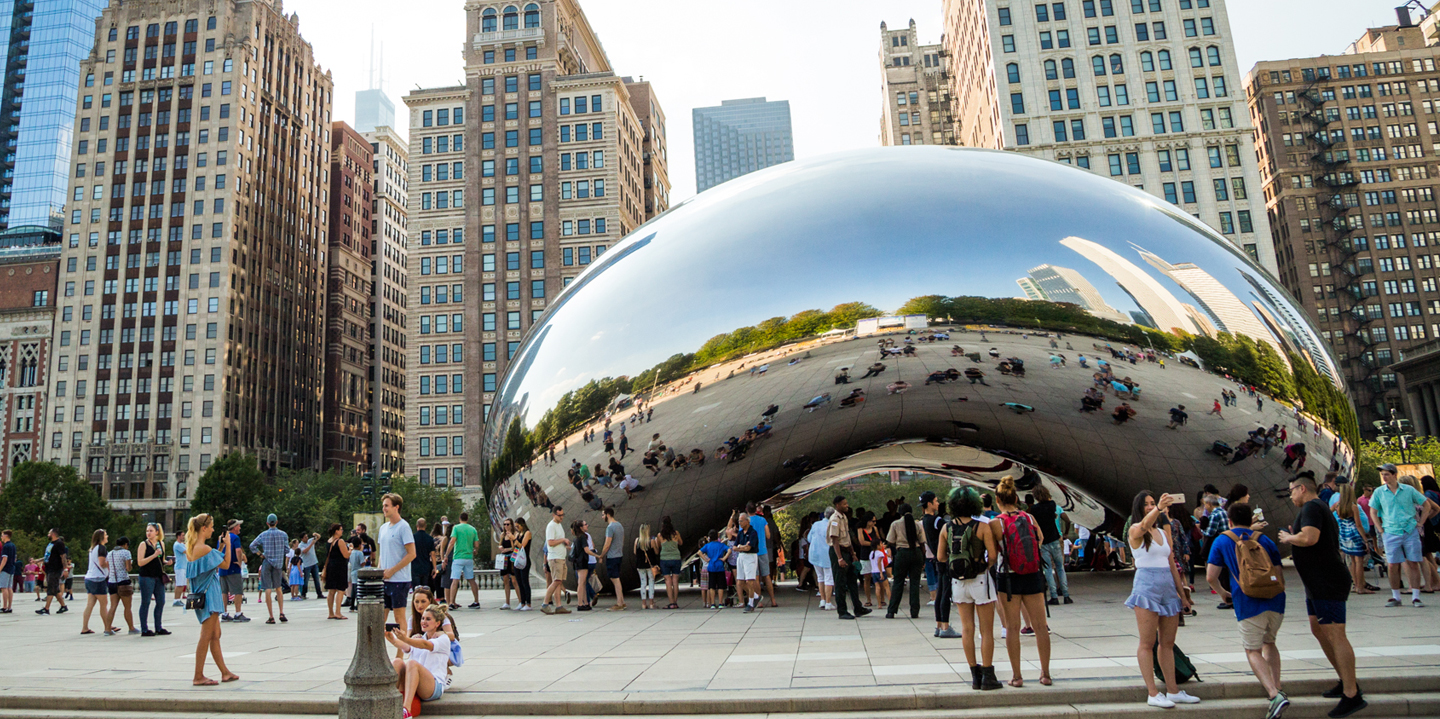
The captivating, mirrored sculpture widely known as the “Chicago Bean” is officially titled Cloud Gate and is prominently situated in Millennium Park, a vibrant public park in the heart of downtown Chicago, Illinois. This iconic landmark, renowned for its distinctive shape and highly reflective surface, has become an indelible symbol of the city’s innovative spirit and a testament to modern public art. Its strategic location within Millennium Park makes it a central feature in one of Chicago’s most significant cultural hubs, drawing millions of visitors annually who come to marvel at its unique aesthetics and interactive qualities. More than just a static sculpture, Cloud Gate actively engages with its urban environment, distorting and reflecting the city’s impressive skyline, the ever-changing sky, and the myriad faces of those who gather around it.
Unveiling Chicago’s Reflective Masterpiece
At the nexus of contemporary art and urban design, Cloud Gate stands as an engineering marvel and a profound artistic statement. Its existence redefines the relationship between public art and its audience, offering an experience that is both monumental and intimately personal. Understanding this landmark requires a deeper dive into its true identity, the vision of its creator, and the architectural significance embedded in its design.
The Icon’s True Identity: Cloud Gate
While colloquially known as the “Chicago Bean” due to its resemblance to a giant legume, the official name bestowed upon this monumental artwork by its creator is Cloud Gate. This name subtly hints at the sculpture’s primary function and artistic intent: to act as a literal and metaphorical gateway to the heavens, reflecting and distorting the clouds, the sky, and the surrounding cityscape. The term “gate” suggests passage, a transition, and an entrance to a different perception of reality. Unlike many sculptures that stand as fixed objects of contemplation, Cloud Gate is a dynamic mirror, continuously altering its appearance based on the time of day, weather conditions, and the movement of people around it. This ever-changing facade ensures that no two experiences of the artwork are ever precisely the same, reinforcing its status as an interactive landmark rather than a mere monument.
Anish Kapoor’s Vision and Inspiration
The visionary behind Cloud Gate is the acclaimed British artist Anish Kapoor. Born in Mumbai, India, and later based in London, Kapoor is renowned for his large-scale sculptures that often explore themes of reflection, perception, and the void. His work frequently employs simple, curving forms and highly reflective or deeply absorptive materials to manipulate space and light. For Cloud Gate, Kapoor’s inspiration was multifaceted, drawing from liquid mercury’s fluid properties and the concept of an object that would completely merge with and reflect its surroundings without a visible seam. He aimed to create a sculpture that was both massive and ethereal, a seamless piece that would invite interaction and introspection. The desire for a perfectly smooth, mirror-like surface was paramount to his artistic vision, requiring extraordinary precision in its fabrication and assembly.
Architectural Significance and Design
The architectural significance of Cloud Gate lies not only in its stunning aesthetic but also in its groundbreaking design and construction methods. The sculpture measures 33 feet (10 meters) high, 42 feet (12.8 meters) wide, and 66 feet (20 meters) long, weighing approximately 110 tons. Its design is a complex paraboloid and ovoid form, crafted from 168 individual stainless steel plates. What makes its architecture truly remarkable is the absence of any visible seams on its exterior. This seamlessness was achieved through an arduous process of welding and polishing, transforming disparate steel panels into a unified, fluid surface.
From an architectural perspective, Cloud Gate challenges traditional notions of building and structure. It lacks interior space in the conventional sense, yet its underside creates an “omphalos” (meaning “navel” in Greek), a concave chamber that distorts and multiplies reflections, drawing visitors into an immersive, kaleidoscopic experience. This inner space fundamentally alters perception, presenting a unique architectural phenomenon that blurs the lines between art, structure, and environment. The exterior, meanwhile, acts as a dynamic façade, reflecting the modernist architecture of Chicago’s skyline and the classical elements of nearby structures like The Art Institute of Chicago, thereby participating in an ongoing dialogue with the city’s diverse architectural heritage.
A Landmark Rooted in Millennium Park
The placement of Cloud Gate within Millennium Park is not incidental but a crucial element that magnifies its impact as a landmark. The park itself is a modern urban oasis, conceived to showcase cutting-edge art, architecture, and landscape design. Cloud Gate’s location within this curated environment provides it with a rich context that enhances both its artistic message and its functional role as a public gathering space.
The Grand Setting: Millennium Park’s Genesis
Millennium Park itself is a monumental undertaking, inaugurated in 2004, designed to transform an unsightly railway yard and parking lot into a 24.5-acre green space. Its genesis was driven by a vision to create a world-class public park that would elevate Chicago’s cultural standing and provide residents and visitors with a vibrant urban retreat. The park hosts several other notable art installations and architectural features, including the Jay Pritzker Pavilion, designed by Frank Gehry, and the Crown Fountain by Jaume Plensa. Cloud Gate was selected through an international design competition, becoming a cornerstone of the park’s artistic program. Its integration into this carefully planned landscape ensures that it is experienced as part of a larger, cohesive artistic and architectural statement.
Strategic Placement and Urban Integration
The specific placement of Cloud Gate within Millennium Park is highly strategic. It is positioned on the AT&T Plaza, a vast open space that allows unobstructed views of the sculpture from multiple angles, as well as providing ample room for the crowds it attracts. Its location offers direct sightlines to the surrounding skyscrapers, including the iconic Two Prudential Plaza and the Aon Center, ensuring that these architectural giants are constantly reflected and playfully distorted on its surface. This urban integration is key to its identity as a landmark; it doesn’t just sit in the city, it actively incorporates the city into its very fabric. The sculpture becomes a dynamic lens through which one can view and interact with the urban environment in novel ways, making it an interactive piece of city infrastructure as much as it is a work of art.
The Art Institute of Chicago’s Proximity
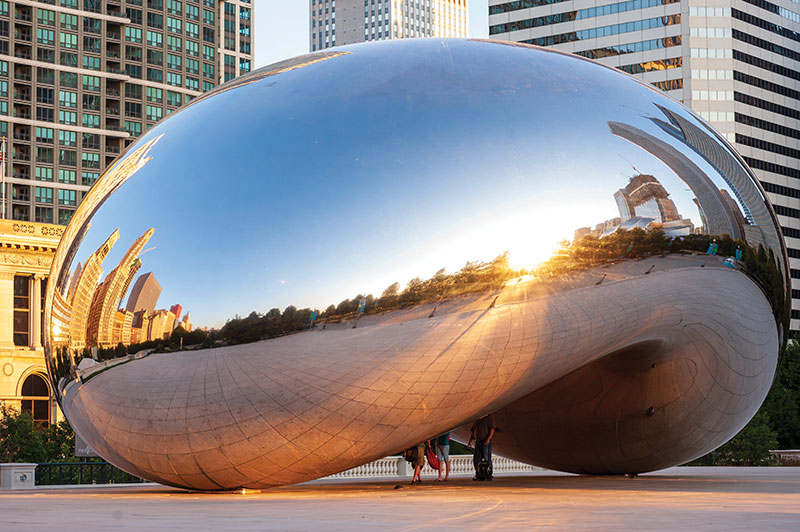
Adding another layer to its historical and cultural context, Cloud Gate is located directly across Michigan Avenue from The Art Institute of Chicago, one of the oldest and largest art museums in the United States. This proximity creates a fascinating dialogue between classical and contemporary art. Visitors can transition from viewing masterpieces of art history within the museum’s hallowed halls to engaging with a cutting-edge public artwork that redefines the boundaries of sculpture and architecture. This geographical relationship reinforces Chicago’s reputation as a city deeply committed to both preserving its artistic heritage and fostering innovation in the arts. The presence of such a significant institution nearby ensures that Cloud Gate is understood within a broader continuum of artistic expression.
The Engineering Marvel Behind the Mirror
The seemingly effortless fluidity of Cloud Gate’s surface belies an extraordinary feat of engineering and craftsmanship. Its creation pushed the boundaries of material science and construction techniques, transforming raw stainless steel into an almost organic, seamless form. The process involved meticulous planning, innovative fabrication, and an unparalleled commitment to achieving Kapoor’s vision of a flawless reflective object.
Fabrication: From Steel Plates to Seamless Sculpture
The construction of Cloud Gate was a monumental undertaking. It was fabricated by Performance Structures Inc. (PSI) in Oakland, California, before being disassembled and shipped to Chicago. The process began with 168 individual stainless steel plates, each custom-cut and shaped to fit the complex curvilinear design. These plates, typically 3/8 inch (10 mm) thick, were then meticulously welded together. The challenge was immense: not only did the welds need to be structurally sound, but they also had to be ground down and polished to such a degree that they would become completely invisible. This required a level of precision usually reserved for aerospace components, not a public sculpture of this scale. The interior structure, a complex network of steel trusses, supports the massive weight and provides the framework for the exterior panels, allowing the seamless outer shell to maintain its integrity against environmental forces.
The Polishing Process: Achieving Flawless Reflection
The key to Cloud Gate’s captivating power lies in its flawless reflective surface. Achieving this was the most demanding aspect of its construction. After the welding of the steel plates, an exhaustive multi-stage polishing process began. Specialized craftsmen spent months hand-grinding and polishing the entire exterior, starting with rough abrasives and gradually moving to finer grits, until the surface was indistinguishable from a perfectly smooth mirror. The goal was to remove every single imperfection, every weld line, every ripple, to ensure that reflections were clear and undistorted. This labor-intensive process was critical to fulfilling Anish Kapoor’s artistic intent, as any visible seam or imperfection would have compromised the illusion of a liquid mercury-like surface. The result is a sculptural surface that virtually disappears, becoming a pure medium for reflection and interaction.
Maintenance and Preservation of a Public Artwork
Maintaining the pristine condition of Cloud Gate’s reflective surface in a busy urban environment is an ongoing challenge. The sculpture is regularly cleaned, often early in the morning before the park becomes crowded, to remove fingerprints, dust, and environmental pollutants. Special care is taken to use non-abrasive cleaning agents and techniques that preserve the highly polished finish. Beyond routine cleaning, the structural integrity of the artwork is periodically inspected to ensure its long-term preservation. This dedication to maintenance underscores the city’s commitment to protecting its public art assets and ensuring that landmarks like Cloud Gate continue to inspire and engage future generations, remaining a shining example of public art for decades to come.
Cultural Impact and Enduring Legacy
Beyond its physical presence and engineering prowess, Cloud Gate has woven itself into the cultural fabric of Chicago and achieved global recognition as an iconic landmark. Its enduring legacy is a testament to its ability to transcend its material form and become a symbol of modernity, public interaction, and urban identity.
A Symbol of Chicago’s Modernity
Cloud Gate stands as a powerful symbol of Chicago’s forward-thinking approach to urban development and its embrace of cutting-edge art and architecture. The city, historically known for its foundational role in skyscraper design and the Chicago School of Architecture, found in Cloud Gate a contemporary expression of its long-standing commitment to architectural innovation. It represents a bold statement that Chicago is not just a city of historical architectural achievements but also a dynamic hub for 21st-century design and artistic expression. The sculpture reinforces the city’s identity as a global cultural capital, unafraid to invest in ambitious public works that push creative boundaries.
Public Interaction and Experiential Art
One of the most remarkable aspects of Cloud Gate is its inherent interactivity. Unlike traditional sculptures that are meant to be viewed from a distance, Cloud Gate actively encourages touch, movement, and close engagement. Visitors walk underneath its soaring arch, touch its cool, smooth surface, and capture countless selfies and photographs with their distorted reflections. This direct interaction transforms passive observation into an active, experiential encounter. The sculpture becomes a giant funhouse mirror, a distorting lens that reveals the viewer as part of the artwork itself, blurring the lines between observer and observed. This emphasis on public engagement is a defining characteristic of contemporary public art and ensures that Cloud Gate remains a vibrant, living landmark, constantly reinterpreted by each new visitor.

Architectural Dialogue and Urban Identity
Cloud Gate initiates a profound architectural dialogue with its surroundings. Its reflective surface captures the grand scale of Chicago’s skyline, the ever-changing sky, and the intricate details of Millennium Park. It offers a unique vantage point, a condensed and often surreal panorama of the city, literally reflecting Chicago’s urban identity back to its inhabitants and visitors. This dialogue is not merely aesthetic; it also prompts contemplation on the nature of urban space, public art, and the perception of reality. As a landmark, it solidifies Chicago’s image as a city that celebrates both its historical architectural prowess and its dynamic future, embodying a sense of pride and innovation that resonates globally.
In conclusion, the “Chicago Bean,” or Cloud Gate, is much more than just a large, shiny object in a park. It is a landmark of immense architectural, engineering, and cultural significance, strategically located in Millennium Park at the heart of Chicago. It represents a confluence of artistic vision, technological innovation, and urban planning, offering a compelling example of how public art can shape a city’s identity and provide an enduring source of wonder and interaction for all who encounter it. Its smooth, reflective surface continues to invite contemplation, serving as a dynamic mirror of the city itself, forever capturing and reshaping its essence.
LifeOutOfTheBox is a participant in the Amazon Services LLC Associates Program, an affiliate advertising program designed to provide a means for sites to earn advertising fees by advertising and linking to Amazon.com. Amazon, the Amazon logo, AmazonSupply, and the AmazonSupply logo are trademarks of Amazon.com, Inc. or its affiliates. As an Amazon Associate we earn affiliate commissions from qualifying purchases.