
The founding of Connecticut as a colony is a rich tapestry woven with threads of religious freedom, political innovation, and the relentless pursuit of new opportunities in the burgeoning New World. While no single date marks its definitive inception, the process unfolded through a series of migrations, settlements, and landmark legal documents during the 17th century, culminating in its official recognition. Understanding Connecticut’s origins offers profound insights into the foundational principles that would later shape the United States and stands as a testament to the pioneering spirit of its early settlers. This historical journey takes us through the establishment of key river towns, the drafting of groundbreaking constitutional documents, and the eventual securing of a royal charter that cemented its place among the Thirteen Colonies.

The Dawn of a New Colony: Early Settlements (1630s)
The seeds of Connecticut were sown in the early 1630s, primarily by Puritan settlers migrating west from the heavily populated Massachusetts Bay Colony. Driven by a combination of a desire for more fertile land, burgeoning economic opportunities along the Connecticut River, and a longing for greater religious and political autonomy, these pioneers ventured into what was then a largely uncharted wilderness. Their journey marked the true beginning of a distinct colonial entity.
The Puritan Exodus and River Towns
The initial migration was spearheaded by groups seeking to establish communities independent of the strict religious and political hierarchy that characterized the Massachusetts Bay Colony. The lure of the Connecticut River valley, with its fertile alluvial soils ideal for agriculture and its strategic location for fur trading, proved irresistible. These early settlers, often led by charismatic ministers, began establishing permanent outposts that would become the core of the future colony.
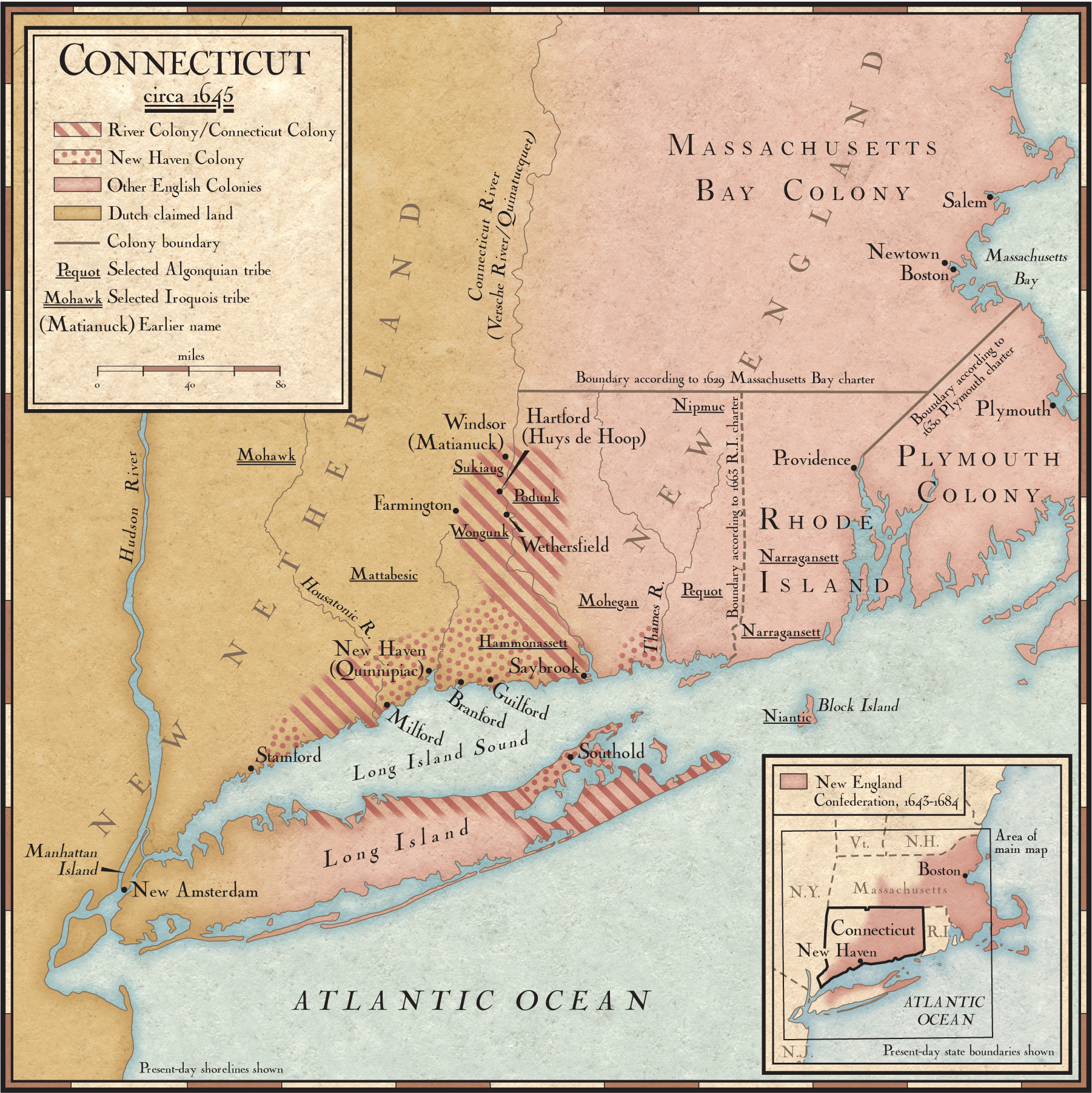
One of the most significant early settlements was Windsor, established in 1633 by traders from the Plymouth Colony, quickly followed by Puritan settlers. Hot on their heels, a group led by Reverend John Warham founded Wethersfield in 1634. However, the most prominent migration occurred in 1636 when Reverend Thomas Hooker and his congregation left Newtown (later Cambridge) and journeyed overland to establish Hartford. These three towns – Hartford, Windsor, and Wethersfield – became the foundational pillars of the Connecticut Colony, cooperating out of necessity for defense and governance.
Simultaneously, other settlements emerged. In 1635, a fort was built at Saybrook at the mouth of the Connecticut River under the leadership of John Winthrop the Younger, acting on behalf of English lords, Lord Saye and Sele and Lord Brooke. This strategic outpost was crucial for controlling access to the river valley and protecting the nascent English presence from Dutch claims and Native American conflicts, notably the Pequot War of 1637.
Leaders and Early Governance
The leaders of these early Connecticut settlements were visionary figures who, while devout Puritans, often held more liberal political views than their counterparts in Massachusetts. Reverend Thomas Hooker, for instance, famously preached that “the foundation of authority is laid in the consent of the governed,” a radical idea for its time. This belief in popular sovereignty became a cornerstone of Connecticut’s distinct political identity.
Initially, each river town operated with a degree of autonomy, managing its local affairs. However, the need for a unified approach to defense, particularly during the Pequot War, and the shared challenges of frontier life necessitated a more formal governmental structure. Representatives from Hartford, Windsor, and Wethersfield began meeting to discuss common policies and laws, laying the groundwork for a broader colonial administration.
The Fundamental Orders: A Blueprint for Self-Governance (1639)
The foundational political document that truly set Connecticut apart and is often cited as its formal founding step, albeit locally, is the Fundamental Orders of Connecticut. Adopted in 1639, this document represented an extraordinary leap in the development of constitutional governance in the New World.
Drafting and Significance
The Fundamental Orders were drafted by Roger Ludlow, with significant influence from Thomas Hooker’s democratic ideals. They were a written constitution that established a representative government for the towns of Hartford, Windsor, and Wethersfield. Unlike the charters granted by the English Crown to other colonies, which typically created governments responsible to authorities in England, the Fundamental Orders were a compact among the settlers themselves. This self-generated constitution was revolutionary.
Key features of the Fundamental Orders included:
- Popular Sovereignty: It declared that the “supreme power” resided in the people, who had the right to elect their magistrates and deputies.
- Limited Government: It defined and limited the powers of the government, preventing any single branch or individual from becoming too powerful.
- Separation of Powers (nascent): While not a full separation as understood today, it established distinct roles for the governor, a general court (legislature), and local officials.
- No Religious Test for Voting: Significantly, unlike Massachusetts, the Fundamental Orders did not require church membership for voting, broadening political participation among freemen.
The adoption of the Fundamental Orders is arguably the moment Connecticut truly founded itself as a self-governing colonial entity, even without explicit royal approval. It was a conscious act of political self-determination, charting a path distinct from its Puritan neighbors.
A Precursor to Modern Democracy
Historians often refer to the Fundamental Orders of Connecticut as the “first written constitution in history to create a government,” or at least a foundational document for modern democratic governance. Its emphasis on the consent of the governed, elected representation, and defined governmental powers laid a crucial groundwork for future constitutional developments in the American colonies and ultimately the United States Constitution.
This document earned Connecticut its enduring nickname, the “Constitution State.” It demonstrated a powerful commitment to orderly, self-directed governance long before the idea of independence from England was widely entertained. The spirit of the Fundamental Orders permeated Connecticut’s political culture, fostering a tradition of strong local control and limited central authority.
The Formalization of Connecticut: From Commonwealth to Charter (1662)
While the Fundamental Orders established a de facto self-governing entity, the colony still needed formal recognition from the English Crown to secure its land claims, protect against rival colonial encroachments (especially from the Dutch and neighboring English colonies), and solidify its legal standing in the imperial system. This process culminated in the granting of the Royal Charter of 1662.
Navigating English Politics
The mid-17th century was a tumultuous period in England, marked by civil war, the execution of King Charles I, and the establishment of the Commonwealth under Oliver Cromwell. These upheavals initially diverted attention away from colonial affairs, allowing Connecticut to develop its self-governing structures relatively unmolested. However, with the Restoration of the Monarchy in 1660 and the ascension of King Charles II to the throne, the colonies found themselves under renewed scrutiny.
Connecticut skillfully navigated this new political landscape. It sent its governor, John Winthrop the Younger, to England to petition the king for a formal charter. Winthrop was an accomplished diplomat and scholar, well-regarded in scientific circles in England, which aided his cause significantly. He presented the case for Connecticut’s established self-governance and demonstrated the loyalty of its settlers to the crown.
The Royal Charter of 1662
John Winthrop the Younger’s efforts bore fruit. On May 10, 1662 (Julian calendar, or April 23, 1662, Gregorian calendar), King Charles II officially granted the Connecticut Colony a royal charter. This charter was exceptionally liberal for its time, incorporating the terms of the Fundamental Orders almost verbatim and granting the colonists an extraordinary degree of self-rule.
The Charter of 1662 did several crucial things:
- Legalized Self-Governance: It officially sanctioned the existing government based on the Fundamental Orders, legitimizing Connecticut’s democratic framework in the eyes of the Crown.
- Expanded Territory: It dramatically expanded Connecticut’s territorial claims, extending its boundaries westward to the Pacific Ocean (though these claims were largely theoretical and later disputed) and northward to the Massachusetts line. Crucially, it also absorbed the independent New Haven Colony, which had been founded in 1638.
- Unity and Stability: The charter brought greater unity and stability to the region, ending the period of fragmented settlements and ongoing territorial disputes with the Dutch and other English groups.
Therefore, while the actual founding of settlements occurred in the 1630s and the principle of self-governance was established in 1639, it was the Royal Charter of 1662 that formally recognized and legitimized Connecticut as a distinct English colony with its own unique and progressive governmental structure. This charter served as Connecticut’s governing document for 156 years, until 1818, a testament to its enduring strength and foresight.
Enduring Legacy: Connecticut’s Historical Footprint
The historical journey of Connecticut’s founding left an indelible mark on its landscape, culture, and political identity. The early settlements and the documents that guided them are not merely historical footnotes but living legacies that continue to define the state.
Sites of Early Colonial Life
Today, visitors can trace the footsteps of Connecticut’s founders by exploring historical landmarks in its original river towns. Hartford, as the capital, is home to numerous sites reflecting its deep history. The Old State House, though built much later, stands on ground where early colonial governance took place, symbolizing the continuity of self-rule. In Windsor and Wethersfield, well-preserved colonial homes and historical societies offer glimpses into the daily lives of the 17th-century settlers.
The Wadsworth Atheneum Museum of Art in Hartford and the Connecticut Historical Society serve as invaluable repositories of artifacts and documents from this foundational period, including information related to the Pequot War and early Puritan life. These sites are not just museums but living connections to the people and events that shaped the colony.
The “Constitution State”
The title “Constitution State” is more than a slogan; it reflects Connecticut’s profound contribution to democratic thought and practice. The principles enshrined in the Fundamental Orders—of government by consent, limited power, and representative democracy—echoed through the centuries. When the American colonies sought independence and later drafted their own Constitution, the precedent set by Connecticut nearly 150 years earlier provided a powerful example of a self-governing people.
The story of Connecticut’s founding is therefore not just a local history but an integral chapter in the broader narrative of American political development. From the bold migrations of Puritans seeking new liberties to the crafting of groundbreaking constitutional documents and the securing of a liberal royal charter, Connecticut’s journey illustrates a sustained effort to establish a society founded on principles of self-determination and popular sovereignty. It remains a powerful reminder of how historical events and legal innovations can leave an enduring legacy that shapes both local identity and national character.
LifeOutOfTheBox is a participant in the Amazon Services LLC Associates Program, an affiliate advertising program designed to provide a means for sites to earn advertising fees by advertising and linking to Amazon.com. Amazon, the Amazon logo, AmazonSupply, and the AmazonSupply logo are trademarks of Amazon.com, Inc. or its affiliates. As an Amazon Associate we earn affiliate commissions from qualifying purchases.