
The story of Las Vegas is one of the most improbable chronicles in American urban history. Situated in the heart of the Mojave Desert, this global icon of entertainment and architecture did not begin as a city of lights, but as a humble watering hole for weary travelers. The evolution of Nevada’s most famous city is a narrative of resilience, engineering marvels, and the relentless pursuit of grandeur. To understand how Las Vegas started is to look at a series of landmark moments that transformed a barren valley into an architectural phenomenon.
The Geographic Foundations and Early Explorations
Long before the first slot machine was ever built, the geography of the region dictated its future. The valley was an essential stop for those traversing the harsh desert landscape, primarily due to the presence of artesian wells that created lush green meadows.
The Discovery by Rafael Rivera
In 1829, a young Mexican scout named Rafael Rivera became the first person of European descent to enter the valley. He was part of a trading party led by Antonio Armijo, who was looking for a new route from Santa Fe to Los Angeles. Rafael Rivera ventured away from the main group and discovered the hidden valley with its abundant water. He named the area Las Vegas, which translates from Spanish to “The Meadows.” This discovery established the Old Spanish Trail, a vital commercial link that brought the first influx of travelers through the region.
The Mormon Mission and the Old Las Vegas Mormon Fort
By the mid-19th century, the strategic value of the valley was recognized by Brigham Young. In 1855, a group of Mormon Missionaries arrived to establish a permanent settlement. Their goal was twofold: to provide a halfway station for travelers between Salt Lake City and San Bernardino, and to convert the local Paiute Indians. They constructed the Old Las Vegas Mormon Fort, an adobe structure that still stands today as a historic landmark. Although the mission was eventually abandoned due to internal conflicts and the difficulty of desert farming, the fort remained, serving as a ranch and eventually a precursor to the modern city.
The Arrival of the Railroad and the Birth of a City
While the early settlers established a presence, it was the industrial revolution that truly birthed the city. The transition from a remote ranching outpost to an official town was driven by the iron tracks of the American railroad system.
William A. Clark and the San Pedro, Los Angeles and Salt Lake Railroad
The true catalyst for the founding of the city was William A. Clark, a powerful politician and mining magnate from Montana. William A. Clark envisioned a rail line connecting the Pacific Ocean to the interior of the United States. He purchased the land and water rights from the Stewart Ranch and integrated the valley into the San Pedro, Los Angeles and Salt Lake Railroad. The availability of water made the location an ideal refueling stop for steam locomotives, ensuring that the town would have a steady economic heartbeat.
The 1905 Land Auction and Fremont Street
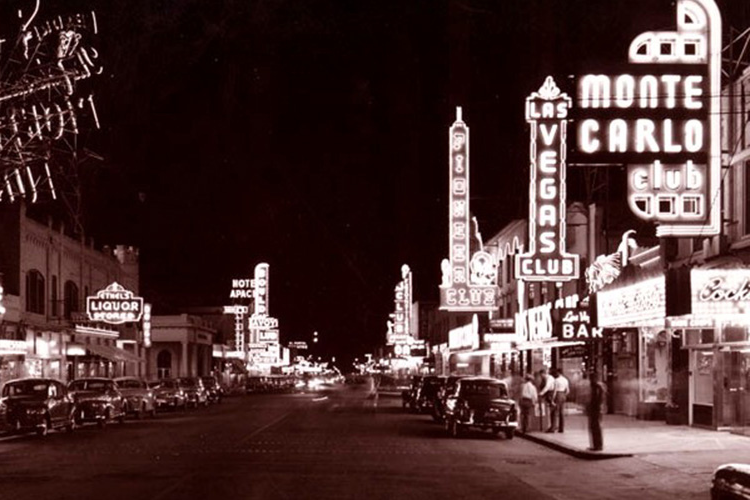
May 15, 1905, is widely considered the official birthday of Las Vegas. On this day, 110 acres of land were auctioned off in the scorching heat near the railroad tracks. Investors and pioneers flocked to the site, and by the end of the day, nearly all the lots were sold for a total of $265,000. This auction created the grid that would become the downtown area, with Fremont Street serving as its primary artery. Fremont Street would eventually become the first paved street in the city and the site of its first traffic light, marking the transition from a wild frontier town to a structured urban environment.
The Hoover Dam Era and the Legalization of Gambling

The 1930s represented a pivotal decade for Nevada. While the rest of the country suffered through the Great Depression, this desert outpost experienced a population boom and a legal revolution that would define its identity for the next century.
Engineering the Boulder Dam
The construction of the Hoover Dam (originally known as Boulder Dam) was an engineering feat of unprecedented scale. Located just 30 miles southeast of the city on the Colorado River, the project brought thousands of workers to the region. To house these workers, the federal government built Boulder City, but the workers sought recreation and excitement in the nearby saloons of Las Vegas. The influx of federal money and labor during a national economic crisis provided the capital necessary for the city’s early infrastructure.
The 1931 Legislation and the Rise of Casinos
In 1931, the Nevada State Legislature made two major decisions: they legalized gambling and eased divorce laws. This was a strategic move to generate tax revenue and attract tourists. The first gambling license was issued to the Northern Club on Fremont Street. Simultaneously, the city became a “divorce ranch” capital, where people could establish residency for six weeks to obtain a quick dissolution of marriage. This era saw the rise of iconic landmarks like the Apache Hotel, which was the first building in the city to feature an elevator and air conditioning—luxuries that were essential for the desert climate.
The Development of the Las Vegas Strip
While downtown flourished, a new development was taking shape outside the city limits. This stretch of Highway 91 would eventually become the world-famous Las Vegas Strip, a corridor of architectural marvels that pushed the boundaries of luxury and design.
El Rancho Vegas and the Frontier Spirit
The development of the Las Vegas Strip began in 1941 with the opening of El Rancho Vegas. Unlike the cramped urban buildings of Fremont Street, El Rancho Vegas was a sprawling resort with a “Western” theme, featuring a swimming pool and horseback riding. It set the precedent for the resort-style hospitality that would define the city. Shortly after, the Last Frontier opened, further cementing the area’s reputation as a destination for travelers arriving by car from California.
The Flamingo and the Mob Era
The most significant shift in the city’s architectural and cultural history came with the opening of the Flamingo Hotel in 1946. Backed by infamous mob figure Bugsy Siegel, the Flamingo Hotel moved away from the rustic Western aesthetic and introduced “Miami” style luxury to the desert. It featured neon lights, streamlined architecture, and high-end entertainment. This era marked the beginning of organized crime’s heavy investment in the city’s development, leading to the construction of other legendary landmarks such as the Desert Inn, the Sands Hotel, and the Riviera.
Modern Landmarks and the Transformation of the Skyline
By the late 1960s, the “Mob era” began to fade as corporate America saw the potential of the desert oasis. The transition toward mega-resorts changed the scale of the city’s landmarks forever.
The Mega-Resort Revolution with The Mirage
The modern era of Las Vegas architecture was ushered in by visionary developer Steve Wynn. In 1989, he opened The Mirage, the first “mega-resort” of its kind. The Mirage was a gold-tinted skyscraper that featured an erupting volcano, a dolphin habitat, and a massive atrium. This project proved that a resort could be a destination in its own right, independent of the gambling floor. It sparked a building boom that led to the creation of themed landmarks like Excalibur, Luxor Las Vegas, and the Venetian Resort, which recreated the canals of Venice in the middle of the desert.

Preservation of History at the Neon Museum
As the city continues to reinvent itself, there is a growing movement to preserve the landmarks that defined its early years. The Neon Museum serves as a “boneyard” for the iconic signs that once illuminated the skyline. By studying these artifacts, visitors can trace the evolution of graphic design and engineering that made the city a global visual landmark. Similarly, the Mob Museum, located in the historic former U.S. Post Office and Courthouse, provides a deep dive into the complex social history that allowed the city to thrive.
The journey of Las Vegas from a small spring in the Mojave Desert to the “Entertainment Capital of the World” is a testament to human ingenuity. What started as a stop for steam engines became a laboratory for architectural experimentation and a monument to the American dream of reinvention. Today, the city continues to expand, with new landmarks like Allegiant Stadium and the Sphere ensuring that the story of how this city started is only the first chapter in an ongoing saga of transformation.
LifeOutOfTheBox is a participant in the Amazon Services LLC Associates Program, an affiliate advertising program designed to provide a means for sites to earn advertising fees by advertising and linking to Amazon.com. Amazon, the Amazon logo, AmazonSupply, and the AmazonSupply logo are trademarks of Amazon.com, Inc. or its affiliates. As an Amazon Associate we earn affiliate commissions from qualifying purchases.