
New York City, a vibrant tapestry woven from the threads of cultures and traditions from across the globe, stands as a testament to the power of human migration and connection. At its very core, this metropolis is defined by its linguistic diversity, a phenomenon that shapes its daily rhythm, its social fabric, and its unparalleled status as a global hub. To ask “How many languages are spoken in New York?” is to delve into the very soul of the city, uncovering a story of immigration, cultural preservation, and a living, breathing testament to the world’s linguistic richness. The answer is not a simple number, but rather a dynamic reflection of its history and its ongoing evolution.

The Babel of the Empire State: A Linguistic Census
New York City’s claim to linguistic preeminence is not an exaggeration. It is a city where hundreds of languages are not just spoken, but are actively used in homes, businesses, schools, and public spaces, creating a unique auditory landscape. This incredible diversity is a direct consequence of its historical role as a primary gateway for immigrants to the United States. For centuries, people from every corner of the world have arrived on its shores, bringing with them their native tongues, their customs, and their unique perspectives. This continuous influx has ensured that New York remains a place where one can encounter a multitude of languages, often within a few city blocks.
Unraveling the Numbers: Estimating the Linguistic Spectrum
Pinpointing an exact number of languages spoken in New York is a complex undertaking. Linguistic studies and demographic analyses offer estimates, but the fluid nature of language use and the constant arrival of new communities make precise quantification challenging. However, consensus among linguists and demographers suggests that over 800 languages are spoken within the five boroughs. This staggering figure places New York City at the forefront of global linguistic diversity, surpassing many entire countries in the sheer variety of tongues heard on its streets. This count encompasses not only widely spoken languages like Spanish, Chinese, and Russian, but also a multitude of lesser-known dialects and indigenous languages, each contributing to the city’s unique linguistic mosaic.
Beyond the Majority: The Ubiquity of Lesser-Spoken Tongues
While languages like Spanish and English are undoubtedly dominant, the true magic of New York’s linguistic landscape lies in the prevalence of its lesser-spoken languages. From Polish in Greenpoint to Yiddish in Borough Park, from Korean in Flushing to Bengali in Jamaica, these languages are not relics of the past but vibrant, living forms of communication. They are spoken in homes, in local businesses, in community centers, and in places of worship, serving as vital links to cultural heritage and identity for millions of New Yorkers. The sheer existence and active use of these languages are a powerful statement about the city’s commitment to embracing and nurturing its diverse population.
The Engines of Linguistic Diversity: Immigration and Cultural Enclaves
The incredible linguistic diversity of New York City is not an accident of geography; it is a direct result of centuries of deliberate human migration and the subsequent establishment of vibrant cultural enclaves. These neighborhoods, often referred to as “Little Italy,” “Chinatown,” or “Little India,” serve as crucial anchors for immigrant communities, providing a sense of familiarity and belonging in a new land. Within these enclaves, languages are preserved, traditions are maintained, and the unique cultural identities of various groups are celebrated and passed down through generations.
From Ellis Island to the Five Boroughs: A Historical Perspective
The story of New York’s linguistic richness is inextricably linked to its history as the primary point of entry for immigrants to the United States. From the late 19th and early 20th centuries, millions of newcomers, including Irish, Italian, Jewish, and Eastern European immigrants, passed through Ellis Island, bringing with them their distinct languages and dialects. As these communities settled, they formed distinct neighborhoods, preserving their linguistic heritage. This historical pattern of settlement, coupled with subsequent waves of immigration from Asia, Latin America, and Africa, has continually replenished and expanded the city’s linguistic tapestry. The legacy of these historical migrations is still palpable today, with many neighborhoods reflecting the dominant languages of their founding immigrant groups.
Cultural Preservation in a Global City: The Role of Enclaves
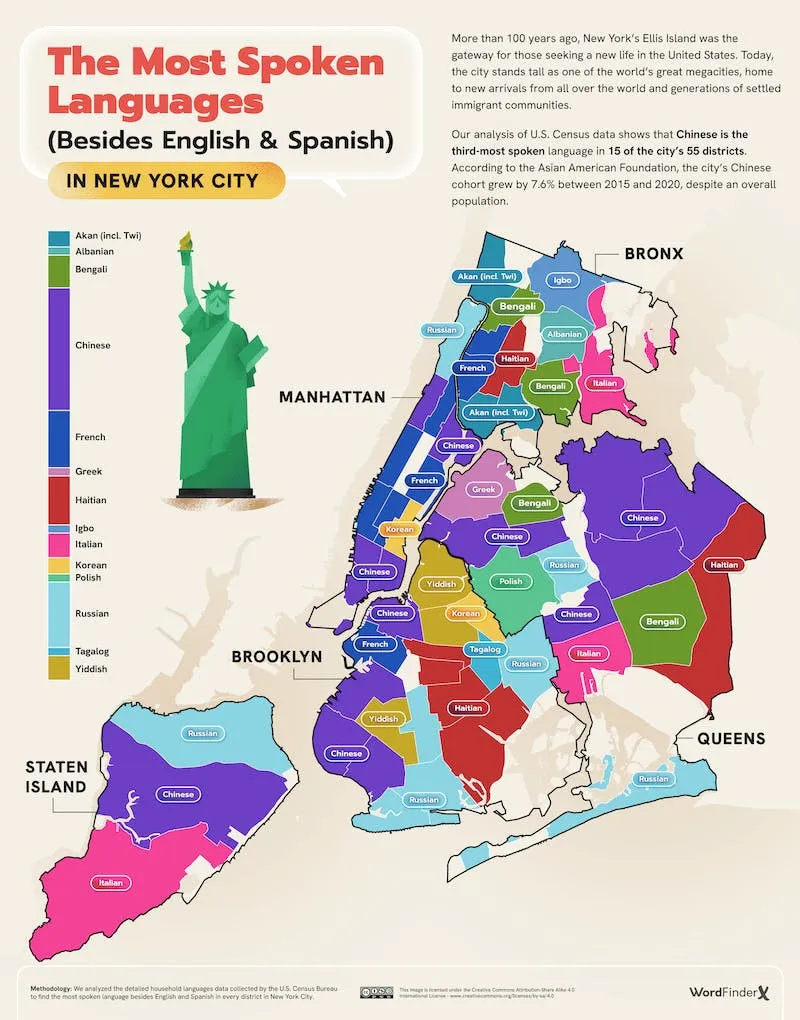
New York’s enclaves are more than just geographical concentrations of people from similar backgrounds; they are vital centers for the preservation and transmission of language and culture. In Jackson Heights, for instance, one can hear a symphony of South Asian languages, with businesses, restaurants, and community organizations catering to speakers of Hindi, Punjabi, Urdu, and Nepali, among others. Similarly, the vibrant Koreatown in Manhattan offers a comprehensive experience of Korean culture, including businesses that operate exclusively in the Korean language. These enclaves provide a crucial support system for immigrants, allowing them to maintain a connection to their homeland while integrating into American society. They are living laboratories of linguistic diversity, where languages are not only spoken but also taught, celebrated, and evolved.
Navigating the Polyglot Landscape: Experiencing New York’s Linguistic Richness
Understanding the sheer number of languages spoken in New York City is one thing; experiencing this linguistic richness is another. The city offers myriad opportunities to immerse oneself in its multilingual environment, from the everyday interactions on its streets to curated cultural experiences. Embracing this diversity can transform a visit into a profound exploration of global cultures.
Everyday Encounters: A Symphony of Tongues
The most accessible way to experience New York’s linguistic diversity is through everyday interactions. A simple trip to the grocery store in Queens might involve hearing Russian announcements or ordering food in Mandarin at a bustling market. Riding the subway can expose you to snippets of conversations in dozens of languages. Even the signage in many neighborhoods reflects the dominant languages of their residents, offering a visual representation of the city’s multilingualism. These spontaneous encounters are the lifeblood of New York’s linguistic identity, demonstrating that language is not just a tool for communication but a fundamental aspect of lived experience.
Cultural Hubs and Linguistic Immersion
Beyond casual observation, New York City boasts numerous cultural institutions and community organizations dedicated to preserving and celebrating linguistic diversity. Museums, such as the Museum of the Moving Image in Astoria, often host exhibitions that explore the immigrant experience and the languages that accompanied it. Cultural festivals, like the annual Queens World Film Festival, showcase films from around the globe, often in their original languages with subtitles, providing a window into diverse narratives. Furthermore, many community centers offer language classes for heritage speakers and newcomers alike, fostering intergenerational connections and ensuring the continued vitality of these languages. Attending a performance at the Lincoln Center might feature productions in various languages, further highlighting the city’s artistic and linguistic breadth. These curated experiences offer a deeper understanding of the cultural significance of language and its role in shaping identity.
The Future of New York’s Linguistic Landscape
As New York City continues to evolve, so too does its linguistic composition. The forces of globalization, ongoing immigration, and intergenerational language transmission will undoubtedly shape the future of its many tongues. While some languages may face challenges, the city’s inherent dynamism and its commitment to cultural pluralism suggest a future where linguistic diversity remains a defining characteristic.
Challenges and Opportunities: Preserving Heritage Tongues
The preservation of heritage languages in a predominantly English-speaking environment presents both challenges and opportunities. For many second and third-generation immigrants, English often becomes the primary language of daily life, leading to a decline in fluency in their ancestral tongues. However, there is a growing awareness and a concerted effort to counteract this trend. Bilingual education programs, community-led language revitalization initiatives, and the increasing accessibility of online language learning resources are playing a crucial role in ensuring that these languages are not lost but are instead passed on to future generations. The desire to connect with one’s roots and to maintain cultural identity is a powerful motivator for language preservation.
A Global City, A Global Voice: The Enduring Legacy
The extraordinary linguistic diversity of New York City is not merely a statistical curiosity; it is a fundamental aspect of its identity and a significant contributor to its global influence. The city’s ability to embrace and integrate so many languages and cultures has fostered an environment of unparalleled innovation, creativity, and understanding. As New York continues to welcome people from all over the world, its linguistic landscape will undoubtedly continue to shift and transform. The ongoing conversation, expressed in hundreds of languages, is what makes New York truly unique – a vibrant, ever-evolving metropolis where the world speaks, and listens. The legacy of its linguistic richness is an enduring testament to the power of human connection and the enduring spirit of a truly global city.
LifeOutOfTheBox is a participant in the Amazon Services LLC Associates Program, an affiliate advertising program designed to provide a means for sites to earn advertising fees by advertising and linking to Amazon.com. Amazon, the Amazon logo, AmazonSupply, and the AmazonSupply logo are trademarks of Amazon.com, Inc. or its affiliates. As an Amazon Associate we earn affiliate commissions from qualifying purchases.