
Texas Hold’em, a game of skill, strategy, and a touch of luck, has transcended its origins to become a global phenomenon, captivating players from all walks of life. Whether you’re a seasoned globetrotter seeking thrilling experiences in opulent resorts or simply looking for an engaging pastime during a long-term stay, understanding the nuances of Texas Hold’em can enrich your travel adventures and offer a unique window into diverse local culture. This comprehensive guide will demystify the game, walking you through its core mechanics, strategic considerations, and the vibrant lifestyle it embodies, from high-stakes tables in Las Vegas to friendly games in a quaint European hotel suite.
The Global Allure of Texas Hold’em: A Game for the Traveler’s Lifestyle
Texas Hold’em is more than just a card game; it’s a social lubricant, a mental sport, and a gateway to incredible destinations. Its widespread appeal means you can find a game almost anywhere, making it a perfect activity to complement your explorations. For many, the thrill of the game is intertwined with the excitement of tourism, particularly in cities renowned for their vibrant gaming scenes.
From Las Vegas Glamour to Macau’s High Stakes
The name Texas Hold’em often conjures images of the dazzling lights of [Las Vegas], the undisputed entertainment capital of the world. Here, iconic landmarks like the Bellagio, ARIA Resort & Casino, and Caesars Palace house some of the most famous poker rooms on the planet. These grand establishments offer an unparalleled luxury travel experience, combining world-class gaming with exquisite accommodation, fine food, and spectacular shows. A visit to these establishments is an attraction in itself, embodying a certain sophisticated way of life that extends beyond the poker table.
However, the allure of Texas Hold’em isn’t confined to the Nevada desert. Across the globe, Macau has emerged as an equally formidable gaming hub, often referred to as the “Monte Carlo of the East.” Here, complexes like The Venetian Macao rival their Western counterparts in extravagance and the sheer volume of high-stakes action. Similarly, the historic elegance of Monte Carlo in Monaco, with its legendary Casino de Monte-Carlo, offers a more exclusive, old-world charm to poker enthusiasts. From the Caribbean paradise of Atlantis Paradise Island in the Bahamas to bustling card rooms in London, Prague, or Barcelona, the game provides a universal language for travelers seeking connection and competition.

The Social Fabric of Poker: More Than Just a Game
Beyond the glitz of professional tournaments and lavish hotels, Texas Hold’em fosters a vibrant social environment. It’s a game that brings people together, whether around a kitchen table on a casual family trip or in a dedicated poker room during a business stay. Many [travelers] find that joining a local game, even a friendly one, is an excellent way to immerse themselves in the [local culture] and meet new people. The shared intensity of a hand, the camaraderie, and the friendly banter create memorable [experiences] that go beyond typical sightseeing. It’s a testament to the game’s ability to transcend cultural barriers, offering a common ground for interaction and entertainment worldwide.
Understanding the Fundamentals: Getting Started with Texas Hold’em
Before you can confidently navigate the poker tables of the world’s most glamorous [resorts] or even just a friendly game at home, it’s essential to grasp the fundamental rules of Texas Hold’em. The objective is simple: win the pot, which consists of all the money (or chips) wagered by players during a hand. You can do this in two primary ways: either by having the best five-card poker hand at the “showdown,” or by making all other players “fold” (give up their hands) before the showdown, regardless of the strength of your cards.
The Anatomy of a Hand: Blinds, Deal, and Community Cards
A standard game of Texas Hold’em uses a single 52-card deck. The game begins with two players to the left of the dealer posting forced bets called “blinds.” The player immediately to the dealer’s left posts the “Small Blind“, and the player to their left posts the “Big Blind”, which is typically double the small blind. These blinds ensure there’s always money in the pot to play for, stimulating action. The dealer button rotates clockwise after each hand, ensuring everyone takes a turn posting blinds and acting in different positions.
Once the blinds are posted, each player is dealt two private cards, known as “hole cards.” These cards are yours alone and should not be shown to other players. The game then proceeds through several betting rounds, interspersed with the dealing of “community cards” – cards that are placed face-up in the center of the table and can be used by all players to make their best five-card hand.
The Betting Rounds: Pre-Flop, Flop, Turn, and River
The game unfolds in four distinct betting rounds:
-
Pre-Flop: This is the first betting round. After hole cards are dealt, the action begins with the player to the left of the [Big Blind]. This player has three options:
- Fold: Give up their hand and forfeit any chips they’ve already put into the pot.
- Call: Match the amount of the current big blind.
- Raise: Increase the bet beyond the big blind.
Betting continues clockwise around the table until all active players have either folded or matched the highest bet.
-
The Flop: Once the pre-flop betting concludes, three community cards are dealt face-up in the center of the table. This is known as the “Flop”. These three cards, combined with their two hole cards, give each player a five-card hand to evaluate. A new betting round begins with the first active player to the left of the dealer button. Players again have the option to check (if no bet has been made, meaning they pass the action without betting), bet, call, raise, or fold.
-
The Turn: After the flop betting round, a fourth community card, called the “Turn”, is dealt face-up. This adds another card to consider for forming the best five-card hand. Another round of betting ensues, following the same structure as the flop.
-
The River: The final community card, known as the “River”, is dealt face-up, bringing the total to five community cards. This completes all the available cards for players to make their best five-card hand. The final betting round occurs.
Mastering the Mechanics: Hand Rankings and Showdown
Understanding which hands beat which is absolutely crucial in Texas Hold’em. Without this knowledge, even the most strategic player will be lost. The goal at the showdown is to create the best possible five-card poker hand using any combination of your two hole cards and the five community cards.
Decoding Hand Strengths: From High Card to Royal Flush
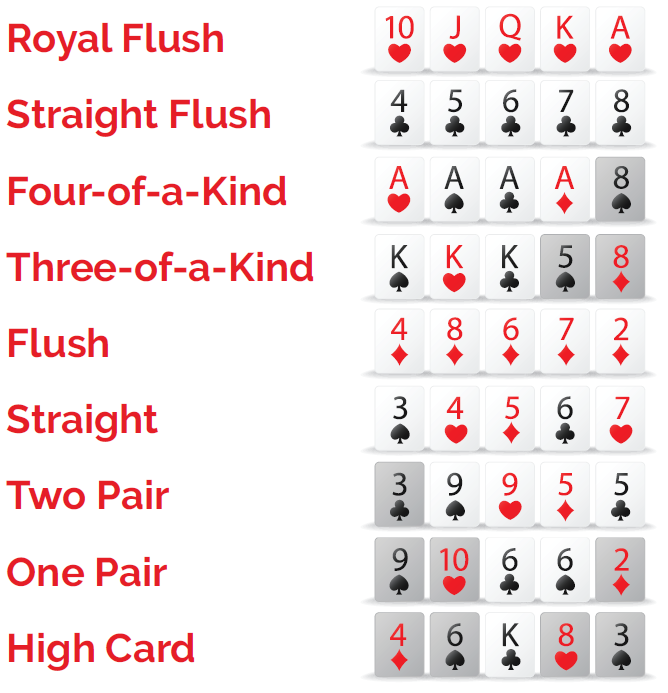
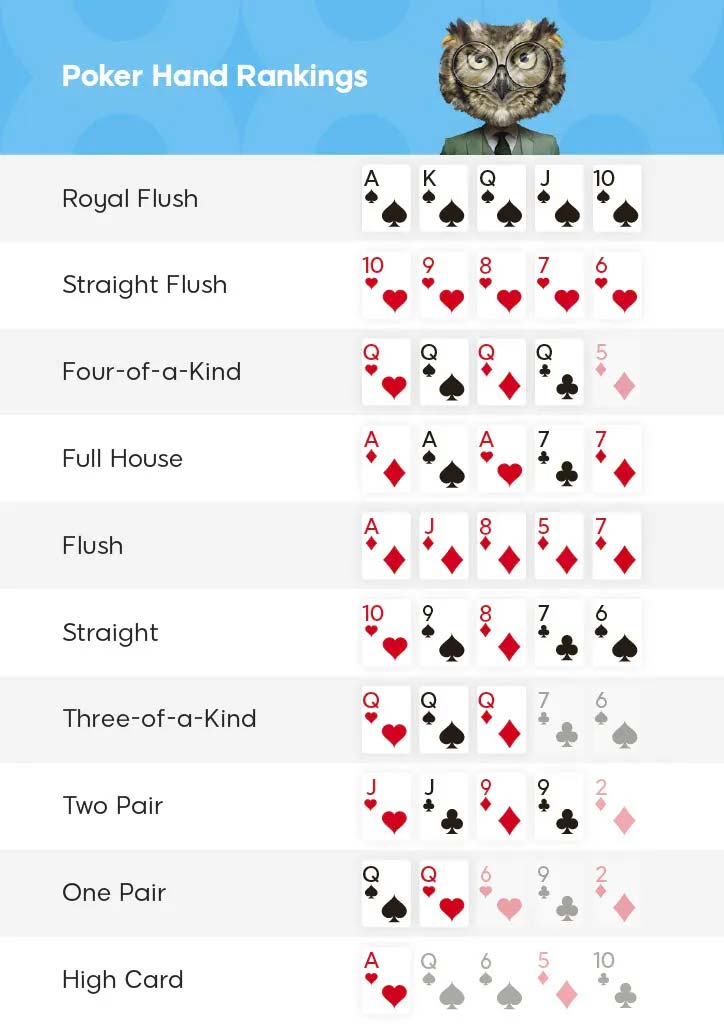
Poker hand rankings are standard across most variations of the game. They are ranked from strongest to weakest:
- Royal Flush: The absolute best hand in poker. A, K, Q, J, 10, all of the same suit (e.g., A♠ K♠ Q♠ J♠ 10♠).
- Straight Flush: Five cards in sequential rank, all of the same suit (e.g., 9♣ 8♣ 7♣ 6♣ 5♣).
- Four of a Kind: Four cards of the same rank (e.g., 8♥ 8♠ 8♦ 8♣ 5♠).
- Full House: Three cards of one rank and two cards of another rank (e.g., Q♥ Q♠ Q♦ J♣ J♠).
- Flush: Five cards of the same suit, not in sequential rank (e.g., K♠ J♠ 8♠ 4♠ 3♠).
- Straight: Five cards in sequential rank, but not all of the same suit (e.g., 7♥ 6♠ 5♦ 4♣ 3♠).
- Three of a Kind: Three cards of the same rank (e.g., A♥ A♠ A♦ 7♣ 2♠).
- Two Pair: Two cards of one rank and two cards of another rank (e.g., K♥ K♠ 5♦ 5♣ J♠).
- One Pair: Two cards of the same rank (e.g., 9♥ 9♠ A♦ 7♣ 4♠).
- High Card: If no player has at least one pair, the hand with the highest-ranking single card wins.
In the event of a tie (e.g., two players have the same Two Pair), a “kicker” card is used. This is the next highest unpaired card in a player’s hand that isn’t part of the main hand components. If kickers are also tied, the pot is split.
The Showdown: Determining the Victor
After the final betting round on the [River], if more than one player remains in the hand, a “showdown” occurs. Players reveal their hole cards, and the player with the best five-card poker hand, using any combination of their two hole cards and the five community cards, wins the pot. It’s a moment of truth, where all the strategic maneuvers and bluffs are put to the ultimate test. Understanding the hand rankings instinctively will give you a significant advantage in quickly determining the winner and knowing whether to push your bets or fold your hand earlier.
Strategic Insights for the Aspiring Player
While the rules of Texas Hold’em are straightforward, mastering the game requires a deep understanding of strategy, psychology, and risk management. It’s this strategic depth that makes the game so endlessly fascinating and addictive for players around the world, whether they’re participating in professional tournaments or enjoying casual games in beautiful apartments during their [travels].
Positional Advantage and Aggression
One of the most fundamental strategic concepts in Texas Hold’em is “position.” The player who acts last in a betting round (i.e., the player closest to the dealer button) has a significant advantage because they get to see how all other players have acted before making their decision. This allows them to gather more information, make more informed choices, and apply pressure more effectively. Playing “tight” (playing fewer hands) in early positions and more “loose” (playing more hands) in late positions is a common and effective strategy. Coupled with position, aggression is key. Betting and raising, rather than just calling, puts pressure on opponents, forces them to make difficult decisions, and gives you more ways to win the pot (either by having the best hand or by bluffing).
The Art of Bluffing and Reading Opponents
Bluffing is perhaps the most iconic and misunderstood aspect of poker. It’s the act of betting or raising with a weak hand (or no hand at all) to convince opponents that you have a strong hand, thereby forcing them to fold. Successful bluffing requires careful timing, an understanding of your table image, and the ability to “read” your opponents. Learning to spot “tells” – subtle physical or verbal cues that might betray an opponent’s hand strength – is an advanced skill that comes with experience. Similarly, maintaining a neutral demeanor, often referred to as a “poker face,” prevents your opponents from reading your own tells. These psychological battles are what elevate Texas Hold’em from a simple card game to a captivating mental duel, an [experience] that adds another layer to your [travels] and interactions.
Crucial Considerations: Bankroll Management and When to Fold
Effective “bankroll management” is critical for sustained enjoyment of Texas Hold’em, especially for those who consider it part of their [lifestyle]. This means only playing with money you can afford to lose and choosing games where the stakes are appropriate for your bankroll size. Jumping into high-stakes games without sufficient funds is a quick way to lose everything and sour your [experience]. For [budget travel] poker players, finding games with lower blinds is essential.
Equally important is knowing “when to fold.” Many beginners make the mistake of playing too many hands or staying in a hand for too long, hoping to get lucky. However, patience and discipline are virtues in poker. Folding weak hands saves chips, allowing you to preserve your bankroll for more favorable situations. It’s a concept that applies not just to poker but to wise decision-making in all aspects of life, including managing your [travel] budget or choosing the right [accommodation].
Experiencing Texas Hold’em: Beyond the Green Felt
The integration of Texas Hold’em into global [tourism] and [lifestyle] trends means that engaging with the game can be an enriching part of your overall [travel] agenda. It’s about more than just playing; it’s about the entire ecosystem surrounding it – from the architectural marvels of casino [resorts] to the cultural nuances of gaming [destinations].
Luxury Accommodation and Integrated Resorts: The Ultimate Poker Experience
Many of the world’s premier poker rooms are located within stunning integrated [resorts] that offer far more than just gaming. Places like the Marina Bay Sands in Singapore are [landmarks] in their own right, featuring breathtaking [architecture], world-class dining, shopping, and entertainment, all under one roof. These establishments define [luxury accommodation], providing everything from lavish [suites] to exquisite [villas] with unparalleled [amenities]. For the poker enthusiast, staying at such a resort means having immediate access to high-quality games while also enjoying a truly opulent vacation. It’s a holistic [experience] where the thrill of the game is perfectly complemented by comfort and indulgence, making it ideal for those seeking [luxury travel] opportunities. Finding the best deals often involves checking [booking] sites, reading [reviews], and doing a careful [comparison].
Gaming Tourism: Planning Your Next Poker Destination
The rise of poker as a competitive sport has led to the growth of “[gaming tourism],” where individuals plan their [travel] itineraries specifically around poker tournaments or renowned card rooms. Major events like the World Series of Poker in [Las Vegas] attract thousands of players and spectators, transforming the city into a vibrant hub of poker [activity]. Other regions, like [California]’s vast network of card rooms or the burgeoning poker scene in [Texas] (the game’s birthplace), offer different flavors of the poker [experience]. Planning a trip around these events can be an exciting way to combine your passion for the game with discovering new [destinations]. These trips often require careful planning, from securing the right [accommodation] to understanding [local culture] and customs around gambling. Reading [tips] from experienced players and travelers can make all the difference.
Embracing the Lifestyle: Poker as a Global Activity
Whether you’re engaging in a spirited cash game at a stylish European [hotel], participating in a local home game, or simply observing the action in a grand casino, Texas Hold’em offers a unique lens through which to view global [lifestyle] and culture. It teaches patience, resilience, strategic thinking, and the ability to adapt to different situations – skills valuable both at the table and in life. It’s a game that appeals to the intellect, the adventurer, and the socialite, making it a perfect companion for any [traveler]. As you explore new [destinations] and immerse yourself in their offerings, remember that a game of Texas Hold’em can be more than just a pastime; it can be an integral part of your unforgettable journey, providing thrilling [experiences] and fostering connections in unexpected places.
In conclusion, Texas Hold’em is a dynamic game that offers endless layers of enjoyment and challenge. From understanding the basics of blinds and betting to mastering hand rankings and implementing advanced strategies, the journey of learning poker is an enriching one. And when viewed through the lens of [travel] and [lifestyle], it transforms into an incredible way to explore the world, connect with diverse cultures, and create lasting memories in some of the most spectacular [hotels] and [resorts] on Earth. So, the next time you plan a trip, consider adding a visit to a local card room or a grand casino; you might just discover your next great [experience].
LifeOutOfTheBox is a participant in the Amazon Services LLC Associates Program, an affiliate advertising program designed to provide a means for sites to earn advertising fees by advertising and linking to Amazon.com. Amazon, the Amazon logo, AmazonSupply, and the AmazonSupply logo are trademarks of Amazon.com, Inc. or its affiliates. As an Amazon Associate we earn affiliate commissions from qualifying purchases.