
Navigating the legal landscape of divorce can be a complex and emotionally taxing process. For residents of Oklahoma, understanding the specific procedures, requirements, and options available is crucial for a smoother transition. This guide aims to provide a comprehensive overview of obtaining a divorce in the Sooner State, demystifying the legal jargon and outlining the practical steps involved. Whether you are considering a contested or uncontested divorce, preparing for this significant life change requires knowledge and a clear understanding of your rights and responsibilities.
Understanding Oklahoma Divorce Laws
In Oklahoma, divorce is legally referred to as a “dissolution of marriage.” The state operates under a no-fault divorce system, meaning that neither party needs to prove the other’s wrongdoing to obtain a divorce. This simplifies the process by focusing on the irreconcilable differences that have led to the breakdown of the marriage, rather than assigning blame.

Residency Requirements
Before initiating divorce proceedings in Oklahoma, at least one of the spouses must meet specific residency requirements. Typically, one party must have been a resident of the state for at least six months immediately preceding the filing of the divorce petition and a resident of the county where the action is filed for at least 30 days. This ensures that the Oklahoma courts have jurisdiction over the marriage.
Grounds for Divorce
While Oklahoma is a no-fault state, there are still recognized grounds for divorce, though proving them is generally not necessary for an uncontested dissolution. The most common ground is “incompatibility,” which essentially means the spouses can no longer live together as husband and wife due to fundamental differences. Other grounds, though rarely invoked in no-fault divorces, include:
- Abandonment for one year
- Adultery
- Impotence
- Concealment of a felony
- Conviction of a felony
- Cruel and inhuman treatment
- Fraudulent contract
- Gross neglect of duty
- Habitual drunkenness
- Insanity for five years
Types of Divorce
There are two primary types of divorce proceedings in Oklahoma:
Uncontested Divorce
An uncontested divorce occurs when both parties agree on all major issues, including property division, spousal support (alimony), child custody, child support, and visitation schedules. This is generally the fastest, least expensive, and least emotionally draining way to obtain a divorce. In an uncontested divorce, the parties can draft a Marital Settlement Agreement that outlines all their agreed-upon terms. This agreement is then submitted to the court for approval.
Contested Divorce
A contested divorce arises when spouses cannot agree on one or more of the key issues in their separation. This type of divorce often involves extensive negotiation, mediation, and potentially a trial before a judge. The court will then make the final decisions on the unresolved matters. Contested divorces can be more time-consuming, costly, and emotionally challenging due to the inherent disagreements.
The Divorce Process in Oklahoma
The divorce process in Oklahoma follows a structured legal framework, regardless of whether the divorce is contested or uncontested. Understanding each step is vital for a smooth progression.
Filing the Petition
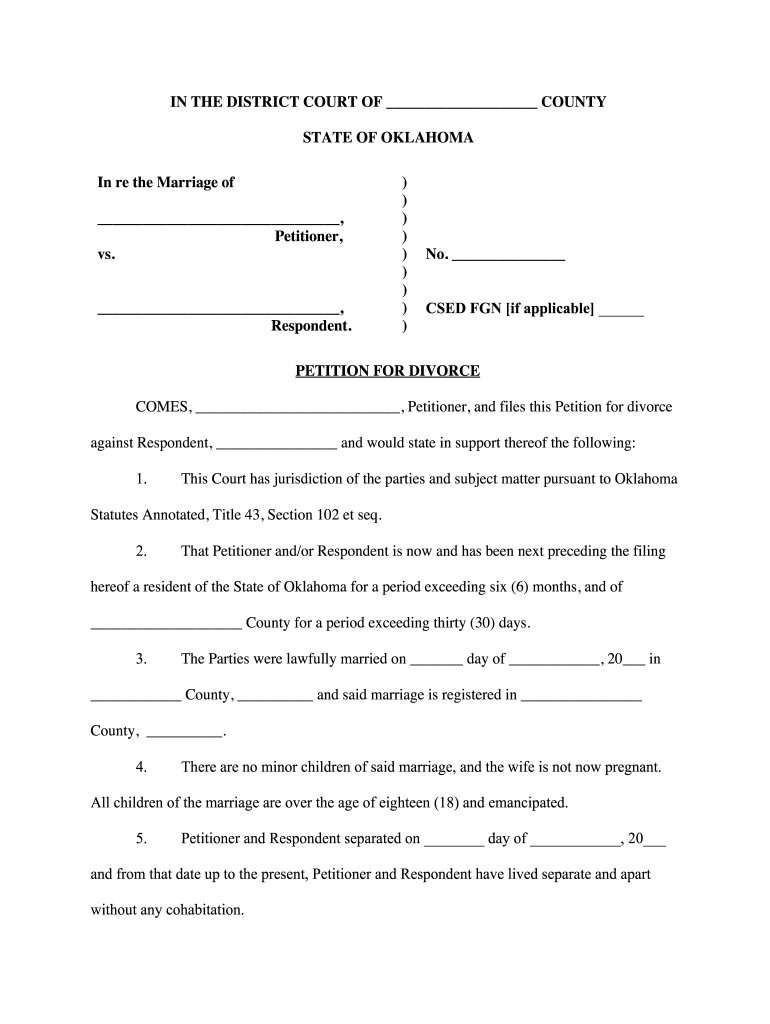
The divorce process officially begins when one spouse, known as the petitioner, files a “Petition for Divorce” with the appropriate district court. This document formally requests the court to dissolve the marriage and outlines the basic information about the spouses, any children, and the grounds for divorce. The petitioner will also file a “Summons” to be served on the other spouse.
Service of Process
Once the petition and summons are filed, the respondent (the other spouse) must be legally notified of the divorce action. This is achieved through “service of process.” Typically, a sheriff’s deputy or a private process server will personally deliver the divorce papers to the respondent. In some cases, if the respondent cannot be located, service may be achieved through publication in a local newspaper, though this is less common and requires court approval.
The Response and Counterclaim
After being served, the respondent has a specific period (usually 20 days) to file a formal response with the court. This response, often called an “Answer,” addresses the claims made in the petition. The respondent may agree with some points and disagree with others. They may also choose to file a “Counterclaim,” which is essentially their own petition for divorce, outlining their requests to the court.
Temporary Orders
If there are immediate issues that need to be addressed while the divorce is pending, either party can request temporary orders from the court. These orders can cover matters such as temporary child custody and visitation, temporary child support, temporary spousal support, and who will remain in the family home. Temporary orders are designed to maintain the status quo or provide necessary support and structure until a final decree is issued.
Discovery
In contested divorces, the discovery phase is critical. This is where both parties exchange information and evidence relevant to the divorce. This can include:
- Interrogatories: Written questions that must be answered under oath.
- Requests for Production of Documents: Requests for financial records, bank statements, tax returns, property deeds, and other relevant documents.
- Depositions: Out-of-court sworn testimonies taken from parties or witnesses.
- Requests for Admission: Written statements that the other party must admit or deny.
The goal of discovery is to ensure both sides have a clear understanding of the marital assets, debts, and all relevant circumstances before attempting to reach a settlement or proceeding to trial.
Mediation and Settlement Negotiations
Many Oklahoma courts encourage or even mandate mediation, especially when children are involved. Mediation is a process where a neutral third-party mediator helps the spouses communicate and negotiate a resolution to their disputes. If mediation is successful, the parties can draft a Marital Settlement Agreement based on their agreed terms.
If mediation is not pursued or is unsuccessful, settlement negotiations between the parties and their attorneys (if represented) will continue. The vast majority of divorces in Oklahoma are settled out of court through negotiation or mediation, avoiding the need for a trial.
The Final Divorce Decree
Once an agreement is reached or a trial has concluded, the court will issue a “Final Divorce Decree” (also known as a Judgment of Dissolution of Marriage). This legally terminates the marriage and incorporates all the terms of the settlement agreement or the court’s decisions regarding property division, child custody, support, and any other relevant matters. The decree is a legally binding document that both parties must abide by.
Key Issues in Oklahoma Divorces
Several critical issues require careful consideration and resolution during a divorce in Oklahoma. These often form the core of any settlement negotiations or court decisions.
Child Custody and Visitation
When minor children are involved, determining custody and visitation arrangements is paramount. Oklahoma law prioritizes the best interests of the child. Courts will consider various factors when making custody decisions, including:
- The child’s physical and emotional needs.
- The ability of each parent to provide a stable home environment.
- The child’s wishes (depending on their age and maturity).
- The relationship between the child and each parent.
- Evidence of domestic violence or substance abuse.
Custody can be awarded as “joint legal custody,” where both parents share decision-making authority, or “sole legal custody,” where one parent has primary decision-making power. Physical custody, which determines where the child resides, can also be joint or sole. Visitation schedules are established to ensure the child has meaningful contact with both parents.
Child Support
Oklahoma uses statutory guidelines to calculate child support obligations. These guidelines primarily consider the gross monthly income of both parents and the number of overnights each child spends with each parent. The goal is to ensure that children receive financial support consistent with the standard of living they would have enjoyed had the parents remained married. Deviations from the guidelines may be permitted under specific circumstances, requiring court approval.
Division of Marital Property and Debts
Oklahoma is an “equitable distribution” state. This means that during a divorce, all marital property acquired by either spouse during the marriage is subject to division by the court. Marital property includes assets such as real estate, bank accounts, retirement funds, vehicles, and personal belongings. Similarly, marital debts, such as mortgages, car loans, and credit card balances, will also be divided equitably.
While “equitable” means fair, it does not necessarily mean equal. The court will consider various factors when determining a fair distribution, including the length of the marriage, the contributions of each spouse, the economic circumstances of each party, and any instances of marital misconduct that may have impacted the marital estate.
Spousal Support (Alimony)
Spousal support, commonly known as alimony, may be awarded to one spouse to help them maintain a reasonable standard of living after the divorce. Oklahoma law allows for alimony in cases where one spouse is unable to support themselves and the other spouse has the financial means to provide support. Factors considered by the court include:
- The needs of the requesting spouse.
- The ability of the other spouse to pay.
- The length of the marriage.
- The education and earning capacity of each spouse.
- The contributions of each spouse to the marriage.
Alimony can be temporary, rehabilitative (to help a spouse gain education or skills), or permanent.

Seeking Legal Assistance
While it is possible to navigate an Oklahoma divorce without an attorney, especially in straightforward uncontested cases, seeking legal counsel is highly recommended, particularly if children are involved or if there are significant assets and debts. An experienced family law attorney can:
- Explain your rights and obligations.
- Guide you through the complex legal procedures.
- Help you negotiate favorable settlements.
- Represent your interests in court if necessary.
Resources like the Oklahoma Bar Association can provide referrals to qualified attorneys. Local legal aid societies may offer assistance to those who qualify based on income.
The process of divorce in Oklahoma is multifaceted, requiring a thorough understanding of state laws and procedures. By educating yourself on residency requirements, grounds for divorce, and the various stages of the legal process, you can approach this challenging time with greater clarity and confidence, ultimately working towards a resolution that best serves your future and the well-being of your family.
LifeOutOfTheBox is a participant in the Amazon Services LLC Associates Program, an affiliate advertising program designed to provide a means for sites to earn advertising fees by advertising and linking to Amazon.com. Amazon, the Amazon logo, AmazonSupply, and the AmazonSupply logo are trademarks of Amazon.com, Inc. or its affiliates. As an Amazon Associate we earn affiliate commissions from qualifying purchases.